As dedicated readers of this blog know, we spend a lot of time observing and commenting on commerce trends in both the B2B and B2C markets, with an em…
As dedicated readers of this blog know, we spend a lot of time observing and commenting on commerce trends in both the B2B and B2C markets, with an emphasis on the implications of how product information affects the customer experience. For example, in 2020 we conducted a Global B2B survey and in 2021 a Global B2C Survey which sought to uncover how B2B buyers and B2C shoppers feel about the state of product information, and whether a good product experience is something customers value (TL;DR: it is!). At Akeneo we firmly believe that a good product experience is necessary to deliver a good customer experience, and our research confirms this to be the case.
And so we were very happy to be invited by Adobe to contribute to their latest eBook entitled “Retail Technologies That Pair Well Together.” The concept behind this new eBook is that “to attract and retain new customers, retailers must create a unified experience that’s also hyper-personalized for each individual.”
Adobe sees that “many sellers’ digital strategies aren’t fully baked…and while retailers have made big strides over the past year—such as expanding merchandise assortments online and adding curbside pickup—they still fail to deliver a customer experience (CX) that’s both seamless and responsive.”
There are two parts to this equation that retailers must solve for.
The first part of what is driving the need for a unified experience is the growth in eCommerce by necessity, and the emergence of new channels. This has caused consumers and buyers to behave differently, taking new paths to purchase. From a product information point of view, it’s therefore critical to provide unified information, tailored for the needs of each channel. Buyers and shoppers should not see inconsistent product information across channels, but should see that information adapted to the product listing requirements for each channel.
The second part is personalization. Consumers want to feel as if the brand knows them, and remembers interaction context across touchpoints, and provides them relevant and timely offers. Part of knowing a customer is understanding what they care about, such as your brand values. Do your customers care about sustainability, responsible sourcing, and other eco-friendly attributes? If so, include that information on your site, and with your products. With more consistency and relevancy – in both product information and customer preferences across channels – customers are more likely to convert and become repeat customers.
What other attributes are common to a unified shopping experience?
Speed. A unified eCommerce experience must be fast and easy for consumers to use.
Predictive content and commerce, tailored to their specific needs at every stage of the buyer’s journey.
Cross-channel consistency, so consumers feel you know them regardless of which channel they visit.
Privacy consciousness and highly secure.
Do you have the right digital foundation?
Creating a unified retail experience requires the right technology to prepare to support the customer experience, from product data to customer data to payments, shipping, and more. And, it needs to work consistently across platforms. However, being able to access and use all of this data is a major challenge for retailers that have not built a digital foundation. And that’s the challenge this eBook seeks to help overcome.
So, check it out! You’ll get advice from several of Adobe’s top partners on how to design, deploy, and continuously improve a unified retail experience that serves up a large helping of success.
Here in the northern hemisphere, school is now out and two things are certain: students are heading out for summer vacation, and they have recei…
Here in the northern hemisphere, school is now out and two things are certain: students are heading out for summer vacation, and they have received their final grades from the school year. In the world of PIM, the same is true — except for the vacation part; the need for PIM never takes a day off! But PIM vendors do get evaluated, and that is exactly what happened recently. PIM vendors have two “teachers” who evaluate us — industry analysts and customers.
The Analysts weigh in
Industry analyst firms provide different kinds of services to technology buyers and vendors. At a high level, industry analysts typically identify technology trends and business needs, size and track markets, research and evaluate technology vendors, and advise end-user clients. For their end-user clients, industry analysts can be a valuable resource to help match end-users with technologies that will best serve the technology initiatives the end-user has. In the PIM market, there are three analyst firms that recently published reports on the leading PIM vendors. Each analyst documents their methodology and explains how they scored the vendors who qualified for inclusion. How did your favorite PIM vendor fare?
Forrester
Forrester publishes The Forrester Wave: Product Information Management approximately every two years. The newest version was published in May 2021. The Forrester Wave analyzed the top 10 vendors in PIM along a set of 15 criteria grouped into three categories: current product offering, vendor strategy, and market presence. All criteria are weighted and scored by the Forrester analysts based on interviews with vendors and reference customers, and research by the analysts. In “The Forrester Wave™: Product Information Management, Q2 2021” report, Akeneo appeared for the very first time. We are named a Strong Performer. You can read more about their analysis and our take on it in our post about the Wave, and also download a copy of the report.
IDC
IDC is well-known for its quantitative analysis of markets worldwide. But they also have a robust industry analysis practice. In December 2019, IDC published the “IDC MarketScape: Worldwide PIM Applications for Commerce 2019-2020 Vendor Assessment” report. IDC also researches vendors, speaks to customers, and analyzes vendors along similar axes of current capabilities, strategy, and size of the company. In the 2019-20 report, IDC analyzed 14 vendors and designated five leaders. This was our very first industry analyst report appearance, and Akeneo was named a leader.
Hot off the press is an update to this report entitled “IDC MarketScape: Worldwide Product Information Management Applications for Commerce 2021 Vendor Assessment” – and we’re proud to say that, among the 16 vendors covered in this analysis, Akeneo was again named a leader in PIM by IDC. You can download a free copy of the newly released IDC MarketScape here.
Ventana publishes a vendor analysis called a Value Index. In their Value Index approach, Ventana takes the point of view of an end-user customer and creates a lengthy and rigorous RFP (request for proposal) about the PIM product. It is very detailed and requires a significant commitment from the vendor to complete, and also includes customer reference checks just like the other analyst research. The 2021 PIM Value Index covered 16 vendors and was released at the end of May 2021. In this analysis, Akeneo was named one of three Overall Value Index leaders. Ventana further categorizes vendors into four classifications, with Akeneo earning the highest “Exemplary” rating. Check out the press release from Ventana Research that recaps the scoring and ratings from the PIM Value Index and then read details about Akeneo’s score in Ventana’s analyst perspective blog post.
The Customer Point of View
While the analysts all do customer reference checks, there are many, many other software evaluation websites where PIM shoppers can get even more opinions and grading about the myriad PIM solutions available on the market. In general, these software evaluation websites are great places for end-users to get an unbiased view directly from users of the tools they are researching. However, not all of these sites perform any in-depth research like the analyst firms, and vendors may or may not be in contact with these sites. Here are some links to a few examples:
G2 tracks PIM vendors and offers a handy grid to identify how they rank vendors based on input from customers. Akeneo is listed as a Leader on this popular site.
Capterra is now owned by Gartner, a well-known industry analyst firm that also owns the Software Advice and GetApp review sites. Gartner also offers Gartner Peer Insights on their website. Akeneo currently has a 5.0 rating on Capterra.
Featured Customers showcases vendors’ customer stories, testimonials, and videos, and has a methodology to rate vendors based on this information.
How should I use all this information?
As you can see, there is no shortage of opinions and grades about PIM software! But as nearly all these resources say, you should use these sites as only one input into your software selection process. Use these resources to create shortlists of vendors to evaluate, and then seek to understand which tool fits best for your business case. Even the analysts themselves do not recommend making a technology selection solely based on their opinion. If you’re a client of Forrester, IDC, or Ventana, reach out to them, explain your business scenario, and get their advice on who would be a good fit given your specific PIM business requirements.
And do your homework!
Akeneo’s VP of Global Marketing & Strategy, Kristin Naragon, speaks to long-time friend and Harvard Business School alum Shilla Kim-Parker, CEO …
Akeneo’s VP of Global Marketing & Strategy, Kristin Naragon, speaks to long-time friend and Harvard Business School alum Shilla Kim-Parker, CEO of ShopThrilling.com, about everything eCommerce and a little bit about the career of working moms…
Kristin: As you had shared elsewhere, there are more secondhand stores across the US than Starbucks and McDonalds combined – yet 99% of these stores are completely offline. It’s remarkable how Thrilling is helping them go online for the first time, while helping small business owners. What are some of the key challenges you’ve seen in their eCommerce transformation? Such as digitizing catalogs?
Shilla: The biggest challenge is time – these small business owners are usually the sole breadwinners for their households and are also usually the sole employees. The amount of work it takes to manage a vintage business can feel overwhelming. These owners have on average 10,000 individual SKUs of inventory, and they have to be the accountant, the inventory sourcer, the warehouse manager, the janitor, the cleaner, the tailor, the photographer, the fulfillment processor, and the marketer.
Our goal is to make the running of their businesses easier and more delightful. Our primary focus is on investing in innovations in our core technology, which makes the uploading of inventory quick and seamless. We do this by incorporating machine vision and machine learning as much as possible into the process, minimizing the amount of data entry required. But we are also offering wraparound services, such as the first on-demand eCommerce assistant service — think Uber for eCommerce uploading — to allow store owners to hire trained vintage assistants to prep and upload inventory onto Thrilling.
Kristin: I’m quite inspired by Thrilling’s mission in disrupting how people shop for apparel to combat environmental waste and harm. In one of the surveys we’ve done here at Akeneo, we also found that customers are increasingly prioritizing brands that feature social responsibility such as sustainable sourcing in their product information. What key product details are/should customers look for most when shopping secondhand clothes?
Shilla: The first and most important thing to ask is whether an item makes your heart skip a beat – that’s when you know it’s “the one.” A critical part of our mission is sustainability, and we want people to fall in love with their clothes and keep them for decades.
Second is fit, especially when shopping online. Our sellers almost always include the measurements and some notes about fit, but if you aren’t sure, just ask. And with Thrilling, you have the ability to try on and return if it’s not quite right.
Last, look for high quality brands or quality construction, so you know the item will stand the test of time. That’s the beautiful thing with vintage – these items were not only designed well, they have already survived 2+ decades. This is the reason why we do not accept any fast fashion or mass produced labels on our site – these items will not last more than a few washes, and they were often created in inhumane and unsustainable conditions.

Kristin: Mckinsey has concluded that the eCommerce industry experienced over 10 years of growth in the first three months of 2020. How has this contributed to Thrilling’s growth and where do you see the future from here?
Shilla: Our revenue grew 1700% over the last year, so we have absolutely experienced the continued mainstream adoption of both shopping secondhand, and shopping online. I see this as the beginning of the beginning – the resale industry is expected to grow from $30bn to $50bn within the next couple of years, exceeding growth rates for traditional retail. As consumers become more passionate about supporting sustainable shopping habits and small businesses around the world, and as platforms continue to innovate the shopping experience to make it more relevant and delightful for shoppers, the growth of the industry will continue to compound.
Kristin: Marketplaces are huge in eCommerce right now and there is clearly an appetite for specialty, curated marketplaces like Thrilling. What trends are you taking note of in the world of eCommerce marketplaces?
Shilla: Curation and aided discovery are key. Marketplaces can quickly become overwhelming, and if you don’t serve up relevant items quickly, shoppers will leave. We do offer a free personal shopping assistant for those who would like a more human touch, but we have also hired a data advisor — the head of data and personalization at Spotify — to help us create a smart recommendation engine and better tailor our products to each individual’s tastes.
Kristin: The pandemic has shown how hard it is when work and family collide. You’ve got 2 young sons, while running a fast-growing startup –– how do you do it all? And how has your view on parenthood changed since 2020?
Shilla: There is no doubt it is challenging, and I think we are not honest enough — in public and out loud — about the difficulties of balancing parenthood and a demanding job. There is a lot of chaos behind the scenes, and just doing whatever we can to make it through the day. Part of it is accepting that you can’t be perfect in every arena at all times – having a sense of humor and some generosity with yourself is key. And I am fortunate to have a wonderful support system in my partner, my family, and my friends.
Kristin: You’ve had a long tenure in the corporate world, from JPMorgan to the Lincoln Center for the Performing Arts and Disney/ABC Television Group. What triggered you to take the plunge to be a founder and entrepreneur? What advice would you give to other working moms templating the move?
Shilla: First of all, it’s a risk, and everyone should be clear-eyed about it, especially if — like me — you don’t come from generational wealth. Sometimes entrepreneurship gets romanticized, and examples of success are held up without discussing the hidden safety nets from which the founders benefited. So it’s crucial to have an honest conversation with yourself and your family about what you want for your own life and the amount of risk you feel you can tolerate.
For me, I knew I had to take the jump. I’ve had that quote from Teddy Roosevelt stuck in my head for years: “It is not the critic who counts … the credit belongs to the [wo]man who is actually in the arena, whose face is marred by dust and sweat and blood.” I wanted to be in the arena, building something with my own hands that helps push the world forward and strengthens our communities.
I had been working on the idea of Thrilling for years, conducting pilots and drafting the business plan on nights and weekends. Part of it was to test the idea as much as possible, but part of it was because I was waiting — waiting for it to feel less terrifying before I made the jump. And finally I just had this sudden realization – it’s now or never. Nothing is going to come along to make the path 100% secure. Do I want to take a leap of faith, or do I want to regret never giving myself a shot? I took the leap.
During our annual PXM event, Unlock 2021, we called upon our vast community to participate in a hackathon. The objective was to challenge developers, …
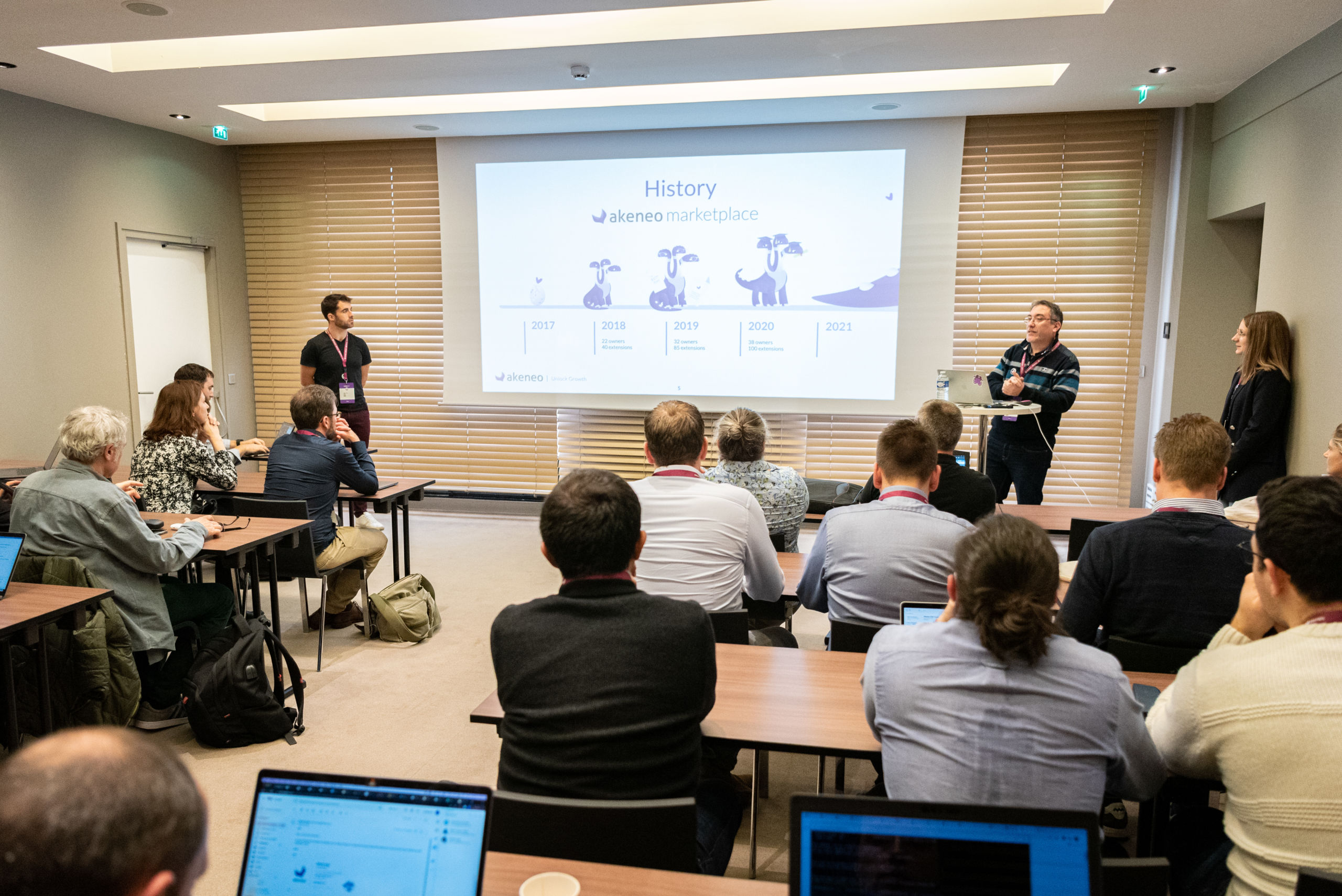
During our annual PXM event, Unlock 2021, we called upon our vast community to participate in a hackathon. The objective was to challenge developers, partners, and even customers to see what kind of innovative ideas they could come up with using the Akeneo API to make Akeneo PIM be even more useful in pursuit of great product experiences. As with all hackathons, it was conducted in the spirit of not only innovation, but also a bit of competition. Who had a great idea? Who could really “think outside the box” and deliver something exciting?
We’re forever grateful to all who participated. And as with any competition, we had the difficult job of naming a winner, and in 2021, that winner is our US-based implementation partner Sitation.
Sitation chose to create a real-time integration from Akeneo to ElasticSearch, a powerful hosted search index, by using the new Akeneo Events API for subscriptions to real-time product create, update, and delete events.
You can see Sitation’s video demo submission on their blog.
Why is this cool? Sitation used the power of the Akeneo API to deliver product information in near real-time. Their solution avoids scheduled publishing via heavyweight integrations. It further supports customers who are implementing microservices architectures and headless solutions, providing scalability and flexibility in search.
We think you’ll agree that it’s really cool – and useful!
So, congratulations to Sitation, winner of the Unlock 2021 Hackathon.
We look forward to having hackathons in the future. What cool new idea will you come up with? We can’t wait to see what’s next!
Akeneo named a Strong Performer in our debut in the Forrester Wave™: Product Information Management, Q2 2021
Forrester’s 2021 Wave on the Product Information Management vendor landscape is here. It’s not often that a first-time appearance in a market anal…
TL;DR – if you need to quickly mobilize your marketing teams with an easy-to-use and quick-to-adopt solution; easily integrate with your existing tech stack; and get your product catalog organized, enriched, and published on traditional channels and on the digital shelf, Akeneo is a very strong choice.
Read on for highlights from Forrester’s analysis of Akeneo PIM and what to take away from their points of view.
User Experience
The Forrester Wave analyzed the top 10 vendors in PIM along a set of 15 criteria. Akeneo received the highest score possible in the User Experience criterion. Specifically, Forrester states “Akeneo is one of a small handful of “born digital” PIM players; its user experience is a particular strength, with the company’s offering providing an intuitive and modern user interface. Reference customers praised Akeneo for its ease of use, describing its hierarchy management as “totally user friendly…”
In our view, ease of use is the gateway to user adoption. If your PIM is too difficult for your catalog management teams to use, or requires too much IT intervention, user adoption will suffer. Because Akeneo is designed for easy adoption, it means you can take your complex catalog hierarchies, high volume, multi-dimensional, multi-language, multi-geography product catalog and output simplicity for your users. In fact, some of our customers have 300+ users collaborating and contributing to PXM in Akeneo. Which makes sense when you consider that some individual Akeneo customers are managing 60MM+ products with us! The result is faster time to market, increased sales, decreased returns, and reduction in cost.
A best-of-breed PIM
In the Wave, Forrester notes that “While Akeneo positions as a platform to support product experience management, unlike many of its peers, the company strategy and innovation roadmap doubles down on optimizing product data for that goal as opposed to expanding into adjacent areas like DAM or commerce.”
Powering your business from one vendor with an all-in-one solution is a tempting vision: that you’ll get PIM, DAM, eCommerce, SEO, OMS, MDM, et al, in one vendor’s offering. Very often, what you’ll get is something that’s not actually great at any of the individual pieces. It’s very often an overpromise. Which is why we believe Forrester has a Wave for DAM, a Wave for MDM, two Waves for eCommerce (B2B & B2C), a Wave for SEO, and a Wave for OMS. If your priority is tackling your product information, it’s best if you hone in on a vendor that is obsessed with making you successful there.
Akeneo has always been squarely focused on PIM and the practice of PXM (Product Experience Management). Best-of-breed also means avoiding the dreaded “vendor lock-in.” With Akeneo, there’s no need to also rip out your eCommerce solution or your DAM solution or your ERP or your OMS. Instead, a best-of-breed solution relies on tight integrations with surrounding tools in your ecosystem. That’s why you’ll find that some of our customers are leveraging our powerful APIs to the tune of 10 million calls per week! And why some of our customers are managing over 1TB of digital assets in Akeneo PIM, either alongside a dedicated DAM that manages other non-product assets, or not. The Forrester report states that reference customers describe Akeneo’s integrations as “one of the strongest parts of the platform.”
No one wants to be oversold when investing in mission-critical tools like PIM. Akeneo’s vision for your company is to leverage PIM in a similar way that you leverage CRM. PIM is to product information as a CRM is to customer information. With that in mind, your requirements to manage product information well, require a PIM solution that is focused on solving core PIM use cases and ensuring sophisticated integrations into other specialized systems.
Merchants with Any Business Model
Forrester notes that “Akeneo targets both B2C and B2B enterprises, with retail, construction, and food and beverage as top industries” and further summarizes that “Akeneo is a good fit for companies that need a PIM built for marketers with minimal IT support needed.”
With over 500 customers on our Enterprise Edition — and over 80,000 on our free-forever Community Edition — Akeneo is well-represented across many other industries too, spanning both B2B manufacturers and distributors, and B2C brands and retailers. The Akeneo PXM Studio includes dedicated offerings designed to enable internal and external contributors who participate in delivering great product experiences that drive growth, all oriented around Akeneo PIM.
Akeneo’s ability to meet the demands of each of these types of business models means that when you choose Akeneo, you choose a future-proof offering for your growth needs. Akeneo PIM was the critical centerpiece for many customers during Covid to enable a quick pivot of their business models from B2B to B2C (or vice versa) because Akeneo supported an easy adaptation of their catalog, quick time to market with new product lines, and ease in integrating to new channels and routes to market. The “phygital” buying experience is here to stay; in fact, a full 50% of Akeneo’s customers are selling in offline channels, in addition to the digital shelf. Who knows what channels your business will need tomorrow or what routes to market your CEO will demand? So you can rest assured, that regardless of your business model, Akeneo will be able to support you.
How to use the Forrester Wave for PIM
Industry analyst reports serve a valuable purpose by doing the initial triage of solutions in the market for you. The Forrester Wave for Product Information Management Q2 2021 presents Forrester’s view of the top 10 solutions, in effect creating a “short-list” of PIM vendors. Next, do some serious reflection on your use cases, business challenges, and priorities. We know there’s a lot of pain when it comes to managing product catalogs and potentially a lot of organizational silos and process challenges to overcome.
If you’re a marketer or catalog management professional and are seeking an easy-to-use solution that integrates with your current technology stack, and have the sense of urgency to rapidly deliver great product experiences to grow your business, contact us for more information. We’d love to help you out!
TL;DR – if you need to quickly mobilize your marketing teams with an easy-to-use and quick-to-adopt solution; easily integrate with your existing tech stack; and get your product catalog organized, enriched, and published on traditional channels and on the digital shelf, Akeneo is a very strong choice.
How ready are you to improve your Product Experience Management practices with PIM? Assess your organization’s maturity in terms of people, process, and technology with our PXM Maturity Assessment – 14 short questions and a personalized report with recommendations to improve are just a click away.
This guest blog is written by our partners at Vincit, formerly known as Bonsky.
The world of digital sales is undergoing revolutionary change with …
The world of digital sales is undergoing revolutionary change with never-before-seen scale, speed, and complexity. The old ways of selling and serving customers and delivering products are no longer valid for many brands. This revolution in digital sales has created new global competition where customer experience is crucial to success. As a result, companies who formerly lagged are finally taking steps toward digital transformation. Leading brands understand that this is not only the era of technology, but also the era of the customer. Technology is needed, but customer understanding is everything. This is a wake-up call to build a winning digital sales machine and put experience at the center of your business.
In this new normal, the only sustainable way to gain a competitive advantage is based on the speed at which an organization can respond to changing customer and market needs. Merchants need a high level of organizational agility and other dynamic capabilities to deliver on customers’ expectations of continuous availability and adaptiveness, as well as their increased interest and concern about ethics, sustainability, and corporate transparency.
Building a winning digital sales machine means product brands must find new ways of enabling success with their products and services, together with their customers and partners. Therefore, product brands must seek to make it easy for customers to experience the brand. The omnichannel environment of digital, physical, and social channels is built on interaction. Experiences create value through these interactions. In this experience economy, a compelling product experience is critical, and dynamic organizational capabilities that enable amazing customer experiences need to stand out.

Enabling product experience for digital sales
Product experience is very much a journey, as customers shop and research products in multiple places, and potentially over a period of time. Leading brands understand that value is created based on interaction and collaboration in the buying and selling ecosystem. Omnichannel increases the need for contextualized and relevant experiences for customers. These different touchpoints in the ecosystem represent opportunities to form and strengthen the bond between the brand and its customers and business partners. These are the moments when the product experience needs to stand out!
To deliver superior product experiences, sellers must have the appropriate functional capabilities in place to create and manage these product experiences that drive digital sales. With the right capabilities and resources, brands will have a solid base on which to build digital experiences that lead to sales.
Enablement by technology
First-class product experiences need fuel to come alive. Consistent and relevant product information representing the brand is the fuel to support sales of products and product-related services. To create a unified view and to control product information across the organization, different technologies must integrate or interoperate to meet business and stakeholder requirements. Typical technologies that play a role in managing the product experience include ERP, DAM, and PIM systems.
Digital architecture and dexterity
Compelling product content representing the brand is not much help if it cannot be efficiently delivered to different digital sales channels in the right form and at the right time. In addition to product information, product availability, learning materials, dynamic pricing, delivery tracking, and more, complete the experience Therefore, product brands should have a sufficient capability to develop a digital architecture that supports flexible and scalable ways of delivering the product experience, and that offers seamless integration for internal and external teams involved in managing product experiences. Product brands also need dexterity to be both efficient today and to be adaptable for coping with changing demands of tomorrow.
Context
Compelling product content is driven by context. Customers experience products across digital, physical, and social channels, and to provide the right information, products need to comply with the requirements for each channel. For example, social selling via Instagram has different product listing requirements than a B2B sales portal. Therefore, brands need to be able to easily accommodate channel-specific requirements while avoiding inconsistency across channels – as well as across regional markets.
Your team
Creating compelling product content requires a capable team with the motivation to strive for delivering better product experiences. Cross-functional end-to-end business teams ensure that all aspects of the brand, products, customers, and business are considered when crafting the product/brand experience. As products and services are the tools companies use to serve their stakeholder needs, product experience should be considered a competitive advantage and become an organization-wide endeavor. For product brands, this is especially important since the whole identity of the company is built on the brand and its message.
Building a winning digital sales machine
Building a winning digital sales machine comes down to creating value for the customer through field sales operations, supporting the partners to learn and excel in sales, and moving from selling products to selling new services. In all of these, the common enabler for increasing sales, customer experience, and growth is the compelling product experience.
Technology, digital architecture, the way of working (processes), and experience delivery are some of the core capabilities needed for first-class product experiences. However, it is all about matching organizational capabilities and resources with those of customers and internal stakeholders across all touchpoints. To win, you must understand everyone’s needs, the way they operate, and what they need to succeed.
It’s also crucial to understand that the real value in a compelling product experience is not created inside the organization in certain systems or with only technology — you also must understand your internal stakeholders’ world and enable them for success. Only then is it possible to build dynamic organizational capabilities for product experience management and find a match across the digital sales field for crafting a memorable experience.
Technological capability creation is only the start of your product experience journey to encourage rethinking value creation in digital sales. However, by enabling your development with a strong technology and process base, the next steps — and capabilities needed — to deliver a first-class customer and product experience will be easier to take.
Learn more about Vincit’s PXM implementation methodology here.
Thank you so much to everyone who participated in and attended Unlock 2021! We are overwhelmed with gratitude and humbled by the positive responses we…
Thank you so much to everyone who participated in and attended Unlock 2021! We are overwhelmed with gratitude and humbled by the positive responses we’ve received about Akeneo’s first-ever digital event. With 2,000 registrants, we’re confident this was the biggest gathering — virtual or in person — of PXM and PIM practitioners to date in the world.
Akeneo’s in-person user conferences have traditionally been oriented around a theme, and this year’s virtual event was no different — Unlocking Growth Through Product Experiences. The Akeneo headquarters was transformed into a scene reminiscent of the time of “extraordinary voyages” as described in the works of French novelist Jules Verne, who, like Akeneo, was born in Nantes. Read on as we take a short walk down memory lane and revisit some of the best moments from Unlock 2021.
Opening Keynote
Akeneo CEO Fred de Gombert opened the conference with a conversation with emcee Francois Chaix to discuss his personal experiences with online shopping during the “extraordinary voyage” that was 2020, and the impact that it had on the world of commerce. “If 2020 taught us one thing, it’s back to basics,” he said. “The job is to sell products. And so wherever products are sold, we need to ensure that the product itself creates a compelling experience.”
The conversation turned on the discussion about customer experience versus product experience. “For years, retailers have been urged to massively invest in customer experience. But then came lockdowns, and what happened? No stores. No more fancy customer experiences,” Fred continued. “One impact from 2020 has been the sudden acceleration of digital channel adoption. Suddenly, managing the product experience became a bottleneck for growth. And PXM has become a real transformation for the long term.”
Fred was quick to conclude, however, that “PXM is not only about technology. It is also about people and process.”
Panel Discussion
Unlock 2021 sponsors Vaimo, BigCommerce, Productsup, and Translations.com joined Fred following his keynote. This lively session of Akeneo partners shared perspectives on how to define and think of product experience management, the main components of what makes a good product experience, and who has ownership within an organization for creating and managing those experiences. The panel also discussed whether PXM was relevant for only B2C, or whether B2B organizations should worry about it. On this point, the panel was in universal agreement — the product experience is more important in B2B. For manufacturers who use printed catalogs, it’s critical to avoid any information mismatch in content parity across channels. The panel also advised that as B2B companies continue to implement direct-to-customer (D2C or DTC) strategies, the product experience needs to be better and more consistent in order to reduce pressure on the total cost of sale.
PXM Maturity Assessment
Following up on Fred’s and the panel’s comments about PXM and its adoption, Akeneo’s PXM Evangelist Virginie Blot and head of product marketing Ali Hanyaloglu discussed the results to date from Akeneo’s PXM Maturity Assessment. This online tool asks 14 multiple-choice questions to assess an organization’s maturity in the areas of people, process, and technology to ensure great product experiences, and offers actionable recommendations on changes you can make. According to the responses, one-third of senior management is still blind to the strategic value of quality product information and the impact it has on driving growth. Furthermore, results to date show that 73% are unhappy with the way collaboration works today. According to Virginie and Ali, “The importance of collaboration across internal teams will have a large impact on the success of your product information management processes.”
Gallery of Great Product Experiences
In the above sessions, we discussed why PXM is so important, how to approach the practice, and the state of PXM today. But what does a good product experience look like? The gallery of great product experiences session looked at some B2C and B2B examples from Akeneo customers who we think are delivering the kinds of experiences customers want and expect. Take a look — how does your product experience measure up?
Customer-led Sessions
Half a dozen Akeneo customers offered insights and lessons learned from their PXM journeys to unlock growth in their businesses, whether by expanding their catalog, adding new channels, or entering new markets. They all echoed the comments from the opening keynote about transformation, change, experimentation, and the need for compelling product experiences.
Evelyne Cardinal from Solotech, an audio-visual and entertainment technology services company, talked about how, with the demise of in-person events in 2020, Solotech leveraged Akeneo PIM to enable a rapid move to selling used audio equipment via eCommerce which led to significant growth in that part of their business. “We initially chose Akeneo PIM Community Edition because it looked easy, and it took IT just a few hours to get it ready,” said Evelyne. “We decided to migrate to Enterprise Edition to create automation in our process. What’s great is as we migrate to our new eCommerce platform, there’s no need to recreate the catalog.”
European footwear retailer Melvin & Hamilton offered insights for how PIM helped their move to expand into new markets. Anja Skolozdrzyk noted, “With Akeneo we can work on translations simultaneously, which we could not do on our ecommerce platform, which saved us 50% in time and effort.” Anja also offered advice for companies looking to fast-track their growth: “Think easy and think big. Choose tools that will facilitate your work and allow you to grow fast.”
Office supplies retailer and business services firm Staples Canada dove into the world of PXM as part of a complete digital transformation across their business. Jeff Serota advised us that “Taking the position ‘that’s the way we did it before’ is never a good thing when you’re going through a transformation.” As a result, Staples completely retooled and revised their processes to enable them to better serve their customers. As Jeff stated, “For Staples, product experience is about what our customers are looking for, what they need and want, in order to work and learn more effectively.”
French fashion brand Zadig & Voltaire offered insights into unlocking growth as part of their omnichannel sales strategy. According to Global CIO Fabien Delivre, “For the omnichannel experience we wanted to offer, we needed one source of truth for every sales touchpoint” and the best way Zadig & Voltaire saw to achieve that was through greater efficiency and fewer manual operations in order to speed time to market.
South African furniture and home goods retailer JD Group offered many interesting thoughts on the importance of PXM in unlocking growth through catalog expansion, and had the business results to back it up. Garreth Trent noted that “Online customers can’t interact with people who can recommend and explain products, so online product data needs to act like a salesperson.” He also remarked that “Consistent product data and marketing messages help our customers trust us, and they’ll find a similar experience on every channel.” JD Group’s results have been impressive — they grew their catalog from 6,000 to 20,000 products, and cut the time to prepare products for sale from 6 days to 6 hours. Impressive, indeed!
Hotel chain Accor Group had a different yet highly interesting twist on how PXM helps their business. They used Akeneo to help achieve a digital transformation in their procurement process. Their idea was to take B2C marketplace standards and adapt them for B2B, with a special focus on product information. According to Emmanuel Barbosa, “PIM is a real must-have. It helps us enhance our business relationships with our suppliers and become more mature in the customer relationship. As a result, we have really achieved our digital transformation in our procurement processes with our suppliers and partners.”
Product Highlights & Demonstrations
In Akeneo PIM Summits of the past, there are always several sessions focused on new products and new features released in the prior year, and Unlock 2021 was no different. Our product managers delivered a series of product highlights sessions as well as some deeper dives into the products which included short demonstrations of new capabilities and products.
The What’s New in Akeneo PIM 5.0 session recapped some of the notable enhancements released to our SaaS customers on a monthly basis over the past year, culminating in the 5.0 version. Due to time constraints we could not discuss the more than 70 new features, but they are documented and easily found in the Help Center!
Two of the sessions were dedicated to drilling down into enhancements in two exciting Enterprise Edition features – the first one on Data Quality Insights and the second on the new user interface for the Rules Engine. With these enhancements, catalog management teams can more easily understand the state of data quality by product and across the entire catalog, as well as build their own business rules to simplify and automate product data enrichment – no coding required!
As discussed by Fred and in the PXM Maturity Assessment session, PXM is also about people and process. A session on governance and productivity enhancements gave an overview of areas of the Akeneo PIM technology that were improved to support these two equally-important pillars of PXM.
As we like to say, a PIM by itself is useless, so Unlock 2021 also featured a session on what’s new with Akeneo’s premium connectors on the marketplace and a session on product data synchronization. The latter session covered new ways to manage connections between the PIM and the systems that surround it, which is so critical to ensuring a smooth integration from raw product data to compelling experiences delivered to eCommerce platforms and more.
Further on the subject of collecting and distributing product data, a product highlight session covered enhancements in Akeneo Onboarder – used for onboarding supplier product data – and a new product called Shared Catalogs, which makes it easy to share published product information with internal and external stakeholders. This session was supplemented by separate talks which offered additional details and demonstrations of Akeneo Onboarder and Akeneo Shared Catalogs.
With the addition of the new Shared Catalogs product, Akeneo’s offering has expanded yet again. A session describing the Akeneo PXM Studio explains how everything fits together and supports the practice of product experience management.
Speaking of new products, we also announced the availability of a new PIM offering called Akeneo Growth Edition. This session described this new offering that is targeted at helping small/medium businesses compete by delivering better product experiences, but using the same type of technology that larger enterprises use. With Growth Edition, customers have a proven SaaS-based PIM that gives access to many of the same core capabilities from our fully-featured Enterprise edition.
If you were unable to attend Unlock 2021, which ran nearly the entire month of April, you’re still in luck! Just click the links embedded above, or browse and watch them in the Videos section of our Resource Center.
See you next year (and hopefully in person!).
It’s no secret that creating compelling product experiences for consumers can be the difference between a fledgling business that never quite gets o…
That’s because attracting new buyers is all about providing compelling product experiences that are built on a foundation of accurate, consistent, and complete product information. But these smaller players typically don’t have the resources that large competitors have in their arsenals when it comes to enriching product information and using it to create the high-quality product experiences that convert shoppers into customers.
Enter Akeneo PIM Growth Edition. It’s designed to provide a proven, SaaS-based PIM that offers access to many of the same core capabilities from Akeneo’s fully-featured Enterprise Edition. It’s focused on helping smaller organizations improve that product information management process and start their PXM Journey.
So, what is Akeneo PIM Growth Edition, exactly? Let’s take a closer look.
Efficiently gather, organize, and standardize product data
Effectively managing product information starts with collecting and centralizing your data in one place. But this data exists in a wide variety of systems, including internal sources like your Enterprise Resource Planning (ERP) system, marketing database, other systems, and external sources such as suppliers, which can make data collection a challenge.
With Akeneo PIM Growth Edition, smaller organizations can easily and efficiently gather product information from virtually any source into a single place. This includes data sourced from your ERP, difficult-to-use Excel files, or any other source. It even offers tools such as connectors, APIs, and import features to collect data from various applications.
You can then use Akeneo PIM Growth Edition to standardize product information and organize your data according to the needs of your product catalog and business strategy. It also gives smaller teams the flexibility to design and adapt your catalog structure, including categories, families, channels, and locales. This makes it easier to categorize products, including supporting product variants (i.e., products that vary by color, size, etc.), and organize your product data for the requirements for different channels and languages.
Enrich and contextualize product data with ease
Once your product data has been gathered into a single system of record, you’ll need to enrich your products — and put them in the proper context for the channel you’re selling on.
That’s why Akeneo PIM Growth Edition allows SMBs to easily and efficiently enrich their product information with all the vital information and digital assets. This can include such as technical data, usage data, emotional data, and even media files like images, PDFs, and videos — anything your customers need to feel confident making a purchase. That way, you can easily and efficiently deliver great product experiences across a wide range of channels.
Then, Akeneo PIM Growth Edition can help you put products into the proper context for both the locale and channel that you sell your products on. This ensures that your content is relevant and impactful to customers, creating compelling emotional bonds that motivate conversions.
Send the right data to the right channels
After you have a complete catalog tailored for different markets and channels, this catalog will need to be distributed across your owned channel. So, once product data has been enriched and contextualized, we can also help you get that data where it needs to go.
Product marketers can use Akeneo PIM Growth Edition features like Export profiles to distribute only the necessary and route it to the desired channel and locale. You can even filter export data based on several products or select attributes, families, categories, and identifiers, then save the profiles for future use.
With Akeneo PIM Growth Edition you also have access to many of the same export capabilities and connectors that are in Enterprise Edition. This includes connectors for popular eCommerce Platforms and syndication tools from the Akeneo Marketplace.
Unlock growth with Growth Edition
For smaller organizations standing out and attracting customers in an increasingly crowded marketplace is often the biggest move that can be made to help fuel and unlock future growth. The best way to attract those customers is to provide compelling product experiences across a wide range of sales channels.
If you want to unlock growth for your small team, you need Akeneo PIM Growth Edition! It’s got exactly what smaller organizations need to expand their customer base and win over new buyers by providing top-notch product experiences built on a solid foundation of accurate, consistent product info.
Plus, because Akeneo PIM Growth Edition is available in the cloud as a hassle-free SaaS offering, teams of any shape and size can access their PIM instance virtually anytime, anywhere. And just like Akeneo PIM Enterprise Edition, Growth Edition comes with the backing of our amazing Customer Success and technical support, meaning you’ll never have to travel the path of your PXM journey alone.
So if you want to give your small, but expanding, business the tools it needs to unlock growth in the omnichannel age, give them Akeneo PIM Growth Edition!
For years, increasing groups of B2C shoppers and B2B buyers alike have been migrating online, buying from eCommerce sites in larger and larger numbers…
For years, increasing groups of B2C shoppers and B2B buyers alike have been migrating online, buying from eCommerce sites in larger and larger numbers each year. eCommerce growth has been notable as a result was responsible for more than 13% of all retail sales volume as of 2019, a notable increase from the year before.
Then, just over a year ago, the effects of the COVID-19 pandemic began to rear their ugly head in the form of lockdown and store closures, forcing those who still preferred legacy shopping channels to embrace eCommerce. Sales shot up sharply as a result, growing by 44% to represent more than 20% of all sales last year.
Even now, with a vaccine in circulation and the full-time opening of physical stores hopefully on the horizon, many experts expect a large proportion of those who have started shopping online to keep up the habit even after the pandemic has passed. So, with eCommerce clearly here to stay, how can you take advantage of this growing market and unlock massive eCommerce growth?
Perfect your eCommerce experience
With more shopping being done online comes increased competition from companies looking for their slice of the growing eCommerce pie. That means you need to stand apart from the crowd by giving your customers not only technical details, but also more value-added information like usage information, and emotional information such as compelling product descriptions and high-quality imagery.
You should also make sure you are delivering the information customers want along their buying journey. For example, if your customers want to know where you stand on issues that are important to them, broadcast your brand values and share information about responsible sourcing, country of origin, and steps you’re taking to ensure your products are environmentally friendly and sustainable. How do you do that? In this example, it means adding relevant filters in your eCommerce platform, fed by a complete range of product attributes that correspond to your brand values.
A good PIM solution will help you gather your data into one single source of truth, enrich your product information, and put it in the proper context for the channel it’s on. It will also provide you with a tool to help you create and manage high-quality digital assets such as photos, videos, and anything else you can use to win over eCommerce shoppers. American scientific equipment manufacturer Midland Scientific, for example, turned to PIM to create better eCommerce experiences, cutting costs and boosting revenue along the way.
Support the buying journey
Just like snowflakes, no two customers are alike — they’ll want and expect different things from their eCommerce experience.
Many customers, for instance, expect to be able to search for exactly the product they want within your eCommerce site and find it at the drop of a hat. Others will want to be able to buy items online and then pick them up from their local brick-and-mortar store in order to save on shipping or get their product more quickly. No matter what it is, expanding your eCommerce offerings requires you to have a mastery of every aspect of your product information.
So, find a PIM solution that makes expanded eCommerce offerings — like site search and BOPIS (buy-online-pick-up-in-store) — easy and efficient by giving you a powerful product information management platform that’s ready for whatever’s next. Rural King, for instance, added BOPIS to their offering to give customers more options and cater to their needs, boosting both in-store foot traffic and revenue along the way
Pick up the pace
Once you’ve got your product experience up to par, it’s time to pick up the pace and give your team more chances to convert customers by accelerating time-to-market and boosting enrichment efficiency.
By getting products to market more quickly, you can give your team more selling days, helping to raise eCommerce revenue. You can also be more flexible, adaptable, and prepared to respond to changes in your supply chain or sudden shifts in market trends. Boosting efficiency and accelerating time-to-market can also boost revenue by helping you to cut enrichment costs.
To unlock the potential eCommerce growth offered by more efficient enrichment processes, make sure you find a PIM that helps your team work more efficiently without increasing manual errors. Look for a solution that offers automation and a business rules engine that can take tedious, manual tasks off your team’s plate and leave them free to focus on creating great experiences for your customers.
Your solution should also be able to identify bad product information and suggest ways to fix it. With Akeneo PIM, we offer a data quality insights feature that checks for the presence of images with products, correct spelling, proper upper and lower case usage, and whether required attributes are enriched. Scoring across these attributes further helps focus your team on only the work the needs to be completed before products are ready to sell.
Unlock eCommerce growth
Succeeding in an increasingly crowded and competitive eCommerce landscape means standing out from the crowd with a compelling product experience built on a foundation of accurate, complete, and consistent product data.
That’s where Akeneo PIM comes in — it has everything you need to gather, standardize, enrich, contextualize, and distribute your product data. Plus, it can help you accelerate time-to-market and speed up your enrichment process, giving you more selling days and slashing enrichment costs, all without increasing the number of errors in your product information.
But that’s not all. With our innovative open source architecture and wide-ranging network of partners, you can easily integrate your Akeneo PIM instance with the leading eCommerce platforms, including Magento, Salesforce Commerce Cloud, Shopify, Big Commerce, Oro Commerce, and many more. Just visit the Akeneo Marketplace to see the dozens of extensions we have to help you take your eCommerce experience to the next level.
The latest version of Akeneo PIM is here! [Akeneo 5.0]
The world moves at the speed of light these days — maybe even faster. That includes Akeneo PIM.
That’s right. Our team of product information…
The world moves at the speed of light these days — maybe even faster. That includes Akeneo PIM.
That’s right. Our team of product information innovators and product experience experts has been hard at work all year to deliver continuously better ways to manage product information and create compelling product experiences across a wide array of locales and sales channels. To improve our already best-in-class PIM and provide a solution that can help you put good data governance in place and that can help you make sure your product data is accurate, consistent, and complete. A solution that can make connectivity to other platforms seamless, and one that can make every member of your product enrichment team productive. And, to get it to our dedicated and growing user base as quickly as possible.
Over the past year, we’ve released more than 70 new features & improvements to our Akeneo PIM Enterprise Edition Serenity customers, and they will keep on benefiting from continuous delivery of the Akeneo PIM latest features and improvements. Now, these enhancements and features are available to our Flexibility and Community Edition customers with the release of Akeneo PIM 5.0!
So what have the product experience experts here at Akeneo come up with and how can this new version help you and your team unlock your growth? Let’s dive in and take a closer look at some of the latest features and improvements included in our latest Akeneo PIM version.
More automation thanks to a revamped rules engine
You don’t want your team spending their time on redundant, repetitive manual tasks. That’s why we added a rules engine many years ago in Akeneo PIM.
Now, we are bringing automation to the next level with a revamped rules engine featuring the Rules Builder, a new screen in Akeneo PIM that will enable users to more easily create and manage business rules. This screen takes all actions from YML files (which will remain available) and empowers marketing teams to automatically categorize products, copy attribute values, set default values, and more, all without the help of an IT team. With this revamp, our product team also introduced new rule actions which allow them to automate new actions, including the creation of harmonized product titles and dynamic product descriptions, making enrichment even faster and easier for your team.
See our new Rules Builder in action!
Effortless and seamless connectivity
Want improved connectivity? We’ve got you covered. Akeneo PIM 5.0’s API improvements will ease data synchronization and distribution with third-party applications.
To that end, we’ve introduced a brand new API, known as the “Events API” to accelerate the synchronization of data between Akeneo PIM and 3rd-party applications. This new API is complementary to our existing REST API, which is not left out, and also benefits from new and improved endpoints to help reduce the amount of data to process and the size of the API call responses. This new release also comes with enhancements on Connections that empower users to better track data sent and received and give them more autonomy to act on synchronization errors.
An enhanced Data Quality Insights dashboard
With Akeneo PIM 5.0, your team can not only move more quickly but also easily monitor their product information quality and get actionable insights to see at a glance which areas of their catalog need additional improvements thanks to our enhanced Data Quality Insights dashboard.
This new and improved dashboard is designed to make it easier than ever for your teams to monitor the quality of your product data and get recommendations on how to improve it. The dashboard provides product enrichment teams with clear, actionable insights to help them fix problematic product data, and even includes a reworked Data Quality Score, which allows you to grade data quality and compliance with ease. Data Quality Insights becomes even more helpful with advanced spell-check features and language coverage to match global organization needs!
A revamped dashboard with actionable insights to improve data quality
Add your own measurement units
Akeneo PIM’s latest release also offers users the enhanced level of catalog and product structure flexibility they need to adjust their catalogs to their business needs.
Akeneo PIM now includes advanced Measurements capabilities designed to give users increased flexibility when enriching product information. Users can now easily create custom units of measurement and measurement families to fit their needs, in addition to the wide range of traditional and standard measurements that are already available in the PIM, meaning you can now easily add any new measurement you need to remain in compliance with local norms or specific industry requirements.
A new menu and a new screen to easily manage your measurements and customize them!
And there’s more to come!
That’s just a few of the amazing new capabilities we’ve added in Akeneo PIM 5.0 and in Akeneo PIM Enterprise Edition Serenity.
There are many other improvements in the latest edition of Akeneo PIM which include features like easier product modeling capabilities, advanced assets and reference entities import and export features, enhancements to our product grid, and new private views designed to allow users to better organize their tasks and daily work.
And there are more on the way! We’ve got plenty of other great features and improvements on our roadmap for 2021 and beyond.
So, if you want to get more value from your investment in PIM, have better control over your product data, improve your connectivity, and help your team become more productive than ever, you need the most powerful PIM solution available, upgrade to or get Akeneo PIM 5.0. If you want to be always on the leading edge of the latest PIM features and improvements, and be relieved of maintenance and hosting pains, have a look at our Akeneo PIM Serenity Edition.