Latest

Winter Release: Commerce at the Speed of AI

Learn More
Akeneo-Logo Akeneo-Logo

Akeneo PIM V6 is Here!

Product Experience

Akeneo PIM V6 is Here!

Akeneo PIM Community Edition and managed services version customers now have access to some of the latest and greatest Akeneo features.

Six Dice
As an Akeneo customer, you’re getting access to a best-of-breed PIM and with this release, you’ll get even more functionality. Akeneo PIM V6 released March 15, 2022 will not disappoint. With this version, discover expanded functionality, with key features like the new Table Attribute and Tailored Exports. You can now work more productively with mass asset deletion, and manage your users in bulk with import and export of users, user groups, and user roles. For those of you integrating Akeneo PIM with the rest of your tech stack, you can now connect your PIM and benefit from more functionality in the REST API. All users get an upgraded experience with new menus, smoother navigation, and other great improvements. Read more to learn about the most exciting updates!   Create Tables within your PIM Being able to display multi-dimensional data has become table stakes for product experiences. From product and shipping dimensions to nutrition labels, size comparison charts, and more, your customers expect the product information that they need to make a purchasing decision, and often times that data is best displayed in a table. That’s where the newest Akeneo PIM attribute comes into play: Table Attribute.
Table attributes cookie example
Table Attributes allow you to create tables quickly by selecting one of the existing templates or building your own from scratch. Once your table is ready and populated, you’ll assign them to a product, and – voilà! – the most complex product data modelization can be used within Akeneo PIM!
Table Attribute Templates
*Only available in V6 for PaaS Edition.   Export the data you need, with the structure you need With Akeneo PIM as your source of truth, the data that lives within it is your gold mine. However, your product data doesn’t just live in your PIM; it gets sent to your distributors and third-party vendors. When you’re sharing it with them, it’s important that it’s formatted clearly and correctly, and that it only includes the data that they need. How do you do that from Akeneo PIM? Enter Tailored Exports.  Tailored Exports is a new type of export profile that allows Akeneo PIM users to create and define their export templates, save them for future use, and download spreadsheets that are customized, aka tailored, for each distributor’s or destination’s need. With powerful operations like concatenation, conversions, and default values, Tailored Exports keeps you from manipulating data and wasting time in spreadsheets, by giving you powerful and repeatable functionality within the PIM to help you save time and reach your business goals.
Tailored Exports structure
Tailored Exports goes beyond straight export of product information with powerful advanced operations, like:
  • Converting measurement units
  • Adding default values in an empty cell
  • Automatically cleaning up HTML tags
  • Replacing values
  • Concatenating attributes into a single column
Ever considered expanding into marketplaces a business goal, but not ready to make the full investment in an API integration? Or maybe that marketplace is so new that it doesn’t have robust integration capabilities yet. Look no further than Tailored Exports. Make your life easier when exporting data by taking advantage of Tailored Exports and all of its powerful functionality in Akeneo PIM V6.
Tailored Export Operation Conversion
Tailored Export Replacement Operation
*Only available in V6 for PaaS Edition.  
Work more productively with new screens and improved experiences Welcome to your new and improved Akeneo user experience. The new System Menu is structured into two main categories, System Navigation and User Management Navigation. This page enables you to see all the sub-navigation items that host important information about your Akeneo PIM system, like the number of products in your PIM and the total number of Users.
Akeneo PIM System
Akeneo PIM V6 also brings you improved category creation and navigation. When creating a new category, you can now define its label for the current locale together with the code. This is a great time saver as you no longer need to click around to access the label field. And there is more! When you navigate through the categories when going back to your category trees, you will see a collapsed view that helps you know exactly what category you are working in.
Akeneo PIM Category Tree
Your attributes options navigation got an upgrade too! When working on long lists of options, you can now search using an option code or label and directly fill in your option labels. This should be quite handy when handling numerous options for your attributes. 
Akeneo PIM Options UI
  How to get your hands on V6! There’s much more to this V6 release for Akeneo PIM Community Edition and managed services versions.  The full list of Akeneo PIM V6 features can be found here. If you want to be always on the leading edge of the latest PIM features and improvements, and be relieved of maintenance and hosting pains, have a look at our Akeneo PIM SaaS Edition.

Learn More About Akeneo PIM SaaS Edition

Sarah Hoffman, Sr. Product Marketing Manager

Akeneo

PIM as a Keystone for Headless Commerce

Product Experience

PIM as a Keystone for Headless Commerce

Migrating to a new composable or headless commerce platform might seem daunting. It doesn’t need to be, thanks to PIM.

They say that hindsight is a great teacher. And if we look back at the last couple of years, we have learned how important it was for brands and retailers to have been ready for the huge pivot they were forced to make virtually overnight (as many of us were in our own ways). Those businesses are still dealing with everything from supply chain issues to getting onto new channels where their customers are now buying. For some, their legacy ecommerce platforms just weren’t ready to keep up with the sudden change in needs and expectations that we shoppers had – whether that was fulfilling demands for sanitizing wipes, or expecting the same high-quality service we got in-store to be available to us digitally. As a result, we at Akeneo have seen a lot of interest in the market to move to new commerce technology architectures that bring that agility and flexibility to those brands and retailers, enabling them to be ready for the growth challenges of today and tomorrow. Let’s take a look at why this matters… A composable commerce architecture, including headless commerce, is one such modern path that promises to bring that agility and flexibility to commerce businesses. These solutions take a modular, best-of-breed approach to commerce technology. By decoupling and then orchestrating front-facing capabilities and experiences from back-office business applications and integrations, brands and retailers can implement new features across all their owned and unowned channels within a matter of weeks, not several months, while supporting new shopping experiences, all without having to upgrade the entire back-end infrastructure (hence being headless). Composable commerce promises to bring greater control back to those businesses for the experiences they provide, compared to the ones the legacy ecommerce platforms used to drive while supporting the ever-evolving needs that we fickle shoppers have, irrespective of where and how we wish to discover, browse and buy the products that we need (or convince ourselves that we need!)

Is Composable Commerce Only for the Most Mature Businesses?

Composable and headless commerce sounds really promising, right? We agree. But these new approaches can be somewhat mystifying to many in both business and IT roles. So much so that Forrester found that 84% of firms are at a beginner or intermediate level of digital maturity. Yet many modern composable commerce solutions are only suitable for the most digitally advanced clients. As Forrester’s Joe Cicman said, “Thinking about your new platform merely as a container to lift and shift legacy customizations is a recipe for trouble.” We have heard from our customers and partners that thinking this way can end up significantly delaying these strategically important transformation initiatives. And that puts businesses at the risk of missing growth targets as a result of a delayed or failed ecommerce replatform project. Relying solely on a new commerce platform isn’t enough to transform a business and be ready for the next pivot, especially if your organization isn’t mature enough or doesn’t have the required resources to make the switch in-time and on-budget. There are so many other factors and technologies that need to be taken into account, from the types of data needed, to the people and processes involved, to the related technologies that need to be integrated into this new composable commerce architecture. So what should be tackled first to smooth the migration to this exciting, future-proof composable commerce architecture?

A PIM Is The First Step To Take

The recommended first step to take before or when starting to replatform to a composable commerce architecture is to get the underlying product data and content in order and ready for migration. And that’s where a PIM solution comes into play. Why is that? Firstly, everything that constitutes product information is a critical foundation to how you deliver product experiences, irrespective of the architecture used or the channel it appears on. The first touchpoint we typically have with a brand or retailer is through the product experience we have with them, and getting the product information right will determine success, no matter how we deliver that experience today or 10 years from now. When we do start shopping for hard-to-find console game controllers from our in-car display screens, businesses won’t be recreating information about their products just for that channel. Secondly, a headless, composable commerce architecture by its nature is made up of individual, best-of-breed applications, each handling a specific aspect of the overall shopping experience (recommendations, merchandising, shopping cart, payment, and so on). Product data and content flows through and is processed by many of those applications, all of which are orchestrated via standardized APIs. Therefore, the product information needs to be well-structured, consistent, complete, accurate (and of course, compelling) to be handled reliably across those applications and correctly according to the channel or experience on the front-end. If you’re thinking “well it sounds like a PIM is a necessary part of this composable commerce architecture” you would be right!

A PIM Can Help Minimize Risk When Replatforming

What should you be looking for in a PIM solution to de-risk your ecommerce replatforming project and be ready for whatever challenges the future throws at us? There are a few things to include in your checklist:
  1. Be a cloud-native SaaS application that is reliable, secure, and highly scalable (especially when it comes to API calls – more on that in a moment). This is a key tenet of a composable commerce architecture: PIM applications that are merely on-premise software hosted with a cloud infrastructure provider may not provide that scale and reliability you need.
  2. Be API-first, with services that are available in a number of different ways and can scale as needed. Composable commerce architectures are built around APIs, and so this is a must-have for each application that is part of the architecture. A PIM solution that is integrated with a composable commerce platform needs to be able to handle massive amounts of API calls and as many SKUs as you have in your current and future catalog. We’re talking about confidently handling tens of thousands of API calls per hour and millions of SKUs.
  3. Have integrations with both your current and future ecommerce platforms, whether they are developed by the PIM vendor or by a trusted & validated 3rd-party solutions provider. The PIM vendor should also have strong, validated partnerships with the leading composable and headless commerce platforms, such as Adobe, Salesforce, BigCommerce, and commercetools. This will ease the transition from one platform or architecture to another, without compromising on the product experiences your shoppers expect over that time. “We have some new technology we’re moving to” is not a forgivable excuse for your customers at any time.
  4. Empower your team to get up-to-speed quickly and start being productive when it comes to enriching product information. If you’re going to build a foundation to your commerce replatforming project that won’t delay your transformation initiatives, then you must have the process of working with product information be seamless for you and your team, have a PIM that is validated by your peers and industry experts as easy-to-use, and not take months to get started and not take months having to go back and clean up erroneous information after the fact.
  5. Be ready for all the new channels that your composable commerce platform will be able to support. As you look to grow your business on new and future channels (such as 3rd-party marketplaces, social media shopping, or even those in-car displays we mentioned earlier) you don’t want to be wasting time recreating product information and content just for those new channels that have their own specific requirements. Some ecommerce platforms have a built-in tool for managing products in your catalog. But they are typically limited in scope and intended for managing the catalog sold on your owned ecommerce site. That won’t suffice as you expand to other owned and unowned channels. A modern PIM supports true omnichannel shopping, providing capabilities to let you enrich information and product across all channels (and locales) efficiently, without having to recreate attributes and content for each one, both today and in the future.

How Can Akeneo Help?

So how can Akeneo help you check these things off this list of success criteria you now have, we hear you ask…
  • Learn how Rural King was able to get more of their products available to buy online faster than ever before and exceed new business goals when using Akeneo PIM while migrating their Adobe Commerce (Magento) platform version.
  • You can also start by checking out the freely-available documentation and guides we have for our REST and Events APIs.
  • Or check out the Akeneo Connectors and other extensions on Akeneo Marketplace. If you’re considering or are moving to Salesforce Commerce Cloud, you can also read up on how Akeneo is Salesforce Headless Commerce Certified.
  • If you’d like to experience for yourself what others are saying about Akeneo’s ease-of-use and powerful flexibility, then feel free to sign up for our Free Trial too.
  • And we’re always happy to have a conversation with you about your own ecommerce replatforming projects and explore your best options.
Demystifying how composable commerce architectures and headless commerce platforms can help your business transform while being ready for the next pivot we will inevitably have to make can seem daunting. But by taking some first steps to build a foundation for your ecommerce replatforming with a scalable, well-integrated, and fast-to-implement solution like Akeneo PIM can ensure the product experiences never miss a beat and get your business going in the right direction. By doing so, we have faith you will be one step ahead of, and not relying on hindsight, in building the next great product experiences!

Ali Hanyaloglu, Sr. Director of Product Marketing

@Akeneo

Creating a Winning Digital Experience: A Q&A with Bounteous’s CTO, Seth Dobbs

Product Experience

Creating a Winning Digital Experience: A Q&A with Bounteous’s CTO, Seth Dobbs

Companies today compete and win through their digital experience.

Companies today compete and win through their digital experience. Bounteous focuses its efforts on co-innovation and transformative digital experiences to drive results for its clients. They elevate brand experiences through their technology partnerships and unparalleled platform expertise. Akeneo’s leading Product Information Management (PIM) solution enhances customer experience with accurate and complete product information. Together we help companies deliver compelling product experiences and drive bottom-line results through award-winning Akeneo PIM implementations.

Companies today compete and win through their digital experience. Bounteous focuses its efforts on co-innovation and transformative digital experiences to drive results for its clients. They elevate brand experiences through their technology partnerships and unparalleled platform expertise. Akeneo’s leading Product Information Management (PIM) solution enhances customer experience with accurate and complete product information. Together we help companies deliver compelling product experiences and drive bottom-line results through award-winning Akeneo PIM implementations. Are you looking for an edge in digital experience? Our VP of Global Alliances and Channels, Scott Rogers sat down with Seth Dobbs, Chief Technology Officer at Bounteous to break down important factors your business must consider at the start of a digital transformation project, current trends in digital experience that are critical to future success, and how your business can stay innovative and ahead of the curve in the current digital landscape. Scott: What are the most important factors businesses must consider at the start of a digital transformation project? Seth: First and foremost, we believe in the power of ‘critical insights’ to inform strategies and experiences we create. ​We generate critical insights to develop end-to-end strategies that yield the most valuable opportunities for experience and commerce innovation. Innovation is accelerated by a virtuous cycle we call ‘digital flow,’ in which data yields critical insights that enable multi-moment orchestration and continuous experience and commerce innovation. We believe in always having a measurement strategy in place with the right tracking to ensure we can continue to learn from and evolve the digital experience – making it work harder and smarter for you. ​ Lastly, when we talk about co-innovation and collaboration, we talk a lot about the right enablement model that must be in place in order to help our customers mature across talent, methods, tech, and data – all of which are critical in achieving a continuous cycle of innovation. These pillars are critical to delivering an innovative digital experience. Without the right team, technology, strategy, platform, and data tools, you’ll be fighting an uphill battle.
Scott: What specific trends do you see in the digital experience (DX) space right now that you think will be critical to future success?  Seth: Right now, I’m seeing three main trends emerging.
  1. Composable Architecture
Trends in headless technology have offered breakthrough improvements in customer experience but implementing headless as isolated projects limit the total business impact. Composable architecture, on the other hand, provides business agility, speed, and reliability by combining efforts logically at the infrastructure level. Composable architecture is a comprehensive approach to consolidating headless initiatives—ultimately bringing agility to the digital experience infrastructure. Think of composable as the big sister of headless DX architecture. Composable requires more initial planning but brings greater long-term savings through process optimization and flexibility. With composable, you can manage the true value of decoupled systems and create the best-in-class solutions for your business—making composable the future of digital experiences.
  1. Customer-Centric Architecture
In the early phase of a relationship between your organization and a platform partner, it’s crucial for your partner to understand the business need and your customer so the platform customization can be architected with those factors in mind. When you lose sight of your customers by letting technology dictate your approach, you start serving the means rather than the end, meaning you’re implementing technology for its own sake, rather than serving a business purpose. As our digital ecosystems become more sophisticated and integrate multiple platforms as well as bespoke components, we expect to see a growing trend around customer-centric architecture.
  1. Co-Innovation
When we work together, we succeed together.  Often, departments within an organization talk to each other but have their own unique goals and objectives in mind when building a platform rather than a single set of overarching, unifying goals.  That tends to create data silos and issues surrounding the points of control around data flow. A good partner can serve as communicative and connective tissue between the departments in an organization. They will help your team look beyond individual department goals and see a cohesive picture that can better inform the implementation.  We expect to see more clients demand this kind of mutuality from their partners in the future. Scott: What were three (3) keys to your success in building digital experiences in 2021? Seth:
  1. A co-innovation model to partnership – one which meant we worked side by side with our customers day in and out to achieve measurable business results on time and on budget.
  2. Embracing a culture of testing and learning to drive ongoing insights and improvement to digital experiences
  3. Using research and insights to drive the digital experience, the way in which the brand is represented in the digital space, and ultimately how brands engage with their audiences across channels.
Scott: How do you help businesses stay innovative and ahead of the curve in the current digital landscape? Seth: At Bounteous, we exist to help leading companies compete and win digitally by continuously innovating brand experiences that drive transformative results. We believe that innovation begins with critical insight and that competitive advantage is attained when a brand can continuously generate and apply those insights. Simply stated, innovation is doing better things and doing things better. Therefore, insights need to be generated for various purposes – to help organizations define their thesis for transformation, create distinct brand experiences, expand and identify customer segments, flawlessly execute to drive conversion, and so much more. We achieve this through our model of co-innovation which is not a project or standalone initiative; it is fundamentally about enhancing the way we work together with our clients to deliver results. We believe that companies today compete and win through their digital experience – and how that digital experience connects to all other aspects of their ecosystem.  While that’s been true for a while, we’ve seen it accelerate these last two years as companies need to connect with their customers more and more – and as 1:1 relationships with customers become the norm. Keith Schwartz, Co-Founder & CEO of Bounteous, has introduced the Co-Innovation Manifesto, which includes principles and a call-to-action for business executives seeking to compete and win digitally.  We highly recommend you check it out! About Seth: Seth Dobbs is the CTO at Bounteous. He’s driven to help others succeed, whether it’s team members, peers, partners, or clients. He defines strategies for his clients across a wide range of business domains, architectural styles, and technologies, sets the direction of the Bounteous Technology team, and drives the development of technical and leadership skills throughout the organization. He’s been named Chicago’s Best Technology Manager and he speaks at conferences worldwide on leadership, architecture, and technology strategy. Seth is an O’Reilly OLT author, and wrote several articles in the book “97 Things Every Engineering Manager Should Know.”

Seth Dobbs, CTO

@Bounteous

Build the Right Ecosystem to Unlock & Accelerate Digital Transformation

Product Experience

Build the Right Ecosystem to Unlock & Accelerate Digital Transformation

The pandemic has accelerated the role of digital channels in customer journeys.

The pandemic has accelerated the role of digital channels in customer journeys. Driving this disruption is the marketing challenge where customers are operating “outside the marketing funnel”. An explosion of product choices and digital channels, combined with a super-informed consumer, has resulted in the traditional concept of the marketing funnel failing to capture all touchpoints and buying ‘moments’. Rising expectations for deeply personalized content and channel-agnostic shopping has highlighted the need for PIM software that interoperates and integrates with an enterprise’s commerce technology stack. As a result of these trends, PIM customers are looking for solutions and providers that can help them build the right ecosystem of value to create winning digital customer experiences. According to Forrester, a “PIM is only as powerful as its connections to the ecosystem, and the same is true of PIM vendors.” Therefore, a highly connected PIM solution is a must-have for companies these days to effectively leverage their eCommerce technology implementation. What are PIM Connectors? PIM Integrations or Data Connectors are pre-built components that sit within a tech architecture and help orchestrate various data flows going into a PIM system, and from the PIM to various marketing and sales channels. In other words, Connectors help automate the flow and reconciliation of data between data sources and destinations. Where do PIM Connectors fit into eCommerce? Today’s pace of eCommerce leaves no margin for error. Hence, automation is vital to boosting productivity to sustain eCommerce growth. Automation is not a luxury but a necessity to scale data management operations that save organizations a great deal of time spent on repetitive and manual tasks. One example of the benefit of this automation is City Furniture who increased productivity by 50%. 1.PIM for eCommerce – PIM creates a single source of trusted product data by aggregating it from multiple sources, cleansing, enriching, governing, and maintaining it consistently. Now that your products are enriched in the PIM, you now need to deliver it to all your channels, syndication or eCommerce platforms. Here are 4 key benefits of integrating a PIM with eCommerce platforms:
  • Improve product SEO: Increase data quality. Simplify ecommerce category, product attribute, reference data, and digital asset management. Increase product discoverability, and improve site search and selection processes.
  • Seamlessly syndicate catalogs: Sync product data from single PIM to one or more ecommerce stores
  • Spend less time on manual work: Automate repetitive tasks. Save time. Eliminate error prone manual product catalog transfer and update processes.
  • Go-to-market faster: Get to market before the competition. Sell more, capture better ROI. Get your products in front of your customers.
2. PIM and DAM Integration – Are PIM and DAM better together? The answer is YES. Companies who are dealing with a large amount of product information, and are looking to manage, organize, and distribute a vast amount of digital assets will benefit from a tightly integrated PIM and DAM solution.  Key benefits include:
  • Deliver better product experiences with up-to date product data and digital assets centralized from various sources
  • More findable, recognizable and useful product data that’s easily accessible to both upstream & downstream systems and departments
  • By combining product data with digital assets, all stakeholders can readily access a single version of the most complete product content that is ready to go to market
  • Elimination of duplicate efforts resulting from disparate folders & versioning issues, and quick syndication of ecommerce-ready product content, tailored for unique channel specific requirements
3. PIM for Distributors – A common challenge faced by Distributors leveraging the Affiliated Distributors (AD) eContent database (AD is the largest contractor and industrial products wholesale buying group in North America.  It provides independent distributors support and resources, like the AD eContent Service program that enables its members to accelerate growth and compete better. Distributor members of AD have access to over 1 million SKUs with rich product data, images, and other digital assets.) is aggregating large volumes of product content from AD and systematically maintaining high-volume product content on an ongoing basis. Industrial distributors typically have tens of thousands of SKUs in the ERP but are able to list only a subset of them on their website. Other challenges could be:
  • Working effectively with large datasets – on a daily basis
  • Matching AD, ERP, Wholesaler, and Manufacturer Price Sheet SKUs at scale to eliminate duplicate SKUs
  • Seamlessly synchronizing product content to ecommerce and other digital platforms
Here are some key benefits of using a pre-built connector to AD eContent:
  • Easily enrich product pages: Use the rich product detail from the AD database including products, variants, groupings, rich titles & descriptions, images, spec sheets, etc. to boost ecommerce environments.
  • Cloud-based: Centralize and manage all product content including AD eContent in the cloud. Eliminate issues associated with using legacy systems and spreadsheets.
  • Content automation: Automate content tasks including ongoing load, categorize, enrich, notify, and publish actions. Rules to map AD SKUs to a client’s unique categories, groups, variants, to improve titles and descriptions, to remove special characters, etc.
4. PIM for cross-border selling – Cross border commerce, international commerce, borderless business – call it what you will but going global with your eCommerce business has become a necessity if you want to succeed in other markets. Statistics suggest that global eCommerce is expected to total $4.89 trillion in 2021. If you’re serious about expanding, localization is an absolute must. But before going global, going native with your website’s language can be the difference between a sale or lost sales. Localized product content matters the most when you’re considering going international with your eCommerce store. Here are some key benefits:
  • Easily submit single or multiple products for translation
  • Track status of submitted translation requests
  • Cancel submissions and documents
  • Helpful error handling and notifications
  • Support for all the locales supported by Akeneo
5. PIM for Powersports – The pandemic generated increased demand for products by people who want to spend more time outdoors. This increased demand created a new group of consumers in the Powersports segment, resulting in a surge in sales of sporting equipment which presented great opportunities for Powersports dealers. According to a report by PJ Solomon the total market grew by 18% in 2020, and accelerated to 25% in the final quarter. According to Global Market Insights, the online Powersports market is estimated to grow at a CAGR of over 4.5% until 2026. This uptick has helped dealerships recognize the need to accelerate digitization and streamline their online presence to meet market demand head-on. One of the crucial ways to list a large catalog online, introduce differentiated product experiences, lower operational costs, and enhance eCommerce scalability is by integrating sufficient PIM practices. Powersport dealers can become self-reliant along the complete product data management lifecycle by automating the collection of OEM and parts catalog data from ARI, cleansing and curating it in PIM, and syndicating it to all sales channels. They need an eCommerce environment powered by a powerful PIM to migrate away from poorly designed and marketed, templated sites to rich and engaging eCommerce websites. There are many other use cases similar to the examples listed in this article. What’s common across them is the need to have tight integration between an Akeneo PIM solution and the relevant commerce systems it supports, including eCommerce platforms, digital asset management systems, translation systems, and industry-specific resources, in order to create and deliver the best possible product experiences. StrikeTru specializes in Akeneo PIM implementations and developing connectors to Akeneo PIM. Check out our wide range of connectors that are available on the Akeneo Marketplace.

Vik Gundoju, Partner

@StrikeTru

Carbon is the New Black: Sharing Your Impact Through Key Product Information

Product Experience

Carbon is the New Black: Sharing Your Impact Through Key Product Information

Based on conversations I have had with companies that Akeneo works with, the impact of their products on the world around us has quickly become a top …

Based on conversations I have had with companies that Akeneo works with, the impact of their products on the world around us has quickly become a top priority for 2022. These companies have started to contract with platform providers who can measure this, with the promise of monitoring the entire supply chain and improving the carbon footprint of products.

Based on conversations I have had with companies that Akeneo works with, the impact of their products on the world around us has quickly become a top priority for 2022. These companies have started to contract with platform providers who can measure this, with the promise of monitoring the entire supply chain and improving the carbon footprint of products. However, calculating carbon footprint is becoming a standard process today. Companies that aren’t doing this need to catch up as it allows consumers to make better purchase decisions. Product information plays an important role in this, enabling companies to be clear on their products’ manufacturing and services carbon footprint. That is their climate impact is measured in carbon dioxide (CO2) equivalent emissions. Reducing the carbon footprint of products not only has an effect on company costs, but also on demand. While greener products tend to be more costly to produce, consumers tend to purchase more at a given price when products have a lower carbon footprint. The levels of brand sensitivity and involvement in this topic have a direct impact on the brand personality. And brand personality does actually influence brand trust, brand attachment, and brand commitment. Thanks to a survey we ran with OpinionWay in 2021, we learned that 52% of consumers would be willing to pay more when brand values are part of the product information shared. Certificates & quality labels should come first!
So where to start your green journey? And what will matter for consumers? Their needs and concerns will be different, based on the respective business areas, consumer segments, and market. While some companies are targeting green consumers in developed markets (who tend to be more mature on the topic), others may be focused on the rapidly growing middle class in emerging markets, which means that the following recommendations will be highly relevant to many but not all businesses. Therefore, it’s vital to adapt your content and product information to what you know about your audience’s expectations.  Here are 5 key ways you should invest in product information:
  1. Share your brand values through product content
Building strong relationships with people is only possible thanks to transparency. More than your products and services, people want to know more about your purpose, your mission, and thus your values. The more “real people” (usually the company founders or leaders) embody these values and share them, the better the impact they will have. Unfortunately, some brands struggle to do this well—if they do it at all. The good old “‘About Us Page” doesn’t always give us a sense of their history, personality, or passion. This is still too basic. So what are the best practices? Leading brands are doing a great job at expressing their ideas in an inspiring, engaging, and enticing way and a specific category of brands is ahead: the Digital Native Vertical Brands. You know, these brands that not only grow with their community but build the business with them. They share everything about the suppliers they work with, the material they use, their vision of the business, the concrete actions they take, and organizations they donate to. All this provides meaning for consumers, and thus higher engagement and growth.

Two great examples from Everlane and Sezane. 2. Educate on certificates & quality labels  Consumers are more familiar with product labels, and they know the most credible ones. The Oeko-Tex Standard 100 confirms the absence of harmful chemical substances is a perfect example. So if you spend money in obtaining these labels, sharing them with consumers via the product page is a first step; being transparent about how you get the label is another interesting one. 62% of consumers consider certificates and quality labels as the #1 information that demonstrates brand commitment. And this is not limited to the material used to create products. Being B Corp certified is recognised around the world, and testifies to the business partners’ work all along the supply chain. From the choice of production methods, raw materials and working conditions, to environmental footprint and engagement in the community, B-Corp certification requires a brand to undergo an intensive analysis, responding to over 200 questions. This is another great example to include alongside the standard information shown on a product’s description page. Consumers are keen to learn more about certifications. They want to understand their sneakers’ carbon footprint like they do calories in food.

B-Corp certification requires a brand to undergo an intensive analysis, responding to over 200 questions. 3. Guide your consumers to the right products If you invest in getting certifications and quality labels that matter for your consumers, it’s crucial for product discovery and search that they can filter e-commerce product lists according to their purchasing preferences. If users are unable to adequately filter product lists, their ability to tailor their shortlist to contain only items of interest is severely restricted and they may be unable to find what they need. The ability to use key information such as a certification or a quality label as a filter needs to be anticipated and managed in the central system you use to manage product information. Some PIM (product information management) software like Akeneo PIM Enterprise Edition makes it easy to update a whole range of products and create information that will be used as filters thanks to automatic rules based on information they contain.

Akeneo customer, Bergfreunde.com / L’alpiniste.fr, makes it easy for consumers to filter on what matters for them in term of sustainability. 4. Reappropriate your second-hand products The rising awareness around environmental issues and conscious spending has led consumers to buy more in the resale market. While saving money used to be the main factor driving second-hand shopping, consumers are now also eager to find eco-friendly products, meaningful gifts, or to get a more personalized experience that doesn’t involve shopping at big box stores. Companies have quickly understood that they have a big opportunity in reappropriating their second-hand products instead of letting people sell it on dedicated (online) stores or resales platforms such as Vinted, Vestiaire Collective, ThredUP or the RealReal. Big brands such as Patagonia and Isabel Marat have shown it’s possible to sell used products alongside new items; other brands can also tap into the trend by offering buy-back programs or easy recycling or resale options for used products. Promoting second-hand products alongside new ones requires a different approach to how products are discovered and described across the places where they are sold. This is where the best practices of Product Experience Management (PXM) come into play as part of a PIM implementation. You’ll save time, and make sure of the product data quality if you inherit information from a trusted foundation you have built (even from the oldest collections) instead of re-creating them.

Example from Akeneo customer, Isabel Marant, who has launched its vintage clothing boutique, available online, on June 21. Young consumers especially understand that conscious consumption and participating in the circular economy is key to reducing climate footprint. As a direct result of their awareness, Gen Z is driving much of the growth in the second-hand luxury market. As this has become a major issue worldwide, this is not limited to the Fashion industry. And because repair is better than replace, France has launched the Repairability Index in 2020 for electrical and electronic equipment and plans to replace it with a Durability Index, whereby manufacturers will disclose not only how repairable their goods are, but also describe the full lifecycle for each product.

Akeneo customer and French startup, Back Market, resells PlayStations, household appliances, and smartphones and raised $335 million in May 2021. 5. Switch to a more climate-friendly shipping solution and reduce packaging The demand for fast deliveries in e-commerce has never been higher. Already today, worldwide freight transport accounts for 8% of global carbon emissions, with last-mile shipping making up a large proportion of this footprint. Effective ways to reduce the impact of shipping from e-commerce are already available, and will continue to grow. Major carriers including DHL, FedEx and UPS offer environmentally-friendly programs such as paperless invoicing, carbon neutral shipping via carbon offsetting, and greener shipping options including bikes and electric vehicles. You can also reduce last-mile delivery by establishing convenient pick up points near customers or partners so that orders can be dropped off in one stop instead of driving to each customer individually. In any case, clearly display the possibilities you offer alongside your products. Retailers often use standard boxes to ship all items and fill the free space with additional packaging material. Shipping items in smaller boxes will not only avoid unnecessary packaging material and waste, but also saves space on the transport, making it more climate-friendly. Given that packaging makes up a big part of the e-commerce carbon footprint, this is a very important reduction lever for your company.
Zara ​boxes with a past. All cardboard boxes that arrive in stores are reused up to 5 times before being recycled into new boxes for online orders. Are you now ready to take action and enhance the key product information you can share with your consumers to make a difference? It may seem overwhelming at first if it’s something you haven’t started implementing yet. But as mentioned before, sharing how you are minimizing your carbon impact can have significant impacts on the loyalty of your customers and the growth of your business. Everyone at Akeneo is here to share their expertise and guide you along that green journey. All you have to do is ask!

Like the leaves in autumn, a new Akeneo release drops

Product Experience

Like the leaves in autumn, a new Akeneo release drops

Today we announced major new product features and benefits as part of our Autumn Product Release Cycle. So far, we’ve released over 70 product enhan…

Enhancements in Akeneo PIM

There are a couple of notable new enhancements in the Autumn release we want to highlight.

In some cases, managing things like nutrition facts, ingredient labels, product dimensions, and product comparisons are a lot easier to do when the data is displayed in a tabular format. So, we’ve added a new Table Attribute which gives users a simple but compelling way to present complex product information in tables. Marketers can more easily visualize the information and select from pre-defined templates that use simple select, number, text, and boolean values.

Tailored Exports is a new feature that lets users easily customize product data export structure, content, and sources to better customize how the data is exported for different data sharing needs. With Tailored Exports, marketers will never need to manipulate their product data in spreadsheets again, making exporting data and sharing product information easier than ever.

The best user interface is one that doesn’t need to be explained. And as we learn more about how marketers are using the PIM and their work evolves, we want the user experience to evolve to drive further efficiency. Thanks to customer feedback, we’ve made numerous enhancements to the user interface so that working in Akeneo PIM is more consistent and user-friendly. Some of the notably improved screens include an updated proposal screen, easier category management, improved settings navigation, a more intuitive activity dashboard, and many others too numerous to list!

Attribute Settings menu before:

New Attribute Settings menu UI:

The new release also brings updates to Akeneo Shared Catalogs and Akeneo Onboarder, enhancing product data collaboration and synchronization between brands and their retailers, distributors, and suppliers. Users can access all attributes and metrics for shared products, with improved sorting, filtering, and advanced search capabilities, as well as support for additional languages to facilitate global collaboration.

A new connection to the Akeneo Ecosystem

We’re very proud of our partner ecosystem and are humbled by the fact that so many organizations want to support our mission to bring PIM for all. The Akeneo Marketplace is a testament to the vibrant ecosystem we have cultivated to date and will continue to expand. With the Autumn release, we’ve taken a giant leap forward in making the ecosystem more accessible to the PIM — the Akeneo Marketplace is now fully embedded in Akeneo PIM! This means customers can quickly discover and access additional functionality, and more easily research and implement compatible tools and third-party applications –– all without leaving the Akeneo PIM dashboard. The new Embedded Marketplace makes it easier than ever to tap into the latest and greatest innovations from Akeneo partners to unleash their PIM productivity without having to toggle between different interfaces.

New Connector for BigCommerce

Finally, we’re announcing a significant addition to our premium eCommerce integrations. A new Akeneo PIM Connector for BigCommerce allows joint customers to power their eCommerce sites with comprehensive, accurate, and up-to-date product data. The new connector uses an API-to-API-based integration that allows for product data generated in Akeneo PIM to be exported to the BigCommerce store. And, as a SaaS connector, it’s easy to implement with no complex configuration, it’s regularly updated, doesn’t require access to any code, and provides for seamless delivery of new features without having to migrate or upgrade the connector.

Get the Akeneo Connector for BigCommerce

We’re excited and pleased to bring these new features and products to market. And remember, you can now get easy access to find out what’s coming next by taking a look at our public roadmap!

What’s Next in Akeneo PIM?

Product Experience

What’s Next in Akeneo PIM?

They say that all feedback is a gift. And one piece of feedback we’ve received from our customers and partners is that they would like to see more c…

They say that all feedback is a gift. And one piece of feedback we’ve received from our customers and partners is that they would like to see more communication from us on what’s next in our product roadmap.

Each year at our annual user conference, we include a session that goes through the major development themes for the coming year, and we often discuss specific features we intend to deliver or even pre-announce products — sometimes it is hard to contain our excitement! But an annual overview isn’t enough. And new customers who join the Akeneo family right after the conference may have needed to wait nearly a year to get their update. It has even been noted by industry analysts that most vendors need to be more open with product roadmaps.

A new roadmap resource

In the spirit of openness and innovation — two of our core company values — we’re very pleased to announce the availability of our brand-new “What’s Next with Akeneo PIM” page that highlights some of the features our SaaS customers will see in the next few months, and a taste of what’s being researched and in early development for the longer term.
 

Resources you have today

The Akeneo Help Center is a publicly accessible site where you can learn about Akeneo PIM features and capabilities in one handy place. In addition to help topics, we document all of the new features released on a monthly basis on our What’s New page which is updated on the 5th of every month. You can easily see what new features were added when, and what major area of functionality each features corresponds to.
By clicking on the “rocket” sidebar icon, you can easily filter and get a more complete view of features by release number, date, and functional area.
To recap: the What’s New page explains what has already happened, and the What’s Next page tells you what’s planned for future releases. We intend to update these pages regularly as features are released and as new capabilities are placed on the roadmap. So check both pages often!

My PIM Journey

Product Experience

My PIM Journey

After spending 5 years implementing Akeneo PIM for all kinds of businesses across several territories, scaling product catalogs to address new digital…

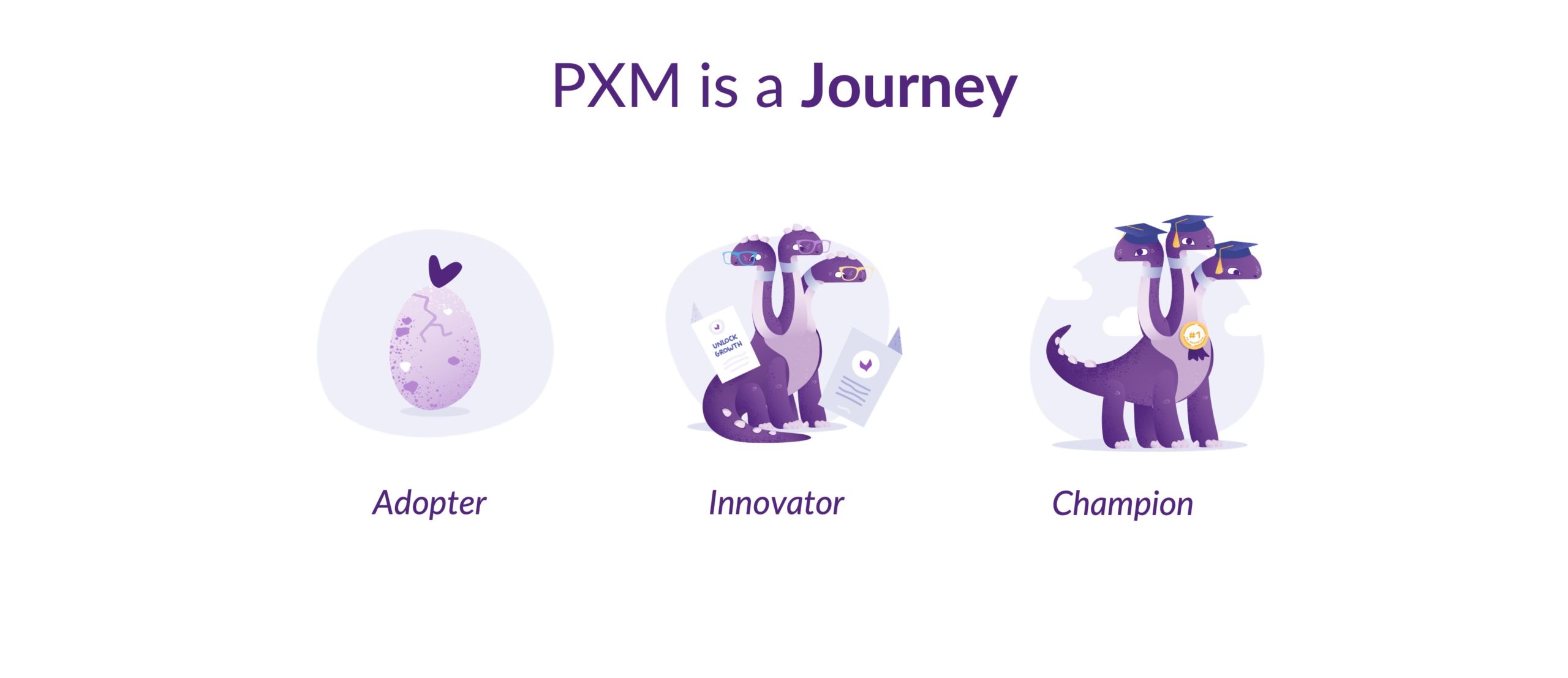
After spending 5 years implementing Akeneo PIM for all kinds of businesses across several territories, scaling product catalogs to address new digital eCommerce challenges, and becoming a Product Marketing Manager and Evangelist 2 years ago, I realized that my personal PIM journey at Akeneo tells the same story as our PXM Maturity Model framework. I certainly grew with Akeneo customers, the same way Akeneo learned and grew with them too. The best is yet to come!

When I joined Akeneo, more than 6 years ago, I came with an ERP consulting background. I was used to spending months implementing pricing & discount models, order types, return processes, and all kinds of supply chain workflows for big companies in the fashion, food, and manufacturing industries. My head was full of codes for all the ERP menus (MMS001, CRS610, OIS010, OIS180… – I’m sure this will resonate with some of you if you’re familiar with M3 ERP), and SQL requests. The scope was broad and I used to work with internal key users whom I was closer to than my own colleagues.

PXM Maturity Assessment

How mature is your organization? How can you take it to the next level?

  So when I opened a PIM for the first time, I have to admit that I did not get it immediately. I had never worked directly in the eCommerce industry (and the eCommerce team is rarely involved in an ERP implementation). What I could see on my screen was a lot of product edit forms! Which makes total sense, as the main goal of a PIM is to enrich product information and improve its quality. But at first, the scope seemed so small to me. After discovering all the features though, I totally got it. I just loved the marketing and customer-oriented approach. I was so ready to go onsite to work with many new colleagues: the eCommerce team, merchandising team, content team, studio team, and print catalog team. For me it was now super clear – ERP does support the supply chain and internal vision of the product, the PIM, the market, and the end consumer. As an experienced consultant, I spent my time listening to these people. One day during one particular project for a mass-market fashion brand, a young well-styled man interrupted one of our workshops to ask the Product Manager if the product he was about to showcase on their Instagram account was the right style, meaning the right color, and to make sure the product had not changed since the sample validation step. We know the impact it has on sales, so you can’t get this one wrong. At the time we were implementing a PIM to support an eCommerce platform migration for this fashion brand. So the project was 100% focused on the eCommerce part. But from that exact moment when the community manager with great fashion sense interrupted the workshop, I understood that a PIM project is much more than implementing another tool to only support one channel. It is about offering a new way of working for all the business users in a company. This community manager-turned-social-seller could have easily and quickly found this information in the PIM. Everywhere you sell and market products, there must be a PIM that establishes a strong foundation of your product data, that is always clean and available to share with all the touchpoints you have with your customers. Not just your social networks like this community manager asked about, but also your physical stores, the digital screens in-store, the sales app, the marketplaces you sell on, and yes, your own website(s).

From an eCommerce-oriented PIM to a channel-agnostic one

As soon as I understood the benefits of implementing a PIM, I started to re-think the workshops we delivered, and about the attendees of these sessions. But this implied challenging the project scope for each customer and making them understand how more teams could benefit from this new tool, and how it could solve a lot of product enrichment issues. Don’t get me wrong, it was not about questioning their strategy, but more about broadening the scope, opening this new goldmine to anyone dealing with or consuming product information. Behind each of your sales touchpoints, there is a team, or at least a human. And these people need to be empowered to understand that they won’t work in silos anymore but will work to support their company strategy, all collaborating with one single source of truth for their product information. So how did I learn to get buy-in and make a PIM project a success that involved everyone? How did I engage them in such a project? Basically, by rallying the troops! For the first workshop at one client, we advised our customer to invite all the people in the company that either enrich, contribute, or even just consume product information – which could lead to having over 30 people in the room at once. Yikes! The main goal we had was to make sure that:
  • Everyone was aware of this new tool in the company.
  • Everybody got the same level of knowledge: what is the PIM scope? How does it work with other systems already used (PLM, ERP mainly)? What does it mean for everyone’s daily work? It’s not about duplicating work or working for others… but about building a strong, healthy, common foundation to support the company’s growth.
  • Everybody understood how they could benefit from this new tool: fewer informal requests, less manual (re)work, fewer e-mails, better relationships, smoother enrichment, and more digital processes.
After making sure all the teams were engaged and successfully able to create this smooth enrichment process, we needed to understand who is responsible for which piece of product information, and who depends on others for information. And we had to get answers to many specific questions: How do you create a product? Is a product a sample beforehand? Is it possible to start writing a description without at least a picture of the product? How is the assortment managed? Is a product available by default for all the markets you address, or do you have an assortment of products by market? Is there a team responsible for validating all the product information? Who makes sure it complies with market regulations? Who decides that a product is ready to be seen by and sold to end consumers?
At the end of the workshops, any stakeholders connecting to the PIM could understand what they had to do, and how to do this, without any additional training because everything would have been designed according to their way of working and their specific needs: from their workspace just showing the products they have to work on, to the language(s) they have to create content for, to the product information they are responsible for.  Ultimately, these people immediately adopted both the technology and the processes to help them, changing the way they worked for the better.

From a PIM to a PXM Studio

Feeling more than ready after this early customer, I was now mature enough to work with all kinds of companies with their different business challenges. Once the teams started to understand the power of collaboration and had product information ready for any new business challenge, they started thinking about broadening the scope of their collaboration with their external providers. For resellers, instead of receiving and dealing with a lot of different formats and spreadsheets, we started to think about making onboarding product data easier and faster. That’s precisely how Akeneo Onboarder was born, by the way! The same goes for the manufacturers I worked with. How could they share accurate information with their business partners, resellers, and marketplaces? Et voilà! Akeneo Shared Catalogs joined the family. The magic really started to happen for me when some companies heard about Akeneo and decided they, too, needed a PIM after some of their business partners mentioned they were saving time, rationalizing processes, and sharing better product data quality with this new way of working.  A lot of Akeneo customers work with other Akeneo customers: in the fashion industry, in cosmetics, in the B2B world, with specialized distributors. So many businesses in these areas are connected to or collaborate with others in one way or another. It is so great to connect people together, simplify their daily life, while all speaking the same language. One of the recurring questions I received from my customers during this time was “How long will the project last?” I have now a clear and irrevocable answer: “The project timing will only depend on how mature and ready you are with your product data dictionary and with your product enrichment lifecycle.”  If a company is clear on what a product is for them, then what their customers need to know about their products and their brand becomes much clearer too. And if every team knows which product information they are responsible for to make it the best it can be, and how doing so can address their business objectives, then they are well on their way to growth, success, and maturity. And this part of my story brings me to what Product Experience Management (or PXM) is all about. It’s how you can make sure your people, your processes, and your technology are orchestrated to efficiently deliver high-quality product information in the right context, adapted to the sales touchpoints and markets you address, all aligned with your business strategy. So that’s my journey of maturity in the world of PIM and PXM. How about you? If you’re wondering where you are on this path, go answer these 14 short questions to receive a personalized report with actionable insights all based on my 6 years of experience with discovering and building your peers’ maturity. I look forward to learning where you are on your journey!

PXM Maturity Assessment

How mature is your organization? How can you take it to the next level?

Akeneo is now Headless Commerce Certified with Salesforce Commerce Cloud

Akeneo News

Akeneo is now Headless Commerce Certified with Salesforce Commerce Cloud

Did you tune in a take a front-row seat at Dreamforce on Salesforce+ this week? There were a lot of great sessions and exciting announcements. Speakin…

Did you tune in a take a front-row seat at Dreamforce on Salesforce+ this week? There were a lot of great sessions and exciting announcements. Speaking of exciting… have you heard the news? In addition to the Akeneo Connector for Salesforce Commerce Cloud, Akeneo is pleased to announce that we have achieved Headless Commerce certification with Salesforce. This is a new certification and we are honored to be a “trailblazer” and among the very first Salesforce Partners to achieve this milestone.

Headless commerce is a booming segment of the eCommerce market. In a headless commerce architecture, the backend and the frontend of the eCommerce application are separate. This allows sellers to create the front end they want without having to re-engineer the backend, and without the constraints of pre-defined customer interfaces. As a result, sellers can create and better control the customer experience they want to deliver. In order to allow this to happen, headless commerce solutions make heavy use of APIs and other tools, and require developers and IT teams to build the frontend. Akeneo has partnered with Salesforce to enable Commerce Cloud merchants to streamline their catalog management processes and deliver a compelling product experience to their customers. Merchants can use Akeneo’s open-source PIM solution to easily consolidate, enrich, manage, and export product information to Salesforce Commerce Cloud. Akeneo’s integration with Salesforce Commerce Cloud is delivered in the form of a connector that leverages the latest API technology to provide seamless integration between Akeneo PIM and Commerce Cloud. The integration enables the merchant to set up predefined jobs in Salesforce Commerce Business Manager to retrieve product data, products with variants, categories, attributes, media, assets, associations, and price books from Akeneo PIM. The benefit of this solution is that Akeneo PIM interfaces with the backend of Commerce Cloud only, which provides merchants with the freedom to build the eCommerce frontend interface, with the security of knowing that high-quality, accurate product information will reliably be delivered from Akeneo PIM. As part of Akeneo’s certification, we’re listed on the Salesforce Commerce Cloud Partner Marketplace under both the Product Information Management capability section and now in the Headless Commerce certifications & success section. There, you’ll be able to access our Headless Integration Guide for Salesforce Commerce Cloud which explains the functional and technical integration capabilities to get Akeneo PIM to feed your Commerce Cloud instance.

Give customers the product information they want

Product Experience

Give customers the product information they want

Last week I logged online and began shopping for products that I intended to use in a very specific way. I needed a light-weight, escape-proof, portab…

Last week I logged online and began shopping for products that I intended to use in a very specific way. I needed a light-weight, escape-proof, portable prison cell for my 4 month-old Weimaraner puppy, and a monitor for my home office to replace my small laptop screen. 


I did a little research and had some specific criteria in mind for both products: The Corral
  • 36 inches high (Weimaraner’s can jump)
  • 72 inches in circumference (Weimaraner’s get big)
The Monitor
  • 32 inches (big enough for spreadsheet work)
  • IPS Panel Type (hardware guides told me this was best).
Much to my surprise, I found that validating these products against my criteria involved having to jump between multiple retailer’s websites to cross-reference SKUs and model numbers and do a lot more scrolling and squinting than I expected. In some cases, the product information I needed was embedded into long descriptions with no way to filter or search, and in other even worse cases, completely missing! These gaps in information made finding the product I wanted difficult. These retailers were failing to give prospective consumers critical information about the products they were trying to sell!

Filling in Product Information Gaps

The notion of using mandatory fields to govern the presence of critical information within your product catalog seems both obvious and easy to implement for retailers. The reality is quite different though. Product catalogs today are massive and the challenge of ensuring integrity across such a large amount of data is only part of the problem. In an increasingly competitive post-Covid landscape retailers must also ensure their data stands up to the intense scrutiny of discerning customers and search algorithms whose requirements are constantly changing; The “Set it and forget it” mindset of yesteryear no longer works, even in the B2B Industry. To properly validate the presence of important product information and ensure “Completeness” sellers need to be able to: 1. Define the unique combination of critical information consumers need for each product type. 2. Account for multiple versions of this critical information across languages, regions, and sales channels. 3. Quickly and efficiently identify and fix missing information across an entire product catalog. Let’s dig into these a little more: The starting point for all product governance is defining exactly which information consumers need. Most enterprises today measure their product catalogs in the tens or hundreds of thousands of products and offer a diverse range of products with radically different product characteristics. For example, a big box retailer may sell Washing Machines and Laptops alongside High Heels and Blue Jeans. The information consumers want for each of these four products is radically different, but they must coexist and be accounted for in the same catalog. In this case a properly built product catalog will have hundreds or even thousands of attributes organized in a taxonomy of discrete product-type structures where the unique requirements of each product type can be accounted for. You cannot have just a few global mandatory fields, you must tailor your mandatory fields to the unique requirements of each product type.
The next consideration in ensuring a Product’s completeness is accounting for the contextualization of the product’s information across languages, geographic regions, and sales channels. It’s not enough to know that the “Description” of the English version of our Product on our eCommerce Website in the U.S. is filled out; we also need to know that the Spanish version of our Product in our Syndication channel in Argentina is ready for our customer’s eyes. Every adaptation and translation of our product, no matter how subtle, must be accounted for as part of our completeness check.
We can’t talk about product completeness without also discussing how to repair these holes in our product catalog. This can be a massive effort. A catalog of 100,000 products with 50 attribute fields has 5,000,000 data points that need to be monitored and fixed. This is an almost insurmountable effort if this product information is spread across multiple sources of truth like an ERP, eCommerce website, or even Excel spreadsheets (which is more common than you may think). Just having a single place of maintenance like a PIM system greatly helps this effort. Next, you need to be able to track and analyze the completeness of your products across the entire catalog and within different product types, business groups, websites, and regions. Once we identify the missing information it’s important to have productivity tools, automation, and even solutions that can leverage suppliers to help fill in the gaps.
In my own endeavor, I ended up finding a Pet retailer site that gave me the exact specifications I needed and purchased a corral for my Weimaraner. This experience then led me to revisit the same site earlier this week when I needed to order a new collar because I was confident that I could validate what I was buying without having to cross-reference, scroll, or squint. In contrast, I struggled to validate the information for my monitor, which I decided was more of a “nice to have,” and gave up completely. The high-quality data of the Pet retailer earned my repeated business while the poor data from the Electronic retailers cost them a sale.

Customer experience depends on product experience

Many retailers today invest significant time and money to drive incremental improvements to their online customer experience by focusing on things like rich-content, SEO optimization, and merchandising. While these are all important considerations, what’s often forgotten is that these areas all have an underlying dependency on complete and accurate product data.  Companies who invest in the basics of building a strong foundation of complete product information find a positive ripple effect through all components of their digital commerce infrastructure that has a tangible impact on their bottom line. Stated simply, strive to exceed your customers’ expectations and provide them with more than enough compelling information to help them find what they need and desire from you, and not someone else.