Latest

Winter Release: Commerce at the Speed of AI

Learn More
Akeneo-Logo Akeneo-Logo

Happy New Year, Happy Ten Years!

Akeneo News

Happy New Year, Happy Ten Years!

2023 marks Akeneo’s 10th year anniversary, and we want people of all ages and skills to get involved! Whether you’re a professional painter or struggle with stick figures, we want to see your rendition of our purple, three-headed hydra to celebrate a decade of Akeneo.

It’s officially 2023, which means that 2013 is now a decade behind us. Since the days of The Harlem Shake and The Cup Song, a lot has changed.  We’ve seen new apps rise and fall (looking at you, Vine), rapid advancements in AR, VR, and AI technology with the likes of Pokemon Go, DALL-E, and ChatGPT enter the arena, and, of course, a global pandemic that reached every corner of the globe and continues to rear its ugly head. But these past ten years mark something else as well; 10 years of Akeneo. That’s right, 2013 was the year our founders bonded over a passion for David Bowie, beer, and helping brands and retailers create strong omnichannel experiences and began developing a new open-source solution that could replace the use of spreadsheets and manual processes to manage product information. And so, while “selfie” was being added to the dictionary, Akeneo was born and the last foundational member joined the team; our three-headed purple hydra, Ziggy.
Ziggy drawing
While once a threatening monster facing our product catalog manager heroine, Julia, that once represented the scary nature of multichannel commerce, Ziggy has since been tamed into our friendly neighborhood Chief Community Officer. She now acts as our Akeneo ambassador who enable customers to succeed in the intimidating world of omnichannel commerce.  
Ziggy concept drawings
So while Ziggy has gone through a fair amount of iterations over the past decade, she’s been a core member of the Akeneo team from the start.  That’s ten years of holiday celebrations, traversing the world, Unlock events, serving up cocktails, and Ziggy birthdays, all while paving the way for compelling omnichannel product experiences. We’ve also seen her in a myriad of mediums; from animated to plushie to steel to even glowsticks, Ziggy has taken many shapes and forms, thanks to the creativity and innovation of the Akeneo team.
Ziggy birthday
     
Ziggy holiday
Ziggy cocktail
Ziggy steel - Unlock Paris
     
Glowstick Ziggy
Ziggy at the foot of Christ the Redeemer
But now, with 10 years of experience under our belt, we want to open up the doors and include our entire PXM community and beyond to get in on the fun. Whether you’re a professional painter or struggle with stick figures,  we want to see your Ziggy masterpieces. You can submit up to 5 renditions of our beloved mascot if you’d like, and our favorite 20 pieces of art will be showcased live in our Ziggy exhibit at the Unlock Paris 10 Year Anniversary party.  Plus, the artists with the winning drawings will receive two free tickets to Unlock Paris and will win a mamma Ziggy plushie of their own! Remember, it’s not purely about artistic skill; creativity and innovation will be a factor in the competition as well. Artwork must be submitted here by February 1st, and winners will be announced on February 15th!  So what are you waiting for? Join in on a decade of Ziggy-inspired art and enter for a chance to receive free tickets to the biggest PXM event of the year.  Start planning quickly, make it pretty, and let’s draw Ziggy!

Casey Paxton, Content Marketing Manager

Akeneo

What Makes a Good PXM Practice?

Product Experience

What Makes a Good PXM Practice?

Product Experience Management (PXM) is the set of people, processes, and technologies involved in creating compelling omnichannel product experiences. Find out where you are today in your journey towards implementing a PX strategy.

Having a great product experience is the crucial first step in providing an omnichannel customer experience. Every interaction with your product that a consumer has during their ever-widening buying journey is going to impact their experience and perception of your brand.

Feeling skeptical? Here are the numbers to back it up: two-thirds of shoppers saying that they have abandoned buying a product because of bad product information experience obtained from any source. What’s more, research also suggests that compelling product experiences can increase customer engagement, enhance brand perception, and improve lead generation and customer acquisition.

Offering a handful of compelling individual experiences, however, is not enough. You need to build an entire strategy that elevates your product experience across every channel, marketplace, and touchpoint.

Building an impactful product experience (PX) strategy is all about improving the customer experience — but that can’t be done unless you start at the foundation: Product Experience Management (PXM).

PXM is the set of best practices and key metrics for successfully making the most out of the people, processes, and technology needed to deliver world-class product experiences.

PXM Maturity

Technology

As any artisan will tell you, a high-quality product is much easier to achieve when you use the right tools for the job. Too often, organizations take the perceived simple route and invariably use the wrong tools (e.g. spreadsheets) to manage product data. The cornerstone of any effective PXM practice is a good Product Information Management (PIM) solution.  This solution should allow you to easily and efficiently collect, standardize, and enrich your product data and make it easy to create great product experiences that you can distribute across a wide range of locales, as well as owned and unowned channels. The right technology will also enable you to streamline the onboarding process for suppliers and data providers, helping you establish a system of record for product information. A good PIM solution will also offer insights to help you improve the quality and consistency of product data across all channels, and enable your team to deliver compelling product experiences to drive increased sales, higher conversions, reduced time-to-market, and more.

Processes

Building an excellent PXM practice requires more than just a good PIM solution, of course. It also requires you to have the right processes in place. This includes product enrichment processes, localization and contextualization, data governance rules, approval workflows, and team collaboration processes that go into creating a great product experience. But while internal processes and collaboration are important, make sure you don’t neglect your business partners! Your suppliers can also provide accurate and high-quality product information. Make sure you account for onboarding information from suppliers into your PXM practice, so that everyone can spend more time producing high-quality and relevant product experiences instead of replicating redundant information.  You may also need to engage with external providers such as translation agencies if you are expanding across borders to new markets. Regardless, a great PXM practice will foster collaboration across all internal and external stakeholders.

People

The last, but certainly not least important, part of building a PXM practice comes down to people: the team of hard-working, dedicated employees you have managing your product experience. Building beautiful, dynamic product experiences is all well and good, but your PXM practice should also make it easier for your employees and any external teams to create and manage these product experiences. It should also consider all the valuable contributors to high-quality product information: creative, marketing, sales, finance, procurement, and more. So, to build a top-notch PXM practice, remove manual processes and bottlenecks around enriching, managing, and sharing product information. You can then begin to unlock business growth by leveraging a user-friendly and adaptable PIM that supports seamless workflows, collaboration, and productivity.
PXM Maturity

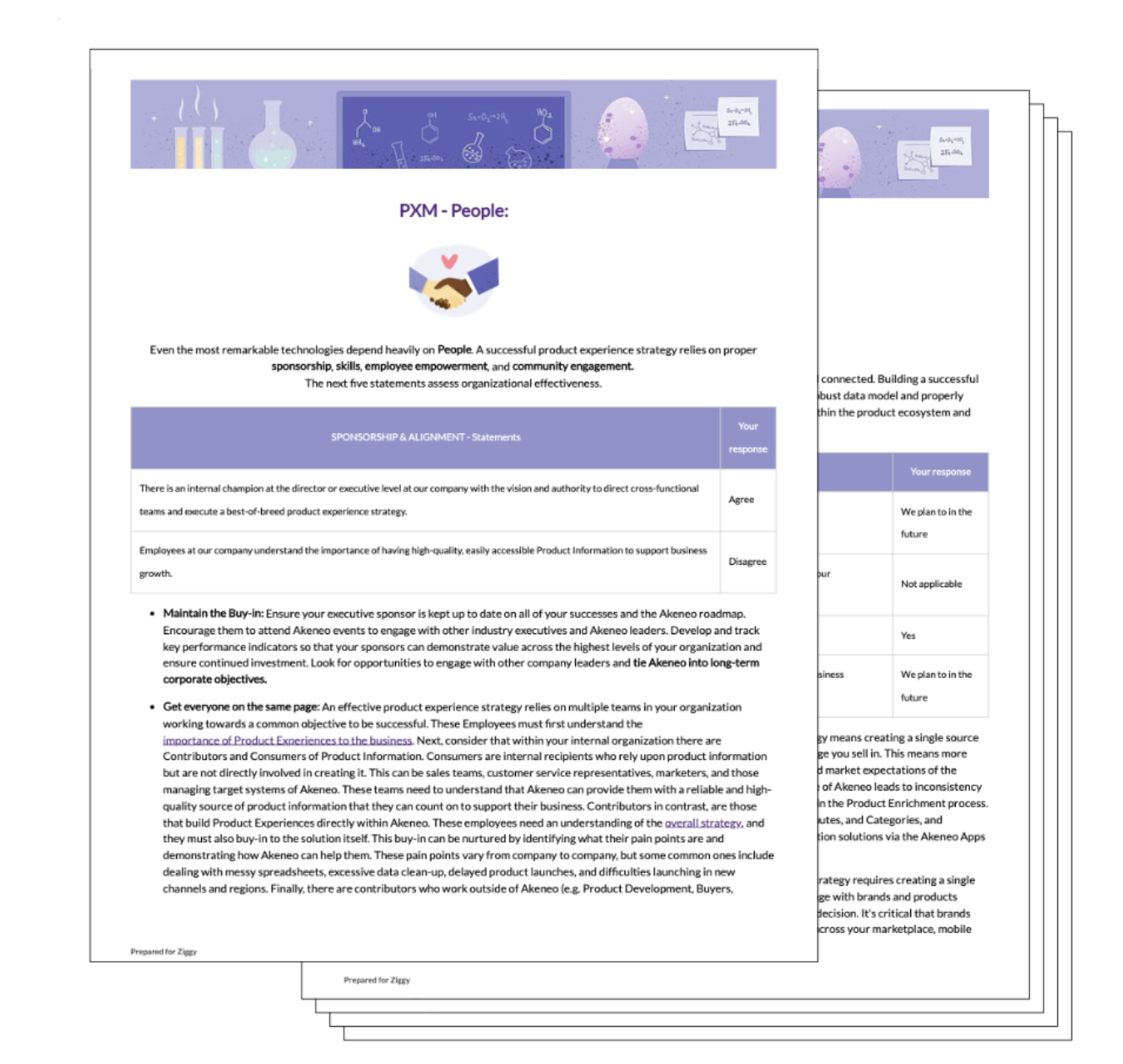
The Akeneo PXM Self Assessment

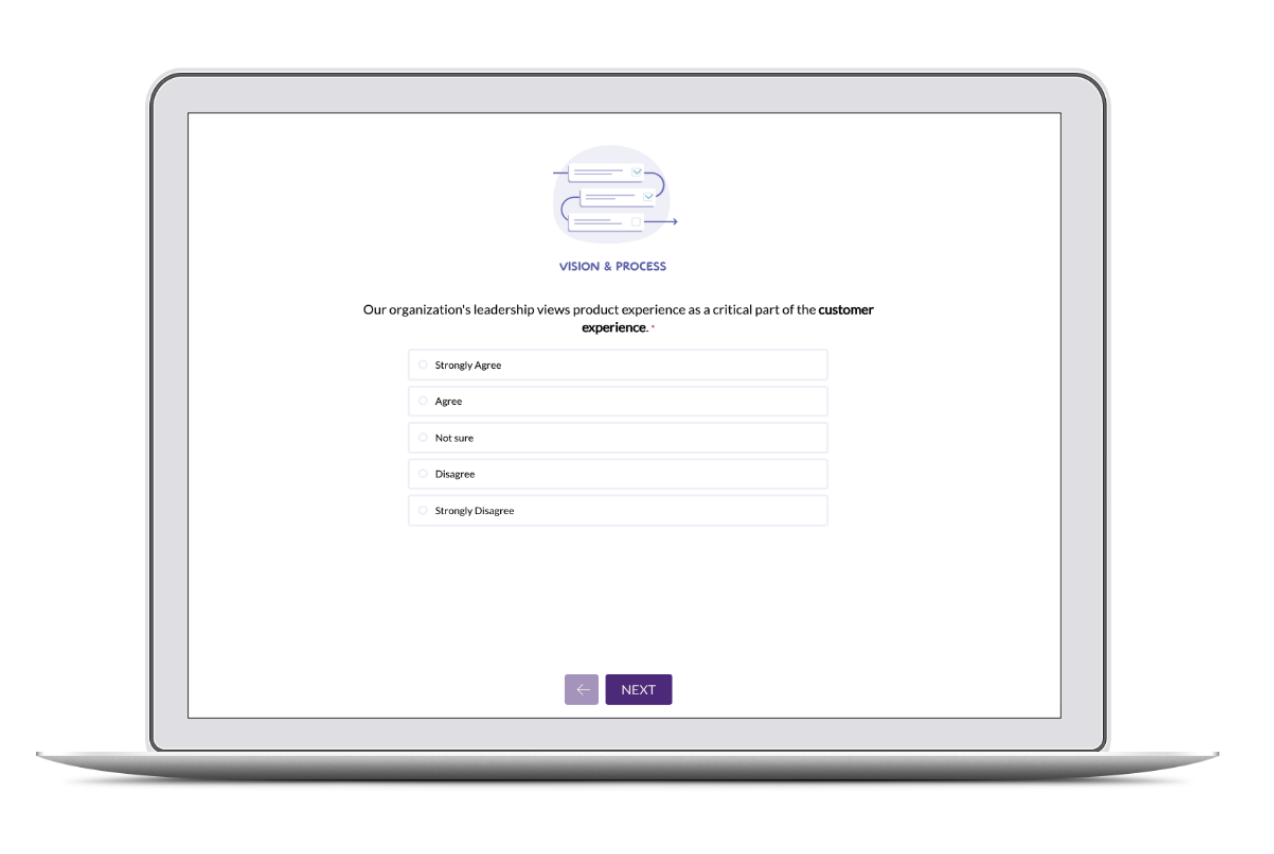
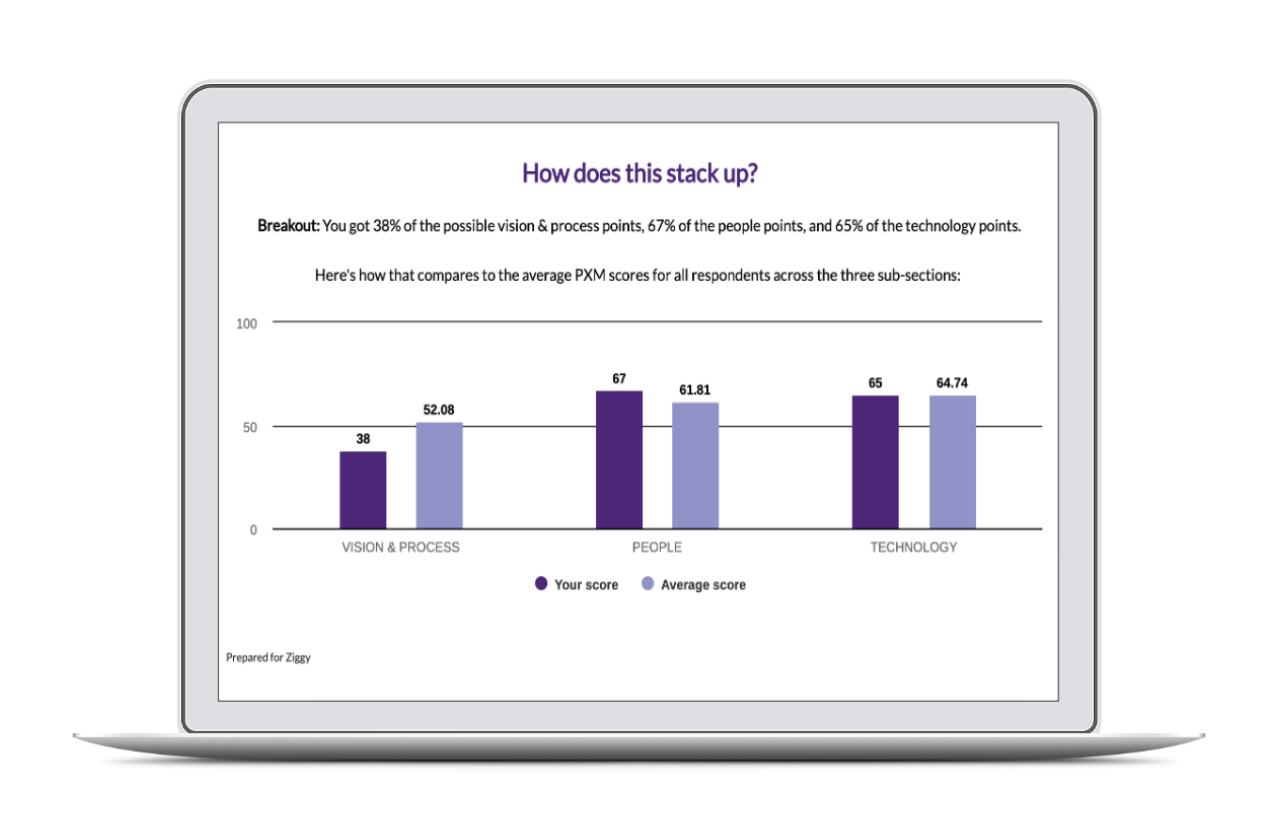
So, as you work to build up your PXM practice into a well-oiled machine, how can you know where you stand in your PXM journey?  The PXM Self Assessment is a short questionnaire that will help you to determine where you are on the path to product experience data excellence and learn how the Akeneo customer platform can help you succeed in your omnichannel PX strategy. Based on your answers, you’ll be categorized into one of the following groups and receive resources tailor-made for your situation: PXM Adopter: Someone who invests in a single source of truth as a strong foundation for consistently using product information across channels and markets.  PXM Innovator: Someone who establishes a collaborative model between teams and formalizes a process to make sure product attributes are defined to match customer expectations all along the buying journey.  PXM Champion: Someone who unlocks growth opportunities thanks to a scalable and well-designed platform involving both internal and external stakeholders. Of course, building a successful product experience practice, and becoming a PXM champion, doesn’t happen overnight. It’s a journey, one that you must carefully navigate to avoid the many potential pitfalls that dot the road to product experience excellence. To get started on the path to becoming a PXM Champion, begin by taking our PXM Self Assessment to get a better understanding of where your organization currently is and what your goals should be.  Then follow the advice offered in your detailed and personalized report to improve your PIM processes and better your PXM practice. Before long, you’ll be well on your way to becoming a PXM Champion!

PXM Self Assessment

Where is your organization on your path to delivering great product experiences? How can you take it to the next level?


Learn from organizations who have cracked the code and become PXM Champions by checking out some customer stories!

Casey Paxton, Content Marketing Manager

Akeneo

What is a Digital Asset Management (DAM) System?

Product Experience

What is a Digital Asset Management (DAM) System?

What is DAM, and how can it benefit your organization? Learn more about digital asset management software, its benefits, and how to find the right one.

It’s been more than 25 years since Bill Gates famously proclaimed “content is king”—and yet it’s still true. Organizations today are creating more content than ever: 66% of content marketers said they created more content in 2022 than the previous year. 

All that content means one thing: a lot of digital assets.

As the amount of content we put out into the world continues to increase, so does our need for digital asset management software. Let’s dive into everything you need to know about this key piece of your data puzzle.

What Are Digital Assets?

Digital assets are unique files that are created and stored on a computer, server, or in the cloud. They are easily identifiable and provide value to your organization.

In the context of product marketing, digital assets include any file that you use to sell or market your products across any channel or marketplace. Most commonly this includes photos and images, videos, graphics, and written product information. It also includes the color palettes, fonts, and so on that you need to create these assets. Even your brand logo is a digital asset. 

Beyond the most common marketing purposes, the digital asset definition can also include sales enablement collateral such as PowerPoints and one-pagers, operations-related assets like diagrams and process documents, and assets from your design and engineering teams such as blueprints and 3D renderings.

There’s also another, more recent answer to “What are digital assets?” With the dawn of cryptocurrency and blockchain technology, more and more people are becoming familiar with the concept of digital assets as currency, virtual real estate, and non-fungible tokens (NFTs).

While these certainly count as digital assets, they are not typically what organizations are referring to when they discuss digital asset management software, so we’ve left them out of this discussion.

What Is a Digital Asset Management System?

A digital asset management system consists of the processes you use to collect, manage, and make use of your digital assets across your organization and across the entire product lifecycle. Most DAM systems today involve software and provide a single database for all of your digital assets and an easy way to share and distribute them around the world.

DAM software will be able to easily import your digital assets from many different sources and in many different file formats, including audio, video, image, and other programs. It will allow you to organize those assets in a flexible and customizable way. And it will connect to your various sales channels so that you can easily transmit those files.

In essence, effective digital asset management ensures that anyone in your organization and outside of it can find the files they need, when they need them.

What Does DAM Software Do?

Today’s digital asset manager systems have come a long way since those of the 1990s. Many of them now run in the cloud, so there is no expensive hardware to maintain, although on-site servers still exist.

Tools for digital asset management include templates you can use to standardize the creation of assets, as well as the ability to upload, organize, and store various file formats. You’ll be able to tag your assets with metadata including the type of asset, technology used, and version. Then you can create workflows that automate various tasks and processes.

Most DAM software also includes collaboration tools, like the ability to make edits and leave comments. Once your file is final, it will provide numerous ways you can distribute the content, such as connecting to your product information management (PIM) software or uploading directly to your website.

Other essential functions of DAM software include unlimited storage, file backups, and version control, which ensures that the latest version is being used. You’ll also be able to set permissions, which allows you to limit who can see and make changes to each asset and helps prevent errors and intellectual property theft. 

DAM systems don’t just store your files—they give you a complete and holistic view into their history and current status. And they do it in a user-friendly way.

Why Do You Need a DAM System?

According to one survey, marketers and creatives estimate their teams spend 91 hours per week searching for digital assets. Nearly half report that this slows down their productivity. And only 14% are happy with how their digital assets are stored.

This is a huge opportunity for organizations to not only improve their efficiencies, but also create happier and more satisfied employees. The same survey found that those who do have a DAM system are 41% more likely to be satisfied with their digital asset workflow.

The larger your digital asset library, the greater your need for DAM software. and it isn’t just marketing teams that benefit. When your sales, customer service, web development, and other teams have easy access to your files, that means your marketing and creative teams don’t have to spend as much time fulfilling digital content management requests.

A good asset management strategy will improve your organizational communication, collaboration, and agility. It will streamline your workflows and optimize digital asset production. It will reduce errors and duplicate content.

Most importantly, good digital asset management will lead to a better customer experience by ensuring that all assets are accurate, consistent, and up to date.

So what is DAM? It’s actually a solution to many of your organizational challenges.

How to Choose the Best DAM Software for Your Business

Managing brand assets doesn’t have to be difficult. Above all, DAM software should solve your business challenges, not contribute to them. Here’s what to look for so you can find a solution that does just that.

Features and Customization

The real question for your organization is, “What is a digital asset management system to you?” Asset manager systems come with many different capabilities. Do you mainly need to store design files? Or do you need mostly digital content management? While many solutions have similar features, some may excel more in the areas that are important to you. 

Any solution you choose should come with the ability to add and remove features as needed. Open source DAM software is an excellent option if customization is especially important to you.

Tech Stack Integration

You don’t want your DAM system to put up walls instead of breaking down silos. The data you upload should never become an island. The best DAM systems are made to not only share, but to easily integrate with your existing tech stack.

Depending on the type of files you work with, you’ll want the ability to import from Microsoft Office, Adobe Creative Cloud, and project management tools. You’ll also want to connect your DAM to your other data management tools, like your master data management (MDM) and PIM systems. If you don’t see your tools listed, ask the company if they provide the ability for your developers to connect via API.

Search Capabilities

Searching for assets is one of the most important capabilities of DAM software. You’ll want to be able to search in two directions: search the metadata to find your assets, and search within an asset to find its metadata.

 You’ll also want to make sure it’s easy to label your assets in the first place, using simple adjustments and customizable fields rather than complicated code that requires a developer. Also consider the ease of filtering your search results. Does the DAM system have the filters you need or will you need to create them?

Security and Recoverability

Security for your digital assets is especially important if you work in an industry involving R&D or other intellectual property. Up-to-date security protocols and the latest encryption are essential, as is a secure server where your data will be stored. Your DAM system should also ensure your files are redundant and recoverable and that the system is backed up and reliable.

Permissions are another aspect of security that’s important. If your DAM software doesn’t provide detailed enough access rights with role based permissions, you may not be able to assign the permissions you want.

Sharing

Your DAM software should make it easier to share files among your team and with outside organizations. You want fast, efficient file transfer that leverages compression without affecting quality.

You’ll also want the ability to easily group files based on who you are sharing them with, like marketing teams, product teams, customers, and suppliers or distributors. Then you’ll want to be sure you can give those people access as needed.

 The real answer to the question “What is DAM?” is that it is quickly becoming one of the most essential tools for asset management, especially for large enterprises and eCommerce. Along with tools like PIM, it’s part of the overall strategy you need to implement to ensure a consistent and streamlined customer experience across all of your channels. In fact, the match between DAM and PIM was made in heaven.

 Want to learn more about how DAM and PIM can work together? Check out this webinar with tech and business experts to learn how this integration can benefit your business. Then book a demo and let us show you how it works.

Casey Paxton, Content Marketing Manager

Akeneo

What Is Product Lifecycle Management (PLM) for eCommerce?

Product Experience

What Is Product Lifecycle Management (PLM) for eCommerce?

What is product lifecycle management? Learn how it can help you improve your products and your bottom line.

Our lives are full of cycles. The seasons come and go, bringing change each year. The economy runs in cycles, from bear markets to bull markets and back again. Businesses go through predictable phases of growth and decline. Many of the cycles in our lives we do not control. But there is one that businesses can control: the product lifecycle. As globalization drives down prices, regulations increase complexity, and the economy shifts in unpredictable ways, it’s time to focus on product lifecycle management as a way to improve your bottom line.  

What is Product Lifecycle Management?

Product lifecycle management (PLM) is the process of directing, supervising, and handling a product as it moves from the early stages of design to the go-to-market phase, and eventually to retirement. Effective PLM can help you make better business decisions across the board, creating higher-quality products, pricing and promoting them correctly, adding features, expanding to new markets, providing customer service, and eventually deciding if and when to retire the product. PLM can be a highly complex form of data management. It includes product design files, supply chain information, customer management, and sales information. It also involves multiple departments, like design, engineering, and sales, thousands or millions of SKUs, and multiple global locations, especially when it comes to eCommerce product management for larger enterprises.  

Who Needs PLM?

PLM is especially important for manufacturers, who need to design, engineer, and market their own products, as well as the distributors and retailers who then work with those products. As more and more of these organizations move online and embrace the digital transformation, product management for eCommerce becomes even more important. When you sell online, you need to manage the lifecycles of thousands of products in real-time. Otherwise, you can’t deliver the product experience—and therefore the customer experience—that will keep your buyers coming back.  This is where product lifecycle management software can help. A good PLM system will incorporate your product data into a single database that can then be used throughout the entire lifecycle. It can import data from a variety of sources, including your enterprise resource planning (ERP) software, and automate many tasks, so you can maximize the profits from every product.  

What Are the Product Lifecycle Stages?

The traditional way of looking at PLM is the five-stage model by Theodore Levitt. Levitt first introduced this model in 1965 in the Harvard Business Review, envisioning the classic bell-shaped curve that would soon be taught in business classrooms around the world. Levitt’s five stages were:  1.Development  The development phase includes ideation, concepting, and design. It includes competitor and market research that influences the ultimate design of the product, as well as validation, analysis, prototype development, and field testing. Consumer feedback is gathered and changes are made until the product is finalized. 2. Introduction   The introduction phase includes production and going to market. Supply chains are determined, production methods are optimized and then scaled, and distribution channels are found and activated. The introduction phase is heavy on marketing and advertising, but low on sales, making it the most expensive phase. 3. Growth  The growth phase is all about increasing demand for your product and scaling your operations. Maintaining and expanding your reach, ensuring your product is in stock, pricing it correctly, providing customer service, establishing better distribution, and differentiating yourself from your competitors are all important during the growth phase. In the eCommerce product lifecycle in particular, the growth phase can occur rapidly. 4. Maturity  The maturity phase is usually the most profitable. You have attained a high market share and perfected your pricing and distribution strategies. However, many consumers have now bought your product, and you may be reaching market saturation. The focus in this phase is to increase customer loyalty and add new features to give them a reason to continue to buy your product. 5. Decline  The decline phase occurs when the market becomes too competitive, the technology is outdated, the market is too saturated, or customers simply lose interest. You’ll need to manage the retirement of your product, including scaling down production, selling remaining units, and continuing to provide customer service and alternative products to your loyal customers.  

Alternatives to the Traditional PLM Model

The answer to “What is product lifecycle management?” isn’t always so straightforward. Since Levitt published the traditional product lifecycle management model, business leaders and economists have been tweaking it. Some leave out the development phase because it occurs behind the scenes. It also doesn’t apply to some eCommerce product management, especially for retailers and distributors who do not manufacture their own products. Forty years after Levitt first published his lifecycle model, Harvard business professor Youngme Moon wrote another article in the Harvard Business Review: “Break Free from the Product Life Cycle.” She argued that by embracing the traditional model of product lifecycle management, businesses may be accepting the stages of maturity and decline when they don’t need to. Many businesses can reposition their products to either move them more quickly into the growth phase or cause them to revert back to the growth phase from the maturity phase. With the introduction of product lifecycle management software, it’s easier than ever for businesses to collect, organize, and manage their product data. This in turn lets them better predict the product lifecycle, and prolong the growth phase or even revert back to it. The increasing complexity of the eCommerce product lifecycle means software is even more important.  

Benefits of Product Lifecycle Management

When used effectively, PLM has positive effects on your bottom line and is an essential part of your digital ecosystem. With the right knowledge, captured at the right time, and shared with the right people, organizations can facilitate collaboration and make better decisions and predictions throughout the product lifecycle. That means you can: 
  • Produce higher-quality, safer products
  • Get products to market faster
  • Reveal hidden opportunities in markets
  • Reduce errors and costs
  • Reduce waste of both materials and time
  • Produce better bills of materials and requests for quotes
  • Predict and manage seasonal changes
  • Improve your forecasting
  • Maximize your supply chain efficiency
 

Examples of Product Lifecycle Management

Product lifecycle management examples can be found in nearly every industry, especially the automotive and aerospace industries, which were some of the first to adopt the model.  One modern example in the automobile world is Tesla. The company introduced its first car in 2008 and the famous Model S the following year. As a pioneer in the electric car space, Tesla’s introduction phase was characteristically slow. The pricing was premium and demand was low. With the release of the Model 3 and its more affordable pricing, Tesla entered the growth phase, where it currently stands. Tesla currently dominates its competitors. The company sold nearly 500,000 cars in 2020 and nearly 910,000 in 2022, an impressive growth rate. They are also constantly introducing new features to the same models to help prevent their product from reaching the maturity stage too quickly. The strategy of introducing new features and retiring others is common today in technology and eCommerce product management. This helps them stay in the growth and maturity phases as long as possible. We’re all familiar with brands like these: Apple, as well as other smartphone makers, are some of the most well-known.  

Best Practices for Product Lifecycle Management

Turning your company into the next Tesla takes more than an innovative product and product lifecycle management software. The product lifecycle is complex and many markets are already very competitive, which makes it difficult to reach the growth stage. Following some product lifecycle management best practices can help.
  • Differentiate your product. Beginning in the development phase, think about how you will position your product against the competition. Your positioning will affect your product design. For example, if you decide to make a more affordable version of the product or a more powerful version, this will affect what goes into the product.
  • Set the right pricing. In many industries, especially eCommerce product management, pricing is always changing depending on the supply chain, consumer sentiments, and even the time of year. Effective PLM helps you tailor your pricing strategy to the part of the lifecycle your product is in as well as outside factors. For example, discounts in the introduction and maturity phases can help increase demand.
  • Be ready to innovate. One of the best ways to extend your growth and maturity phases is to constantly iterate on your product. Adding new features isn’t the only way. You can try new marketing strategies, bundling your products, or cross-selling. You can even change your business model entirely, like Netflix did when it made the switch from DVD rentals to streaming.
  • Measure your success. You’ll only know if your PLM is succeeding if you measure it continuously. Fast lead times are an indicator that you’re meeting customer demand. Less waste of materials, labor, and money means your supply chain is efficient, while excess materials and products may mean you overestimated demand. Low numbers of returns and complaints mean you have happy customers and quality products.
So what is product lifecycle management? Ultimately, it’s a way to ensure you’re selling your products efficiently. By creating quality products, setting the right prices, and ensuring that you have items in stock, you’re not only saving your business money, but creating an excellent customer experience. At Akeneo, our product information management (PIM) software is all about providing an amazing product experience that leads into the best customer experience you can offer. Learn more about our PIM, as well as the differences between PIM versus PLM, then contact us if you have any questions. We’re always here to help you sort out what you need.

Casey Paxton, Content Marketing Manager

Akeneo

What is eCommerce Inventory Management Software?

Product Experience

What is eCommerce Inventory Management Software?

eCommerce inventory management software helps you source, store, and sell your products as efficiently as possible. Discover the benefits and learn how to find the one that’s right for you.

If you’re in eCommerce, you know that making order out of chaos is a big part of the job.  You’ve got suppliers around the world. Warehouses around the country. Online stores and third-party channels. Digital catalogs in the cloud and print catalogs hot off the presses. And brick-and-mortar stores haven’t gone extinct: U.S. retailers announced twice as many store openings as closings in 2021. You’ve got a lot going on. How can you keep track of it all? One process stands out for eCommerce in particular: inventory management From your local corner store to retail giants like Amazon, everyone needs eCommerce inventory management software, but different tools work better for different teams. So how do you find the right one for your organization? That’s what we’re here for.   

What is eCommerce inventory management software?

eCommerce inventory management software tracks and manages your products so that you always know the amount in stock, its location, its price, and how fast it’s selling. It helps you source, store, and sell your products as efficiently as possible.  eCommerce inventory management itself can be grouped into four categories:
  1. Raw materials. The materials that go directly into your product, like fabric and thread for a clothing manufacturer.
  2. Production goods. Items used to make your product that aren’t directly a part of it, like sewing machines for clothing. 
  3. Works-in-progress. Products that are still in the design phase, like next season’s fashions.
  4. Finished goods. Products that are ready for sale, like current fashions either in a warehouse or on the rack
When it comes to eCommerce inventory management software, we’re usually talking about the fourth category: finished goods. The previous stages are typically managed by other types of software, like product data management (PDM), and all are part of product lifecycle management (PLM), which often has its own tools to manage as well.  It’s all a part of building the right ecosystem, but inventory management software is especially important.  

Why is inventory management software important for eCommerce?

There are so many benefits of eCommerce inventory management systems, it’s hard to know where to start. So let’s just dive in. 
  • Better forecasting. Even the most basic eCommerce inventory management software provides insights into what you have and where it is, from the warehouse to your customers’ doorsteps. That means you know when to restock, how much to buy, and where to store it so that you make the most profit. 
  • More successful product launches. When you know what’s selling—and what’s not selling—you can apply that information to future product launches. Did customers go crazy for your stuffed pickle dog toy, but weren’t sold on the red rope? We see more fun food-inspired toys in your future. 
  • Improved quality control. Inventory management software will tell you when something was made, when it arrived at the warehouse, and when it needs to be sold, so you know exactly what to prioritize. Instead of stock going missing, you can get it out the door before it goes out of date—or out of fashion. 
  • Positive omnichannel customer experiences. Your goal is always to keep your customers coming back. How do you do that? By providing an amazing buying experience wherever your customers are. eCommerce inventory management software will sync with your digital product catalog and other channels so that your inventory counts are always correct, and your customers always get what they ordered.
Ultimately, effective inventory management for eCommerce helps you make the most possible profit from each and every item you sell. And that keeps you in business.  

Essential features of inventory management software

It’s not an exaggeration to say that inventory management can make or break your business, so you want to spend the time to find the software that’s right for your organization. Here’s what to look for. Real-time tracking If your eCommerce inventory software doesn’t update in real-time, then you—and your customers—don’t actually know what’s in stock and what’s out-of-stock. You need to know what’s been ordered, what’s been bought in-store, what’s been delivered, and what’s been returned. And you need to know it in real time.  Automation It seems like everything is automated these days, and just like your sales and marketing software, your car, and your electronics, your eCommerce inventory management software should be too. When inventory management and optimization happens automatically, you free up your employees to focus on planning for the future.  SKU scanning Real-time capabilities and the smartest AI in the world don’t mean anything if you can’t easily input your SKUs. Keeping tabs on your stock is a fundamental task of eCommerce inventory management, so you’ll need software that integrates with the barcode scanners you use.  Syndication Modern eCommerce operates on a plethora of platforms: Amazon, Facebook, Alibaba, eBay, Etsy, Google Shopping, plus new channels you may not even be aware of yet. Can your eCommerce inventory management system syndicate all those systems? It won’t do you much good if it isn’t able to track what’s being sold on third-party sites and easily sync to new channels as they emerge.  Price optimization Price is easily one of the most important factors in inventory management. Is your price too high, or too low? Should it change seasonally? When should you put items on sale or on clearance? How can you make the most profit? These are all things your software should be able to tell you.  Forecasting You don’t just need to optimize your price points. You need to optimize the inventory itself. If your sales vary based on season, holidays, customer trends, or economic factors, your eCommerce inventory management software can help you predict the future, so you know what you need to order, reorder, and unload.  Integration across channels and locations If you have physical stores, you’ll need software that integrates with your POS system and transmits all sales and stock level details. You’ll be able to see your overall inventory as well as what you have at each store. The same goes for multiple warehouses: Your inventory management software should be able to input and track data from each warehouse, making it easy to see what you have and move product from place to place.  Reporting We hope you’re a data nerd, because you’re going to have a lot of data. Why not use it? With detailed reporting dashboards and capabilities, eCommerce inventory software can provide valuable insights into customer behavior, order fill times, delivery times, inventory control, when to reorder, and more. That helps you optimize your operations and keep your costs down.  Customer support You’re all about customer support for your own business, but it may never cross your mind when it comes to your tech stack. It should—fast, knowledgeable, and friendly customer support can make a big difference when you need a problem fixed. Getting questions answered quickly can also decrease your onboarding and training time.  Your eCommerce inventory management system is an essential tool to help you create fast, seamless customer experiences across all of your channels. It should make your life easier, not harder, by integrating with your existing systems. And ultimately, it should make your customers happier and keep them coming back Ready to hear more? Request a demo with an Akeneo expert and see how our hassle-free software can help your business run more efficiently. 

Casey Paxton, Content Marketing Manager

Akeneo

PIM vs. MDM: Why Product Information isn’t like the other 1’s and 0’s

Product Experience

PIM vs. MDM: Why Product Information isn’t like the other 1’s and 0’s

Discover the differences and similarities between PIM and MDM, and how a PIM’s focus on marketers can work with data from an MDM to drive brand value through product experiences

Companies exploring Product information Management (PIM) solutions often find themselves directed, through marketing and sales activities or internal stakeholders, to also explore Master Data Management (MDM) solutions. This isn’t surprising considering that on the surface these two software offerings appear to serve similar purposes within the data ecosystem. Further complicating the discussion is that PIM is actually considered a specialized subcategory of MDM, and in recent years, some MDM vendors have begun trying to blur the distinction between the two systems. So let’s take a look at both to understand what makes them different and how PIM’s deep focus on marketers and their ability to drive brand value through product experiences makes them distinct from MDMs and an important offering for any retailer.   

What is MDM? 

Master Data Management (MDM) is a category of software that centralizes and standardizes different data types and processes from multiple systems within an enterprise to build a “Master” record. Modern enterprises include dozens of disjointed systems that store critical Customer, Product, Supplier, Location, and Employee information in both structured and unstructured formats. MDM platforms are IT driven solutions that bring harmony to this chaotic ecosystem by synchronizing and standardizing data across the entire ecosystem to provide a golden record that eliminates the potential for redundancy, duplication, and miscommunication. This stewardship over the entire enterprise’s data makes it a valuable tool for Business Intelligence (BI), the establishment of data policies and guidelines, regulatory compliance, and improving operational efficiencies.   

What is PIM? 

Product Information Management (PIM) is considered a subcategory of MDM but differentiates itself by limiting its scope to being the Master for just Product information. PIM solutions are business driven applications that provide marketers a single place to collect, manage, translate, and enrich product information and media to create catalogs that can be quickly distributed to multiple sales channels and markets. PIM systems offer robust support for omnichannel commerce by providing a wide range of connectivity solutions for eCommerce platforms, marketplaces, mobile apps, and social media. PIM software’s focus on Product Experience makes it critical to companies looking to ensure their brand provides a consistent high-quality experience across all customer touchpoints. The benefits of PIM can be measured in higher conversion rates, lower return rates, and faster time to market for new products.   

MDM vs PIM

In the past, technical product information compiled in an MDM from supplier feeds, data hubs, or internal systems (PLM/ERP) may have been sufficient, but the rapidly evolving demands of digital commerce require more. Companies must increasingly be equipped to provide compelling, high-quality, and contextualized product information to a wide-range of customer touchpoints at a moment’s notice. Product information can no longer be treated as a commodity; it is an important differentiator in the digital world, a business function ruled by marketers and merchandisers who collaborate with a wide range of internal teams and external partners and suppliers to deliver technical, visual, instructional, and emotional product information that is localized for and compliant with international markets. It is PIM software’s capacity to support these requirements that have made it a distinct and rapidly growing software category.  MDM and PIM platforms serve distinct but complementary functions within a business ecosystem, and many enterprises use both systems. MDM platforms can feed core product information aggregated from across the ecosystem into a PIM system. This information is then tailored and enhanced by marketers and combined with assets within the PIM before being distributed across all of a company’s sales channels. When companies don’t have an MDM solution, PIM software can be a much faster and cheaper way to cleanse and govern product information to support digital commerce activities, though they make poor MDM substitutes when it comes to managing an entire company’s data management needs. For companies that do already have an MDM, the addition of a PIM platform gives their marketers a better place to build superior product experiences with support for digital commerce. There is sometimes a temptation to forgo PIM software in favor of the “all-in-one” solution that MDM platforms appear to offer. Companies that go down this path tend to do so because of an underappreciation of the importance of quality product information to the business. From their perspective, products are simple lists of attributes attached to a SKU to describe the basic technical information about a product (height, weight, generic color etc.). And when this is the extent of your Product Information, it does seem only logical to consolidate it along with all the other 0’s and 1’s within an MDM. But product information is much too important to be treated in this manner, because ultimately product information is critical in driving customer experience. We must consider this human element and provide a compelling experience to customers as they prepare to make that buying decision! Consolidating, reducing, and standardizing our sales data in an MDM makes sense, but do we really want to manage our customer’s product experiences the same way we handle last month’s invoices?

MDM to PIM Integration Best Practices 

When integrating an MDM system to a PIM system, establish a single source of truth for each data field and determine who can access and manipulate what within each system. Bring only relevant customer-facing information from the MDM into the PIM and determine how frequently the data needs to be updated. Core product information is often populated from the MDM into the PIM, enriched by the marketing team, and then passed back into the MDM for reporting and dissemination. API-based integrations are preferred. PIM and MDM platforms are distinct but complementary technologies that both play an important role within a company’s ecosystem. While MDM platforms provide a powerful but resource intensive solution for IT teams to provide governance, reporting, and standardization across the entire enterprise, they can’t build compelling product experiences. Only Marketers, empowered to collaborate in a PIM platform engineered specifically for their needs, can provide the high quality, differentiated product experiences modern commerce demands. Don’t treat product information as just another piece of data to be managed, nurture it in a PIM and turn it into a competitive advantage to drive sales and unlock growth.

Adam Beatty, Community Evangelist

Akeneo

The Total Economic Impact of Akeneo PIM

Akeneo News

The Total Economic Impact of Akeneo PIM

This past year, Akeneo commissioned Forrester Consulting to conduct a Total Economic Impact (TEI) study to quantify results that existing Akeneo PIM customers have seen in order to provide a better understanding of the benefits, costs, and risks associated with an investment in PIM technology.

Have you ever wondered what the actual business impact is on a piece of technology? Whether it’s for your own personal interest or to convince your boss that it’s a necessary investment, proving the economic impact of software can be the difference between acquiring a platform that revolutionizes the way you work or sticking to the status quo.

One of the most frequently asked questions we get here at Akeneo is about the return on investment (ROI) that organizations may realize by implementing a PIM solution. That’s why we commissioned Forrester Consulting this past year to conduct a Total Economic Impact (TEI) study to quantify results that existing Akeneo PIM customers have seen to provide those interested with a framework to evaluate the potential financial impact of Akeneo’s PIM solution on their organizations.

For the purposes of the study, Forrester collected and aggregated feedback from a number of representatives with experience using Akeneo’s PIM solution in order to better understand the benefits, costs, and risks associated with this investment. 

The results were astounding; for a full breakdown, you can download the report here, but let’s dive into a cursory view of a few key issues that these organizations were facing, and how they used Akeneo’s PIM software to help.

Many of the interviewees noted how their organizations struggled with common challenges, including:


1. Lacking a single source of the truth 

Without a PIM solution in place (or an inefficient, outdated PIM system), many organizations saw product data scattered everywhere. Some data is stored in the ERP, in legacy technology, or even in random spreadsheets, meaning that multiple departments had different parts of the product record. Users faced constraints on available fields, field sizes, product categorizations, and organizing product data for intended product data users. 

Duplicate effort occurred in maintaining the data and excess effort occurred accessing the data. Ensuring data quality was not possible, so inaccurate input was not caught and departments frequently had common data that conflicted.

With no central repository of product data, organizations struggled with:

  • Labor redundancy
  • Data duplication
  • Incomplete data
  • Ineffective data sharing
  • An abundance of data errors


2. Slow to expand ways of selling

The report also uncovered that many organizations felt that they lacked the combination of resources, technical skills, and nimbleness to respond to new market opportunities.This meant that teams were slow to respond to new markets and channels, and struggled to take advantage of new revenue streams. This hampered not only their ambitions to expand selling channels, but also bottle-necked the number of products they were able to sell through various sales channels and approaches, such as upselling, cross-selling, selling by product groupings, and product rankings.

This also meant that distributors were losing new product placement opportunities because competitors were able to provide new product information to retailers and eCommerce partners faster than they were able to.


3. Inefficient internal operations

Several organizations interviewed stated that product managers were being forced to spend a large amount of time on inefficient activities such as collecting and managing product data, which in turn led to inefficient activities to activate that data with channel partners or with their own catalogs and eCommerce systems. Creating redundant work for these product catalog managers meant that they were spending more time hunting down and organizing product information (or even worse, creating it from scratch when it already existed somewhere) instead of utilizing their precious time in a better way.

Do any of these struggles ring a bell? Good news is you’re not alone – the better news is that Akeneo PIM can help. Our easy-to-use interface and administrative workflows meant that we were able to provide these organizations with complete and accurate product information and an easier process for internal and external product data communication.

TEI Report - Akeneo PIM

In particular, the Forrester report found that, after implementing Akeneo PIM: 


1. Revenue increases of $10.4 million due to faster time-to-market (TTM) 

With a centralized system of product information, organizations interviewed were able to expand the number of products sold and facilitate new product adoption sooner due to an improved time-to-market (TTM). In addition, Akeneo PIM offered a single source of record for all teams and product managers to reference and utilize, leading to more value-add work, more new products, and more innovative products. With complete and accurate product information, distributors gained a competitive advantage as they were able to enter new markets faster and smoother.

We believe that our sales growth has been 2x higher than our competitors over the last two years and we contribute a significant amount of credit to the product experience transformation that Akeneo enabled.

VP marketing, eCommerce, and customer experience machinery and parts manufacturer

2. Revenue increases of $45.4 million due to Akeneo-enabled data management and quality improvements

The ability to centrally store and manage all product information allows organizations to improve the experience for managing data and supports better insights into data quality. This also enables these organizations to supply all their sales and marketing channels more easily with rich, search-engine-optimized (SEO) product information that leads to improved product performance on partner and eCommerce sites. 

This also means less redundant work for product managers; when they are able to trust that their product data is accurate and up-to-date, they spend less time double-checking the information and more time on valuable activities. Lastly, improved data quality and management means that organizations were able to open new streams of revenue through additional cross-selling and upselling practices. 


3. Operational improvements through return reduction due to quality and decision accuracy of $1.1 million over three years

One of the biggest killers to revenue and hinderances to growth is returned products, and ambiguous product information is one of the top reasons customers return online purchases. By improving product information completeness and quality using Akeneo PIM, the organizations that were interviewed for the report experienced a reduction of returns, leading to operational savings related to the shipping and handling costs of the returns as well as any discounting or write-offs associated with the returned items. 

When customers know what they ordered and receive the product they expected to receive, they are far less likely to make the return and far more likely to come back again as a repeat customer.

At the end of the day, Akeneo PIM provides an easy-to-use interface for organizations to centralize, manage, optimize, and communicate their product information across internal and external teams, saving these businesses time, money, and resources.

For a deeper analysis of these results and more fascinating insights into how PIM can revolutionize your business, be sure to download the Total Economic Impact Report of Akeneo’s PIM in its entirety today, or reach out to an Akeneo expert to see how you can get started.


Akeneo Forrester TEI


Casey Paxton, Content Marketing Manager

Akeneo

Top Retail Trends for 2023

Product Experience

Top Retail Trends for 2023

From omnichannel shopping experiences to promoting sustainability to incorporating new technological advancements, check out what’s in store for the retail industry in 2023 and beyond.

As we approach the end of 2022, many brands and retailers are in the depths of planning season and are looking ahead to the coming year to see what trends will shape the industry. But with a global pandemic, supply chain disruptions, economic uncertainty, and massive leaps in technology, it’s become more clear than ever before that nobody can predict the future with 100% accuracy.

Although the crystal ball may be a bit fuzzy, we can utilize consumer behavior as our tea leaves to glean a glimpse into the future as we round out the biggest shopping season of the year. 

From personalization to value-driven purchasing to virtual reality shopping experiences, new technologies and an increased interest in where and how our products are sourced seem to be driving a major change in how consumers are buying. So let’s get out our tarot cards and divine a look into the biggest trends that will be driving growth in the coming year.


1. Omnichannel customer experiences

Nowadays, it can be nearly impossible to predict where or how your shoppers will stumble on your product. Think about how you would research and discover brands; maybe you saw an ad on Instagram, came across a listing on Amazon, asked your friends for recommendations, or simply searched what you were looking for on Google and clicked the first option that came up. Maybe you even just walked right into a store and browsed the shelves until you found what you were looking for (how very retro of you!).

Whatever the case may be, there are dozens and dozens of channels that a customer may discover you on, both digitally and in-person. In order to keep up in 2023 and beyond, organizations are going to need a way to create consistent, compelling product experiences across each of these touchpoints that exist, and those that are coming down the road. Even just one bad experience on one of these channels of not being able to find the information they’re looking for (or worse, finding the wrong information) can spell lost sales and unsatisfied customers.

Let’s take a look at a brand that’s managed to create strong product experiences across a number of channels – Fossil. A popular watch designer and manufacturer, Fossil has managed to replicate and personalize the shopping experience across all channels, whether it’s owned by them or not.

Starting with their own eCommerce site, Fossil provides in-depth tech specs, photos, videos, accurate sizing, user reviews, and shipping and stock information to ensure that a customer has all the information they need to make a purchase decision, even if this is the only point of interaction in their entire buying journey.

Fossil - eCom
Fossil - eCom

They even offer the opportunity for their buyers to utilize a virtual shopping assistant – interested customers can book a meeting with a Fossil sales associate from the comfort of their own home and receive all the guidance and advice they need to make an informed decision. This type of virtual shopping behavior and advancements in technology are going to have a huge impact on shopping behaviors, but more on this later.


Fossil - virtual shopping assistant

Outside of their own eCommerce website, Fossil does a fantastic job of keeping their shopper’s experience consistent and compelling on other channels as well. Let’s take a look at both Instagram and Amazon – again, it’s important to provide all the accurate, up-to-date product information and visuals that a customer may need to make a purchase decision, but their experiences on both of these digital touchpoints will be quite different.

On Instagram, there is obviously a heavy focus on imagery and videos. Fossil makes it easy for their potential customers to research, view, compare, and purchase their products without ever having to leave the social media site. 

Fossil - instagram
 
Fossil - instagram

We’d be remiss not to take a look at Fossil’s presence on internet retailer behemoth, Amazon. With hundreds of thousands of sellers listing millions of products, it can be easy to get lost in the crowd; how do you stand out? By providing the right information, in the right way, at the right place. Fossil has managed to create compelling visuals that catch the eye and provides important product information that allows shoppers to compare products and ensure they’re making the right choice before clicking ‘Buy Now’.


Fossil - Amazon
Fossil - amazon

Whether a shopper stumbles upon a Fossil product on Instagram or Amazon, or goes directly to their eCommerce site, Fossil has ensured that they’re providing consistent and compelling product experiences across each of these channels, and more. With two-thirds of shoppers saying that just one bad product experience can lead to an abandoned purchase, Fossil’s omnichannel product activation strategy means that they’re providing strong customer experiences across the touchpoints of today and tomorrow, setting themselves up for success in 2023 and beyond.


2. Hyperpersonalization

With advancements in technology and deeper insights into customer shopping behavior, brands and retailers are now able to offer highly personalized product recommendations and experiences to their customers. This can help to build loyalty and drive sales, as customers are more likely to make a purchase when they feel that an organization understands their needs and preferences. With 71% of consumers expecting companies to deliver personalized interactions, it’s no longer a luxury to offer this type of customized shopping experience but a need in order to stay competitive in the coming years.


Personalization

Let’s take a look at Stitch Fix, an online personal styling service that’s boomed in popularity over the past few years, with over $1 billion in sales and over 3.4 million users, as of 2020. Stitch Fix relies on Artificial Intelligence (AI) and customer data to improve the shopping experience by providing completely personalized items and clothing and shops. They ask their shoppers to take a short style quiz, wherein they gather data about sizes, price range, and personal taste, and based off of their answers, Stitch Fix provides expertly-picked clothing packs and sets up a personalized store for shoppers to continue perusing.


Stitch Fix
Stitch Fix

By leveraging the technological advancement of AI to pick clothing items for their customers, Stitch Fix ensures that each and every customer is receiving personalized care and attention even through a computer screen. Plus, this level of care and attention leads to reduced returns and exchanges, and more satisfied, loyal customers.


3. Value-Driven Purchasing

With more information at our fingertips than ever before, consumers, particularly Gen-Z consumers, are starting to base more of their decisions on how much their personal values align with a brand’s values. From social unrest to sustainability, what your company cares about matters, and incorporating your brand values into your messaging is a crucial way to connect with customers and build loyalty.

Take, for example, Belco Coffee, an independent family business that sources, imports, and distributes environmentally friendly and responsibly-sourced coffee from around the globe. Belco does a fantastic job of explaining their company’s mission, which is to provide authentic, innovative, and sustainable coffee, and to create long-lasting relationships with independent roasters.


Belco Coffee
Belco Coffee

Beyond that, Belco Coffee doesn’t just inform their customers about their commitment to sustainability, but actually provides context and important information on how they’re ethically-sourcing their products. This establishes a deeper connection with their customer base, providing an in-depth look into their processes and practices so that their consumers feel comfortable and confident that the products they’re purchasing align with their personal values.


Belco Coffee

Consumers are becoming more aware of the environmental impact of their purchases, and many are looking for products that are made from sustainable materials and produced in a way that is environmentally friendly. Communicating your commitment to sustainability is not only good for the future and the environment (after all, there is no global economy if there is no globe), but brands and retailers who are able to effectively communicate what they’re passionate about are likely to see a boost in sales as more and more consumers prioritize sustainability when making their purchasing decisions.


4. Experiential shopping experiences

As we touched on earlier, the use of AI and other advanced technologies is becoming increasingly common in the retail industry, and is only expected to grow in 2023 and beyond. From augmented and virtual reality to voice search and personal assistants to cashless or contactless payment and delivery options, the blending of technology and retail can help retailers better understand their customers and provide more personalized shopping experiences, as well as streamline operational processes and costs.

A great example of this is Swedish home goods manufacturer and retailer, IKEA. Released back in 2017 and still thriving today, the IKEA Place App allows users to utilize Augmented Reality (AR) to virtually place furniture items in their own home and get an idea of how the product will fit and work in the space. You can share or save pictures, price and reserve items you like, and purchase the item to either be shipped directly to you or picked up at the nearest IKEA location.


IKEA

Obviously, this provides a number of benefits to consumers; with a much better idea of the size, shape, and color of the item, customers are able to purchase with more confidence than ever before, resulting in reduced returns and satisfied, loyal customers. As technologies like AR, VR, and AI continue to evolve and improve, organizations that incorporate these innovations are able to provide stronger customer experiences and empower their consumers to keep coming back to see what’s next.


5. Social commerce

The rise of social media and other online platforms is changing the way that retailers interact with their customers. According to a study conducted by Forbes, 75% of retailers are now selling on social media, and 43% of retailers who sell on social platforms say that half or more of their profit comes from social media sales.  

 With such staggering numbers, we can expect to see more and more retailers using social media not only to advertise their products, but also to build relationships with their customers and provide them with valuable information and resources in 2023. In turn, this can help drive sales, not only because it’s an additional sales channel, but also because customers are more likely to make a purchase when they feel connected to a brand.

Social media provides a unique, personal way to directly interact with customers and share genuine user-generated content. For our last example, let’s take a look at Brazilian flip-flop brand, Havaiana’s. With a thoughtfully curated and designed Instagram feed strategic partnerships with prominent influencers, Havaiana’s has been able to craft a very strong social media presence that effectively communicates the essence of their brand. Plus, they regularly interact with followers and fans of their account by replying or reacting to comments, which encourages even more engagement. 

Havaiana's - Instagram
 
Havaiana's Instagram
 
Havaiana's - Instagram

Havaiana’s doesn’t just stop at Instagram – if we hop on over to Tik Tok, we can see that the sandal company has done a fantastic job of curating a strong community of engaged users on the video-sharing platform. They’ve crafted content specifically for the channel, instead of just repurposing their existing content on Instagram, ensuring that their followers get a unique, but compelling, experience on every social media channel. This has garnered them many viral videos, including a series that’s accrued over 17 million views. By embracing new technologies and adapting to new social commerce platforms, Havaiana’s has been able to reach new audiences and establish stronger, more loyal relationships with their customers.

Havaiana's - Tik Tok
 
Havaiana's - Tik Tok
 
Havaiana's - Tik Tok

To 2023 and Beyond

Despite what many economists and analysts would want you to believe, nobody can predict the future. What we can do is take a look at consumer behavior and analyze the strategies that companies are using to successfully navigate such uncertain times. Technological advancements and economic unrest mean that the retail landscape is changing at a break-neck speed, and organizations who are able to adapt and optimize their presence on new channels and markets are the ones who will be around for the long haul.

Interested in future-proofing your organization through 2023, and beyond? Reach out to an Akeneo expert today to see how we can set you up for success.

Casey Paxton, Content Marketing Manager

Akeneo

PIM vs ERP integrations in the Product Ecosystem

Product Experience

PIM vs ERP integrations in the Product Ecosystem

Gain a better understanding of what an ERP is, how it integrates with PIM, and how it fits into the larger product ecosystem to support PXM.

After working with dozens of companies over the last few years to build Akeneo solutions, I’ve spent more time than you can imagine talking about Enterprise Resource Planning (ERP) systems. This isn’t surprising because ERP solutions, now reimagined as Digital Operations Platforms (DOPs), are a foundational element within the technology stack of most companies, and represent a large investment in time, money, and tears (we’ve all been there). And when PIM enters the mix, companies naturally want to understand the strengths and limitations of each system and how they should interact with each other. So let’s break down exactly what ERP tools are and get a better understanding of their importance to product inception and basic enrichment, their limitations in supporting customer experiences, and best practices for integrating them with PIM solutions.  

What is ERP?

Enterprise Resource Planning (ERP) is a category of business management software that centralizes, manages, and provides insights into core accounting, manufacturing, supply chain management, sales, marketing, and human resource business processes within an organization. Common characteristics of ERP solutions include a modular design with easy internal integrations, a shared database and data format, a consistent user interface, and the ability to manage real-time transactional data. Like most software solutions today, ERP solutions are moving towards cloud-based deployments and SaaS, but many companies still use legacy on-premise solutions that in some cases can be heavily-customized. The substantial implementation costs of ERP solutions and their criticality to core business processes make ERP solutions a significant investment for most companies.  

ERP Systems and Product Experience Management (PXM)

 ERP solutions play an important role in Product Experience Management(PXM) for many companies because they have traditionally served as a point of origin for products and an initial collection point for basic product information. Distributors, wholesalers, and retailers originate products in their ERP systems as part of the procurement process from suppliers, while manufacturers may utilize a Product Lifecycle Management (PLM) system to develop a product before passing it onto their ERP system. In both scenarios, the ERP system is typically where the Stock Keeping Unit (SKU) is generated to identify and differentiate products across various applications in the ecosystem.  While generating SKUs within the ERP system remains the modus operandi for most companies, a recent shift has seen some businesses in industries like Fast Fashion and Home Furnishing challenge this approach. For these companies, time-to-market and customer and product experiences drive the product creation process; brand managers and marketers originate products within their Product Information Management (PIM) system before passing it onto their back-office systems (ERP). To support this shift, many PIM vendors include capabilities for customers to generate incremental SKUs based on their unique naming conventions (Department IDs, Product Category, Supplier, etc.). It’s important to note here that regardless of where the product information originates, ERPs are still a necessary part of the ecosystem because PIM systems cannot be used to manage the rest of the vital back-office operations ERP systems perform.  ERP systems can play an important role in the creation of products in a company’s ecosystem, but they are not designed to create, manage, or distribute compelling product experiences for customers. ERP systems have rigid data models that inhibit product marketers from creating rich differentiated experiences with high levels of data governance, lack support for contextualization of product data (By Region, Language, and Sales Channel), and don’t have the ability to manage Media and Asset content. ERP systems also lack dedicated features to support product enrichment, which relies heavily on collaboration, automation, translation, and a user-interface built for marketers. Finally, getting data out of ERP systems can be a challenge; they don’t have syndication capabilities and store sensitive financial and customer information that brings additional security concerns that can complicate integrations with external systems. 

ERP systems are important, but theyre rigid back-office systems. They arent flexible enough to meet the needs of business users managing high-quality product catalogs.’

George Dzurickso Senior Director of Solution Architecture

Sitation
It’s critical to identify what data is actually relevant to crafting the customer experience when considering how your ERP system will support PXM. ERP systems manage a lot of information around procurement, fulfillment, internal reporting, and bill of materials that is important to the business, but irrelevant to customers. Leave this data in the back-office where it belongs! ERP systems do house useful product data though, because they are where procurement and product development teams populate basic product details like Name, Price, Basic Color, Short Description, and Dimensions when onboarding new products. This data may be a useful reference point or even a source of truth for brand managers and marketers building compelling customer-facing information in downstream systems (like PIM). Failing to delineate this useful customer-facing information from operational “back-office” data means more work for business-users in downstream systems, more complex integrations, and in extreme situations, it could mean a digital commerce experience that’s handcuffed to the catalog structure of a 15 year-old ERP system! 
ERP & PIM
 

ERP and PIM Integration Best Practices

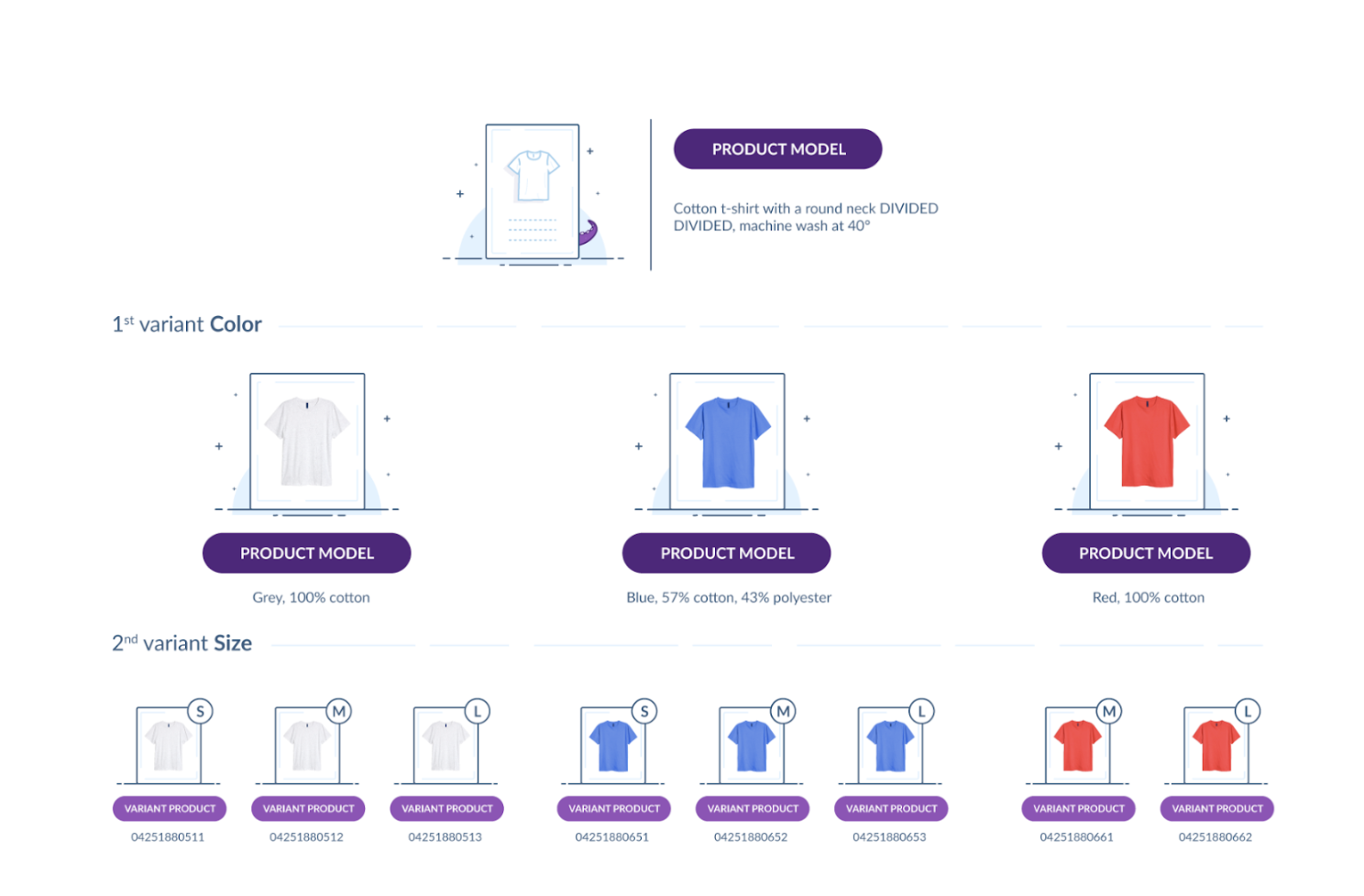
When integrating an ERP system to a PIM system, establish a single source of truth for each data field and determine who can access and manipulate what within each system. Bring only relevant customer facing information from the ERP into the PIM and determine how frequently the data needs to be updated. Most ERP to PIM integrations communicate one-way (from ERP to PIM), but bi-directional integrations are sometimes necessary (though these are often more time-consuming and expensive). API-based integrations are preferred and will often require middleware software to support. Flat-file exports are also a viable solution when outdated ERP systems or security concerns preclude the use of APIs. Flat-file exports from an ERP to a PIM can also be more economical and are perfectly sufficient for smaller product catalogs that are updated less frequently.  Note: Many ERP systems do not support Model Variant relationships between products (e.g. T-shirts in multiple sizes and colors, TVs by screen size etc.). This relationship is expected by customers and should be built out to support digital commerce, either in a middleware layer or a PIM system.    ERP Systems are an important part of a company’s back-office ecosystem, but they should not be used to build, manage, and distribute customer-facing product experiences. PIM systems provide unique capabilities to manage product catalogs that cannot be replicated in an ERP. When approaching a digital transformation with PIM and ERP, build a composable solution that utilizes the capabilities and intended design of each system to maximize their value.   Still unsure of where to start? Feel free to reach out to us, and an Akeneo Expert will gladly walk you through first steps.

Adam Beatty, Community Evangelist

Akeneo

What is a Digital Product Catalog for eCommerce?

Product Experience

What is a Digital Product Catalog for eCommerce?

A digital product catalog is an interactive listing of all of your products that’s hosted on a website, like a digital brochure, and allows your organization to create a truly omnichannel experience.

There’s nothing quite like cracking open a fresh, print catalog.  The colorful images. The leisurely flipping of pages. That new-catalog smell. It’s enough to inspire even the toughest customer to consider a purchase.  Yet the digital transformation is here, and eCommerce sales are on the rise, even for industries that traditionally operated with print catalogs only. The Granite Group, a wholesale distributor and Akeneo customer, says its eCommerce share of sales was about 20% in 2021—well above industry standards. What’s a traditional, print-catalog business to do?  The good news is that print catalogs aren’t going anywhere. They’ll remain integral to many sales processes, but they’ll need to be supplemented with digital product catalogs. The even better news is that you can use digital catalog software for both print and eCommerce, creating an omnichannel strategy that keeps up with the times.   

What is a Digital Product Catalog?

A digital product catalog is an interactive listing of all of your products that’s hosted on a website, like a digital brochure. The most basic type will allow customers to browse and see product information. More advanced digital catalogs also allow customers or sales reps to:
  • Make purchases directly through the website
  • Search for what they want
  • Compare items based on features and price point
  • Filter items by desired attributes
  • Watch videos or see 3D models
On the business side, there are lots of potential features that make it easy to create a digital catalog and see its benefits:
  • Easily create custom and shared catalogs 
  • Update product information
  • Track and manage your sales
  • Optimize for mobile and other new channels
Digital product catalogs weren’t always so packed with functionality. Back when the internet was just getting started, digital catalog creation might have involved simply uploading scanned PDFs of your print catalog. We’ve come a long way.   

How a Digital Product Catalog Can Benefit Your Business

No matter your industry or vertical, business success starts with customer experience. Your customers may be sales reps or distributors, but the story remains the same: Providing a seamless, immersive buying experience via a digital catalog helps move your customers more quickly from discovery to purchase.  What if you don’t have a digital product catalog? Or, what if your catalog is very basic, like that early-2000s scanned PDF version? The truth is that you could fall behind the competition.   We’ve all heard the story about how the human attention span is only 8 seconds, which is shorter than a goldfish’s. It isn’t exactly accurate, but studies have shown that our attention spans are indeed getting shorter.  There’s no telling your customers’ exact attention spans, but chances are if they head to your website and can’t find exactly what they’re looking for, they’ll bounce—and they’ll do so quickly. But give customers the product information they want, when they want it, where they want it with an easy-to-use digital catalog, and you’ll create loyalty for a lifetime.  Digital catalogs aren’t just for customers and sales reps. They also allow manufacturers, retailers, and their internal teams to have a single source of truth when it comes to product information. With digital catalog software, your catalog can automatically update product information so that everyone is on the same page. And that has big benefits for your business, including: 
  • Increasing agility. Print catalogs can take six months to a year to update. That dramatically affects your product release schedule and your time-to-market. If you operate in print or even in a basic digital catalog, you may wait to release new products. When you create a modern digital catalog, you can release your products whenever they’re ready—helping you stay agile and keep up with the competition. 
  • Streamlining operations. Digital catalog software ensures your engineering, product, sales, and marketing teams are all working with the same information, and the benefits are immeasurable. You’ll make fewer mistakes. You’ll communicate better. And you’ll always know the status of your products. 
  • Offloading inventory. Because print catalogs are time-consuming, many businesses only create one or two versions. With digital product catalog software, you can easily create as many versions or layouts as you want. The best idea? Create a catalog for old and surplus inventory you want to offload. Customers get a deal, and you get to focus on the future. 
The bottom line: Digital catalogs aren’t just good for business—they’re the future of business. Are you ready to get on board?  

Digital Catalog Creation: The Basics

Learning how to create a digital catalog can seem overwhelming. You have thousands of SKUs. Incredibly detailed product specifications. A global network of manufacturers and sales people. But that’s exactly what digital catalog software is for. Choose your software The first step is always to choose your digital catalog software. This is your central system for inputting data, organizing product information, and creating your catalog.  There are various tools and price points available, but the more features you have, the better. Videos and 3D models are becoming must-haves, and you’ll definitely want to provide the ability to search, filter, and compare.  Input your data The biggest barrier to digital catalog creation is often the sheer amount of data. This is another area where catalog design software comes to the rescue. Digital catalog creators like Akeneo Product Cloud allow you to easily input raw data from many different sources, including spreadsheets and product data management software. You can combine, enhance, and refine data until you have a complete and accurate description for every product.  Create a tagging system Even the most basic digital catalogs today allow customers to sort, filter, and search products. Product tagging is the foundation of these features. First you’ll need to categorize your products by function, size, type, and so on. Then you’ll tag each product so they can be found based on these attributes. Again, digital catalog software can help you automate this process. Sync your channels Using the same SKU, model number, and name for each product, across all of your channels, is essential to avoid confusion among both customers and your employees. From in-store to your website to your print catalog, consistent information makes it easier to find what you’re looking for. Your software should do this automatically.  If you don’t have a digital catalog, it’s time to bring your business into the future. And if you do have one, you might want to take another look and consider if it’s providing all the features you need. Because your digital product catalog shouldn’t just list your products—it should provide an immersive, seamless customer experience that encourages conversion.  At Akeneo, we’re experts at digital catalog creation, product information management (PIM), and customer experience, and we have industry-leading software that allows you to take advantage of that expertise. Start your free trial and let’s see how we can help. 

Casey Paxton, Content Marketing Manager

Akeneo