It’s nearly time to upgrade to Magento 2 — and your PIM solution will be an important part of this process.
It’s nearly time to upgrade to Magento 2 — and your PIM solution will be an important part of this process. Need proof? Check out the newest white paper from our partner StrikeTru to discover more about the quickly-nearing transition, and explain why PIM will be so crucial to Magento 2.
It’s almost time to update to Magento 2 — is your company ready to make the switch?
With the deadline fast approaching for Magento 1 customers to upgrade to Magento 2, it is becoming crucial to ensure that all aspects be evaluated to ensure a smooth transition. The Magento 2 upgrade project is really a re-implementation and needs to be approached as such. The complexity and size of that effort will be proportional to the complexity of current customizations to migrate, site improvements to make, and data cleansing and data migration involved.
Any internal user experience improvements will likely require a modern Product Information Management (PIM) platform. Any customer experience or sales growth enhancement objectives will likely need rich, granular, and high-quality product content that is best managed in a modern PIM.
In this new white paper, Vik Gundoju, a partner at StrikeTru and a thought leader in PIM and eCommerce solutions, discusses how to make the most out of your Magento 2 upgrade and understand:
Why PIM matters for Magento 2 upgrade
The top commerce and content challenges addressed by PIM
Recommended implementation roadmap for PIM, and
Features of PIMGento, the fastest Akeneo to Magento integration connector
Solve seasonal sales struggles with PIM and PXM! Learn how PIM and PXM can help your company take advantage of seasonal shifts in marketplace trends, be more agile and efficient, and update and expand your product catalog with ease.
As sad as it may be to say, summer is once again coming to a close.
Soon enough, the days will get shorter, the leaves will change, and the crisp breeze of autumn will fill the air. That means school buses will be roaming the streets and that teachers, students, and parents will once again be gearing up for another year of learning. Meanwhile, the rest of us are left to pack up our sandals and break out the ski boots.
It also means that distributors, manufacturers, retailers, marketplaces, and other B2B and B2C businesses alike are turning over their sales catalog. Out with the summer styles, warm-weather wares, and beachside basics, in with the cozy coats, indoor indulgences, and winter weather equipment.
But making these seasonal changes in your product catalog isn’t as simple as flipping the calendar to the next month. Updating or expanding a product catalog is often a monumental undertaking for nearly all companies. It means onboarding new products from manufacturers and suppliers, adding new photos and other digital assets, and updating hundreds or thousands of SKUs on multiple sales channels in time for the new season, all without succumbing to errors and inaccuracies in product information.
Add it all up, and it’s enough to make even the most resilient retail product manager or distribution diehard want to go into hibernation until it’s all said and done. What’s more, this isn’t a one-time problem — product assortments change regularly due to changes in consumer tastes, seasons, and even new legislation or regulation.
Don’t despair — prepare! You can get ready for seasonal shifts in product catalogs and information by unleashing the power of your Product Information Management (PIM) solution. This powerful tool can help you easily and efficiently deal with the challenges that arise from a new season making its presence felt.
Model & automate
One of the biggest shifts that often accompanies a change in season for B2B and B2C organizations is the change in product assortment. Many companies will offer entirely different product lines or collections for different seasons, often with little-to-no crossover or overlap.
Manually deleting products and adding new ones to your product catalog in time for each new season is a truly time-consuming and error-prone process, one that can drive your team nuts and cripple your efficiency. The same can be said of dealing with photos, videos, and other digital product assets can also quickly become a nightmare. Relying on a PIM for help with implementing product catalog changes, on the other hand, makes it dramatically easier for product managers.
PIM tools automate processes, easily model new categories, offer bulk editing, and allow you to centrally manage product data and digital assets. They also make it easier and more efficient to include certain products in these catalogs only for the time of the sale to create a limited-time catalog or product groupings.
Get emotional
It’s time to create some warm, fuzzy feelings on a cold winter’s night.
Whether you’re getting your catalog ready for the Christmas rush, helping customers delight the objects of affection for Valentine’s day, or coming up with a spooky surprise for Halloween, emotionally compelling product experiences are catnip to seasonal consumers. But if your team is stuck dealing with tedious, time-consuming work like manual product updates or digital asset management, they won’t be very inspired.
A PIM can help liberate your team so they can set their creativity free. It takes manual tasks off their plates, allowing them more time to craft compelling product descriptions to help stir emotion and build trust in potential buyers. What’s more, PIM can help ensure that products are put into context for each of the several sales channels you use to reach them. Your objective is to assemble a unified set of product information, and to also make sure that the “right” information appears in the print catalog, the eCommerce store, and your mobile app.
Now that’s managing the product experience!
Pick up the pace
As anyone who’s wished for summer to be just a little bit longer can tell you, the seasons change fast. If you can’t keep up with the pace of these changes, you’ll get left behind, and could find yourself trying to sell Christmas decorations in July!
When it comes to seasonal sales, time is of the essence and organizations can’t afford to miss the seasonal window. A long catalog enrichment process could doom your sale if the catalog isn’t available during peak buying times.
PIM significantly increases productivity and helps you keep up with changing seasons — without making careless errors or providing inaccurate product information. PIM solutions can help foster collaboration across the teams involved in onboarding new products, streamline the catalog update process, eliminate errors and inconsistencies in product information and ensure that any updates made within the system are distributed to all of the appropriate channels. It can also further help improve sales as it supports the multi-channel marketing of seasonal campaigns and bundled offers.
Solve Seasonal Sales Struggles With PIM
Make sure your team is ready to conquer the Christmas rush, beat the summer heat, go back to school, and bloom with the flowers of spring by arming them with PIM.
PIM lets you move with speed and agility all year long, whether you want to do a limited-edition collection or want to do a small specialty catalog for back-to-school. It makes seasonal and contextual sales and responding to customer moods and rapidly changing trends breeze.
Solve seasonal sales struggles with PIM! Learn how PIM can help your team conquer expansions with relative ease by reading our blogs on Turning A New Commerce Channel Into A Success and Expanding To New Locales today!
Two years ago, we launched our cloud edition, offering two flavors to benefit from our enterprise PIM. We have had amazing traction with this offer an…
Two years ago, we launched our cloud edition, offering two flavors to benefit from our enterprise PIM. We have had amazing traction with this offer and we’re glad to announce that more than 80% of our new enterprise customers are choosing the cloud edition!
Following the cloud launch, we announced a change in our product release cycle. Our objective was to provide a more nimble and responsive approach to market demands and to more rapidly deliver new product enhancements on a predictable schedule.
For the most part, we have delivered on this promise! Quarterly releases consisting of two short-term support (STS) versions and two long-term support (LTS) per year have arrived either on schedule or shortly after the planned release date.
After two years, we have received feedback from many customers that it can be difficult to keep up with this release cadence, especially if they are on-premises or Flexibility Mode (PaaS) customers. Planning upgrades and executing them can be time-consuming and require coordination across several teams. This issue was particularly acute for x.3 and x.0 releases which occurred 90 days apart and were both LTS versions. Serenity Mode (SaaS) customers received new features automatically every 90 days — but even then, certain incremental improvements and enhancements could have been available even sooner.
Another challenge from our frequent release cycle is ensuring that the connectors and extensions developed and maintained by our technology partners are compatible with the latest releases. Our ecosystem is a very strong source of business value for Akeneo customers and we want to encourage it to grow and easily keep pace with our product releases.
Based on this customer and partner feedback, we have decided to further simplify our release cycle in order to better support everyone whether you’re an on-premises customer, a Flexibility Mode customer, a Serenity Mode customer, or a technology partner who develops extensions and connectors for the PIM.
What’s the new release schedule?
For on-premises and Flexibility Mode customers, our new release cycle will make it even easier to plan for upgrades and will reduce the number of upgrades necessary to keep pace with the latest feature and performance improvements.
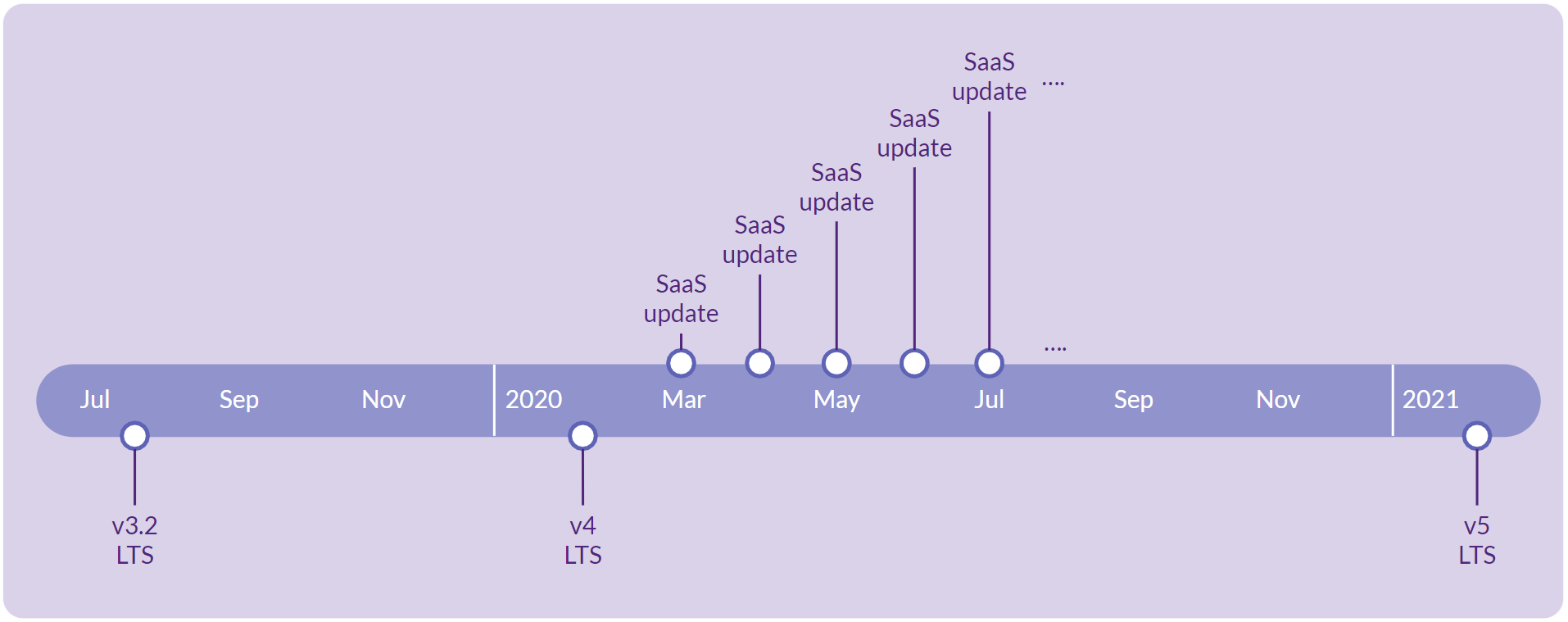
Instead of two STS versions followed by two LTS versions each 90 days apart, we’ll release one major version every year for our on-premises and Flexibility Mode customers. These releases will be Long Term Support versions, which will remain at 18 months. Consequently, we will no longer do STS releases! This will reduce technical support complexity and confusion about how long your version is supported, as well as simplify project and upgrade planning for you and your solution partner or integrator.
For Serenity Mode customers, our new release schedule will enable us to deploy new features and improvements on a monthly basis instead of quarterly. You’ll receive more business value more frequently, with Akeneo taking care of upgrades on your behalf as we do today.
For planning purposes, our current release schedule and status of support will be as follows:
To support this transition, Akeneo PIM version 3.2 (shipped in July 2019) was announced as an STS version, but we will now consider it an LTS version and will support it through January 2021.
We will not release a “3.3” LTS release in October as previously planned.
The next major LTS release (version “4.0”) will occur in early 2020 approximately at the time of our annual Akeneo PIM Summit, and every 12 months thereafter. As always, should there be the need for patches in between annual releases, we’ll provide them as required.
SaaS releases will occur at the end of each week and your SaaS instance will be automatically upgraded by our team.
Here’s what the release schedule looks like in full color mode!
We believe this new release cycle will enable Akeneo to better serve our customers on all deployments while reducing disruption and simplifying version management and technical support for all. And we’re really excited about the new enhancements we are currently developing for 2020. We can’t wait to see you at Akeneo PIM Summit 2020 to tell you all about it!
How Product Information Leads To Social Selling Success
Power social selling with PIM! Learn why great product information helps drive conversions on Facebook, Instagram, and other emerging social sales channels
All told, nearly 3.5 billion people around the world (or 45% of the population), count themselves as active social media users. Social media is particularly popular in regions like North America, where 95% of internet users use social media, Northern Europe (95%), and Western Europe (94%), where nearly all internet users also have active accounts on social media networks. In terms of total users, Facebook is still king, boasting 2.2 billion active users, followed by YouTube (1.9 billion users), Asia’s WhatsApp (1.5 billion users) and WeChat (1.1 billion users), Instagram (1 billion users), and Pinterest (265 million users).
These social networks are popular places for communication and entertainment, but they’re also becoming powerful commercial platforms. Facebook, social media’s biggest player, has long offered sales via their Marketplace channel, but when it comes to promoting products, it lags behind a pair of fashion-forward platforms: Instagram and Pinterest. While these platforms fall behind Facebook in terms of user base, they convert customers at a far higher rate.
Instagram is top dog in that regard, with 72% of Instagram users reporting making purchase decisions based on something that they saw while browsing the app. 55% of Pinterest users, meanwhile, say they visit the site specifically to look for new products to purchase, more than 4 times the number of users who say the same for other social platforms.
So, whether you’re doing business on Instagram, Pinterest, or Facebook, how can you ensure your social selling endeavors are a success? The answer lies in your product information — the assets, content, and data that help customers find and understand your offerings.
A flashy Facebook feed, intriguing Instagram story, or perfect Pin can help catch your potential customers’ attention, but won’t do you much good if your product information isn’t accurate, consistent, and high-quality.
If your product information isn’t up to par, then shoppers won’t convert into customers. They’ll struggle to find your products via search engines or social media apps or other means of discovery, and even if they do make their way to your eCommerce site, they’ll likely abandon the purchase.
It is, therefore, crucial to perfect your product information and convert social media scrollers into loyal customers.
Deliver accurate product information in place
While most eCommerce selling happens when customers are specifically searching for a product, social selling can be quite different.
Often, selling on social happens when products pop up in a user’s feed. They see it because they are following an influencer or perhaps they are following your brand. Suddenly they now to have it. Social media has an effect on impulse buying but to close the deal, your product information needs to be accessible and in context for social sales channels. Take an example from apparel – the first thing a prospective buyer wants to know is if it will fit them properly and can they get it in their favorite color. If they’re not confident in the information they do find, they’ll quickly abandon the prospective purchase. Easy come, easy go.
But you don’t want your customers going anywhere. You want them to buy directly from the social site (or navigate to and stay on your site), complete that purchase, and hopefully come back for more. Ensuring they don’t abandon requires answering their product information questions instantly, by providing accurate, consistent, and emotionally compelling product information in the moment.
Time is of the essence
Social media moves at the speed of light. Seemingly every second, there are hundreds of new posts waiting to populate your customers’ timelines and inspire them with new trends, styles, or innovations.
But just as quickly as these trends dominate the market, they fade away, becoming just another fad. That means it’s crucial to take advantage of every opportunity, seize every new seasonal offering and style, and move quickly, lest you risk being left behind in the digital dust. Each time a new trend makes its presence felt in your market, your organization needs to be ready to seize the moment and take advantage.
But if your team is stuck completing time-consuming, tedious catalog expansion or update process, you won’t be able to keep up with the social selling. The results, however, will be much worse than some lost followers or un-liked posts — say hello to declining sales or even increasing returns, as customers fail to get their purchases before a trend goes out of style.
PIM helps you eliminate this inefficient, tedious, and time-consuming labor. That means your team can focus on keeping up with changing trends and styles, and ensure they’re making relevant connections with their customers via social media.
Contextualize and distribute data
Accurate, consistent, and compelling product information and assets are crucial to social success — and so is speed. But even if those factors are taken care of, all those efforts will have been wasted if you aren’t presenting your product information for the channel shoppers are using.
As we addressed above, social selling customers are different beasts than their typical eCommerce compatriots. They don’t set out on a search for a specific product, and are highly subject to suggestion. All it takes is a peek at an appealing advertisement or a recommendation that piques their interest from a trusted influencer.
What’s more, each social media network offers its own best practices and requirements. Glossy, high-quality images with length captions rule the day on Instagram, hyper-shareable pictures and pins are the currency of the day on Pinterest, and Facebook has its own detailed and complicated web of rules for social sellers.
Use PIM tools that offer ways to pick exactly the content, data, and assets that you want to push to a specific social media network, and pay careful attention to the choices you make. By using PIM to present product information in the proper context, you’re more likely to connect with social media users and make a sale.
Power social selling with PIM
Social media platforms have the potential to be a particularly powerful tool for B2B and B2C organizations alike. These networks allow companies to reach massive audiences of customers and create new opportunities for communication and commerce.
But in order to take advantage of these opportunities, your product information needs to be up to par. Use PIM features and tools like automated business rules engines, validation workflows, export profiles, and more to more efficiently and successfully sell your products via social media networks like Facebook, Instagram, Twitter, and more.
Power social selling with PIM! Learn how PIM can help your team conquer these new sales channels with relative ease by reading our blog on Turning A New Commerce Channel Into A Success or get in touch today!
Solve your B2B distribution problems with PIM! Discover how Product Information Management and Product Experience Management can help you conquer common industry challenges.
B2B distribution is being disrupted.
What was once a world limited to bulky catalogs, manual ordering and purchasing workflows, and pen-and-paper processes is getting with the times and going digital. Increasingly, as retailers work to drive growth and reach new buyers, print catalogs and other legacy ordering methods are being augmented with digital and omnichannel selling.
A second trend is the changing profile of B2B buyers, many of whom are digital natives. Given this trend, B2B distributors are seeking to deliver the B2C-like customer experiences these new B2B buyers are accustomed to.
There has also been a rapid rise in B2B eCommerce. Online sales in the U.S. alone grew by 11% to more than $1 trillion last year, and annual B2B sales are projected to top $10.6 trillion around the world in 2019. What’s more, this growth isn’t projected to change course anytime soon.
This digital transformation can, and should, be a boon to many B2B distributors’ bottom lines.
But most are struggling to bring their product catalogs into the 21st century. These organizations face challenges surrounding everything from data governance and collaboration to catalog and market expansion.
Fortunately, there is a solution that can help solve these challenges and clear B2B distribution roadblocks. Product Information Management (PIM) and Product Experience Management (PXM) solutions help B2B distributors more efficiently and easily manage large product catalogs and prepare for a successful digital transformation. B2B distributors using these solutions typically report increased conversions, reduced returns, and notably higher levels of marketer productivity after adopting PIM.
Below are a few examples of where and how PIM and PXM can help you solve these B2B distribution challenges.
Go Digital
Even with a single sales channel such as a print catalog, managing a large assortment of complex products including related products, add-ons, and spares, as well as images and documents for each is a massive undertaking. Factor in the diverse group of manufacturers and suppliers that distributors do business with, the differing formats they use to share product data, and it’s clear there’s enough going on to make your head spin.
Opening up a new commerce channel is always a labor-intensive undertaking, and given the catalog reality noted above, it’s clear there is much room for improvement and efficiency.
Whether your digital transformation initiative includes deploying an eCommerce site or just simplifying the way you share product information online, a PIM solution and a PXM approach make the digitization process a relative breeze. PIM offers a centralized place to manage disparate product data from internal systems and suppliers and to enrich it specifically for your print or eCommerce or website – and any other channel you choose to pursue. A major benefit is Akeneo PIM’s ability to put product data in context for each channel — because each channel has its own rules.
Efficiencies are also delivered in the form of business rules engines and validation workflows. With these and other PIM features your team can easily eliminate tedious, repetitive tasks and ensure that only accurate, consistent, and contextual product information is presented to customers in the format required for each channel.
Expand with ease
Widening your company’s reach to a new channel isn’t the only expansion opportunity B2B distributors face, of course.
As digital innovations makes cross-border commerce more feasible and offer the opportunity to increase your product assortment, it’s also crucial that your company is ready to add a new geographic market or product to its roster. But translating and localizing product information for such a large and diverse catalog can be a challenge for distributors, limiting the potential of new markets. And if your product information is already disorganized, inaccurate, or low-quality, adding new items to your product catalog can magnify the problem and further contribute to poor customer experiences.
Akeneo PIM speeds the product information management and new product introduction process, along with automation, completeness, validation features so you can get your products to market faster — across all channels and regions. What’s more, its ability to manage and control catalogs by locale and its connectivity with translation tools eases cross-border expansion and helps put your team on the road to international success.
Govern and control your data
Organizing and governing data can be a challenge in and of itself, but B2B distributors also face an additional hurdle. This information is commonly expressed and exchanged in industry-specific data formats which may or may not be appropriate in its raw state for use in a given channel. Furthermore, in an attempt to create a B2C-like buying experience, distributors need to massage and enrich product information according to each channel and its rules, as well as for each locale. A great example is adherence to regional compliance standards. All this makes it harder to manually manage product information and assets for omnichannel commerce. Add in the integration of the systems needed to handle and process this data and it’s a real trio of troubles.
Collaboration is also a key aspect of managing product information across different groups. This can be with respect to multiple teams internally as well as collaborating with suppliers. In this case, there needs to be a solid governance and control process in place to manage not only the data but also the users and their roles and privileges.
PIM and PXM are specifically designed to manage and govern data and user groups in these situations. Akeneo PIM can help your team more efficiently and easily manage product data and descriptions, and includes an advanced user management capability to help reliably control who can edit what, who approves the final catalog, and how to track and ensure the catalog is complete and accurate before you publish. It can also help your team simplify data management by integrating disparate systems and tools via our network of connectors and extensions, eliminating errors and inconsistencies in product information and helping ease distribution to your commerce platforms.
Boost productivity
B2B distributors need to move rapidly if they want to succeed. It takes agility and efficiency to keep up with new product introductions, entering new markets, and keeping pace with products that are quickly gaining or decreasing in popularity.
Dealing with all that data, however, can slow distributors down, hurting sales figures and revenue in the process. Low levels of operational collaboration and chaotic or inefficient workflows can make these problems even worse, and leave B2B distributors struggling to keep up with the increasing pace of modern commerce.
Akeneo PIM includes features like automation, validation, and workflow controls to eliminate unnecessary and repetitive tasks. That way you can more rapidly distribute and sell more products, boosting revenue and improving relationships with suppliers and customers along the way.
Conquer Industrial Manufacturing Challenges
It isn’t easy to be a B2B distribution company these days — but PIM and PXM can help. By using product information and product experience management solutions to enrich and manage your product data, your team can expand to new channels and locales more efficiently, handle industry-specific data formats with ease, and boost their productivity.
It’s the moment you’ve been waiting all summer for — the finale of The Goupil Experience is finally here!So far, we’ve seen our brave heroes …
It’s the moment you’ve been waiting all summer for — the finale of The Goupil Experienceis finally here!
So far, we’ve seen our brave heroes try just about everything they can think of to locate a new Goupil. From voice assistants to social media and from hotlines and catalogs to advertising and social media, nothing has worked. Now, Ake has become Julia’s full-time roommate — and it’s driving her nuts and making her boyfriend jealous!There’s seemingly no chance Ake will be able to return to his home time period, not with all the product information challenges that Goupil is facing. But maybe Julia’s boyfriend can help— even if he doesn’t realize it yet — and Ake can help him in return…Get your product information and product experience ready for the future! Learn how PIM and PXM can help your team conquer these new sales channels with relative ease by reading our blog on Turning A New Commerce Channel Into A Success or get in touch today!
It’s the penultimate episode of The Goupil Experience, and Ake has just about given up hope. …
It’s the penultimate episode of The Goupil Experience, and Ake has just about given up hope.
After trying once again to locate a replacement for his Goupil time travel online, Ake and Julia figure their destiny is sealed. Ake is doomed to live out the remainder of his days in an unfamiliar, strange, and primitive time period, devoid of his family, friends, and any of his futuristic conveniences. Julia, meanwhile, has seemingly been sentenced to a lifetime of forced companionship with this strange acquaintance from a distant future decade who seemed to appear on the floor of her apartment out of thin air.But just as all seems lost, hope arrives in the form of a radio ad. Will Ake and Julia find the solution to their problem in seemingly the most unlikely of places?Get your product information and product experience ready for the future! Learn how PIM and PXM can help your team conquer these new sales channels with relative ease by reading our blog on Turning A New Commerce Channel Into A Success or get in touch today!
[Video] Goupil Experience #4: When All Else Fails, Try Amazon
It’s time for another episode of our summer comedy video series, The Goupil Experience! In last week’s edition, Ake and Julia turned to Goupil’s…
It’s time for another episode of our summer comedy video series, The Goupil Experience!
In last week’s edition, Ake and Julia turned to Goupil’s strangely-organized catalog and not-so-helpful customer service in hopes of finding the replacement time travel controller. However, instead of finally securing a new controller and sending Ake back home, the pair were only met with more product information problems.Now, as Julia continues to become more frustrated with her futuristic squatter, she recommends he turn to the internet’s one-stop-shop for 2019 consumers: Amazon. Surely, the online marketplace known for selling everything from A-to-Z will be able to provide a solution — or will it?Get your product information and product experience ready for the future! Learn how PIM and PXM can help your team conquer these new sales channels with relative ease by reading our blog on Turning A New Commerce Channel Into A Success or get in touch today!
Akeneo at #DMEXCO19: Explore — Inspire — Discover!
Summer is in full swing, and that can only mean one thing — it’s time to get ready for DMEXCO!
Summer is in full swing, and that can only mean one thing — it’s time to get ready for DMEXCO!
DMEXCO 2019 (Digital Marketing Expo & Conference), the leading trade fair for the digital industry, will once again attract thousands of visitors from all over the world to Cologne, Germany in September. And as in previous years, Akeneo will be there in full force!
Continue reading “Akeneo at #DMEXCO19: Explore — Inspire — Discover!”
Welcome to episode 3 — we’re mid-way through our summer comedy video series, The Goupil Experience! On the last episode of The Goupil Experience, …
Welcome to episode 3 — we’re mid-way through our summer comedy video series, The Goupil Experience!
On the last episode of The Goupil Experience, Ake and Julia turned to the wisdom of the crowd, hoping that social media could help Ake find a replacement Goupil time travel controller to return to his own time period. Unfortunately, the social experiment didn’t go as hoped. Instead of finding a controller, the pair found only frustration — and a healthy dose of internet conspiracy — as consulting both the official Goupil page and Julia’s 2019 friends failed to produce the product they searched for. If you want a job done right, you have to do it yourself. They’ve got their hands on a Goupil catalog and are headed right to the source. They plan to call up the company directly so they can find a new controller for Ake and get him out of Julia’s hair. Check out our latest video to find out!Get your product information and product experience ready for the future! Learn how PIM and PXM can help your team conquer these new sales channels with relative ease by reading our blog on Turning A New Commerce Channel Into A Success or get in touch today!
 Summer Release






![[Video] Goupil Experience Finale!](https://www.akeneo.com/wp-content/uploads/2022/01/Goupil-thumbnail_6.png)
![[Video] Goupil Experience # 5: Advertising Adversity](https://www.akeneo.com/wp-content/uploads/2022/01/Goupil-thumbnail_5.png)
![[Video] Goupil Experience #4: When All Else Fails, Try Amazon](https://www.akeneo.com/wp-content/uploads/2022/01/Goupil-thumbnail_4.png)

![[Video] Goupil Experience #3 – Not-So-Hot Hotline](https://www.akeneo.com/wp-content/uploads/2022/01/Goupil-thumbnail_3.png)