From making your team more efficient and accelerating your time-to-market to improving your product experiences to reduce returns and increase convers…
From making your team more efficient and accelerating your time-to-market to improving your product experiences to reduce returns and increase conversion rates, Akeneo PIM can do a lot for your business.
But implementing any new software solution in your organization can come with challenges or difficulties and PIM is no different — that’s why Akeneo employs a team of PIM experts as consultants, ready to solve any problem and answer any questions that arise during the PIM implementation process, with the ultimate goal of ensuring your PIM helps realize better business results and rapid ROI.
In the latest edition of the PXM Pioneers’ Pulpit, host Brendan Murray caught up with a pair of Akeneo functional consultants, Adam Beatty and Brad Johnson, to offer insights they’ve gained during dozens of customer implementation and training sessions.
Miss the live taping? No problem! We’ve compiled a few of Adam and Brad’s best tips and tricks in this blog, so read on to learn how to make your PIM project a success, and find our full discussion in the video below.
The key to successful implementation? Preparation, preparation, preparation
So you’ve picked Akeneo PIM to help you create compelling product experiences using a foundation of accurate and comprehensive product information — now what? How do you make sure your new solution is implemented without major difficulty?
According to Adam and Brad, it’s all about preparation.
“I think one the most important things that, surprisingly, gets overlooked, is the amount of work that needs to happen before we get data into a PIM,” Brad noted. “I often tell people that I can teach you Akeneo and the UI in an hour and a half. It’s all of the other work, making your data nice and neat before we get it into the PIM…so we can be confident in that data.”
Adam also preached preparation, imploring new Akeneo customers not to forget to clearly outline the objectives for a PIM project before they go live.
“The key is to have a strategy,” he said. “It sounds kind of obvious but…it’s important to have a strategy and understand exactly what you’re trying to accomplish. Are you trying to get a faster time-to-market for new products? Are you trying to implement data governance? Are you trying to improve SEO? Do you want to support future expansion? It’s crucial that you understand those goals and have a strategy to work toward them.”
Common challenges — and how to conquer them
Our pair of Akeneo experts also helped identify challenges that new PIM users frequently face. One of the biggest issues? Not truly understanding the scope of a PIM project and the different members of your team that need to be engaged in order to make it a success.
Specifically, Adam said, PIM users need to make sure they have Julia on board. “Julia” is Akeneo’s stand-in for the catalog managers responsible for maintaining product information for a company — and without them, your PIM project may never get off the ground.
“Sometimes, projects are driven largely by the IT team, but the people that can really fix and model the data appropriately are what we at Akeneo call ‘Julia’ — those product content marketers…the people who really have an intimate knowledge of the product,” Adam said. “Those are the people that really need to be involved in this process of cleaning a data model, improving a data model…You need to take that time as a business to understand how you want to structure it, and you really need to make sure you have those experts involved in the process.”
Brad said that having those all-important product content experts working with Akeneo is a key ingredient for a prosperous PIM project.
“It really helps to understand how Julia works because that’s really the problem at the end of the day,” Brad said. “So having all your Julias there is really key so we can work with them to make their lives a little better.”
The critical need for communication
No matter what challenges arise, Adam and Brad said that the biggest thing PIM users should keep in mind is that it requires a wide range of voices and efforts in order to go live successfully. That means it’s crucial to make sure all members of the organization are on-board with PIM.
“It’s really important to remember that an Akeneo project is a collaboration,” Adam said. “It’s very cross-functional and impacts many different players across an enterprise. So, make sure that everyone is working together and understands the overall objectives, and make sure there’s a stakeholder to hold everyone accountable and make sure the project succeeds.”
But how can you get all these different members of your team on-board? Brad said that the companies that find the most success with PIM are those that make sure everyone has a seat at the table.
“I think it’s really important to have decision-makers from different parts of your organization,” he said. “We’re going to be making decisions about how the data is, about what it looks like in Akeneo, and if we don’t have those people there…it drags the process out…so having the right decision-makers about the products there is really important.”
Want more insights and best practices from Brad and Adam? Check out the full video below! Or, if you’re hungry for more information on the sweet science of Product Experience Management, check out our eBook, PXM for Dummies!
There are a few advantages to working from home. No traffic to deal with on your commute for one, and no forgetting your lunch at home either.
Bu…
There are a few advantages to working from home. No traffic to deal with on your commute for one, and no forgetting your lunch at home either.
But the biggest advantage? It might just be replacing your office’s typical soundtrack of overheard conference calls, water-cooler chatter, and the clacking of neighbors’ keyboards with your own favorite songs to help pass the time.
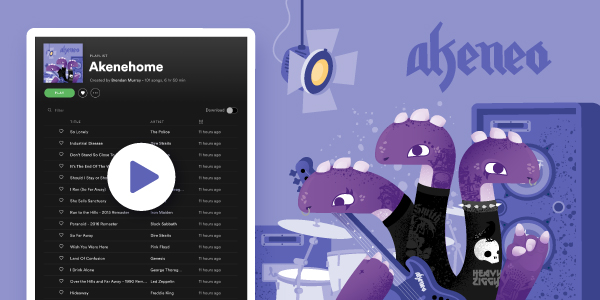
And if you’re looking for some new tunes for your self-isolation soundtrack, we have just the thing: the Akenehome Spotify playlist! This playlist is the ultimate quarantine companion — it comes fully stocked with more than 100 songs featuring artists and song titles inspired by the current pandemic. Each track was suggested by different members of the Akeneo team, and the playlist includes a range of genres, from classic rock to hip hop to oldies and everything in between.
So turn on, tune in, and dance to your favorite songs on the Akenehome playlist! While you’re at it, share your songs with the Akeneo PIM community on LinkedIn and Twitter with the hashtag #Akenehome, and see which tunes are the community’s favorites!
This is a guest post from Jonathan Dropiewski, from our partner, priint
Omnichannel is a buzzword that really has a different meaning for everybo…
This is a guest post from Jonathan Dropiewski, from our partner, priint
Omnichannel is a buzzword that really has a different meaning for everybody. But what does the term mean to your organization?
To some, it is lumped in with other trendy terms like “digital transformation.” However, after we get past the buzzword bingo and take a closer look, there are often some key areas that are being left behind in this race.
It is amazing how many conferences, webinars, and industry experts spend 100% of their omnichannel sessions speaking about entirely online touchpoints. While these digital channels are incredibly important, even essential for a modern organization, these discussions often cast aside or ignore the “omni” part of omnichannel entirely. It is easy in the age of digital transformation and eCommerce to forget about some of the less obvious areas where there has been little to no innovation or automation over the last 15 years.
One of these areas of potentially huge, but oft-ignored, ROI is publishing, which can affect both the generation of top-line revenue as well as bottom-line cost savings. Using the clean and consistent data provided by Akeneo PIM, modern publishing platforms can enable your organization to excel at delivering superior and truly omnichannel experiences.
In today’s world, publishing goes well beyond the traditional paper catalog or product brochure — though those publications remain more important and relevant than many give them credit for. These publications are still an ideal platform for new product discovery and introduction, but in most instances, the processes used to create these are archaic at best.
We are constantly amazed — though not always positively — at some of the things we hear from organizations across the spectrum of verticals and of different sizes. Unbelievable as it may be, there are companies that spend 12-18 months working to produce a single publication. Most of the layouts we see are still done manually via copy and paste and Excel exports — then, by the time the publication is ready to go to print, much of the information is out of date, once again lengthening the process further as more revisions are made.
Even purely “digital” publications seem to follow these patterns. For instance, the prototypical PDF datasheet downloadable from many websites and webshops often follows a similar process, no matter who produces it. Whenever a new product is released or updates are made, an employee must get a data export from IT, manually open up Adobe InDesign, make the change, send for proofreading and approval, generate the PDF, and finally someday publish it to the website.
These are just a few examples of the many scenarios that we encounter frequently.
Publishing and other offline touchpoints have been largely ignored thus far in the digital transformation initiatives of most marketing departments. The ideas of segmentation, personalization, A/B testing, AI, etc. remain out of reach of the publishing world to this point. However, a new generation of tools is now available, including tools that offer layout automation, headless publishing, personalization, and more.
Rather than furthering the narrative that offline is dead or dying, these tools enable the marketer to deliver a true omnichannel experience. They also have the ability to show very robust ROI from your Akeneo PIM system. Imagine producing a catalog, complete with published data sheets and other associated printed or digital material, 80% more efficiently in terms of time and cost.
What if you were able to produce ten 200 page variations of a catalog for various segments versus one 1000 page monolithic catalog for all? This ROI comes from both a better-targeted publication and then you would also save the 800 pages in printing costs. As an added benefit the time gap between online and offline narrows significantly. Suddenly these publications go from being a legacy necessity to a strategic capability. Creative marketers and agency partners transition from being copy and paste editors to true strategic marketing. Marketing automation platforms are now able to easily incorporate these capabilities into your campaign planning. And, because clean and consistent data is needed for this level of automation, your PIM serves as the foundation for all of this automation and capability.
Whether you are assessing what a PIM may be able to do for your organization, are in the process of implementing, or looking to take better advantage of the system you have up and running, be sure to take a look at how you are leveraging the information that is in the PIM, and whether there may be a large hidden cost that can be reduced or market opportunity to take advantage of. Product and Content Management for the sake of data organization has some inherent value, but the organizations that will succeed the most are the ones who excel at not just managing their content but better leveraging it.
While digital channels and outputs often drive the initial push for a PIM solution, there is often very large ROI that remains obtainable by modernizing some critical but legacy processes as well.
Jonathan Dropiewski is President/CEO of priint Americas, developers of print:Suite, the leading Global Platform for Publishing Automation and Personalization. www.priint.com
New Podcast: Deliver a Superior Product Experience with Akeneo
P-X-M. If you’re an avid Akeneo observer, you probably see those three little letters all over our website. You may know it’s an initialism for Pr…
P-X-M. If you’re an avid Akeneo observer, you probably see those three little letters all over our website. You may know it’s an initialism for Product Experience Management — but what does it really mean?
It’s a new profession. It’s the foundation of your customer experience. It’s the subtle science of delivering product information in context, adapted and scoped by channel and locale to match the buying experience at every touchpoint. It’s the ability to provide the right data and insight for every customer, and on every channel.
It’s all of this, and much, much more. To help offer a better understanding of what PXM is and what it means for your company, Akeneo’s PXM evangelist, Virginie Blot, recently joined the Alpine Consulting Podcast Series, where she shared her experience helping hundreds of clients manage their product data, and offered tips and tricks to help you master PXM.
Listen now to learn:
Exactly what PXM is, and how you can use it in your business
PXM use cases and success stories
Best practices and tips for managing product information and product experience
Akeneo PIM: A Remote Control For Product Experience Management
This might be an overstatement, but I’m going to make it anyway. The television remote control might be the single greatest invention of all time.
…
This might be an overstatement, but I’m going to make it anyway. The television remote control might be the single greatest invention of all time.
It may sound crazy on first blush, but hear me out.
After all, where would we be without the humble remote control? (Especially during days and weeks like this!) Sure, you could watch television without one. But anyone who’s ever spent hours cramming themselves behind couches and under tables to try and find a missing remote knows just how essential the remote control is to the television viewing experience.
Without the remote control, you can’t simply sit back, relax, and let the entertainment come to you. Instead, you need to go through the tedious, manual process of changing channels by hand, flipping through every single one until you find a program worth watching — and repeat that process every time a commercial comes on, every time you want to switch up the show you’re watching, every time you want to raise or lower the volume. What’s more, if you have a smart TV, it’s essentially impossible to navigate through streaming services like Netflix or Amazon Prime without a remote.
Obviously, not having a remote control makes the TV experience more tedious and difficult. But it also makes it more time-consuming to find your favorite channel or program. And believe it or not, lacking a remote control can even lead you to make mistakes when it comes to choosing your program — because when you need to go through a long, arduous process, it’s more likely that something will go wrong along the way and you’ll be left watching something unappealing.
So, there’s my argument for the remote control as one of the best inventions the world has ever seen, if not the single greatest invention known to man.
And just like every good new television needs the remote control, every good product enrichment team needs its own essential piece of equipment — a product information management (PIM) solution. Because in many ways, a good PIM solution is just like a remote control for the product information and product experience.
Pilot your teams
Just like the remote control allows you to control your TV from anywhere in the house, a PIM can help you manage your product experience anywhere, anytime.
PIM helps your teams collaborate whether they’re in a centralized office environment, working in offices around the globe, or working from their home offices. With a strong PIM solution, your teams can work together seamlessly to ensure that you’re able to offer enticing, compelling omnichannel experiences to your customers, no matter what environment they’re working in.
Switch channels
Just as a remote control can help you more efficiently and quickly change channels, PIM gives your team a purpose-built tool that can help them enrich or update product information in no time flat. It can also help optimize the process of collecting, enriching, and getting new products to market using one centralized, trusted source for product information by providing a system of record for product information and digital assets, improving the accessibility of product data and liberating it from disconnected silos.
This means faster time-to-market for your business. But picking up the pace doesn’t mean you need to make more errors. Remember when we said a remote control can keep you from making mistakes when trying to choose a channel or program? PIM does the same when it comes to product information. Pushing your team to move more quickly without giving them the right tools can sometimes lead to errors and inconsistencies in product information, which kill your product experience. But with PIM, you can accelerate your time-to-market, all while eliminating errors and inconsistencies.
Get a guide
One of the best parts about your television remote is that handy-dandy guide button. It lets you get a view of all the available channels and programs while saving you the time and effort it would take to flip manually through each channel to find out what’s on TV. And, as luck would have it, your PIM solution can do much of the same.
By giving your team a system of record for all of your products, product descriptions, digital assets, and any other elements that comprise your omnichannel experience, Akeneo PIM can serve as their guide to product information. It can also help them understand not only what products need to be enriched, but also help them assess the quality and completeness of the product data and assets you’re presenting to your customers.
So, if the remote control is the greatest invention of all time, may we humbly suggest that PIM — AKA the greatest invention for managing product information — might just be a close second.
Give your team a remote control for your product information management— master product experience management from anywhere, anytime, with Akeneo PIM! Discover how companies like Novia and Pierce have used Akeneo to make product information management as simple as hitting a button on their remote control.
New Webinar: Be Safe and Stay the Course — How We Executed a Virtual PIM Platform Kickoff
Each product information management (PIM) software implementation is like a snowflake — no two are exactly alike. But they usually do share one com…
Each product information management (PIM) software implementation is like a snowflake — no two are exactly alike. But they usually do share one common element — an in-person kick-off.
But when unavoidable circumstances rear their ugly head and keep Akeneo’s PIM experts from visiting our clients in person, all that needs to change. But as the saying goes, the show must go on — and so must the PIM implementation!
Check out this recent webinar featuring Akeneo’s Brad Johnson, the Granite Group’s Matt Spangler, and C2’s Jonathan Currie. The group discusses how to conduct high-quality PIM implementations in a remote environment, and the results of the project.
Watch now to discover:
How Akeneo, C2 Consulting, and the Granite Group retooled for a virtual event
Technologies used to overcome remote implementation challenges
New Webinar: What To Consider When Choosing A PIM with IDC
Product information management (PIM) software is an essential tool for organizations looking to more effectively sell their products and services acro…
Product information management (PIM) software is an essential tool for organizations looking to more effectively sell their products and services across the many channels where customers engage.
But how can you evaluate what a PIM can really do for your business? What does a good scenario for adopting a PIM look like? And how do you select the best solution for your needs from all the available tools?
Check out this recent webinar from Akeneo’s John Evans and special guest Jordan Jewell, Research Manager, Digital Commerce, at IDC. The pair discuss why high-quality product information is crucial to better results from your commerce initiatives, what PIM can do to help, and tips and best practices for selecting the right technology.
Watch now to discover:
Key reasons and use cases for adopting a PIM to support your commerce objectives
Typical business benefits of PIM
Must-have capabilities of a PIM solution you should consider
Remember the Staples “Easy Button?” If not, here’s a reminder.
These familiar red-and-white buttons were a product of office supp…
Remember the Staples “Easy Button?” If not, here’s a reminder.
These familiar red-and-white buttons were a product of office supply chain Staples’ mid-2000’s advertising campaign, originally debuted as part of the 2005 Super Bowl, and presented an alluring, if simple, premise. Just press your handy-dandy “Easy Button” and poof! Any conceivable problem someone was struggling with, from a bucking bronco that refused to be lassoed, to a new father struggling to keep up with twins, to a business owner or employee searching for an affordable and convenient spot to pick up office supplies, would magically fix itself.
A colleague referenced the campaign last Friday afternoon, and I spent most of the weekend (and if we’re being honest, a good chunk of that workday), fantasizing about just how great it would be to really have an Easy Button.
Want to spend some time watching TV instead of checking chores of your weekend’s “to-do” list? Easy Button! Stuck in traffic and running late? Easy Button! Don’t feel like cooking dinner after a hard day writing blogs? Easy Button! (At least there’s GrubHub!) Want to take some tasks off your plate at work? Easy Button!
Then it hit me. Akeneo’s PIM (product information management) solution is a lot like an Easy Button for your business — especially when it comes to making eCommerce easy.
For example, let’s say you need a top-rated solution to compete in the increasingly fierce and fractured digital market. Winning the battle for customers online all comes down to the experience you offer your customers, which means it’s crucial to arm yourself with the best product information arsenal you can assemble.
There’s a big difference between a “good enough experience” and a compelling, dynamic, contextual experience. If you want to succeed in eCommerce, you don’t just want a good solution — you want the best — and Akeneo PIM is a leader in helping B2B brands and B2C companies alike create these compelling experiences.
Just ask retailers like American farm equipment and supply store Rural King, who have used Akeneo PIM to reinvent their eCommerce experiences and live up to the high expectations set by their in-store experience. Other retailers, like Europe’s leading retailer of outdoor and camping equipment, Obelink, have used PIM to create dynamic product experiences that help them reach customers far outside the walls of their flagship brick-and-mortar stores. Europe’s largest luxury shoe retailer, Kurt Geiger, meanwhile, used PIM to dramatically improve productivity and efficiency. This allowed the company to more quickly add new products to its catalog or expand to a new channel and also helped them better manage seasonal products and events.
PIM can also be an integral part of an eCommerce re-platforming or migration, reducing the time spent migrating product data to the new platform and helping your team more efficiently handle the product information related challenges that come with such a transition. Or, if you’re looking to reach new customers by selling products in new locales, Akeneo can help you localize and optimize your eCommerce experience to fit the needs and norms of your new market while making it easier for your employees to track exactly which pieces of product data need to be translated or updated.
Maybe you’re struggling to take your eCommerce endeavor to the next level? Make it easy with Akeneo’s dynamic open-source ecosystem of partners and integrations.
Integrate with major eCommerce platforms like Magento, Salesforce Commerce Cloud, Shopify, Big Commerce, Oro Commerce, and many more via the dozens of extensions in our marketplace. Or, get help with your most difficult eCommerce challenges from our community — more than 3,000 PIM enthusiasts and evangelists are ready to help you conquer even the biggest obstacles. Or, brush up on your PIM skills and show off your eCommerce expertise by joining the community yourself.
No matter what your business needs to make eCommerce product information management easier than ever, Akeneo PIM has it. So get your hands on the Easy Button of product information, Akeneo PIM, today!
Ready to make eCommerce easy to the next level with Akeneo PIM? Discover how companies like Novia and Pierce have used Akeneo to make product information management as simple as pressing the Easy Button.
Hello PIM and PXM Enthusiasts!
Looking for a dose of community while working away from the office and your normal routines? Akeneo’s got you co…
Hello PIM and PXM Enthusiasts!
Looking for a dose of community while working away from the office and your normal routines? Akeneo’s got you covered!
We’d like to cordially invite you to watch the first live edition of the PXM Pioneers’ Pulpit — a new webshow from Akeneo PIM featuring our vibrant PXM community. Join us as we take a deep dive into the world of Product Experience Management and the exciting ecosystem that surrounds it with Akeneo experts and guests from around the community!
Watch the debut episode of this new adventure below! Help us grow the community by sharing this episode with a friend, and join us on our next episode where we’ll invite some Pioneers to join us in discussing some of their PXM tips, tricks, and best practices.
Dear Customers + Partners,
Around the world, the COVID-19 pandemic and resultant economic, social, and political turmoil have changed our daily l…
Dear Customers + Partners,
Around the world, the COVID-19 pandemic and resultant economic, social, and political turmoil have changed our daily lives. Many European countries such as the UK, Italy, France… have closed all their schools and have asked people to stay home and limit social interactions as much as possible. Working from home whenever possible has now become a civic act that slows the spread of the virus and saves lives, protecting the elderly, the vulnerable, and each one of us.
As a global company with offices and employees all over the world, Akeneo is already experienced in managing a virtual workforce and has taken all the necessary decisions to be able to work and serve our community (customers and partners) as usual. As a cloud-based business, we are fortunate to have a suite of tools that keep our business operating smoothly, no matter where our people are. We have also increased the capacity of our infrastructure to ensure the current ramp-up. Therefore, at this time, we do not anticipate any impact on our ability to continue to render services to our customers.
Please note that for the safety and health of our teams, business travel at Akeneo is on freeze until further notice, but we all remain operational and ready to run meetings and workshops via video conference. We keep doing everything we can to ensure our products and services will help support your own operations in the best conditions.
Our dedicated maintenance and support teams are available for you as usual. You can reach us through our regular communication channels.
We wish you, all of your employees, and loved ones to stay healthy and to get through this unusual period as well as possible, together.
Fred de Gombert,
Akeneo CEO
 Summer Release