Register

Unlock 2026: The Great Restack

Learn More
Akeneo-Logo Akeneo-Logo

To Be Customer-Centric, You Must Be Product-Centric

Product Experience

To Be Customer-Centric, You Must Be Product-Centric

In order to stay competitive in today’s market, your team can’t afford to focus on just the customer experience or the product experience.

Despite what many tech-savvy articles and advice columns may have to say, you may not necessarily have to choose between being product-centric and customer-centric. The truth is much more convoluted than a black-or-white choice between focusing on your product and focusing on your customer base, and the reality of this omnichannel world we live in is that the two are not mutually exclusive. You can be both. In fact, you should be both; in order to be truly customer-centric, you have to be product-centric because the product experience has a direct impact on the customer experience. Think about it: if your product is terrible, it doesn’t matter how well you treat customers in other ways. They’ll still have a bad experience with your brand and they won’t want to do business with you again. And even if your product is good but your service is lacking—even if you get the order right but make customers wait for it—that also leaves them less than thrilled with their experience and canvassing the market for something better. Someone better. In order to stay competitive in today’s ever-changing market, your team can’t afford to be focusing solely on the customer experience or the product experience. It takes a dedicated, blended approach of the two simply because they influence each other so heavily; you can’t have a customer-centric organization without focusing on the product because the product experience is such a big part of the customer experience. 

In the traditional sense, what does it mean to be “customer-centric”?

Companies that are customer-centric are focused on the customer experience, which means they help to connect the right product to the right person at the right time in an enjoyable way. Customer-centric companies also think about their products or services as part of a larger ecosystem: what do we need to put into this environment so it works? A great example of this approach is Amazon Prime Air. Amazon saw a problem with delivery times and created a solution by developing drones that deliver packages as quickly as 30 minutes after ordering them online. This type of solution requires thinking about multiple stages of interaction between consumers and businesses (eCommerce platform, fulfillment center logistics software) instead of just focusing on shipping costs or warehouse inventory levels alone.

In the traditional sense, what does it mean to be “product-centric”?

When we talk about being “product-centric,” we’re talking about companies that focus on their products above all else. It’s easy to see why companies would choose this approach: they want their products to always be as good as possible so that customers keep coming back for more. This is especially important when it comes to technology companies like Apple and Google who release new versions of their products every year or two. In this method, organizations focus their attention on building and bringing products to the market rather than the customers that purchase their products. The strategy of a product-centric company differs from a customer-centric company in that a company centered on their product is going to build their customer base on how much value the product itself brings, and will rely heavily on the product’s core features and functionality to sell. Product-centric organizations measure success by looking at the quality of the product itself—they use metrics such as bugs per release and time spent fixing issues as indicators for both internal development teams as well as external stakeholders/investors who may be interested in funding future projects based on previous successes.

The Intersection

There are many who believe you have to choose between being a product-centric organization or a customer-centric organization, and it’s understandable why. With different measurements of success and different organizational-wide goals, it can seem daunting to try to find a middle ground. But what happens when your company gets so focused on your own products that you forget about your customers? That’s when you end up with things like high prices, limited support options, annoying security updates and even poor user experiences (like when Microsoft Word decided it wanted to change its default font). Or what happens when you pay too much attention to just the customer experience, and let the product itself fall to the wayside? That’s when your organization gets hit with buggy products, low customer retention and satisfaction rates, and a plummet in brand trust. The secret sauce is a multidisciplinary approach of product-customer centricity that is focused on the product, as well as its customers. It is a holistic way of thinking that takes into account all aspects of a product’s lifecycle – its creation, development, and delivery to customers across multiple channels and touchpoints. Consumers have a vast array of product assortments at the tip of their fingertips, which means they can shop for anything, anywhere, and at any time.  The sheer amount of choice that exists in the market means that if you give a consumer the chance to check out your competitor, they’re going to take it. According to a 2022 Akeneo survey, two-thirds of consumers would stop buying from a brand, or go for an alternative product, due to one bad product experience on any channel. By focusing on creating a product that caters to the customer’s needs, you end up creating an environment of trust and transparency because you’ve kept their needs top of mind. 

There’s no good customer experience without a compelling product experience.

That’s been the Akeneo motto for years. If you want to be customer-centric, you need to begin with a deep understanding of your product and how it affects the lives of your customers—from how they interact with the product to how they view your business as an entity. In order to pull this off, you need to align all aspects of your customer experience around the customer’s unique needs and expectations—and that starts with your product. Ultimately, your product is the backbone of your business. It doesn’t matter what kind of customer experience you can showcase if your product experience doesn’t live up. The market is more competitive than ever in this omnichannel world, and opting to invest in product experience as much as in customer experience can give your organization that competitive advantage and more flexible and scalable growth possibilities.  

Casey Paxton, Content Marketing Manager

Akeneo

Announcing The Vaimo PIM Connector for Akeneo and commercetools

Product Experience

Announcing The Vaimo PIM Connector for Akeneo and commercetools

Akeneo is excited to announce the launch of the Vaimo Product Information Management (PIM) Connector for Akeneo and commercetools.

With the push of a button, the Vaimo PIM Connector converts your Akeneo PIM data model into a commercetools project where product data will be available within minutes. The Vaimo PIM Connector is ready-to-use for your storefront, social media, dashboards, and any applications in your existing and future composable landscape. Akeneo is excited to announce the launch of the Vaimo Product Information Management (PIM) Connector for Akeneo and commercetools. The first in a series of MACH (Microservices, API, Cloud-Native, and Headless) services currently being developed by Vaimo, the Vaimo PIM Connector aims to grant product migration at the push of a button. As opposed to spending valuable time updating product information, Akeneo and commercetools users can now integrate with little manual effort. Watch our recent webinar with Vaimo and commercetools for a first-hand experience of the Vaimo PIM Connector. 

With more than 40 enterprise PIM projects in our portfolio, we saw a need to streamline the product data migration process. We wanted to help companies with a PIM solution save time and energy when migrating their products to their commerce engine. This will set a new benchmark in terms of de-risking platform integrations.”

Tommy Essenholm Head of Sales and Business Development, PIM

@Vaimo

PIM tools are a foundation for Product Experience Management (PXM). They unlock the opportunity to offer the ultimate Customer Experience to consumers, regardless of whatever sales channel they use. It is a delight for us at Akeneo to see Vaimo working hard to release their Vaimo PIM Connector for brands and retailers to unlock their growth through product experiences with an integrated solution between Akeneo and commercetools. Vaimo is known and recognized as a leader in helping companies implement their omnichannel strategies and was promoted in September 2021 as an Akeneo Gold Partner. Their new Vaimo PIM Connector is the next big thing in our partnership, and we look forward to a successful release.

Scott Rogers VP Global Alliances and Channel

@Akeneo

The combination of Akeneo’s enterprise-grade PIM with the leading headless commerce technology from commercetools will simplify re-platforming projects for prospects and greatly reduce the time spent updating their product information. The Vaimo PIM Connector will be a game-changer for B2B and B2C retailers and commerce companies. 

Dirk Weckerlei Vice President of Global Partnerships at ice President of Global Partnerships

@commercetools
Features and Benefits
  • Leverage the easy-to-use UI and automation in Akeneo to populate large and complex product catalogs quickly and easily. Directly sync these to commercetools as product types, products, categories, and attributes.
  • Use localization features in Akeneo for conversion of measurements or translation of content to be passed to each store front in the commercetools environment. This allows you to easily expand where you can sell your products around the world.
  • Save time and effort by bulk updating or using multi-select features in Akeneo and then populating those changes in commercetools.
  • Tailor the way product data is passed to sales channels to suit their specific requirements using Akeneo’s channels feature. 
  • Set up specific user roles down to a category level, and set approval flows and processes in order to protect the integrity of ecommerce environments and prevent costly errors.
  • Gain actionable insights into the quality of product data and where it needs to be improved to boost conversions on commercetools sites and any other sales channels.
  • Take data from any source, including other ecommerce platforms, enrich it in Akeneo, and publish directly to commercetools to make replatforming simple and to get the site to market faster.
Find us on the commercetools marketplace here.

Our Customers Voted Us Leaders in Product Information Management on G2

Akeneo News

Our Customers Voted Us Leaders in Product Information Management on G2

Customers ranked Akeneo a leader in G2 Enterprise Grid and Mid-Market reports for Product Information Management and Catalog Management, based on G2 reviews.

The results are in! G2’s Summer 2022 Grid Report are released, and our customers have once again named us a leader in Product Information Management. Not only that, but for Catalog Management as well! We’re both thrilled and humbled to be the leading PIM platform for another quarter, and as more and more software tools emerge, we’re validated by our customers’ needs and the market’s need for solutions that effectively build product experiences.  The Summer 2022 report shows that we are also Leaders in a few other categories, Easiest to Use and Highest User Adoption. 
G2 Summer Awards 2022
G2 is one of the largest software marketplace and services review platforms, used by 2,000 companies and more than 5 million buyers each month. Users ranked Akeneo a leader in both the G2 Enterprise Grid and Mid-Market reports for Product Information Management and Catalog Management. The G2 Grid Report represents the voice of real software users, rating products algorithmically based on data sourced from G2 user product reviews and data aggregated from online sources and social networks.

A software solution without happy customers is just shelfware. Thats why we are humbled and so appreciative to be recognized by our many customers as leaders in the PIM space. The adoption and engagement that we see with the Akeneo solution is validation that we are partnering closely with our customers to usher forward a bright future in the world of PXM. With their help, weve built a strong community that focuses on enabling omnichannel customer experiences, through activating amazing product experiences. And, as always, Id like to show my appreciation to the Akeneo team (Ziggy included) for their focus, compassion, and dedication to ensuring the best possible outcomes for our customers. It certainly takes a village.

Kristin Naragon VP of Global Marketing & Strategy

Akeneo
Here are a few quick words some of our customers shared:  “Akeneo helps speeding up time to market as we can implement automatic rules and easily import product data” “Akeneo PIM A user-friendly solution that helps put product people in charge of information and have a single source of truth for product information for the benefit of your entire digital ecosystem.” “Akeneo has a user-friendly interface, easy export-import wizards and reports, a powerful tool for the enrichment team. The Akeneo team is very communicative and support partners very skilled.” Thank you to our customers for once again making us a leader. Check out more reviews on our G2 page.  Not a customer yet? Schedule your custom Akeneo demo today. 

What is Product Activation?

Product Experience

What is Product Activation?

Shoppers today are omnichannel by nature. So what brands and retailers need is a single comprehensive strategy that activates product stories across any channel, in order to grow revenue and create satisfied and loyal customers wherever they may be.

As I write this, family vacation time is almost here. It’s been 3 years since the last one abroad, and we realized there were lots of new things we needed for the trip. For me, it’s a new camera bag. Choices abound for these, across styles and features and price points. But which one should I get, as quickly as possible? Here’s how I came to a decision on one:
  • I checked out the websites of the brands I was already familiar with, many times over
  • I used a couple of search engines to see if there were any brands I hadn’t heard of yet. For the new brands, I checked out their websites too, many times over
  • I also browsed reviews, images, info, availability and pricing on Amazon, eBay and some of my favorite camera gear retailers
  • One evening, I popped into my local Target store to see if they had any inventory in stock that I could touch, try on and compare to (they didn’t)
  • I swiped through my social media feeds to see who else had bags from my shortlist, how they looked in real life, and how they were being used by those beautiful influencers
  • I read over countless reviews by photography experts I trust
  • I might have even clicked on an ad I saw while reading the news in my browser
I counted at least 15 individual touchpoints to come to a conclusion on a single product that I now really like and can’t wait to use. That doesn’t include the retargeting ads and “you forgot something!” emails I saw along the way. Yes, like the other 90% of shoppers out there, I am a 100% bonafide omnichannel shopper. Was I led by the brands to follow a particular customer journey? Absolutely not! My stops at these points and channels were totally random and at my convenience. My decision was based on that warm, satisfying feeling that I had all the information I needed to make a solid decision that I wouldn’t regret later. What happened here is that the brand I purchased from [sorry, I won’t tell you which one here, you will just have to catch me at a live or online event and ask me directly] had done the work to ensure their brand values and style, alongside information and assets about their products, was shared and leveraged widely across all those different channels I was on. They didn’t come chasing me by tracking my every step (maybe a little, but that’s OK). Nor did they blatantly try to drive me to a particular place to buy (I ended up buying from one of those retailers I visited). Instead, wherever I went, I had a consistent, informative and enjoyable product experience with them, whether that was on their owned properties or someone else’s they didn’t control. Brands like this one don’t look at each channel and touchpoint as separate strategies for selling and marketing their products. If that were the case, any one of those owned or unowned channels and touchpoints would have been a disappointment. Information missing. No images to see what the bag could carry. Unconvincing descriptions and reviews. We’ve all seen those bad product experiences somewhere. And all it takes is one bad product experience for me to not buy from that brand and go elsewhere. Or not be satisfied with my purchase once I receive it, inconveniencing me with expensive returns and no bag to carry all that camera gear in. When approaches to bringing product information and content to life in the market are siloed, the chances of mistakes slipping through are that much greater. So clearly what’s needed is a single, holistic and comprehensive strategy to activate a brand or retailer’s product story across any channel or market that I, you or our fellow shoppers see, explore and buy from. It should support and drive their company goals and objectives, while meeting or exceeding the experience expectations shoppers have. It needs to be built on a strong and scalable foundation of the complete product record that encapsulates everything the shopper needs to make informed and satisfying decisions. It also needs to enable the brand or retailer to learn and adapt from what works and doesn’t work, and quickly launch into new markets and channels without having to recreate everything. This single approach to having a product story win on any channel is what we call Product Activation. “But isn’t that just product content syndication?” you might ask. Actually, it’s so much more than that. Product Activation brings together many different types of technologies and approaches for each of the channels you need to be on:
  • It needs a means to be able to reliably and scalably connect with and publish rich product data and assets to your owned properties, so your e-commerce sites, point-of-sales systems and people, and maybe your commerce-enabled apps, all have a consistent set of the latest and greatest information about your products in multiple locales for your international customers.
  • Yes, product content syndication and feed management are parts of Product Activation, so you have the pipework necessary to automate the publishing of your product data and assets to those unowned 1st-party retailers, 3rd-party marketplaces and marketing channels like ads, search and email. You need a way to be able to tell a consistent and compelling product story across all of these, even with their specific and sometimes ever-changing requirements.
  • For those unowned channels that don’t have automation endpoints like APIs, you need a method to be able to filter and transform your existing product record to their requirements as flat files like CSV or spreadsheets easily right from with your PIM, without you having to change your internal product catalog structure.
  • And don’t forget that people need to activate your product story too, whether they are your long-tail retail partners selling your products in that cool college town, or maybe your sales and service teams helping customers make informed decisions to buy from you, or influencers telling your story to their followers. They all need the means to make sure they have the latest, consistent and relevant product information from you too.
But why do this? It all sounds cool, right? By taking this Product Activation approach across all your routes-to-market, with a consistent and compelling product experience across any of those channels, you will be able to drive higher conversion rates and greater loyalty that comes from omnichannel shopping. But you and your teams will also be able to lower your time-to-activation of those product stories across current and future channels your shopper will be on, enabling you to get to revenue faster than ever before. And many of our customers are applying a Product Activation strategy today. Take Bradfords Building Supplies as an example, a truly omnichannel business that just recently celebrated its 250th anniversary:  

Akeneos solution has played a key part in helping us optimize the digital sales channels and increase conversion. Not only are we seeing conversion rates improve, but we are also seeing returns volumes falling because customers are ordering and getting the product that is exactly what they asked for or that best matches their needs.

Fergus Bell Head of eCommerce

@Bradfords
As we head into a period of economic uncertainty, commerce businesses are beginning to wonder what will happen to the shopper behaviors that drastically changed during a pandemic when we all had to go into lockdown, unable to take that vacation abroad with our loved ones. The answer is: no one really knows. But one big thing businesses can control is their product story. And those businesses who are ready with a Product Activation strategy are the ones who will be able to survive and thrive through another unpredictable and tumultuous time. Will that be you? I’m sure it will be. If we can help you find a way through that, please do let us know. In the meantime, let’s see exactly how much photography gear I can get in that bag. After all, there’s no such thing as too many cameras and lenses.

Ali Hanyaloglu, Sr. Director of Product Marketing

@Akeneo

Equipping Champions: Babolat & Akeneo

Akeneo News

Equipping Champions: Babolat & Akeneo

Akeneo customer Babolat equips tennis legend Rafael Nadal with the right tools as he heads to Wimbledon.

The Wimbledon tennis tournament begins this week, and following his exhilarating win at the French Open, all eyes are on Spanish tennis legend Rafael Nadal. Ranked #4 worldwide in singles by the Association of Tennis Professionals and with 22 grand slam wins in his back pocket, it’s clear that Nadal knows what it takes to win, and knows that the right equipment goes a long way. Rafael Nadal’s association with Babolat, the oldest racquet sports company in the world, goes back to when he was just nine years old and has only grown stronger over the years. His collection of trophies and accolades rest comfortably on top of his Babolat racquet, and he’s even become instrumental in the development and design of new racquets. He credits much of his success to having the right tools at hand, and understands the value of a solid foundation.
Success takes dedication, hard work, and discipline, but equipping yourself with the right tools and the right mindset is how you become a champion. As an Akeneo customer and recipient of the 2022 Unlock Expansion Award, we’ve worked with Babolat to develop the best customer experience possible so that everyone, including Rafael Nadal, gets everything they need to succeed. For more information on Akeneo and Babolat, you can check out our customer case study, and don’t forget to tune into the Wimbledon championship this week!  

Akeneo & Babolat Customer Study

Akeneo Receives Gold Medal from 2022 PIM Data Quadrant Report

Akeneo News

Akeneo Receives Gold Medal from 2022 PIM Data Quadrant Report

Akeneo wins top marks across the board in SoftwareReviews annual PIM Data Quadrant Report.Drum roll please – Akeneo has been recognized as a gold meda…

Akeneo wins top marks across the board in SoftwareReviews annual PIM Data Quadrant Report.
Drum roll please – Akeneo has been recognized as a gold medalist and leader in the 2022 Product Information Management Data Quadrant report from SoftwareReviews, a division of research and consulting firm Info-Tech Research Group. SoftwareReviews Data Quadrant Awards recognize outstanding vendors in the technology marketplace as evaluated by their users annually. Each product is compared and contrasted with all other products in the category to create a holistic, unbiased view of the product landscape. In the full report, you’ll find data collected from real end-users, meticulously verified for veracity, exhaustively analyzed, and visualized in easy-to-understand charts and graphs.  Akeneo PIM has received a composite score of 8.4, earning us a gold medal and title of “Industry Leaders” within the PIM landscape based on satisfaction with product features, vendor experience, capabilities, and emotional sentiment. We also earned top marks in:
  • Plan to Renew (100%)
  • Likeliness to Recommend (88%)
  • Satisfaction that Cost is Fair Relative to Value (73%)
Akeneo also received a high Emotional Footprint score of +84, a value that is an aggregate of emotional response ratings in the areas of service, negotiation, product impact, conflict resolution, and strategy/innovation. The Emotional Footprint score creates a powerful indicator of overall user feeling toward the vendor and its product from the software users’ point of view. 
You can check out the full press release here, or download the 2022 PIM Data Quadrant report now.

Download the Report Now!

Long Term ROI from Product Information Management Solutions

Product Experience

Long Term ROI from Product Information Management Solutions

For most successful business initiatives, major investment comes down to potential return vs risk.

Introduction

For most successful business initiatives, major investment comes down to potential return vs risk. Product Information Management (PIM) solutions and thus Product Experience Management (PXM) are significant, organization changing, ecommerce driving solutions, but they are also costly investments. The solution licensing and the implementation and enablement process often have separate substantial costs. It is easy to question the value of new software and technology solutions, but for leading providers like Akeneo, who is approaching a decade in business, having a multitude of successful clients helps to speak for investment return. Much of the Return on Investment (ROI) evidence can be broken down into these top four improvements driven by PIM:

1. Speed: Faster Time to Market

A common and accurate attraction to PIM solutions is speed. Faster product information creation, faster data updating, and ultimately faster time to market are primary value drivers. Much of this speed, designed to give teams their time back as well as improve overall efficiencies is due to simplified processes and team visibility. The ability to enter and standardize data across departments in your organizations means less wait time to generate accurate information. Working within a PIM solution also means your content and assets are stored in one location; a single source of truth, rather than siloed on various spreadsheets, servers, and desks. Complete product information no longer needs to be shared with marketing as they are already accessing it and contributing to the completion process. Mobile Technologies Inc.’s Chief Technologies Officer, Travis Hooper shared that “Akeneo has been a game changer, making it possible to use data to simplify new product introduction; succinctly publishing products globally.”. The ability to begin or expand your international ecommerce initiatives without time efficiency loss is a gain from PIM investment. Partnering with Sitation in winning the Akeneo Experience Award 2022, Revalize’s Director of Content Services, Jim Starr says that with the help of the platform “We can take something that used to take hours of time and just run a single rule within that specific data set to say what the product description should be.”  He gets right to the heart of it; “We’ve been able to reduce the time spent manually creating product descriptions.” which brings us to the second improvement.

2. Effort: Reduction in Manual Processes

Less investment and greater return is the goal. It signifies impeccable efficiency, often driven by intelligent advancements. This is a major PIM value when it comes to the effort and processes required for data and content creation as well as updates. Not only do solutions like Akeneo help you do many business functions faster, it helps you do them with a reduction in manual processes. Sitation client, Nationwide Marketing Group, through Chief Digital and Technology Officer, Aaron Bundschuh weighs in on Akeneo’s ease of use, directly contributing to lift reduction, saying “We loved where the focus was on the development roadmap. We are really looking at somebody who is investing in core technology and making it operationally easy to use. It is very aligned with where we are going, as far as the role data plays in our future.” That reduction means you can accomplish the same goals with minimal training and in less touches. That decrease is not only in creation but also in how much backend correction is required. Manual processes are error prone as they often rely on humans with different organizational processes to collaborate. “Working with the premier out of the box functionality of Akeneo allows us to reduce the human process in massive updates and decrease the manual product creation lift by 50%. Not only is that a resource saver, it improves our ability to deliver accurate product data and that is our ultimate value to our customers.”- Jim Starr, Revalize.

3. Cost: Decrease in Operational Expenses

If we pause to examine the powerful effects of increasing speed and reducing effort, we begin to see an exciting contribution to return on PIM investment. This graph demonstrates Revalize’s decrease in cost to enrich product content per sku and we begin to see it very soon after their May 2021 Akeneo adoption. We can see the steady and consistent decline in the number of resources the organization needs to provide to maintain equal productivity, or even improved production rates.  
ROI_Graph

4. Engagement:  Improved Customer Interaction

Akeneo’s Check Your PX Before You Wreck Your CX sheds some light on the value of driving customer engagement through product data. “In our 2021 Global B2C Survey, we talked to 3,500 consumers from France, Germany, the UK, Australia, China, Canada, and the US. We learned that 50% would pay a premium (10% or more) for a better product experience consisting of more accurate product information.” This survey shares similar results to those of independent surveyors as well as studies conducted by other PIM solution providers. Enriching content and product information through PIM is efficient and can be done systematically. Customer engagement isn’t just about your ecommerce listing but also about how PIM solutions can help create catalogs and connect to customer portals for suppliers or distributors.

Conclusion

Ultimately, the long-term ROI from PIM is everywhere. The reduction in expenses, the increase in product information completion, the conversion driver of a compelling product experience, are among the demonstrable process improvements that exemplify value and return. While solution software is a valuable commitment and investment, what that looks like can be quite different for varying organizations based on several factors. For more information on which Akeneo option might be right for you, check out A CIO’s Guide to Akeneo and reach out to Sitation for guidance through your leap into PIM solutions.  

Aishia Williams, Sales & Marketing Specialist

@Sitation

George Dzuricsko, Senior Director, Solution Architecture

@Sitation

Expanding Your eCommerce Success with Print

Product Experience

Expanding Your eCommerce Success with Print

The demise of print and other offline touchpoints has been greatly exaggerated. One of the definitive effects of Covid was that retail traffic obviously plummeted while e-commerce dramatically increased- forcing companies to re-evaluate their marketing strategies in the wake of this traffic shift. 

The title of this article is not a misprint, nor is it hyperbole or exaggeration. We all know we live in a different world than we did just 18 months ago. The Covid-19 pandemic has upended many previous trends and predictions for the modern-day world of both B2C and B2B eCommerce. The demise of print and other offline touchpoints has been greatly exaggerated. One of the definitive effects of Covid was that retail traffic obviously plummeted while e-commerce dramatically increased- forcing companies to re-evaluate their marketing strategies in the wake of this traffic shift.  In today’s world, the definition of “print” has expanded well beyond the traditional paper catalog or product brochure – though those publications remain more important and relevant than many folks give them credit for. These types of publications remain an ideal platform for new product discovery and introduction. However, in most instances, the processes used to create these are archaic at best. We are constantly amazed by some of the things we hear from organizations across the spectrum regardless of industry or company size. Unbelievably, there are even some companies that spend 12-18 months working on a single publication. Most of the layouts we see today are done manually with copy/paste techniques and excel exports. By the time a publication is ready to go to print, much of the information is already out-of-date, further lengthening the publication process as more revisions are made. Even purely “digital” publications often follow these patterns. For instance, the prototypical PDF datasheets that are downloadable from many websites and webshops often follow a similar process. Whenever a new product is released or updates are made, someone has to get a data export from IT, manually open up Adobe InDesign, make the change, send for proofreading and approval, generate the PDF, and finally publish it to the website. These are just a few of the scenarios that we encounter frequently. Outdated processes such as this just exacerbate the stereotype of print’s important role in the omnichannel experience.  Print and other offline touchpoints have been largely ignored thus far in the digital transformation of most marketing departments. A primary reason for this is that the types of capabilities that are taken for granted in the digital world have simply not yet been made accessible to the creative publisher. The ideas of segmentation, personalization, A/B testing, AI, etc., have remained out of the reach for much of the publishing world up to this point. However, a new generation of tools offering layout automation, headless publishing, personalization, and more is now readily available. Rather than furthering the false narrative that offline is dead or dying, these tools enable the marketer to deliver a true omnichannel experience. Additionally, they have the ability to produce very robust ROI from investments in systems like a PIM. Imagine producing a catalog up to 80% more efficiently in terms of time and cost. For example: What if you were able to produce ten 200-page variations of a catalog for various segments versus one 1,000-page monolithic catalog for all? In this case, the substantial increase in ROI comes from both a better-targeted publication and also having saved 800 pages in printing costs. As an added benefit, the creative production time gap between online and offline narrows significantly. Suddenly these publications go from being a legacy necessity to a strategic capability. Creative marketers and agency partners transition from being copy and paste editors to true strategic marketers. Marketing automation platforms are now able to easily incorporate these capabilities into your organization’s campaign planning. The foundation for all the automation and capability is your corporate data that is often contained in a PIM system. Simply put, clean and consistent data is essential for this level of automation. There are several areas where these new capabilities can be employed to directly improve your e-commerce performance. It’s now possible to instantly generate accurate and up-to-date downloadable datasheets simply by making a change to the product data in the PIM without the creative team having to lift a finger. Organizations can enable users to create their own on-demand personalized catalogs, brochures, and more. To cite a particularly innovative use case, a large electronics retailer is now using cart abandonment data to generate personalized postcard offers instead of a standard follow-up email approach. The difference in open rates is staggering. Depending on your source, the email open rate averages around 18-20% and that number is not climbing. Again, depending on your source, the “open” rate on these kinds of offline mailer offers tends to average around 75-80%. Anecdotally, our customer says they have seen a significant increase in conversion and that, additionally, this automated process has not added any burden to their company’s creative marketing resources.  Taking advantage of the well-managed data that exists in the PIM, closing the creative production time gap and enabling the flexibility to produce the same quality of segmentation and personalization offered by offline channels is the key to delivering the complete customer experience management and optimizing the effectiveness of your company’s e-commerce channel. Organizations that capitalize on true omnichannel experiences are the ones that will ultimately succeed in differentiating themselves from their competitors. 


Jonathan Dropiewski, President & CEO

@priint Americas

Announcing Akeneo’s ISO 27001 Certification

Akeneo News

Announcing Akeneo’s ISO 27001 Certification

We take the security of your data very seriously. So much so, that we are thrilled to announce that we have received our ISO 27001 certification.

Security Image
American national security expert and former government official Richard Clarke famously once said “If you spend more on coffee than on IT security, you will be hacked.” We Akeneos do love our coffee, and Ziggy knows a good cup when she sees one. But our commitment to the continuous improvement of how we handle the security of our customers’ and partners’ data is infinitely more important than a strong café noir. And it is that commitment to security implementation and risk mitigation that has been validated with Akeneo achieving ISO 27001 certification status. This is a milestone that we are proud to reach and share with our community. You may be wondering what ISO 27001 is exactly, and you wouldn’t be alone. In short, ISO 27001 is a management system covering processes, people, and tools to protect the confidentiality, integrity, and availability of the information organizations manage in a systematic way. It not only provides the know-how, but a company can also get certified against ISO 27001 and so demonstrate to its customers, partners, and employees that it safeguards their data. As an international security standard, it is well-recognized around the world across all industries and organization sizes.

We have always treated the protection and management of our customers’ and partners data as a top priority. We are proud to have achieved ISO 27001 certification status, and we are committed to continuously improving the security of our customers data so that they can be confident in working with Akeneo to accelerate their growth today and in the future.

Benoit Jacquemont

Benoit Jacquemont CTO and Co-Founder

Akeneo
The scope of the information security management system that Akeneo is certified for covers the activities and processes that we use to build, deliver and maintain the products that deal with client and partner data, including Akeneo PIM, Onboarder, Shared Catalogs, Connectors, and Apps. It also covers the different editions and ways we deploy our software, and all the Akeneo teams involved across all our office locations. So why does this matter to you as a member of our Akeneo community? It’s a simple answer with huge implications: you can trust and rely upon a robust solution for PIM and PXM from a provider that takes the people, processes, and technologies to protect your data very seriously. One who is willing to make the investment and be audited by independent third parties to be certified in its approach to the security of your data. So the next time you order that double-shot soy milk no foam spiced pumpkin latte in celebration of achieving your growth goals, you can do so confidently knowing that Akeneo is taking care of your data and the platform that helps drive your success.

Ali Hanyaloglu, Sr. Director of Product Marketing

Akeneo

Check Your PX Before You Wreck Your CX

Product Experience

Check Your PX Before You Wreck Your CX

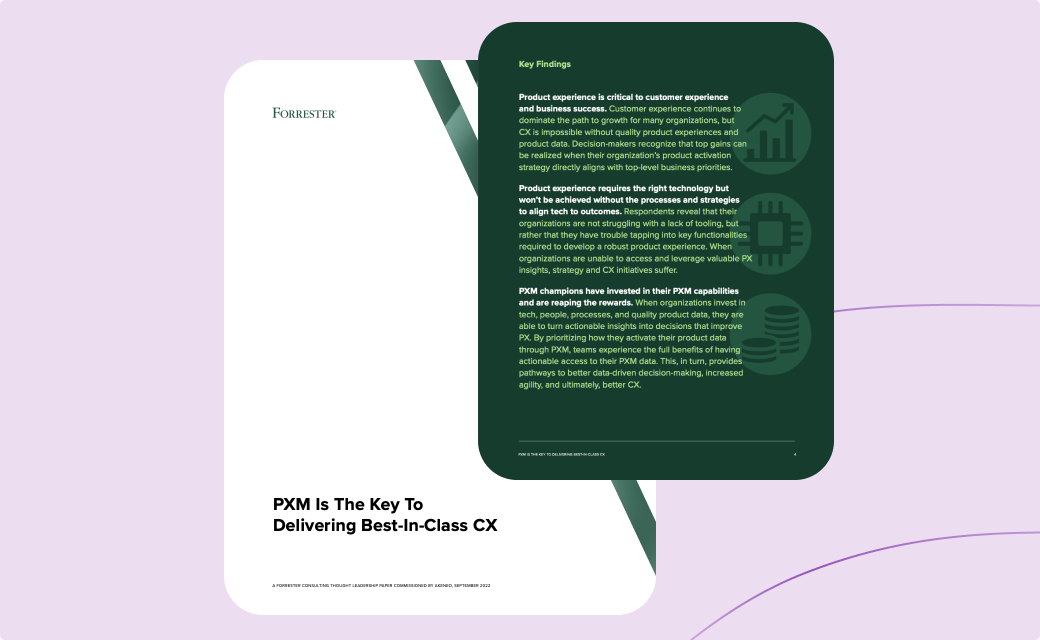
According to a Forrester report, creating a strong product experience is a crucial aspect of the customer experience. Discover how product information management can revolutionize your customer experience.

For years, the Akeneo mantra has been, “There’s no good customer experience without a compelling product experience.” We have had this vision for a long time, and it serves as the backbone for our product designed to help brands, retailers, manufacturers, and distributors deliver world-class product experiences. The link between product experience (PX) and customer experience (CX) is well-established and documented not only by us, but also by industry analysts.

Consider this Forrester report, “How US Digital Retailer Brands Earn Loyalty With The Quality Of Their Experience”, wherein the leading analyst firm created a CX Index methodology that measured how well a brand’s customer experience strengthens the loyalty of its customers.

The report lists 4 key drivers, and this is the first one in the list? Product and services experience.

‘Products and services’ is the most important driver category for digital retailers’ CX. Drivers relating to a digital retailer’s products and services — including what it offers and how well its online descriptions match reality — have the most impact on a brand’s overall CX Index score.

Forrester Report: The US Digital Retailers Customer Experience Index How US Digital Retailer Brands Earn Loyalty With The Quality Of Their Experience

The product experience has the highest impact on customer experience, and product experiences aren’t just limited to product descriptions, but includes all the information you can provide about the product, including accurate technical specifications so buyers can be sure the product will fit and meet standards; usage information and how easy that is to access and understand; and emotional information, which includes great product descriptions as well as high-resolution images, videos, and other documents. Think also about what kind of images you offer. Are they simple photos of the product floating in space? Or do they show the product “in action”? For example, stage the furniture you’re selling in a room where it is designed to be used. Context is king, both in terms of product information relevance by channel and by country, as well as in imagery. Be creative! And use that creativity to build trust and emotion.

This last point leads us to one of the other interesting statements from the Forrester report, and that is about disappointing your customers. This one of course feels very obvious, but there is a measurable impact when customers are frustrated by their experience. From the report, Forrester states:

Annoyance, disappointment, and frustration will drive customers away. Making your customers feel annoyed, disappointed, or frustrated is the most harmful to their loyalty. Out of customers who felt disappointed, just 12% will advocate for the brand.

Forrester Report: The US Digital Retailers Customer Experience Index How US Digital Retailer Brands Earn Loyalty With The Quality Of Their Experience

These research findings from Forrester are based on US company data, but they align with surveys Akeneo sponsored with both B2C and B2B audiences globally.

What do consumers and buyers say about product experience?

Our 2022 Global B2C Survey found that 2 out of 3 customers, just over 66%, said they would abandon a purchase due to a poor product experience

And the year before, in our 2021 Global B2C Survey, we talked to 3,500 consumers from around the globe and learned that 50% of customers would pay a premium (10% or more) for a better product experience consisting of more accurate product information.

If you aren’t prioritizing your product experience, these statistics can feel alarming. The good news is that investing in a strong product experience can be aided by using tools that bring teams together, foster collaboration, evaluate data quality and suggest improvements, and enable marketers to ensure that the digital assets associated with a product are the right ones. How many times have you come across a product you’d like to purchase only to discover that the images did not match the descriptions, or so much product information was missing it was impossible to select that product?

Review your product catalog and make sure it is complete. Are all the mandatory fields filled in? Do the images match the items? Can shoppers search on the right filters, or is important information embedded in descriptions that make it hard to find and compare products? There are so many seemingly little things that can ruin the shopping experience. If your teams find this difficult to spot and fix, perhaps it’s time to review your people, processes, and technology and see if there are things you can do to improve.

Check it before you wreck it!

At the end of the day, it’s clear to see how much of an impact product experience has on customer experience. It is simply impossible to create a compelling CX without first focusing on improving your PX, and your product experience starts with your product information.

You can download the Forrester report now for full insights into how CX impacts PX, or if you’re ready to jump right in, you can request a demo of Akeneo today to see how proper product information management can revolutionize your customer experience.

PXM Maturity Assessment

How mature is your organization? How can you take it to the next level?