Summer Release
PIM vs PLM Software: What’s the Difference?
Learn everything you need to know about the differences between Product Information Management and Product Lifecycle Management to make the right choice for your business.
If you’ve been feeling like customer expectations are on the rise, you’re right. According to a Salesforce survey, 73% percent of customers expect companies to understand their unique needs and expectations. Yet only 64% trust that companies will do so.
Among other challenges, the digital transformation has ushered in an age of instant gratification as our attention spans decline. Customers expect fast, frictionless experiences, especially when it comes to eCommerce. The good news is that the shift to digital has also brought advances in technology that can help you deliver what your customers may want. Two important pieces of the puzzle are product information management (PIM) and product lifecycle management (PLM) systems.
Decision makers often wonder about the differences between PIM vs PLM—and whether they need both. We’ll cover everything you need to know to make the right choice for your business.
Product Information Management Definition
Product information management, abbreviated PIM, is the process of collecting, sharing, and distributing your product information across your internal teams as well as your external sales channels and catalogs. PIM capabilities include importing data from various sources such as your other platforms, as well as your suppliers, and providing various ways for you to classify, track, enrich, and syndicate that data. The goal of PIM is to ensure accurate, complete, and consistent product information across all owned and unowned platforms and channels.
Product Lifecycle Management Definition
Product lifecycle management, abbreviated PLM, is the process of collecting and organizing internal data so that you can track and predict the lifecycle of a product. PLM capabilities mostly involve providing a database for data such as CAD files, parts and inventory information, bills of materials, and other technical assets. The ultimate goal of PLM is to organize internal information, which increases efficiency and allows you to get your products to market faster.
Similarities Between PIM and PLM Software
While there are a lot of differences between PIM and PLM systems, there are also some similarities. Both provide a single repository for product information and data. Both can be integrated with other software and systems in your tech stack, which can enhance them. And both can lead to better collaboration and efficiency, adding value to your organization and helping you innovate at a faster pace. But that’s where the similarities between PIM and PLM tools end.
Differences Between PIM vs PLM Software
PIM and PLM systems are used at different stages in the product journey. When implemented well, they can complement each other perfectly. But they are not one and the same. Here are the top six differences between PIM vs PLM software.
Role
PIM: PIM is a system designed to handle your customer-facing data. It enables and simplifies the flow of product information from internal databases to your customers, syndicating your data across all channels and ensuring a consistent product experience. It contains information such as product descriptions, specs and sizing, inventory levels and availability, pricing, and more. Any information your customers want to know can be found in your PIM.
PLM: PLM is an internal-facing system. It collects and centralizes information from various internal sources and departments so that all of your internal teams are working from the same database. Your PLM contains information related to the concepting, design, development, and engineering of your products. Any information that your internal teams want to know can be found in your PLM.
Product Lifecycle Stage
PIM: PIM helps you manage the marketing and selling of your products once they’re ready to be brought to market. Many eCommerce companies use PIM for product syndication and distribution. PIM can either automatically upload, enhance, and format product data, or your internal teams can do it manually.
PLM: In the discussion of PIM vs PLM, PLM actually comes first—it helps you manage the product development phase, from ideation to manufacture and launch and even after-sales support. Collaboration is essential during this stage, and clarity on what has already been done, what needs to be done, and any previous iterations of the product can help optimize your product lifecycle. Once the product is launched, PIM takes over.
User Base
PIM: Since PIM and PLM systems were created for different stages of the product journey, it follows that they’re used by different departments within your organization. PIM will mainly be used by your marketing and sales departments, including your field reps. These are the people who need access to things like descriptions, SKUs, visual assets like images or 3D renderings, and product metadata.
PLM: PLM is used by your engineering and technical departments, including developers and designers. It can also be useful for product and sales teams, to help them get a historical context of their particular product. When you’re discussing PIM vs PLM with your internal teams, be sure to include all of these departments. You can even integrate your suppliers into your PLM, which can help you foresee supply chain issues that may affect your product lifecycle.
Data
PIM: One of the most important PIM capabilities is to store many different types of data. It can, and should, incorporate data from your PLM, such as technical data. It’s also highly customizable, so the types of data it uses can vary by organization and even by product. Data can include technical specifications, digital assets like video, audio, and image files, design files and PowerPoints, product metadata including keywords and descriptions, as well as customer data, marketing data, and financial data.
PLM: PLM tools store data related to design and engineering needs only. This might include CAD renderings, Photoshop and InDesign files, lists of parts, materials, and components, bills of materials, requests for quotes, and more. PLM software can stand alone and can also be integrated into your PIM when your product is ready to be put on the market.
Integrations
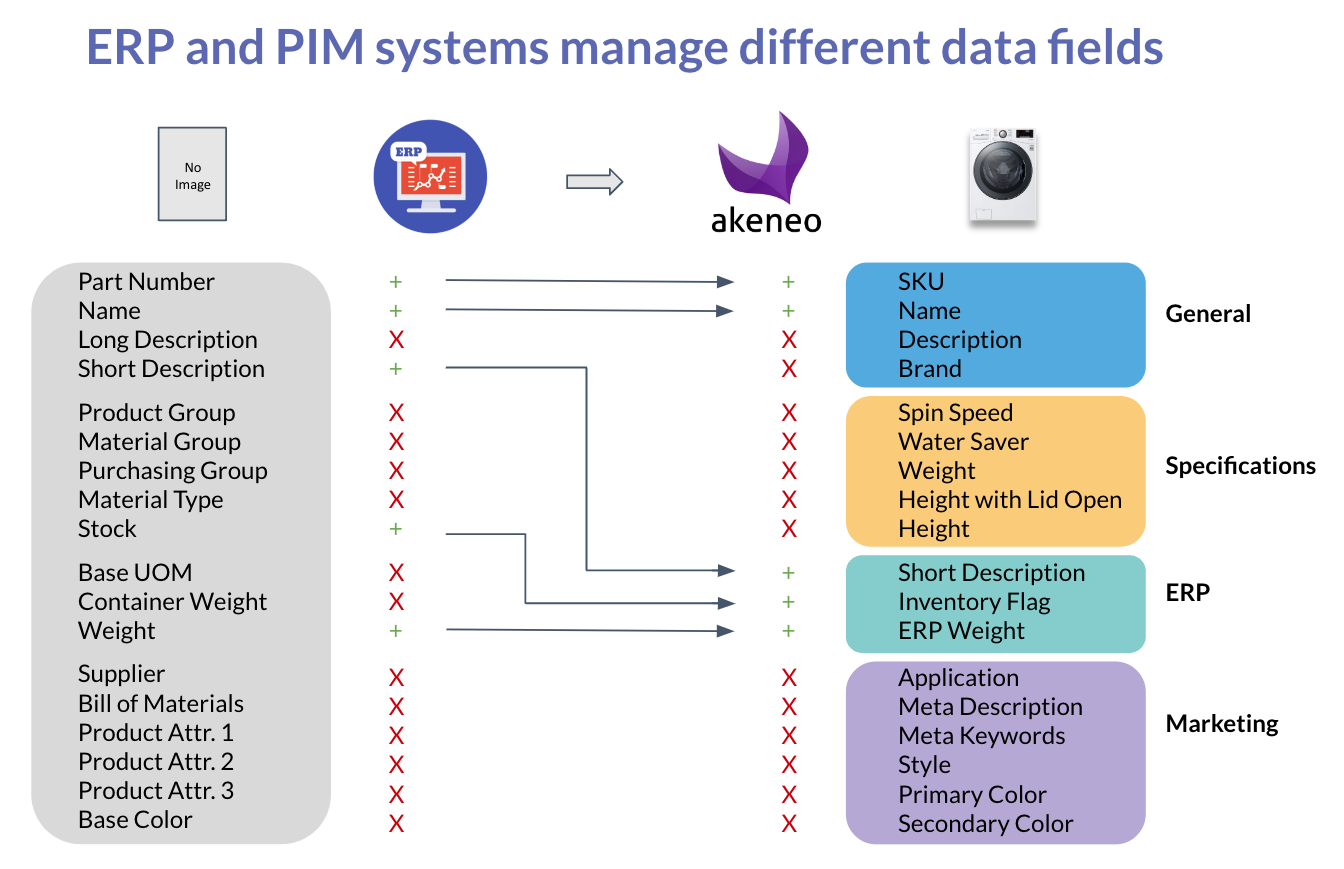
PIM: PIM tools and PLM tools integrate into your existing tech stack very differently. PIM aggregates more types of data and can typically integrate with more systems. PIM integrations might include your enterprise resource planning (ERP), digital asset management (DAM), product data management (PDM) systems, and even your PLM itself. It usually also allows you to import CSV and XLS files as well as use APIs to connect to your online and print channels. APIs have proven benefits: Researchers at Boston University found using the right APIs can increase annual net income for a large firm by more than $250,000.
PLM: PLM capabilities focus on design and manufacturing, and therefore so do its integrations. You will be able to integrate with CAD programs and Adobe Illustrator, as well as other design software. Like PIM, PLM also typically integrates with ERP and PDM systems. It orchestrates all of these different programs, providing you with comprehensive historical data.
Outcomes
PIM: PIM helps your team deliver compelling product experiences, which ultimately provide a customer experience that can improve your sales, extend your reach, and result in fewer returns. It can help you keep pace with changing customer preferences, encourage loyalty to your brand, expand your market share by helping you create larger and more varied digital product catalogs and sell on more channels, and improve your efficiency and save resources. It does all this by automating tasks, including localization and syndication, and reducing the risk of inconsistent or inaccurate information making it into your customer-facing assets.
PLM: PLM helps your team get products to market faster and at a higher quality. Through various tools and workflows, it can improve collaboration and internal efficiencies throughout the development of a product. It does this by providing visibility into the entire lifecycle so that everyone involved can see at a glance what is going on with the product. It can also help you standardize and automate your bills of materials so that you can better price your product, as well as manage your quotes so that you get the best bids.
Do I Need Both PIM and PLM Systems?
The bottom line is that there is no real debate between PIM vs PLM. They serve different purposes, and most organizations that both produce and sell products will likely need both, especially larger organizations or those with many products. The two systems complement each other: PLM applies to product development, while PIM applies to product experience, sales, and marketing. Together, they streamline your entire product lifecycle from ideation through distribution and retirement and create a better experience for both your internal team and your customers.
The good news is that you can share information between your PIM and PLM systems. The Akeneo PIM is designed for seamless integration with many of your existing systems, including the technical information from your PLM.
Book a demo with Akeneo and we’ll show you what PIM can do for you.