Latest

Winter Release: Commerce at the Speed of AI

Learn More
Akeneo-Logo Akeneo-Logo

How Pre-Sale Product Information Makes or Breaks the Customer Experience

Product Experience

How Pre-Sale Product Information Makes or Breaks the Customer Experience

Frustrated when the product you ordered online doesn’t live up to the hype? You’re not alone — and brands feel the sting, too. Discover why product experiences are the cornerstone of customer satisfaction and how inconsistent product information can lead to lost sales, returns, and damaged trust.

As consumers, we’ve become accustomed to the conveniences of online shopping – all the products, options, and sales we could want, without ever leaving the comfort of our couches. 

While it can often sound like a dream, we’re all also familiar with the nightmarish pitfalls of digital commerce. Who hasn’t experienced those exciting moments of anticipation as a package arrives… and that excitement quickly turns to frustration and disappointment when we tear open the package only to find that what we received is not what we ordered, or at least not how it was pictured or described online. Whether the sizing is off, materials are wrong, color or quality, it can feel like you’ve been betrayed by the brand that made a promise and didn’t deliver. 

From a customer perspective, it can be devastating. Maybe you had planned to wear the outfit for a special occasion and now you have to go back to your closet for a disappointing but suitable back-up. Or, maybe it was a birthday present for a friend and now you have nothing to gift them for their special day. Regardless of why you purchased it, it’s not a fun or enjoyable experience when expectations don’t meet reality.

As frustrating as this is to consumers, it can cause a much bigger headache for the brand or retailer who misrepresented the product in the first place. At surface level, it might seem like they simply lost a sale if the customer returns the item. But the long-term impact can be much more consequential and, if not addressed, have a negative snowball effect on brand reputation and revenues. Plus, the cost and logistics of processing returns can have a massive impact on the organization.

Misaligned expectations on products are a big misstep on the part of brands, and one that can be easily avoided. Let’s take a look at why consistent, reliable product information is so critical to the pre-sale process, and how retailers and brands can ensure they are meeting and exceeding customer product expectations to drive improved customer satisfaction, retention, and revenue. 

Why Product Expectations and Experiences Matter

When it comes to the retail industry, customer experience has been in the limelight for years – and for good reason. Strong CX drives retention and revenue. 

However, there is an important caveat here that often gets overlooked: there is no customer experience without a product experience. 

The product is often the first and most significant touchpoint between the customer and the brand, so customer’s experience with a brand is deeply tied to how they interact with the product. If the product doesn’t meet their expectations, whether due to poor quality, incomplete information, or usability issues, it will negatively impact their entire perception of the brand.

From how it’s discovered online to how it’s described, purchased, and used, every interaction forms part of the customer experience.

The Product Experience Revolution

In particular, there are three key ways the product experience affects the customer experience:

1. Customer trust and retention 

Product experiences go hand-in-hand with customer experiences in retail. Just one bad experience can be enough to deter customers from shopping with the same brand again; it’s critical to manage expectations by making sure your product descriptions are as accurate, consistent, and detailed as possible before the sale is ever made. That way, there are no surprises when the product arrives at their door, ensuring a more reliable experience that keeps customers coming back because they know they are getting what they pay for when they shop with the brand.

2. Brand perception and value

A product that delivers on its promises, comes with rich and accurate information, and provides a satisfying user experience elevates the customer’s perception of the brand as reliable, high-quality, and customer-centric.

In today’s retail environment, where two-thirds of business leaders (66%) confirmed “product and brand values” is the feature that will most likely increase in importance over the next 2-3 years, the product experience also serves as a reflection of the brand’s values. If a company claims to be eco-friendly but uses excessive or non-recyclable packaging, the product experience doesn’t align with the brand’s messaging, leading to customer disillusionment. Brands that offer detailed product information about clear eco-certifications, minimal packaging, or responsibly sourced materials are likely to be seen as authentic and responsible, enhancing the perceived value of the brand and helping to differentiate it in a crowded market.

3. Informed purchasing behavior that reduces returns

Returns are painful for both customers and brands. For customers, they’re forced to deal with the hassle of packaging something up or dropping it off at an approved location. Companies need to eat the cost of return shipping and deal with the costs of restocking products.

There’s also an environmental impact, as returns often lead to increased carbon emissions due to additional transportation back to the warehouse or retailer, contributing to fuel consumption and greenhouse gas emissions. In 2022 alone, emissions from shipping returns equaled 24 million CO2 metric tons. Plus, not every item returned can be restocked, not only wasting valuable resources but also adds to the growing problem of textile waste in landfills. The volume of returns in landfills in the U.S. nearly doubled from 2019 to 2022, amounting to 4.3 billion tons.

A well-curated product experience is one of the most effective ways to mitigate return rates. When customers are fully informed about the product through accurate descriptions, high-quality images, user reviews, and detailed specifications, they are far more likely to be satisfied with their purchase.

Product Information: The Key to Product Experiences

The best way to avoid any post-sale customer frustration, is to have a sound, comprehensive product information management strategy in place, pre-sale. Providing the right information before the point of purchase is the best way to ensure that customers are satisfied with their purchase and are able to make confident, informed decisions. This will pay dividends over time, as customers keep coming back for repeat purchases.

With the vast and fractured eCommerce space today, it’s not an easy feat to ensure product information remains consistent across so many retail channels, marketplaces and outlets. But it is paramount that what a customer sees for product details on one marketplace — such as Walmart.com or Amazon – matches what they see on your website and all other channels. Without this consistency, customers will come to question the reliability and quality of the product and brand experience.

When your product experience is aligned with the customer’s expectations, it creates a ripple effect of positive brand perception, repeat business, and long-term customer loyalty. Investing in a robust PIM system doesn’t just simplify the process of managing and enriching product data, it ends up shaping the entire customer experience from discovery to post-purchase.

If you’re interested in learning more about how a PIM system, like Akeneo, can help you create a compelling customer experience based on product experiences, reach out to an Akeneo expert today.

Are you ready to take the next step?

Our Akeneo Experts are here to answer all the questions you might have about our products and help you to move forward on your PX journey.


Casey Paxton, Content Marketing Manager

Akeneo

B2B Goes Digital: What That Means for You

Product Experience

B2B Goes Digital: What That Means for You

The B2B industry is undergoing a dramatic shift, driven by the rise of digital sales strategies and cutting-edge technologies like AI and visual configuration tools. Discover how AI is not only transforming customer interactions but also ensuring accurate, reliable product information across all touchpoints, and learn how B2B organizations can stay competitive in the digital age.

The B2B industry has historically operated with a well-defined, albeit conservative, sales process. This approach has been characterized by face-to-face interactions, lengthy negotiations and sales cycles, and a strong reliance on established relationships. 

However, even the most conservative business approaches are subject to modernization as a matter of competition and survival. As B2B consumers increasingly look for experiences mirroring those in the consumer sector, companies are realizing they must undertake a digital transformation to remain competitive. 

Our recent study on B2B companies revealed that 85% have already adopted a digital sales strategy. We also found that, for these companies, digital channels are not just supplementary; they are substantial contributors to overall revenue. On average, digital channels account for nearly half (48%) of total company revenue, with one-in-ten (9%) companies reporting that digital sales make up over 80% of their revenue.

And this momentum is showing no signs of abating; 90% of B2B organizations stated that they plan to strengthen their digital sales strategies over the next two years. 

So what does this all mean in practice? B2B organizations can’t afford to delay their digital transformation any longer; evolving to meet customers where they are is the only way to ensure that your customers aren’t switching to more digitally-advanced organizations.

The role of emerging technologies

The adoption of digital sales strategies is closely linked to the use of emerging technologies. Nine of ten B2B organizations are utilizing or planning to implement advanced technologies, such as GenAI, voice search, and visual configuration tools, within the next 12 months. These technologies offer significant advantages, including improved efficiency, enhanced customer experience, and more streamlined operations. 

Generative AI, for example, can automate and personalize interactions, providing customers with tailored recommendations and support. Voice search technology can make it easier for customers to find products or services through voice commands, which reflects a growing trend toward voice-assisted searches. 

Visual configuration tools enhance the buying experience by allowing customers to visualize products in various configurations, making the decision-making process more intuitive, engaging, and informative. 

The importance of consistent, accurate, and reliable product information

While the adoption of digital channels and emerging technologies is crucial, it’s arguably more important to ensure product data remains consistent, accurate, and reliable across all channels. B2B organizations are catching on to this trend – nearly half (48%) are leveraging AI to ensure their data is uniform and precise across their various touchpoints. This is critical, as inconsistencies or inaccuracies in product information can result in lost revenue, customer dissatisfaction, or worse, reputational harm. 

In this context, AI is quarterbacking the process of updating and verifying product information across various platforms. This helps minimize human errors while ensuring that customers consistently receive accurate and current information, which is fundamental for building trust and facilitating informed purchasing decisions. 

Beyond ensuring data accuracy and consistency, AI is also transforming how B2B companies create and deliver product experiences. Approximately 76% of B2B organizations are utilizing AI to modernize the customer journey with personalized recommendations, interactive product displays, and dynamic configurations. These AI-driven capabilities create the more consumer-esque buying experiences decision-makers at B2B organizations are expecting. It also reflects a broader trend toward leveraging technology to help streamline operations, foster deeper customer engagement, and drive sales. 

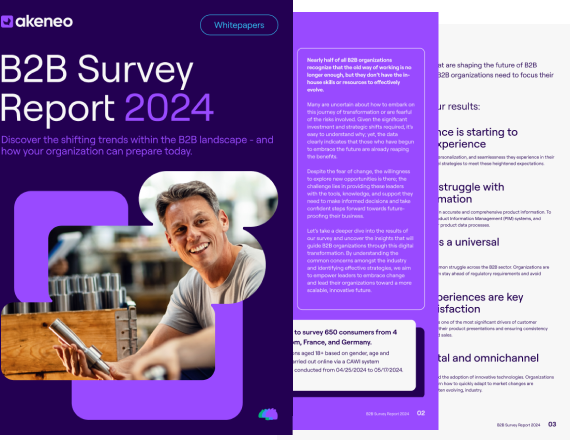
2024 B2B Survey Results Report

The shift toward consumer-like purchasing experiences

As B2B companies leverage AI and other emerging technologies to enhance product data accuracy and streamline processes, they are also responding to a fundamental shift in customer expectations. Today’s B2B buyers are no longer satisfied with traditional, slow-moving sales processes. They expect the same convenience, speed, and personalization they experience as everyday consumers. 

This expectation shift is not surprising, as we’ve seen a trend of companies across industries racing to personalize their products and services to consumers in a highly competitive market. It’s causing B2B organizations to reevaluate their strategies and adopt digital solutions that deliver more efficient, customer-centric experiences. 

An example of this transformation is the adoption of visual configuration tools. This allows B2B customers to customize products to their needs like the deep personalization options commonly found in consumer retail. By striving to match this level of customization, B2B companies can improve the customer experience and gain competitive advantages within their markets. 

AI-powered chatbots and virtual assistants are further elevating the customer experience by providing immediate responses to customer inquiries. This level of responsiveness mirrors the high-quality customer service offered by leading consumer retail brands and helps close the gap between traditional B2B interactions and the dynamic, real-time engagement that today’s buyers have come to expect. 

Simply put, integrating these technologies allows B2B companies to position themselves to meet evolving market demands while driving operation efficiency and growth. 

Looking towards the future: digital and physical channel integration

Introducing digital channels marks an essential milestone in a B2B company’s digital transformation journey, yet many consumers still value those face-to-face interactions with knowledgeable sales reps, especially when it comes to more complex purchases. So the real challenge lies in integrating the digital touchpoints with physical ones to create a unified and cohesive customer experience; achieving this requires that product information remains consistent, accurate, and reliable across both physical and digital touchpoints.

For B2B organizations, this involves implementing robust systems and processes to manage product information effectively. Leveraging technologies such as a Product Information Management (PIM) solution is essential for creating a single source of truth for data while also investing in tools such as AI that help to deliver higher-quality customer experiences. This approach allows companies to deliver a seamless experience that aligns with the evolving expectations of today’s buyers. 

The B2B sector is undergoing a much-needed transformation as companies increasingly adopt digital sales strategies and cutting-edge technologies. The rise of digital channels, coupled with the integration of advanced tools like AI and visual configuration systems, is fundamentally changing how B2B organizations engage with their customers. 

To remain competitive, B2B organizations must embrace these technologies and ensure they are deployed in such a way that they deliver precise, consistent, and compelling product information across all touch points. As the industry continues to evolve, those able to merge digital innovation with a strong focus on the customer experience will be well-positioned to thrive in the new digital landscape. 

Discover the Future of B2B

Download the comprehensive report based on the findings of our survey of B2B professionals to receive insights and actionable tips on navigating the tricky waters of the B2B industry.

Casey Paxton, Content Marketing Manager

Akeneo

The Key to Keeping up with Regulations

Product Experience

The Key to Keeping up with Regulations

Navigating today’s regulatory landscape can feel overwhelming for B2B brands, but it doesn’t have to be. Discover how a proactive compliance strategy, driven by centralized data, can help B2B businesses not only meet today’s regulatory demands but also unlock new opportunities and stay ahead of the curve.

For B2B brands, today’s regulatory landscape can feel like navigating a complex, never-ending maze. In our latest B2B survey, we found that nearly half of B2B companies cite regulations as one of their organization’s biggest challenges. 

On top of that, we found that almost all (99%) of B2B companies face multiple hurdles in staying compliant with local, regional, or industry-specific regulations. From supply chain management to automation to data security and privacy, consistently maintaining compliance is paved with challenges. 

In this context, creating a single, centralized source of truth for product information would enable B2B businesses to stay compliant with current and emergent regulations while staying agile enough to prepare for future changes. 

Let’s take a look at just a few of the benefits of a centralized data system and how B2B organizations can stay up-to-date and compliant with some of the most challenging regulations, including Digital Product Passport legislation and ETIM classification.

 Tackling the Regulatory Compliance Challenge

For years, B2B companies approached compliance with a reactive mindset – doing so to avoid fees and stay out of legal trouble. But today’s complex regulatory environment requires organizations and business leaders to view compliance as a strategic priority so they’re no longer at a disadvantage and playing catch-up with competitors or the latest requirements. 

Still, nearly every B2B company is grappling with compliance challenges, often due to the sheer volume of regulations and the need to adapt quickly to new requirements, including:

  • Supply chain management practices: Our survey indicated that 50% of companies continue to struggle with aligning supply chains to meet regulatory demands.
  • Implementing agile processes: Agility was deemed as essential for 48% of B2B organizations to remain compliant in our survey, meaning that there’s a need for these businesses to be able to pivot quickly when new regulations are introduced or existing ones are modified. 
  • Leveraging automation: While automation can be a powerful tool when it comes to streamlining data auditing and updating, 45% of organizations face challenges in automating compliance processes.

These issues are further complicated by the fact that regulations are a living, breathing entity that often evolve at the whim of technology developments or when public fervor over technological advancement reaches unprecedented heights. B2B organizations and their leaders need to strive for a straightforward, proactive approach to compliance rather than remaining reactive. 

Spotlight on Emerging Regulations

To better understand these challenges facing B2B organizations and why a centralized repository for data is needed, let’s explore a few emerging regulations that will reshape how B2B companies operate in the years to come. 

1. Digital Product Passports

Digital Product Passports are designed to provide consumers and business partners with highly detailed insights into a product’s entire lifecycle, including where its materials come from, how it was produced, and how it can be disposed of responsibly. Information like a unique identifier, material data, sustainability, and repair data will have to be shared, in addition to the basic but still mandatory product name, product model, manufacturing place and date, and warranty details.

Essentially, a DPP is a digital record containing comprehensive information and details about products through its lifecycle. The latest updates to DPP regulation now require companies to provide detailed data on the product’s repair history, reusability, resource efficiency, and details on any potentially hazardous substances. With this updated regulation, the EU is working towards ensuring maximum visibility, transparency, and durability for products.

2. ETIM Classification

ETIM Classification is a standardized system for classifying technical products, particularly in the electrical and building industries. With ETIM, products are assigned specific attributes to make it easier for manufacturers, distributors, and retailers to manage product information more consistently. 

Updated versions of ETIM are released regularly, requiring companies to update product classifications on a regular basis to stay compliant. Rather than simply adhering to these regular updates, B2B leaders should take action further by proactively improving supply chain transparency and efficiency. 

Standardizing product data across industries allows companies to collaborate better with suppliers and customers, reduce operational redundancies, and speed up product-to-market timelines. Companies that take up the leadership mantle in adopting and enhancing ETIM standards can offer a more seamless experience to customers and partners, putting them ahead of competitors who may still need help with disorganized product information. 

3. Natasha’s Law

Natasha’s Law, named after a young woman who passed away after an allergic reaction to a prepackaged sandwich, mandates stricter labeling requirements for food products in the UK. This law requires food producers to list all ingredients and allergens clearly on packaging, even for products made or assembled on-site. 

For food manufacturers, retailers, and restaurants, ensuring compliance with Natasha’s Law means having accurate and up-to-date ingredient information readily available. A centralized source of information allows companies to quickly and accurately update food labels, reducing the risk of non-compliance and protecting consumer safety. 

2024 B2B Survey Results Report

A Single, Centralized Source of Truth is Essential  

Given the evolving complexity of modern compliance, relying on disparate systems and reactive, manual processes is a recipe for missteps. A single, centralized source of truth – where all data is accurate, up-to-date, and easily accessible across teams – addresses many compliance challenges faced by B2B leaders. Creating and maintaining this single source of truth also helps future-proof your business against future regulations. 

Simply put, a robust repository of data enables your organization beyond doing the bare minimum and opens the door to new opportunities that can enhance efficiency and consistency, build consumer trust, and potentially create new revenue streams. 

There are a multitude of reasons why a centralized source of truth is key for compliance, including:

  • Greater consistency and control across the organization: A single centralized system ensures every department works with the same information, significantly reducing the risk of conflicting data, which is crucial in meeting regulatory requirements. 
  • Proactive regulatory shaping: When a company has complete command over its data, it can shape the regulatory landscape by being at the forefront of best practice discussions with industry bodies and regulators. Taking a proactive approach turns your company into a sought-after leader, setting industry gold standards, and potentially influencing the outcome of new regulations. For instance, Twintag has shaped the future of sustainability and transparency by actively discussing the European Commission’s Ecodesign for Sustainable Products Regulation (ESPR), which includes Digital Product Passport (DPP) requirements. Twintag’s level of involvement cemented its status as a leader in helping to define industry standards and practices for product sustainability.
  • Unlocking new revenue streams through being compliant: Simply adhering to compliance can open up new business revenue streams. For example, as consumers and governments push for greater transparency, companies embracing Digital Product Passports not only ensure compliance but can leverage their commitment to sustainability, potentially attracting new customer demographics and partnerships. Compliance becomes a brand differentiator, leading to higher revenues and stronger brand relationships. 

Anticipating and Preparing for the Next Wave of Compliance

Regulations are only going to get more complicated and intense over time, especially as consumer demand for increased transparency grows and as regulatory bodies continue to emphasize granular data reporting and product safety. It’s imperative that B2B leaders start preparing now by implementing a centralized data management system and a proactive strategy in order to stay compliant in the future.

The sooner you start preparing, the less likely it will be that you’ll have to scramble to meet compliance rules as they come into effect and potentially face fines and disciplinary actions from legislative bodies. Those who treat compliance as a market asset to carve out new segments and define how regulations are to be followed will lead the charge in innovative solutions for compliance management. 

Discover the Future of B2B

Download the comprehensive report based on the findings of our survey of B2B professionals to receive insights and actionable tips on navigating the tricky waters of the B2B industry.

Casey Paxton, Content Marketing Manager

Akeneo

Building a Product-Centric Culture: Lessons from Peavey Industries

Product Experience

Building a Product-Centric Culture: Lessons from Peavey Industries

Peavey Industries is shifting toward a more product-focused approach, breaking down silos and fostering a collaborative environment that’s driving innovation and long-term success. But how did they overcome the challenges of securing internal buy-in, and what role did training play in making this shift possible? Discover how Peavey Industries is navigating this journey and the key lessons they’ve learned along the way.

At Peavey Industries, a shift is happening — one that’s about becoming a more product-focused company. And at the heart of this transformation is a simple idea: success starts with people.  

Peavey Industries LP, the parent company of Peavey Mart and MainStreet Hardware, has been serving loyal customers across Canada since 1967. With a focus on essential products and services for the rural lifestyle, Peavey Mart has established itself as a trusted destination for quality goods and personalized customer service. 

Led by Shaun Guthrie, the Head of Technology and eCommerce, Peavey Industries has learned firsthand how important it is to manage change in a way that gets everyone involved. Initially focused solely on technology, Shaun’s role soon expanded to include eCommerce with the intention of fostering collaboration between the technology and eCommerce teams, breaking down silos and creating a cohesive environment where ideas flow freely and solutions are reached more swiftly. 

By fostering a sense of ownership and teamwork across the company, Peavey Industries is setting itself up for long-term success in an ever-changing market, with innovation and customer satisfaction leading the way. It’s this focus on people that’s truly driving their transformation.

Internal Team Buy-In: The Key to Success

One of the most significant challenges faced during this transition was securing buy-in from all team members. Change often meets resistance, especially in large organizations. To overcome this, the leadership team at Peavey Industries emphasized the importance of communication and involvement. 

By involving everyone and ensuring that each team member understands their value, Peavey Industries has fostered a culture of mutual respect and shared goals, not only improving workflows but also strengthening the organization’s culture.

The Akeneo PIM not only transformed the way we work but also ignited a wave of positive change within our organization. We have created an environment where productivity soars and innovation thrives while driving concrete business results.

Shaun Guthrie Head of Technology & eCommerce

Peavey Industries

The Role of Training and Education

Everyone’s heard the old adage, “Rome wasn’t built in a day.” Well, it’s no different here with Peavey Industries; a transformation as significant as this didn’t happen overnight, and requires ongoing education and training to ensure the entire internal team is up to speed. 

Leveraging Akeneo Akademy empowered Peavey’s teams with the essential training needed to quickly and efficiently adapt to the new tools and processes in a product-centric environment. As Shuan Guthrie notes, “Training through the Akademy has been essential. It’s not just about learning new skills but about embracing a mindset of continuous improvement.”

The Future for Peavey’s Product-Centric Revolution

While Peavey Industries has made significant strides, the journey is far from over. As the company continues to digitize and expand its offerings, the lessons learned about change management, product-centricity and team buy-in will remain at the forefront of its strategy.

For organizations looking to embark on a similar journey, the experience of Peavey Industries offers a valuable lesson: change takes time, but with the right approach, the rewards are well worth the effort.

If you want to learn more about Peavey’ Industries road to a product-centric organization, you can tune in here to listen to the full story. 

Are you ready to take the next step?

Our Akeneo Experts are here to answer all the questions you might have about our products and help you to move forward on your PX journey.

Samira McDonald, Senior Manager, Community

Akeneo

The 5 Most Common Product Data Challenges in B2B

Product Experience

The 5 Most Common Product Data Challenges in B2B

Discover the five most common product data challenges facing the B2B industry today, from integrating AI and managing supplier data to ensuring team efficiency and consistency across channels. Gain an understanding as to how these challenges are impacting B2B companies and learn actionable strategies to turn them into opportunities for growth and success.

Product information is the lifeblood of B2B organizations. But managing it effectively? That’s where things get complicated. 

According to our latest B2B Survey Results Report, an overwhelming 99% of business leaders revealed that their organization faced at least one major product information challenge in the past year.

These challenges are not just about data entry errors or slow processes—they represent much deeper, more critical issues that, if unresolved, could slow time to market, weaken customer trust, and hold back revenue growth. 

From adopting AI to streamline data management to struggling with team collaboration or managing supplier data, let’s break down the five most common product information challenges facing B2B companies today and explore how they can affect the entire business—from operations to customer satisfaction. If you’re in the trenches of product information management, these stats will resonate. More importantly, they’ll offer insights into how your organization can address them head-on.

Five Most Common Product Data Challenges Facing B2B

1. Applying automation/AI applications to make data usage more efficient

With the increasing availability of automation and AI tools, many organizations are eager to leverage these technologies to improve product information management. However, 37% of B2b business leaders report that integrating automation or AI into their product data processes is one of the most significant technological challenges they face. 

While AI promises the potential to revolutionize product data management, many B2B organizations are still reliant on manual processes to ensure data consistency and accuracy across all channels. In fact, 40% of these businesses continue to use manual methods, which can be both time-consuming and error-prone, and leads to outdated product descriptions, inconsistent pricing, or missing specifications.

Additionally, the more complex a product portfolio becomes, the more difficult it is to manage data manually. B2B organizations often deal with large volumes of product data across diverse categories, making manual processes highly inefficient. Even small errors in product specifications or availability can lead to negative consequences, such as increased return rates, customer dissatisfaction, and the erosion of brand trust.

The perceived benefit of AI is clear: 39% of businesses believe that AI will speed up time to market through automation, which in turn enables faster product rollouts, increased market agility, and the ability to respond quickly to customer needs. Organizations that fail to integrate AI into their processes not only miss out on this benefit but also face operational slowdowns, leading to delayed product launches and reduced competitiveness.

2. Team efficiency and ability to collaborate on product data management

Another common challenge facing B2B organizations is team efficiency in managing product data. 

Many companies recognize that the old ways of working—often characterized by siloed departments and manual processes—are no longer enough to stay competitive in the modern marketplace. 

However, change can be difficult, and many organizations lack the resources required to evolve. In fact, 41% of B2B business leaders say they lack the right staff and skills to manage product data effectively, while 34% report budget constraints that prevent them from making necessary tech investments.

The lack of collaboration across teams can lead to a disjointed product information management process. When teams are unable to work efficiently together, product data errors can occur more frequently, leading to inconsistent information across channels. This inconsistency can confuse customers, erode trust, and lead to increased return rates. 

For companies that sell complex or highly technical products, accurate and comprehensive product data is especially critical for ensuring customer satisfaction and minimizing the risk of post-purchase issues.

To combat these inefficiencies, organizations need to invest in both talent and technology that enables seamless collaboration. In the long run, failing to invest now in the right software and strategies can result in higher operating costs, longer time to market, and lost revenue opportunities due to inaccurate or incomplete product information being shared with customers.

2024 B2B Survey Results Report

3. Making product information more easily understood and accessible to buyers

As B2B buyers increasingly seek self-service options, the demand for easily accessible product information has grown. In fact, 52% of B2B companies are focusing on making more product information available online to meet this demand. 

Digital self-service portals, social media, and product marketing websites have become essential channels for sharing product details, with 51%, 46%, and 45% of companies, respectively, using these tools to engage customers. However, the challenge with these channels lies in making this information both accessible and easily understood by potential buyers. Customers expect detailed product specifications, pricing information, and usage guidelines to be readily available across all digital touchpoints. The ability to access this information quickly can make or break a sale, particularly for companies selling to decision-makers who often juggle multiple priorities, need immediate access to critical details, and prefer these self-service resources.

Failing to deliver easily understandable product data can lead to frustration among buyers, resulting in abandoned carts or lost sales. Plus, poorly communicated product information can create unnecessary support inquiries, which drain customer service resources and further impact the company’s efficiency.

By prioritizing the creation of clear, comprehensive, and accessible product information, businesses can not only enhance the buying experience but also reduce pressure on their support teams and improve overall customer satisfaction.

4. Managing how product information is activated on sales channels & marketplaces

As B2B organizations expand their presence across multiple sales channels, including online marketplaces, managing consistent product information becomes increasingly complex. Half of the B2B organizations surveyed see significant benefits from selling on B2B marketplaces, such as:

  • Access to more customers (52%) 
  • Increased visibility (50%), and
  • Faster sales cycles (43%)

However, 40% of companies report that ensuring product data is consistent across channels remains one of their biggest challenges.

Inconsistent product information across channels can lead to confusion among buyers, who may encounter conflicting descriptions, prices, or availability data. This inconsistency not only frustrates customers but also damages the brand’s reputation and can lead to increased return rates and customer churn.

Additionally, some companies choose not to sell on B2B marketplaces because they want to retain control over their customer data and optimize their own channels. However, forgoing marketplaces can limit their reach, making it essential for companies to strike the right balance between marketplace participation and channel management. Implementing effective product information management systems is key to ensuring data consistency and maximizing the potential of each sales channel.

5. Collecting and managing data from suppliers

One of the most common challenges cited by B2B organizations is the time and effort required to collect and manage product data from suppliers. The process is often slow, with 70% of companies taking two weeks to gather and collate product information, and 10% taking more than 30 days. Plus, B2B companies stated that it takes an average of 16 days to enrich product data; that’s nearly one month’s time between receiving a new product to launching the product.

This delay in collecting, managing, and optimizing supplier data can have significant consequences for the business. When product data is not readily available or accurate, companies may struggle to launch new products, update listings on sales channels, or provide customers with the most up-to-date information. As a result, sales opportunities may be missed, and customer trust can erode due to inconsistent or outdated product information.

Improving supplier collaboration and streamlining the data collection process is critical for B2B organizations that want to accelerate their time to market and enhance their competitiveness. 

Turning Product Data Challenges into Opportunities

Product information might not always make the headlines, but it’s the backbone of every B2B transaction. The findings from our latest B2B Survey Results Report are a wake-up call: 99% of B2B businesses face significant product data challenges, and the impact reaches every corner of the company. Whether it’s delayed time-to-market, inefficient team collaboration, or inconsistent data across channels, these problems are far from isolated—they are woven into the fabric of daily operations.

Yet, there’s a silver lining. While the challenges are real, 91% of business leaders agree that their Product Information Management (PIM) system is invaluable. Those who embrace solutions—whether through AI automation, better team collaboration, or more efficient data collection—are the ones best positioned to gain a competitive edge.

The takeaway? If your product information strategy isn’t keeping up, neither is your business. It’s time to move from manual struggles to streamlined success, and with the right tools in place, the future of your product data management can look a whole lot brighter.

Discover the Future of B2B

Download the comprehensive report based on the findings of our survey of B2B professionals to receive insights and actionable tips on navigating the tricky waters of the B2B industry.

Casey Paxton, Content Marketing Manager

Akeneo

The Product Data Paradox: How GenAI Revolutionizes Content Creation

Product Experience

The Product Data Paradox: How GenAI Revolutionizes Content Creation

In the age of digital retail, consumers demand detailed, accurate, and personalized product content across every platform, yet creating this information at scale can be a daunting challenge for brands. Discover how GenAI is resolving this paradox by automating key tasks such as generating product descriptions, optimizing SEO, and translating data for global markets.

Retailers and brands are caught in a paradox when it comes to creating product information: consumers demand increasingly detailed, accurate, and personalized product content across every touchpoint, but producing this information at scale is time-consuming and labor-intensive. 

Product detail pages (PDPs) must be rich with descriptions, features, and reviews to drive engagement, yet retailers often struggle to keep up with these demands while maintaining quality and speed.

Enter generative AI (GenAI)—a solution that almost two-thirds B2C commerce vendors have already begun using to generate high-quality, SEO-optimized product content at scale.

By automating manual and lengthy processes, GenAI allows retailers to generate content faster, reduce time to market, and ensure product information is accurate across multiple channels. 

Sound too good to be true? Let’s take a look at six real-life use cases for utilizing GenAI to create product information at scale.

6 Ways GenAI Can Be Utilized to Create Product Data at Scale

1. Generating product names and descriptions 

Creating product names and descriptions that are both SEO-friendly and compelling to consumers is a core part of any product’s digital identity. Traditionally, this process required skilled copywriters to craft unique descriptions for thousands of items—a process that could take weeks or even months for large catalogs.

GenAI is enabling retailers to accelerate this process. For instance, Colgate-Palmolive is piloting a GenAI tool to optimize its product detail pages to ensure they resonate with target audiences. Similarly, beauty giant Ulta is using GenAI to streamline the creation of product descriptions, making them more engaging while saving time and resources.

Beyond these examples, many other brands are exploring how GenAI can handle this task. By analyzing product specifications, target audience preferences, and industry trends, GenAI can create tailored descriptions that boost engagement and conversion rates. Retailers can even use GenAI to A/B test multiple descriptions, identifying which ones drive the most sales.

Additional use cases might include:

  • Personalized product descriptions based on a customer’s purchase history or preferences.
  • Generating names for products that align with seasonal or trend-driven keywords.
  • Crafting unique, story-driven descriptions for high-end luxury items to convey a sense of exclusivity.
  • Developing region-specific descriptions, especially useful for international markets with cultural nuances.
  • Optimizing product descriptions for voice search, ensuring content is suitable for virtual assistants like Alexa or Siri.
  • Automating bulk product updates, such as when new features or variants are added to a product line.

2. Summarizing user-generated content

Customer reviews are a goldmine of information for both consumers and retailers. For shoppers, reviews provide an unbiased, trustworthy insight into how the product has performed for them and can create a real feeling of authenticity, which is crucial in today’s day and age. Sixty-eight percent of US online adults say it’s important for retailers to include ratings and reviews on their site. 

For brands and retailers, not only do customer reviews provide insights into product performance, but they also boost SEO by including real, user-generated content with keywords that are popular with their actual audience.

However, sometimes the sheer volume of reviews can be overwhelming. Long review sections may cause decision paralysis, making it difficult for potential buyers to extract relevant information, and could take weeks or even months for an employee to comb through and extract key insights.

This is where GenAI comes in handy. In particular, retailers can apply GenAI to:

  • Highlight key features mentioned across multiple reviews, enabling shoppers to focus on what matters most.
  • Summarize customer sentiment about product quality, durability, or usability.
  • Generate insights based on regional or demographic preferences revealed in the reviews.
  • Translate reviews from various languages, making global customer feedback more accessible.
  • Create visually appealing review snippets, summarizing pros and cons for a quick read.
  • Generate user-generated content insights for retailers to improve future product offerings based on common feedback patterns.

3. Optimizing search engine performance

Getting product pages to rank well in search engine results is crucial for driving organic traffic. However, tweaking content to match the latest SEO guidelines can be labor-intensive, especially as search algorithms become more sophisticated.

GenAI can help by automatically optimizing content to improve search engine performance. This includes suggesting high-ranking keywords, refining product descriptions to align with current search trends, and ensuring product metadata is structured correctly. 

Automating processes through GenAI can also significantly enhance search engine optimization, such as auto-generating meta descriptions, alt-text for images, product FAQs that answer common customer queries, and product titles that are optimized for specific search queries and creating long-tail keywords for niche product categories, which would help retailers capture more targeted search traffic. As Google continually updates its algorithm to favor more natural, conversational content, GenAI’s ability here to produce human-like text becomes more and more invaluable.

The State of GenAI in B2C Commerce

4. Creating marketing content

GenAI is proving invaluable for retailers who need to scale their marketing efforts across multiple channels. From email campaigns to social media posts and video scripts, GenAI can generate marketing content that aligns with a brand’s voice and objectives. According to Forrester’s Consumer Digital Experiences Survey, 61% of digital experience professionals who indicated their retail organization is using generative AI with customers use it to generate images for use in consumer communication.

Retailers like Carrefour and Stitch Fix are already leveraging GenAI to create marketing assets at scale. Carrefour used ChatGPT and AI-generated avatars for its video marketing, while Stitch Fix employed GPT-3 to generate ad copy for its fashion products, saving time for its creative teams.

Retailers can harness the power of GenAI to create blog posts or articles that showcase key product features, or generate email newsletters with content that is automatically tailored to different customer segments for a more personalized approach. Beyond this, GenAI enables the creation of individualized content, such as customized product recommendations or reminders, enhancing the overall shopping experience. 

In the realm of video marketing, GenAI can produce scripts optimized for platforms like YouTube or TikTok, ensuring the messaging resonates with specific audiences. It also simplifies social media management by crafting content that maintains brand consistency while adapting to the unique needs of each platform. Plus, the speed at which retailers can generate this content with AI means that they’re able to respond quickly to real-time trends and stay relevant in the fast-moving digital landscape.

5. Getting customers involved

GenAI can also be a tool for customer engagement. By creating interactive, customer-facing features, brands can deepen customer relationships and drive loyalty. A great example is 1-800-Flowers.com, which used ChatGPT to create personalized poems and songs for Mother’s Day. 

Thinking outside of the box on how to utilize GenAI for exciting customer engagement campaigns is a great way to not only capture media attention but also engage customers who may not have interacted directly with your brand otherwise. Some other ideas here could include:

  • Creating personalized shopping guides based on individual preferences and purchase or browsing history.
  • Generating interactive quizzes that recommend products based on customer inputs.
  • Creating AI-powered virtual shopping assistants to answer questions 24/7 and make intelligent product recommendations in real-time.
  • Developing AI-driven design tools, allowing customers to create personalized versions of products (Coca-Cola is a great example of this.)
  • Enabling AI-generated customer surveys to collect feedback in an engaging and interesting way.
  • Powering customer service chatbots that respond intelligently to complex queries in real-time without requiring extensive customer support resources.

6. Translating product data

In a global marketplace, translating product information quickly and accurately is vital for reaching international customers. Traditionally, this has been a manual process, prone to inconsistencies and errors.

GenAI can automate and standardize the translation process, making it easier for retailers to localize content for different regions. Commerce search vendors are also integrating this functionality to help global brands offer a consistent shopping experience.

There’s a massive range of potential uses of GenAI in translation, including localizing product descriptions to suit different markets while taking into account cultural context. It can also translate customer reviews, ensuring that feedback is accessible to customers worldwide, and can enable the creation of region-specific marketing materials that align content with local preferences and customs. 

Retailers can generate multilingual FAQs to address the needs of diverse audiences, and use real-time translations during live customer service interactions to ensure smooth communication. Finally, GenAI can automatically translate labels and product specifications, ensuring compliance with regulations in different countries, helping brands maintain consistency and accuracy on a global scale.

The State of GenAI in B2C Commerce

The paradox of modern retail is clear: while consumers expect highly detailed, personalized, and accurate product information across every touchpoint, creating this content at scale has traditionally been a labor-intensive process. 

However, as we’ve explored, GenAI is helping to resolve this challenge by enabling brands to automate and streamline the creation of product data, from generating names and descriptions to summarizing reviews, optimizing search engine performance, and even translating product information for global markets.

With nearly two-thirds of B2C commerce vendors already leveraging GenAI, the potential for scaling product information efficiently while maintaining quality is becoming more achievable than ever. Whether through automating marketing content, enhancing SEO, or engaging customers with interactive experiences, GenAI is proving to be a vital tool for the future of retail.

For even deeper insights into how GenAI is shaping the B2C landscape and transforming product information at scale, you can download “The State of Generative AI in B2C Commerce Solutions” for a comprehensive look at the latest trends, real-world applications, and strategies to help your business stay ahead and take advantage of GenAI.

The State of GenAI in B2C Commerce

Featuring real-world applications and practical advice for integrating genAI into your business strategy, this report dives into how this tech is impacting the B2C commerce industry.

Casey Paxton, Content Marketing Manager

Akeneo

The Future of B2B: Insights from Our Latest Survey

Product Experience

The Future of B2B: Insights from Our Latest Survey

Discover the key findings from our recently released survey of B2B industry leaders, uncovering the challenges and opportunities B2B organizations are facing today. From the increasing demand for B2C-like buying experiences to the complexities of managing product information and maintaining regulatory compliance, this article offers a snapshot of the critical insights that will shape the future of B2B.

The B2B landscape is in the midst of a significant transformation – with rapid technological advancements and evolving customer expectations, businesses are being pushed to rethink their strategies.

To better understand the challenges and opportunities that lie ahead for B2B organizations, we conducted a comprehensive survey targeting industry leaders and decision-makers in the B2B industry. What we found was that, while a significant number of these leaders recognize the importance of evolving and adapting to new technologies and processes in order to build sustainable growth, there is still a palpable sense of hesitation. 

Let’s take a look at a few of the key findings from our survey and discuss what they mean for the future of B2B organizations – and while this overview provides valuable insights, you can download the full report for a comprehensive analysis that can help your organization navigate the changing landscape with confidence.

2024 B2B Survey Results Report

1. B2B Buying Experience is Becoming More Like B2C

Today’s B2B customers expect the same level of convenience, personalization, and seamlessness that they experience when shopping as consumers.

For instance, 90% of B2B organizations plan to significantly grow their use of online marketplaces in the next two years. These platforms, traditionally associated with B2C transactions, are becoming a crucial tool for B2B buyers to compare products, check prices, and make purchases with ease. 

Digital self-service portals, social media platforms, and marketplaces are also becoming integral to the B2B buying process, enabling customers to engage with brands and make purchasing decisions independently.

2. Managing Product Information is a Major Pain Point

Our survey also revealed that 99% of B2B organizations face challenges with managing product information

Despite the availability of advanced tools to help address these issues, 40% of organizations still manage product information manually. This reliance on outdated methods is a significant area for improvement, as manual processes are prone to errors and inefficiencies that can impact product launches and customer satisfaction.

3. Regulatory Compliance: A Universal Challenge

Another major concern highlighted in our survey is the challenge of maintaining regulatory compliance. Nearly all respondents (99%) indicated that they face multiple challenges in this area, with 50% citing supply chain management as their top compliance concern.

The complexities of navigating ever-changing regulations, especially across different regions, make it critical for B2B organizations to invest in robust compliance solutions. Automation is a key enabler here, but 45% of respondents still find it challenging to implement these technologies effectively.

4.  High-Quality Product Experiences Drive Customer Satisfaction

In the competitive B2B landscape, delivering high-quality product experiences is essential for customer satisfaction and business success. Our survey found that two-thirds of senior managers see increased repeat business and conversions as key benefits of offering exceptional product experiences.

However, many organizations struggle to deliver these experiences consistently. A comprehensive Product Experience (PX) strategy can help B2B companies elevate their customer engagement across all touchpoints, driving more profitable sales and fostering stronger customer relationships.

5. B2B is Digital and Omnichannel

The final key takeaway from our survey is the growing importance of digital and omnichannel strategies in the B2B sector. A significant 85% of companies have already adopted a digital sales strategy, with digital channels now accounting for nearly half of total revenue for many businesses.

When asked to look ahead, the B2B industry leaders we interviewed identified several innovations that they expect to shape the future of B2B product experiences the most; these include further adoption of AI, hyper-personalization of product content, and the integration of augmented reality (AR) and virtual reality (VR) to create more immersive customer experiences.

The Future of B2B

Navigating the future of the B2B landscape will not be easy, and requires a strategic blend of technology adoption, customer-centricity, and data efficiency. From mimicking the seamless, personalized experiences of B2C to grappling with the complexities of product information management and regulatory compliance, the path forward is fraught with obstacles but also rich with potential.

As customer expectations evolve, so too must the approaches that businesses take to meet them. Organizations that invest in robust Product Experience (PX) strategies, leverage the right technology and automation, and prioritize regulatory compliance are better positioned to thrive in this developing industry.

For a deeper dive into these trends, more critical insights, and actionable strategies for your organization, be sure to download our full 2024 B2B Survey Report as it’s packed with valuable insights that can help you navigate this period of change and position your business for long-term success.

Download the 2024 B2B Survey Results Report here.

Discover the Future of B2B

Download the comprehensive report based on the findings of our survey of B2B professionals to receive insights and actionable tips on navigating the tricky waters of the B2B industry.

Casey Paxton, Content Marketing Manager

Akeneo

How GenAI Solutions for Ecommerce and Long-Form Queries Can Help Merchandisers Understand Shopper Intent

Product Experience

How GenAI Solutions for Ecommerce and Long-Form Queries Can Help Merchandisers Understand Shopper Intent

Explore how generative AI is improving customer search queries and simplifying the process of understanding shopper intent in this guest article, created by trusted Akeneo partner, Constructor.

Any merchandiser will tell you that one of the most challenging aspects of their job is trying to read the minds of their customers and understand shoppers’ intentions when they come to their site. But what if generative AI could change the way consumers shopped so that they revealed more information in the search bar?

With increasing adoption of tools like ChatGPT and even Rufus, more and more consumers are learning to formulate search queries using natural, conversational language rather than traditional keyword-based searches. This presents a unique opportunity for merchandisers to learn more about shoppers’ intents when they visit their eCommerce sites, which in turn leads to better merchandising decisions.

By analyzing the rich, detailed queries that customers use, merchandisers can identify trends, understand specific needs, and personalize the shopping experience at user-level, ultimately driving higher conversion rates and customer satisfaction.

Why It’s So Hard for Merchandisers to Understand Shoppers’ Intent

Ecommerce merchandisers are faced with the unique challenge of interpreting shoppers’ intent based on their digital footprint. 

Shoppers leave behind a vast amount of data, from search queries and click-through rates to purchase history and abandoned carts. This data is often unstructured and spread across multiple platforms, making it difficult to consolidate and analyze comprehensively. Merchandisers are spending a large chunk of their time investigating under the hood of their site’s search tool to interpret this data, looking at popular search queries and connecting the dots of a customer’s journey. 

In short, it’s an extremely complicated and frustrating task not that far off from mind-reading. 

For instance, a traditional keyword-based query like “blue denim” doesn’t give much for merchandisers to go off of –– was this shopper searching for a new wardrobe staple within a certain budget? What style of jeans were they looking for? Were they looking for pants or a denim button down? With so much context missing, it’s nearly impossible for merchandisers to know the right products to show. 

5 Myths About Generative AI

Google and ChatGPT Are Retraining Consumers On How to Search 

Thankfully, the way consumers interact with search engines is evolving. Google and ChatGPT, two giants in the world of artificial intelligence and natural language processing, are fundamentally retraining consumers to be more conversational with their search queries, making interactions more intuitive and effective. 

Advanced technology like natural language processing has enabled users to ask questions in a more conversational manner without worrying about specific keywords. This more relaxed, dialogue-based approach to search becomes more about solving problems than simply searching for products. 

This conversational search is a game-changer for merchandisers. A search question like  “What are the most comfortable mens jeans under $50?” reveals so much more about shopper intent than “blue denim.” The more information about shoppers’ intent available, the easier it is for merchandisers to make more effective decisions, and ultimately, provide a satisfying customer journey.

Don’t Fall Behind: How Retailers Can Build This Functionality Into Their Search Experience

Building conversational search functionality into an eCommerce platform requires a combination of advanced technologies, thoughtful design, and continuous improvement. At Constructor, we believe product adoption should take a user-centric approach when it comes to implementing emerging tech –– and one of the best ways to do that is to provide customers the opportunity to speak with an expert. 

Constructor’s AI Shopping Assistant (ASA) is a conversational product search and discovery tool that combines Generative AI with Constructor’s user-level personalization to optimize ecommerce KPIs. ASA allows shoppers to ask longer-form, detailed questions, and receive recommendations tailored to their unique preferences, shopping history, and intent, all aligned with real-time inventory.

Intent-based recommendations can also assist in creating an overall search experience that feels natural and intuitive for users. Features like autocomplete can suggest natural language queries that reflect common conversational phrases, training users to interact with the search bar in a more conversational manner. This helps to capture the shopper’s intent early in the search process, making the shopping experience more efficient.

Most merchandisers wouldn’t be surprised to see “mind-reader” as a requirement on a job listing. But thanks to generative AI, the shift from traditional keyword-based searches to natural, conversational queries is allowing for a deeper understanding of customers’ true intentions –– no mind-reading skills required. 

This blog post was created by Akeneo partner, Constructor. You can learn more about their AI Shopping Assistant here.

Are you ready to take the next step?

Our Akeneo Experts are here to answer all the questions you might have about our products and help you to move forward on your PXM journey.

Nate Roy, Director of Brand & Content

Constructor

Leveraging User-Generated Content to Build Consumer Trust

Product Experience

Leveraging User-Generated Content to Build Consumer Trust

Are you looking to unlock the power of authentic marketing that resonates with consumers on a personal level? Discover the immense potential of user-generated content (UGC) and actionable tips on how to encourage UGC, establish best practices, and track its impact, all while building a loyal and engaged community around your brand.

In the digital age, the power of content creation is no longer solely on the onus of businesses and professional content creators. Anyone with an internet connection can create and share content, leading to the rise of authentic user-generated content (UGC). This becomes particularly relevant during key shopping seasons or events such as back-to-school or around the holidays. 

But with such a vast range of possibilities, you may be asking yourself, what exactly constitutes UGC? 

What is User-Generated Content (UGC)?

Simply put, UGC refers to any form of content, such as images, videos, text, audio, or any such combination, that users on social media and online forums have posted. It’s quickly become a powerful tool for engaging consumers and leverages the creativity and experience of everyday people to enhance brand reach and credibility. This is especially important when consumers are actively seeking out trustworthy and reliable information about specific products or services. 

Types of UGC

User-generated content comes in many forms, including:

  • Product reviews: Customers sharing their experiences on review boards or social media platforms is one of the most powerful forms of UGC. These independent reviews build trust and influence purchasing decisions by offering authentic insights from fellow consumers. 
  • Social media posts: Users frequently share their experiences with products or services on social media through photos, videos, or quick comments. The viral potential and authenticity of these posts can significantly enhance brand visibility. 
  • Blog posts: Blogs allow users to create highly detailed content such as reviews, tutorials, or guides about a product or service. These can be some of the most in-depth forms of UGC, and  are valuable for consumers seeking a comprehensive overview before committing to a purchase. Brands can collaborate with bloggers in their niche, share their content with a broader audience, and provide richer insights. 
  • Forum discussions: Forums like Reddit and Quora are platforms where users discuss and share their experiences. These discussions provide real-time insights and solutions that brands can leverage to connect with consumers, gain feedback, and monitor trends. 

Examples of UGC

The impact of UGC is evident in numerous successful brand campaigns. For example, Coca-Cola’s “Share a Coke” campaign effectively leveraged UGC by encouraging users to share pictures of personalized Coke bottles on social media. 

Example of a successful UGC Campiagn: Share a Coke

Similarly, GoPro consistently features customer-created videos, showcasing the real-world capabilities of its products and strengthening the connection between the brand and its community. 

Example of a successful UGC campaign: Go Pro

Although these are two examples out of many, they illustrate how effective user-generated content showcases the power of everyday consumer creativity while driving brand engagement and loyalty. 

UGC – A Brand’s Best Friend

UGC has grown from a niche hobby done by a few to one of the most influential tools in a brand’s marketing toolkit. Unlike traditional advertising, user-generated content can be perceived as more authentic, trustworthy, and “real” because it comes directly from everyday users rather than the business itself. Encouraging user-generated content fosters a sense of community and engagement among users, which in turn leads to increased brand loyalty.

Additionally, UGC provides brands with a real-time feedback and insight loop on products or services, allowing for a better understanding of consumer preferences that product teams can leverage to make improvements. Moreover, as more users share their content with their network or followers, it can significantly boost a brand’s visibility and reach. 

3 Tips for Utilizing UGC

While UGC has become a powerful lever for brands looking to build trust and authentically engage with their audience, it’s crucial to approach it strategically to maximize the results. Here are three key tips for effectively utilizing social UGC to enhance brand presence and connection with customers:

1. Create a reward or incentive program for UGC

Brands can motivate customers to create and share content by offering incentives or rewards such as discounts, exclusive access to new products, or featuring their posts on social media. This can boost content creation by everyday users, which builds a loyal community around a brand.

2. Establish UGC best practices

Create and communicate best practices for UGC to guide customers in producing content that aligns with brand messaging. Offering clear examples or themes helps ensure the content is authentic and consistent with your brand values, making it easier for users to contribute meaningfully. 

3. Determine UGC metrics and analytics to track success

Identifying key metrics and analytics helps to measure the effectiveness of a UGC program over time. This could include tracking engagement rates, shares, conversion rates, and overall reach, all of which would provide  valuable insights into what resonates with audiences so that your team can  refine your UGC strategy and maximize its impact. 

User-generated content offers businesses a unique opportunity to build trust, engage users, and enhance marketing efforts. Businesses can create a mutually beneficial relationship with customers by actively engaging UGC and implementing strategies to utilize it effectively. The key to successful UGC lies in fostering a culture of encouragement, appreciation, and reward for your users’ efforts. Embrace the power of UGC, and it’ll strengthen your brand and build a loyal, engaged community!

Are you ready to take the next step?

Our Akeneo Experts are here to answer all the questions you might have about our products and help you to move forward on your PXM journey.

Casey Paxton, Content Marketing Manager

Akeneo

Bringing Color to Rainbow Shops’ Product Experience Strategy

Product Experience

Bringing Color to Rainbow Shops’ Product Experience Strategy

Discover how Rainbow Shops, a leading clothing retailer, transformed its product management process with Akeneo PIM. Hear about the challenges of managing a massive product catalog across multiple channels and how the integration of Akeneo’s automation and AI tools revolutionized their operations directly from the tech lead of Rainbow Shops.

When it comes to having large product catalogs, prominent clothing retailer Rainbow Shops is no stranger. With over a thousand brick-and-mortar locations and a bustling online presence offering thousands of SKUs, Rainbow Shops offers clothing for men, women, and children across the globe.

At a recent PXM Client Club, we had the chance to sit down with the tech lead of the Rainbow Shops team, Ben Smith. He described the scope of their operation as, “We have about 56,000 SKUs online on sale today, but that’s actually a low number as that’s at the end of our Black Friday and Cyber Monday sales. Our average SKU size tends to sit around 66,000.” 

That’s a lot of products to manage across a lot of touchpoints; a product catalog of this size requires an advanced system that can effectively manage massive loads of product information. Before Akeneo, Rainbow Shops was using a homegrown PIM solution, but the scale of their catalog simply outgrew their internal solution.

In particular, Rainbow Shops faced two key challenges:

  1. Product volume management: Rainbow Shops needed to manage a high volume of products efficiently, ensuring that each product’s information was accurate and up-to-date, a process that was, before Akeneo, cumbersome and prone to errors.
  2. Multi-channel consistency: Beyond their eCommerce platform, Rainbow Shops integrates product information into various downstream systems, including recommendation engines and social commerce platforms like TikTok, Facebook, and Google Merchant Center. Each one of these channels requires consistent, reliable product information.

We sell a lot online by volume, just at sheer scale. That means we have to have merchandisers and people that work within our PIM system to make sure that we get all this information out in front of the public as quickly as possible in a way that’s presentable and readable.

Ben Smith eCommerce Tech Lead

Rainbow Shops

The adoption of Akeneo’s Product Information Management PIM system allowed Rainbow Shops to automate critical processes and significantly boost efficiency, allowing Ben and his team to focus on enhancing the customer shopping experience. 

One of the key features that Ben credits for improving their operations is Akeneo’s rules engine tool, which allows for the automation of mundane tasks, such as categorization and pricing adjustments, both of which are vital for keeping the online store competitive and up-to-date with current market trends.

Initially, Rainbow Shops started with automating the most critical and repetitive tasks. Ben and his team focused on setting up rules that would categorize products automatically based on predefined attributes. Over time, as the team recognized the benefits, they expanded the rules engine to cover more complex scenarios, eventually setting up around 30 rules that oversee the automation of core attributes necessary for accurate product categorization in their Shopify platform.

So not only did the PIM system simplify internal operations, but it also enabled quick scalability across multiple channels, which is essential for a retailer with as broad and varied of an audience as Rainbow Shop’s.

Ben described the impact of Akeneo by saying, “When the rules engine came out, it was a godsend to us when it came to optimizing that product information management process. It’s not been that tricky for me or the team to manage in the end once Akeneo came on board.” 

The merchandising team at Rainbow Shops, supported by a dedicated photo lab and a social photography team, also works seamlessly within the Akeneo PIM. Products are rapidly enriched with detailed attributes—of which Rainbow Shops tracks 137 across various families—allowing them to move from photo shoots to being available online in a streamlined process.

The integration of AI and automation into the Akeneo PIM has also brought about remarkable efficiencies for Rainbow Shops, allowing their team to categorize thousands of pieces of product information very quickly, and improve their time-to-market when it comes to launching new products or updating existing ones. 

Overall, Rainbow Shops’ adoption of Akeneo demonstrates the power of embracing the right technology at the right time. Being able to efficiently manage a vast and ever-changing product catalog is no easy job, but by integrating Akeneo technology into their processes, Rainbow Shops was able to streamline their internal operations and create a strong foundation for compelling product experiences wherever they sell.

Are you ready to take the next step?

Our Akeneo Experts are here to answer all the questions you might have about our products and help you to move forward on your PXM journey.

Samira McDonald, Senior Manager, Community

Akeneo