Product data is the foundation of your business performance. With Akeneo, AI agents govern and orchestrate it in real time, from supplier to post-sales, improving traffic, conversions, and AI discoverability, so your catalog is never just managed. It performs.












Scale your product data lifecycle orchestration with AI agents embedded throughout. Your product data is continuously optimized and ready to perform wherever commerce happens. Market signals from every channel feed back into your PIM, so that product data doesn’t just keep up, it actively drives results.

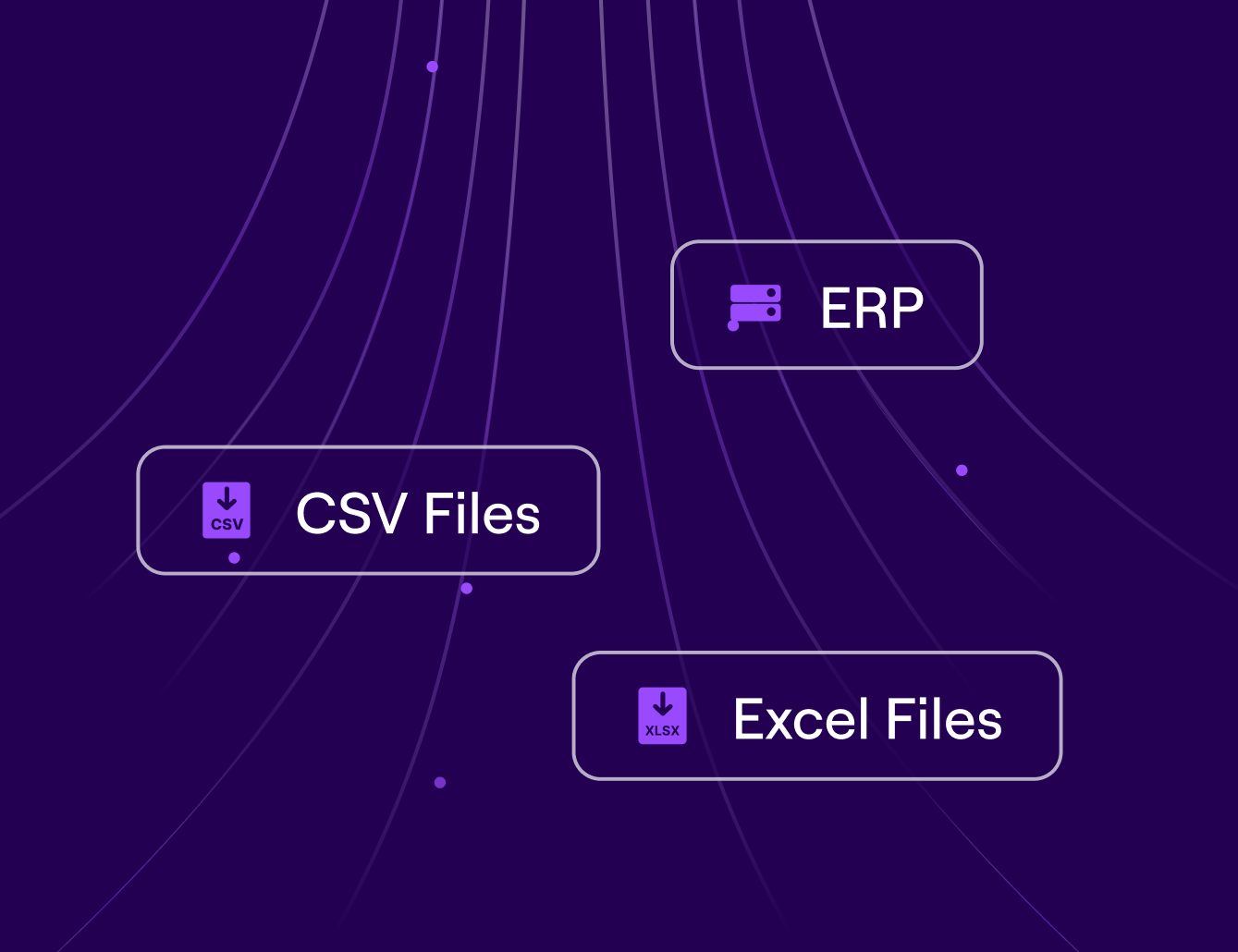
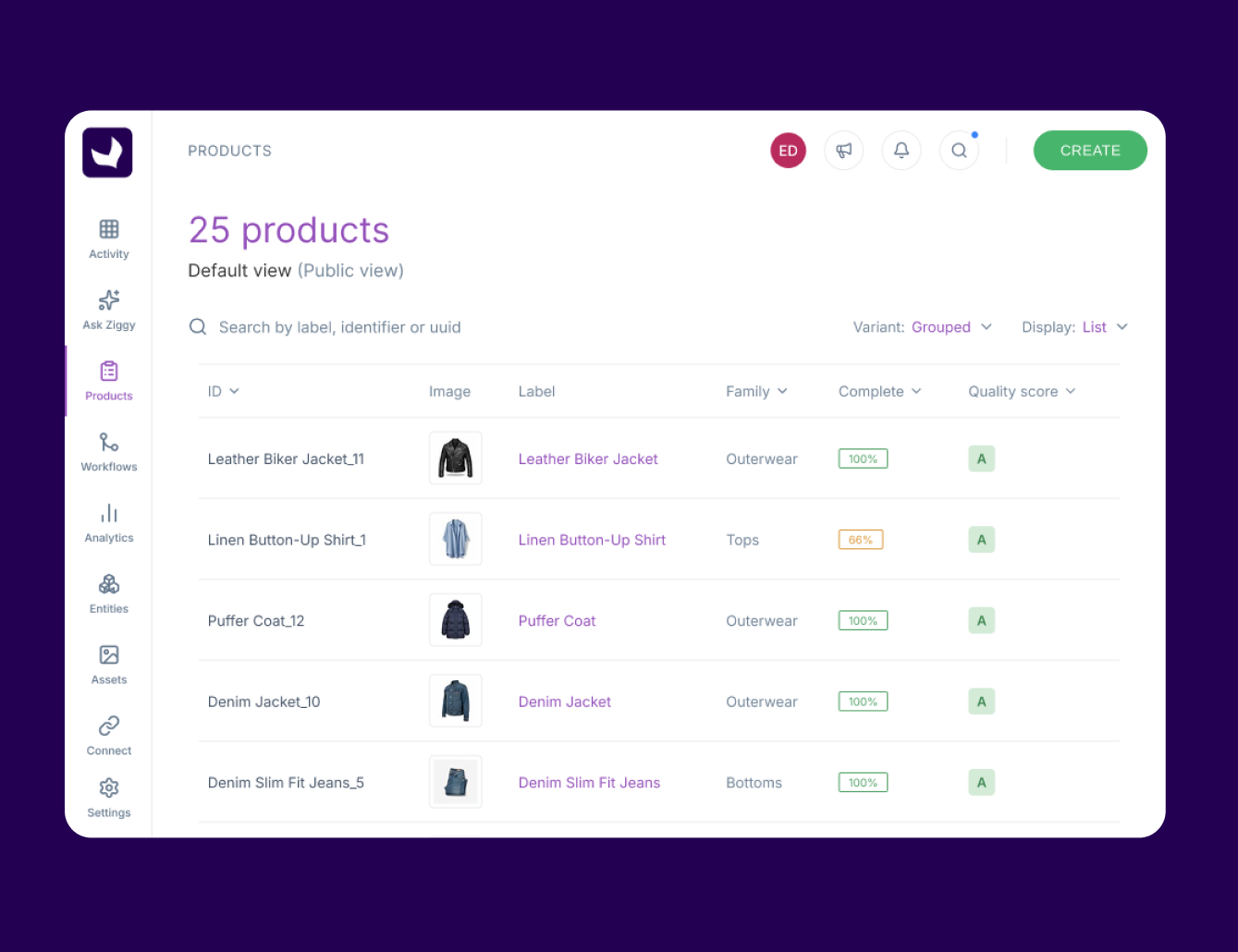



Akeneo’s fleet of agents surfaces gaps, flags inconsistencies, and helps your team make smarter data decisions, faster, at scale.
PX Insights monitors how your products perform across channels and AI-driven search, turning intent and market signals into actionable intelligence for your PIM.
Push perfectly mapped product data to every channel with AI-automated channel mapping that eliminates manual work and keeps your catalog in sync as channel requirements evolve.
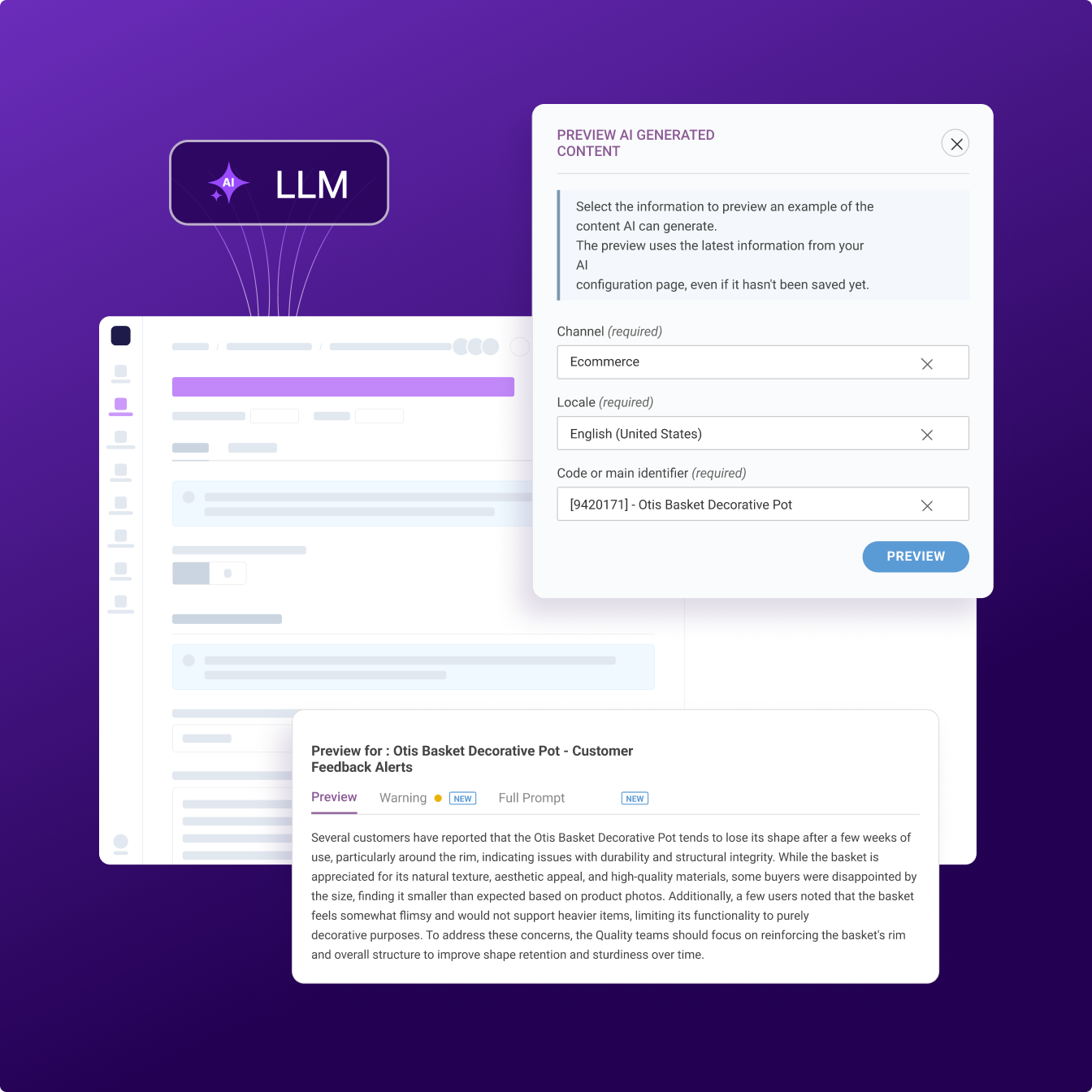
Scale product content with Akeneo’s generative AI, without compromising accuracy or brand voice. Connect your own LLM to enforce governance, leverage proprietary data, and act across every channel.
Akeneo’s Supplier Data Manager uses AI to automatically extract, map, and normalize product information from any supplier format, so data enters your catalog clean from day one.




Master your product data at the core, then extend it everywhere. Power every connected technology, from eCommerce, marketplaces, and agentic commerce protocols to ERP and DAM. APIs, MCP, and full custom extensibility included. Start vibe coding on your PIM today.


With Akeneo governing product data quality and localization across markets, they launched 7 new eCommerce markets in 6 months.
Read the full storyRead the full storyRead the full story
Streamlined that entire process into Shared Catalogs, now taking two hours.
Read the full storyRead the full storyRead the full story
Moving from manual, time-intensive workflows to a centralized AI-powered system, enabling faster launches across all channels.
Read the full storyRead the full storyRead the full story
Used Akeneo’s native AI to replace manual, time-intensive launch processes with governed, centralized automation across global channels.
Read the full storyRead the full storyRead the full story
Used Akeneo Supplier Data Manager to centralize and automate supplier collaboration, transforming an operational burden into a scalable, accurate product data engine.
Read the full storyRead the full storyRead the full story
Using Supplier Data Manager, achieved 98% classification accuracy, 10x the previous annual rate.
Read the full storyRead the full storyRead the full story
Streamlined entire product data workflow, cutting enrichment time in half, accelerating time to market, and reducing enrichment.
Read the full storyRead the full storyRead the full storyClean, govern, and activate your data to power next-generation experiences.
Akeneo helps businesses centralize, enrich, optimize, and activate their product information so they can deliver consistent, compelling product experiences across every sales channel. Many organizati…
Akeneo helps businesses centralize, enrich, optimize, and activate their product information so they can deliver consistent, compelling product experiences across every sales channel.
Many organizations struggle with scattered product data across spreadsheets, ERP systems, eCommerce platforms, and supplier portals. This leads to inconsistent product descriptions, slow product launches, internal inefficiencies, and poor customer experiences.
Akeneo Product Cloud acts as a single source of truth for product information, making it easier to:
By streamlining product data management and enrichment, Akeneo enables teams to work more efficiently while delivering better product experiences that drive conversion and revenue.
Akeneo provides the foundational “Product Data Intelligence” required to fuel modern AI ecosystems. For AI to be effective, it requires more than just raw data; it requires structured, hig…
Akeneo provides the foundational “Product Data Intelligence” required to fuel modern AI ecosystems. For AI to be effective, it requires more than just raw data; it requires structured, high-context information that is “machine-ready.”
Akeneo prepares your data for three critical AI frontiers:
How Akeneo makes this happen:
By treating product data as a strategic asset, Akeneo ensures that your business isn’t just using AI, but is findable and functional within the AI-first economy.
Akeneo PIM is purpose-built to centralize, manage, enrich, and distribute product information for commerce, while ERP, DAM, and MDM systems serve different core functions. Although these systems often…
Akeneo PIM is purpose-built to centralize, manage, enrich, and distribute product information for commerce, while ERP, DAM, and MDM systems serve different core functions. Although these systems often integrate with each other, they are not interchangeable.
While these systems often hold product data, they serve fundamentally different masters. ERPs manage operations, DAMs manage files, and MDMs manage records. Akeneo PIM is the only system purpose-built to manage the Product Experience (PX).
Here is how Akeneo differentiates itself at the “hand-off” point:
ERP (Enterprise Resource Planning): An ERP system manages operational and transactional data such as inventory, pricing, orders, and financials. It is not designed to enrich marketing-ready product content or manage omnichannel product experiences.
DAM (Digital Asset Management): A DAM system stores and organizes digital assets like images, videos, and documents. It does not structure product attributes, manage product data quality, or control product content workflows.
MDM (Master Data Management): An MDM system governs core business entities (e.g., customers, suppliers, products) at a high level. It focuses on data governance across the enterprise, not on optimizing product content for commerce and customer experience.
In short, ERP runs operations, DAM manages assets, MDM governs master records, and PIM powers the entire product experience.
Akeneo is used by mid-market and enterprise brands, manufacturers, distributors, and retailers that manage large, complex product catalogs across multiple sales channels. These companies typically sel…
Akeneo is used by mid-market and enterprise brands, manufacturers, distributors, and retailers that manage large, complex product catalogs across multiple sales channels.
These companies typically sell through eCommerce sites, marketplaces, retail stores, distributors, or a combination of channels, and need consistent, high-quality product information everywhere.
Akeneo is especially valuable for organizations that:
Industries commonly using Akeneo include retail, fashion and apparel, consumer goods, manufacturing, automotive, home and garden, electronics, food and beverage, and B2B distribution.
Any organization that depends on accurate, enriched product data to sell effectively can benefit from Akeneo.
Akeneo is built on an API-first architecture, specifically designed to act as the heartbeat of a modern, composable commerce stack. Rather than simple file transfers, Akeneo uses a high-performance in…
Akeneo is built on an API-first architecture, specifically designed to act as the heartbeat of a modern, composable commerce stack. Rather than simple file transfers, Akeneo uses a high-performance integration framework that ensures data flows in near real-time across your entire ecosystem.
Our integration strategy relies on three technical pillars:
Where Akeneo fits in your stack:
The Result: A “best-of-breed” ecosystem where data isn’t just moved—it’s synchronized. Akeneo eliminates data silos and ensures that your “vibe coding” projects, AI engines, and storefronts always have access to the latest product truth.
Product data is the foundation for AI-powered commerce because AI systems rely on accurate, structured, and enriched product information to generate meaningful results. Artificial intelligence (AI) an…
Product data is the foundation for AI-powered commerce because AI systems rely on accurate, structured, and enriched product information to generate meaningful results.
Artificial intelligence (AI) and generative AI (GenAI) tools power capabilities like personalized recommendations, intelligent search, conversational commerce, automated content generation, and dynamic merchandising. But these systems are only as effective as the data they are trained on and connected to.
When product information is incomplete, inconsistent, or unstructured, AI outputs become unreliable, leading to poor recommendations, irrelevant search results, and inaccurate content.
High-quality product data enables AI to:
Without strong product data, AI cannot deliver strong commerce outcomes. With it, businesses can unlock smarter automation, better personalization, and more engaging product experiences.
 Summer Release