Release

Put AI Agents to Work Across Product Data, With Control Built In

Learn More
Akeneo-Logo

The 10 AI Agents Every Product Data Team Should Be Planning For

Artificial Intelligence

The 10 AI Agents Every Product Data Team Should Be Planning For

AI agents are beginning to take on everything from supplier onboarding and enrichment to content creation, compliance, and performance analysis. But the real opportunity goes beyond automating one task at a time. Discover the 10 high-impact AI agents product data teams should be planning for, what each one could do across the product lifecycle, and why trusted data, shared business rules, and connected workflows will determine whether those agents create real value or simply add more complexity.

If you work with product data, there is a good chance you’ve already implemented your first AI use case.

Maybe you want to automate supplier onboarding. Perhaps your team is experimenting with AI-generated product descriptions. Maybe enrichment is taking too long, localization is creating bottlenecks, or channel errors are eating up hours every week, and so you’ve been testing out how AI can help optimize these processes, and maybe you’ve already seen success with some of these programs.

But once one AI-powered workflow starts delivering value, the natural question becomes: what else could we automate?

That is where product teams begin moving from a single AI assistant toward something much more interesting: a collection of specialized AI agents working across the product lifecycle.

There is no single “AI agent for PIM.” There are many potential agents, each solving a different problem and supporting a different stage of product operations. The ten below represent some of the highest-impact opportunities product data teams should be thinking about today.

1. Product Modeling Agent

Before a product can be enriched, marketed, or published, it needs the right structure.

A Product Modeling Agent can analyze product families, variants, relationships, and taxonomies to identify inconsistencies, duplicates, or opportunities to improve how a catalog is organized.

Think of it as an always-on partner for keeping your product model aligned with the reality of what you sell.

2. Supplier Data Agent

Supplier onboarding is still one of the most manual parts of product information management.

A Supplier Data Agent can connect to supplier sources, extract and map product information, normalize formats, validate incoming data, and prepare products for enrichment. Instead of teams spending hours reconciling spreadsheets and files, the agent handles much of the repetitive groundwork.

3. Enrichment Agent

This is one of the most obvious AI opportunities for product teams.

An Enrichment Agent identifies missing or incomplete product information and fills gaps using trusted sources such as supplier documentation, technical PDFs, imagery, or approved web content.

The important word there is trusted. AI does not magically fix fragmented data. If the underlying sources conflict, an agent can just as easily scale the wrong answer as the right one.

4. Content Agent

A Content Agent turns structured product information into customer-facing content.

Descriptions, titles, bullet points, FAQs, marketing copy, and channel-ready content can all be generated from the same governed product record while following approved terminology and brand guidelines.

The biggest opportunity here is producing content that is consistent across thousands of products without requiring your team to start every page from scratch.

5. Localization Agent

Translation is only one part of localization.

A Localization Agent can adapt content for language, terminology, cultural expectations, and market-specific requirements. The goal is not to produce a literal translation, but content that is ready for a specific market.

That becomes increasingly valuable when product teams are managing many regions, languages, and local requirements at once.

The 10 AI Agents Your Team Should Be Planning For

6. Asset Intelligence Agent

Product assets are often treated separately from product information, even though the two are deeply connected.

An Asset Intelligence Agent can analyze product images and other digital assets, generate metadata, assess visual quality, connect assets to the correct products, and flag where additional imagery or information may be needed.

That can significantly reduce the manual work involved in organizing and validating large asset libraries.

7. Quality & Compliance Agent

The bigger your catalog becomes, the harder it is for people to spot every inconsistency.

A Quality & Compliance Agent can continuously monitor catalog health, identify incomplete or potentially incorrect information, check business and regulatory rules, and recommend corrective actions.

Crucially, it won’t make every decision itself. High-risk or uncertain recommendations can (and should) still be routed to a human expert for review.

8. Activation Agent

Creating good product information is only useful if channels can actually accept it.

An Activation Agent monitors connected marketplaces, retailers, and other destinations for publication errors, changing requirements, and policy issues. It can identify root causes, group similar problems, and recommend or prepare corrective actions.

Instead of discovering errors after a listing fails, teams can move toward proactively managing channel readiness.

9. Market Intelligence Agent

Most product data workflows still operate primarily in one direction: create the information, publish it, and move on.

A Market Intelligence Agent closes that loop.

It can monitor channel performance, reviews, customer behavior, and AI search visibility, then feed those signals back into the product information process so teams know what should be improved next.

10. Insights Agent

The final agent looks across the system rather than focusing on one specific task.

An Insights Agent can analyze catalog performance, customer behavior, channel signals, and AI discovery data to identify opportunities, recommend actions, and measure business impact over time.

In other words, it helps product teams move from managing tasks to making better decisions.

A Note on Human Oversight

None of these agents should be thought of as fully autonomous replacements for product data teams.

Their real value is in taking on repetitive, manual, and time-consuming work such as classifying supplier data, identifying missing attributes, generating first drafts, checking for inconsistencies, or preparing content for activation, all while keeping people in control of the decisions that require judgment.

That means human review still very much matters. Product information can carry legal, regulatory, technical, commercial, and brand implications, so teams need clear boundaries around what an agent can complete automatically, what should be recommended for approval, and what must remain human-led.

The goal is not to remove people from the process. It is to make better use of their time.

When agents handle the predictable work and surface the exceptions that deserve attention, experts can spend less time on repetitive tasks and more time applying the context, experience, and judgment that AI cannot provide on its own.

The Future of PIM Agents

You do not need to build all ten of these tomorrow, nor can you.

Most product teams will start with one or two high-impact use cases: perhaps supplier onboarding, enrichment, content generation, or activation.

But there is a bigger idea worth planning for.

As individual AI capabilities become easier to access, the long-term differentiator will not be having a single Content Agent or an Enrichment Agent, but will come from how effectively multiple agents work together and interact with each other.

Does your Content Agent know when the Enrichment Agent has updated an attribute? Does your Localization Agent wait until content has been approved? Does your Activation Agent understand which version of the product record is authoritative?

That is where trusted product data, shared business rules, human oversight, channel intelligence, and traceability become essential. Without that foundation, a collection of useful AI tools can quickly become a collection of automation silos.

The best place to start is with the use case that solves a real operational problem today, and start building a foundation that makes the next agent easier, safer, and more valuable to introduce tomorrow.

The Agentic PIM Playbook: The 10 AI Agents Your Product Data Team Should Be Planning For

Discover the 10 AI agents reshaping product operations, and the trusted product data foundation you need to make them work together at scale.


Casey Paxton, Content Marketing Manager

Akeneo

What is the AI Harness? The Infrastructure That Makes Enterprise AI Work

Artificial Intelligence

What is the AI Harness? The Infrastructure That Makes Enterprise AI Work

AI models are becoming more powerful, but the real challenge is making them useful, trustworthy, and safe inside the enterprise. Discover what an AI harness looks like in practice, why it becomes essential as organizations move toward agentic AI, and the foundational steps businesses can take to build one.

For the past few years, much of the conversation around enterprise AI has focused on the model.

Which model should we use? How powerful is it? How accurate are its answers? Can it generate better content, automate a workflow, or power an AI agent?

But as organizations move from experimenting with AI to actually putting it to work, another question is becoming much more important:

What are the guardrails of our AI model?

An AI model on its own may be able to generate a convincing answer, but it does not automatically know which product information it is allowed to use, which business rules it needs to follow, when a human needs to approve an action, or whether it has permission to update a system.

That surrounding infrastructure is increasingly being described as the AI harness.

What is An AI Harness?

An AI harness is the combination of systems, controls, context, and workflows that allow an AI model or agent to operate reliably within a business.

Think of the model as the engine. The harness is everything that connects that engine to the rest of the vehicle and keeps it moving in the right direction.

It can include capabilities such as:

  • Memory and context that give AI the information it needs to make relevant decisions
  • Permissions that determine what information an agent can access and what actions it can take
  • Guardrails and business rules that define acceptable behavior
  • Orchestration that coordinates AI across systems, workflows, and other agents
  • Human approval workflows for decisions that require expertise or oversight
  • Auditability and traceability so organizations can understand what happened, why, and using which information

This idea becomes especially important as businesses move toward agentic AI.

While a chatbot can really only answer a question, an autonomous AI agent may actually take an action by enriching a product record, translating product copy, classifying an item, publishing information to a marketplace, or recommending a pricing change.

Once AI moves from answering to acting, the infrastructure around it becomes critical.

Why AI Needs More Than Good Prompts

Early AI experimentation often starts with prompts.

Give a model the right instructions, provide some information, refine the prompt, and see what happens.

That works well for experimentation. It becomes much less dependable when AI is connected to operational processes.

If you have an agent tasked with improving product descriptions, then it needs to understand questions like:

  • Which product attributes are approved sources of truth? 
  • Which claims can legally appear in a particular market? 
  • What tone should the brand use? 
  • Which terminology is prohibited? 
  • Does the description need human review? 
  • Which version should be published to Amazon versus the company’s ecommerce site?

These questions require access to trusted systems, structured product information, business context, permissions, governance, and workflows.

In other words, they require a harness.

The AI Harness Connects AI to Systems of Record

For many enterprises, the foundation for an AI harness likely already exists.

ERP systems contain operational information, PIM platforms govern product information, DAM systems manage digital assets, and commerce platforms, marketplaces, supplier systems, and customer-facing applications each hold additional context.

The challenge is enabling AI to interact with these systems in a controlled way.

For product-related AI in particular, a PIM can play an important role as a trusted system of record. Instead of allowing an agent to pull product information indiscriminately from spreadsheets, websites, supplier files, and disconnected databases, organizations can give it governed access to consistent, validated product data.

That dramatically changes what AI can do.

The Agentic Commerce Reality Check

What Does an AI Harness Look Like inPractice?

There is no single piece of software called an AI harness that every organization can simply install. Instead, businesses will build the capabilities progressively around the AI use cases they deploy.

A practical implementation can begin with four areas:

1. Establish trusted data foundations

AI can only work reliably with the information available to it.

Before giving agents greater autonomy, organizations need to identify the systems that contain authoritative product information and reduce fragmentation between supplier data, ERP records, PIM systems, commerce platforms, and channel feeds.

Structured, complete, governed product information gives the harness a dependable foundation.

2. Give AI business context

An AI agent needs to understand how your organization operates: taxonomies, approval requirements, channel specifications, brand terminology, regulatory rules, localization standards, and other repeatable decisions.

Capturing that knowledge as reusable context allows AI to operate according to the business rather than generating generic outputs.

3. Define permissions and human checkpoints

Not every AI action should have the same level of autonomy. An agent might be allowed to automatically fill a low-risk missing attribute but require approval before changing a compliance claim or publishing information to a retailer.

Organizations should explicitly define what AI can read, recommend, change, approve, and publish.

Human-in-the-loop workflows then become part of the harness rather than an emergency safeguard added after something goes wrong.

4. Build traceability into every action

As AI takes on more operational responsibility, businesses need to know where its decisions came from.

Which source data did the agent use? What instruction was it given? Which rule was applied? Did a human approve the result? What was eventually published?

That audit trail becomes essential for governance, troubleshooting, compliance, and ultimately trust.

The Real AI Advantage is What You Build Around It

The race to adopt AI can make it feel like the model is the main event. But models are becoming more powerful, more accessible, and increasingly interchangeable.

The harder thing to replicate is the environment you create around them.

Your product knowledge. Your business rules. Your approval processes. Your channel requirements. Your governance. Your understanding of what AI should be allowed to do independently and where human judgment still matters.

So instead of asking whether your organization has access to the latest AI, ask a more revealing question:

If you gave an AI agent the keys to part of your product experience today, would it know how to drive?

The AI harness is what makes the answer yes

10 Hard Truths from IT Leaders on What’s Holding AI Back

Akeneo’s latest global survey reveals where AI confidence collides with the realities of product data, governance, integration, and scale.

Casey Paxton, Content Marketing Manager

Akeneo

How to Prepare Your Product Data for Agentic Commerce

Artificial Intelligence

How to Prepare Your Product Data for Agentic Commerce

Strong SEO rankings alone may no longer be enough when AI assistants and autonomous agents are comparing products, interpreting specifications, evaluating trust signals, and potentially making purchases on a shopper’s behalf. Discover what agentic commerce and AEO mean for brands, retailers, manufacturers, and distributors, and the practical steps you can take to build product data that is ready to compete when the decision-maker is a machine.

My sister recently needed to replace her child’s car seat before a long road trip. 

She needed one that fit her particular car model, worked for a specific age and weight range, met the right safety standards, had a washable cover, and could be delivered within two days, in time for the road trip.

A few years ago, that would have meant opening a handful of retailer tabs, checking specifications, reading reviews, comparing delivery dates, and probably second-guessing whether it was actually compatible with her car model or would actually arrive on time. 

Instead, she went straight to ChatGPT.

She described exactly what she needed and asked it to narrow down the options. Within minutes, she had a shortlist of products that appeared to meet her criteria, along with explanations of why each one might be a good fit.

That experience captures a much bigger shift in how people are beginning to shop. Increasingly, consumers are not starting with a search bar and working their way through a list of links. They are starting with a question, a problem, or a set of constraints and asking AI to do more of the research for them.

And this is only the beginning.

As AI evolves from recommending products to acting on behalf of shoppers, we are moving toward agentic commerce: a world where AI agents can research options, compare products, assess details like price, availability and policies, and potentially complete purchases with far less human intervention.

That changes the rules of product discovery. AI agents need product information they can actually interpret, verify, compare, and trust.

That is where Answer Engine Optimization, or AEO, comes in. And more importantly, it is why preparing your product data for AI today is quickly becoming one of the most important steps toward succeeding in agentic commerce tomorrow.

What Exactly is Agentic Commerce?

Today, most AI-powered shopping experiences still involve a human somewhere in the decision-making process. A shopper asks a question, an AI assistant recommends products, and the shopper decides what to do next.

Agentic commerce pushes more of that journey onto the AI.

An agent might interpret a request, establish requirements, compare products, evaluate compatibility, check delivery or return policies, assess trust signals, and eventually complete a transaction. 

The next phase of AI-powered discovery happens when agents move beyond answering questions to evaluating and potentially acting on behalf of shoppers.

But an agent can only make decisions based on the information available to it.

If your dimensions are missing, compatibility information is buried in a PDF, availability is outdated, or two retailers list conflicting specifications, the agent has a problem. It cannot confidently determine whether your product meets the shopper’s requirements.

And confidence matters when the AI is deciding whether to recommend or purchase it.

Where Does AEO Fit In?

SEO was designed for a world of keywords, rankings, traffic, and clicks. The objective was to get a page high enough in search results that a human would click through, visit your website, and continue their journey there.

AEO focuses on a different outcome: making information understandable, credible, relevant, and structured enough that an AI engine can use it in an answer or recommendation.

That distinction is increasingly important because SEO success does not automatically equal AI visibility. A product can rank well in conventional search while remaining difficult for AI to recommend because its underlying information is incomplete, inconsistent, unstructured, or difficult to verify.

Ultimately, AEO (and agentic commerce readiness) comes back to the product data itself.

Get Your Products Seen, Trusted, and Recommended by AI

How to Prepare Product Data for Agentic Commerce

1. Start with a governed source of truth

AI readiness becomes much harder when product information is scattered across spreadsheets, ERP systems, supplier portals, eCommerce platforms, and regional teams.

Agents need reliable product information, and organizations need a clear place where that information can be governed.

That is already influencing AI architecture; 65% of organizations rely on structured systems such as PIM or ERP to power their AI models, partly in response to integration challenges and data silos.

A centralized product information foundation gives teams somewhere to standardize, validate, enrich, approve, and distribute the information agents will depend on.

2. Make product information machine-readable

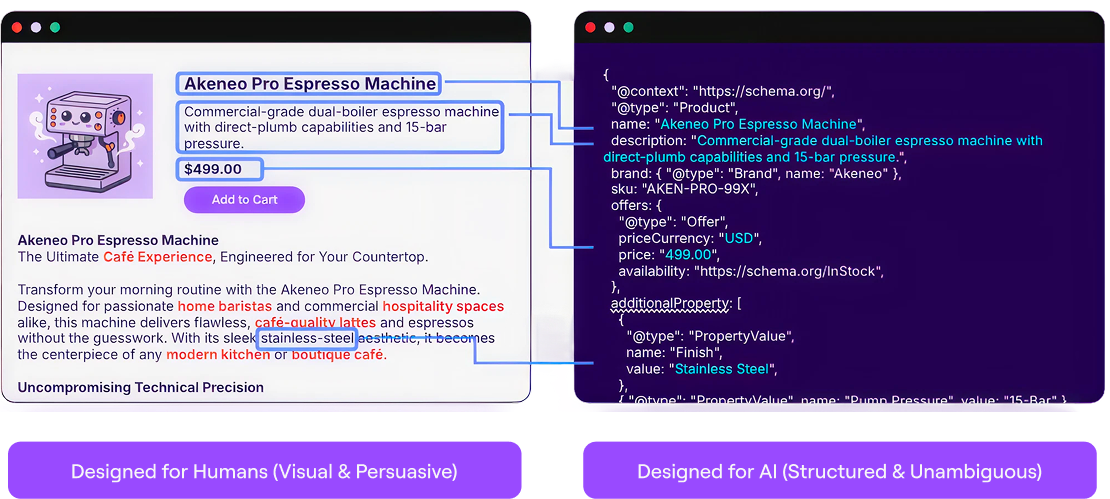
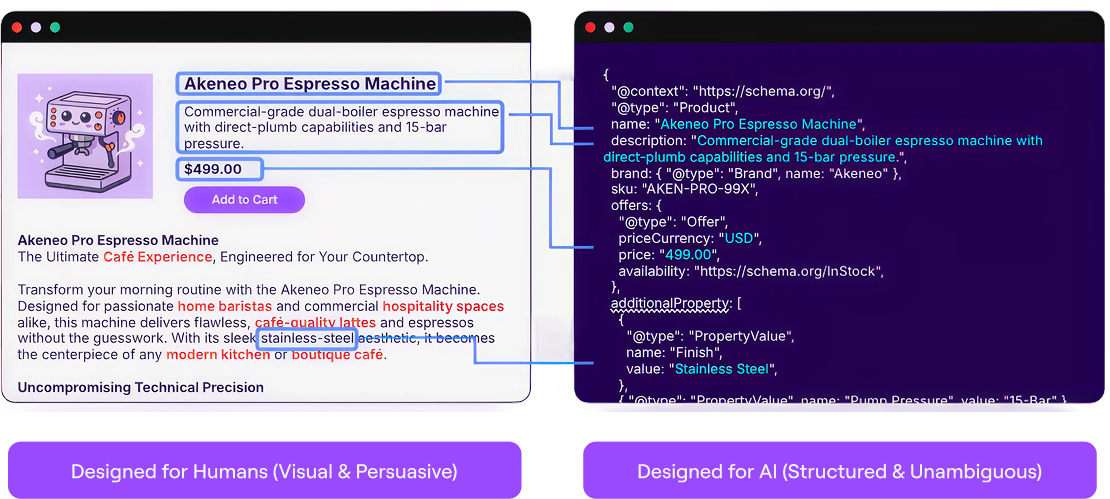
Beautiful product pages are designed for people. Agents need information designed for machines.

That means structured attributes, standardized categories, global identifiers, relationships between products, and appropriate product schema. These elements create the translation layer between human-facing content and machine interpretation.

Instead of forcing an AI to extract a product’s dimensions from a paragraph, give it clearly defined height, width, depth, material, compatibility, and other relevant attributes.

The less an agent has to infer, the easier your product is to evaluate.

3. Think beyond traditional completeness

A completed product record should not simply mean that every mandatory field in your PIM is filled in. Completeness increasingly needs to reflect buyer intent.

If someone asks for “a waterproof backpack suitable for commuting with a 16-inch laptop,” does your product data explicitly contain enough information to establish waterproofing, laptop compatibility, capacity, intended use, and relevant materials?

That’s why we recommend enriching records around environments, occasions, personas, problems, compatibility, and customer intent so AI can match products to real-world situations.

4. Replace vague language with useful facts

AI systems need evidence.

“Sleek design” tells an agent very little. “6-inch footprint that fits beneath standard kitchen cabinets” is far more useful. Specific, extractable facts help AI systems connect product characteristics with what a shopper is actually asking for.

Look at reviews, customer questions, search queries, and return reasons too. They can reveal the information shoppers care about that may never have made it into the original product record.

5. Keep information consistent everywhere

An agent may encounter your product on your website, a retailer site, a marketplace, a product feed, a review platform, or somewhere else entirely.

Conflicting prices, specifications, identifiers, or claims create uncertainty. The goal should be one governed product record that distributes consistent, enriched information across every relevant channel.

The Real Work of Agentic Commerce Happens Before the Agent Arrives

With the growing popularity of AI-powered search and discovery, a shopper may never read your carefully written description, scroll through your comparison table, or click through your category navigation. An AI agent may encounter your product somewhere else entirely, pull together what it can find, compare it against a dozen alternatives, and make a judgment in seconds.

In that moment, your product data becomes your salesperson.

It has to explain what the product is, who it is for, what it works with, why it is different, whether it is available, and whether the information can be trusted. There is no opportunity for a merchandising team to step in and clarify a missing attribute. No second chance to explain that an outdated retailer listing is wrong. The agent works with the evidence it has.

That is why preparing for agentic commerce is less about chasing the newest AI capability and more about making your catalog impossible to misunderstand.

The Invisible Shelf: Get Your Products Seen, Trusted, and Recommended by AI

Download the AEO playbook and learn how to make your products visible, trusted, and recommended in the era of AI commerce.

Casey Paxton, Content Marketing Manager

Akeneo

Digital Product Passport Requirements: What’s Mandatory in 2026 and 2027

Regulation Compliance

Digital Product Passport Requirements: What’s Mandatory in 2026 and 2027

Digital Product Passports are becoming a key part of the EU’s sustainability and product transparency agenda, with the first major compliance deadlines arriving in 2027. Discover what DPPs are, which companies and product categories are affected, what is actually mandatory in 2026 and 2027, and why complete, transparent, and traceable product information will be essential for staying ahead of future regulation.

For the past few years, the Digital Product Passport (DPP) has been easy to file under “something we’ll need to worry about eventually.”

Eventually is now getting a lot closer.

The infrastructure is now being put in place, product-specific rules are moving forward, and by February 2027, certain batteries sold in the EU will need a digital passport containing detailed, accessible information about everything from their composition and performance to their origins and end-of-life handling.

And that first deadline matters even if you do not sell batteries.

The Digital Product Passport is part of a much broader shift in how the EU expects companies to manage and communicate product information. Over time, more manufacturers, retailers, distributors, and brands will need to prove not only what a product is, but where its materials came from, what claims can be substantiated, how it should be repaired or recycled, and whether that information can be traced back to a reliable source.

That makes DPP compliance much more than a QR-code project. It is fundamentally a product information challenge.

So, what is actually mandatory today? What changes in 2027? And what should companies be doing now to make sure their product data is ready?

What is a Digital Product Passport?

A Digital Product Passport is a structured digital record associated with a product, component, or material. It is designed to make reliable information available throughout the product lifecycle, supporting sustainability, circularity, and regulatory compliance.

Depending on the category, a DPP may contain information about product identity, materials, origin, environmental performance, durability, repair, reuse, hazardous substances, and recycling. Users access it through a data carrier, such as a QR code, attached to the product, packaging, or accompanying documentation.

A DPP must use a unique identifier, follow applicable interoperability requirements, be registered in the EU DPP Registry, and remain accurate over time. The Registry stores identifiers and metadata, while detailed data remains decentralized under the responsible operator or a service provider.

Which companies are affected?

The Ecodesign for Sustainable Products Regulation (ESPR) establishes a framework that can ultimately apply to most physical goods placed on the EU market, including components and intermediate products. Food, feed, medicines, living organisms, and products of human origin are among its exclusions.

The ESPR does not automatically require every covered product to have a passport. Product-specific delegated acts determine which products need one, what information it must include, and when compliance begins.

The rules apply to domestic and imported products. Responsibility can fall on manufacturers, authorized representatives, importers, distributors, dealers, or fulfillment service providers. Primary responsibility for creating an accurate DPP generally sits with the economic operator placing the product on the EU market. Online marketplaces will also need to make applicable passports accessible during distance sales.

A UK, US, or Asian brand is therefore not outside the regime simply because it has no EU factory. 

Any business selling an in-scope product into the EU must determine which operator is responsible and ensure the required information can move across the supply chain.

What is mandatory in 2026?

For most sectors, 2026 is the year the DPP infrastructure becomes operational, not the year every product needs a passport.

The EU DPP Registry became operational on July 20, 2026. Six harmonized technical standards were formally adopted in July, with two additional standards scheduled for September. The Commission also plans to adopt product-specific requirements for iron and steel in the fourth quarter of 2026.

Yet an adoption date is not a compliance date. The Commission states that companies will receive a transition period of at least 18 months after an ESPR delegated act is adopted. On that minimum timetable, even if the iron-and-steel act arrives as planned in late 2026, its practical deadline would fall in 2028 or later.

Inclusion in the ESPR working plan means a product group is being assessed and regulated; it does not create an immediate DPP obligation.

Digital Product Passports 101

What becomes mandatory in 2027?

The clearest binding deadline is February 18, 2027. From that date, every electric-vehicle battery, light-means-of-transport battery, and industrial battery with a capacity greater than 2 kWh placed on the EU market or put into service must have a battery passport.

This covers EV batteries, batteries for e-bikes, e-mopeds, and e-scooters, and qualifying industrial batteries. The operator placing the finished battery on the market (not the supplier of an individual cell or module) is responsible for creating and maintaining the passport. It must be linked to the battery through a QR code.

The Commission’s August 2026 guidance maps 71 possible battery-passport data points and identifies which are mandatory, optional, conditional, or not yet required at launch. Relevant information includes identifiers, manufacturer details, model and serial or batch information, manufacturing location and date, weight, capacity, chemistry, critical raw materials, hazardous substances, performance, durability, and information supporting repair, reuse, and recycling.

Other sectors will advance during 2027. Delegated acts are planned for construction materials, textiles, aluminum, and tires. These are expected rule-adoption milestones, not automatic 2027 compliance deadlines. A planned 2027 textiles act, for example, does not mean every garment must carry a DPP before year-end; the minimum transition period still applies.

What is required for DPP success?

The visible QR code for a DPP is actually the final step. The difficult work is creating complete, transparent, and traceable product information behind it.

Completeness means identifying every required field, determining whether it applies at model, batch, or item level, and collecting it from systems and suppliers. Data may be spread across PIM, ERP, PLM, compliance, lifecycle-assessment, and supplier platforms. Missing evidence cannot be solved with polished copy at the last moment.

Transparency means making reliable information available to the right audience. Some data will be public, while other information may be restricted to authorities, repairers, or authorized actors. Sustainability claims should connect to calculations, certificates, and source records, not stand as unsupported marketing statements.

Traceability means giving products and operators stable identifiers and preserving the origin, timestamp, ownership, and approval history of each data point. Passport information must remain accurate as a product is repaired, repurposed, or otherwise changes.

Companies also need named data owners, validation workflows, supplier requirements, change controls, and interoperable systems. A central product information layer can coordinate the data, but it must connect to the specialist systems where technical, environmental, and compliance evidence originates.

The 2027 battery deadline is only the beginning. As DPP requirements expand into additional sectors, businesses will need to have a reliable foundation for managing complete, transparent, and traceable product information.

That means bringing product data together, improving its quality, establishing clear governance, and making it easier to connect information from suppliers, compliance systems, ERP, PLM, and other sources. Those capabilities are valuable for DPP compliance, but they also support better product experiences, faster channel activation, and stronger readiness for future regulatory requirements.

Akeneo can help businesses build that foundation. By centralizing, enriching, governing, and distributing trusted product information, Akeneo gives teams a more scalable way to prepare for evolving requirements like the Digital Product Passport.

See how Akeneo can help you build a product information foundation that is ready for what comes next.

Are you ready to take the next step?

Our Akeneo Experts are here to answer all the questions you might have about our products and help you to move forward on your DPP journey.

Casey Paxton, Content Marketing Manager

Akeneo

The Four Pillars of AEO: How to Make Your Products Visible, Trusted, and Recommended by AI

Artificial Intelligence

The Four Pillars of AEO: How to Make Your Products Visible, Trusted, and Recommended by AI

Product discovery is changing as more shoppers turn to AI for direct answers and recommendations instead of scrolling through traditional search results. Discover how Answer Engine Optimization (AEO) differs from SEO and the four pillars that determine whether AI can confidently recommend your products.

For years, digital visibility has largely meant one thing: search engine optimization (SEO). We optimized product pages around keywords, technical performance, and search rankings with the goal of getting shoppers to click through to our websites.

That strategy still matters. But the way people discover products is changing.

Instead of searching for “best coffee machines” and scrolling through pages of results, a shopper can now ask ChatGPT, “What’s the best coffee machine for a small apartment that can make espresso?” ChatGPT then interprets the shopper’s intent, compares different products, evaluates available information, and produces an answer.

That shift is where Answer Engine Optimization (AEO) comes in. AEO is the practice of structuring product content and building brand authority so that AI engines can confidently cite and recommend your products.

The important distinction is that SEO primarily focuses on optimizing pages to rank in traditional search, while AEO focuses on whether your products are visible and understandable within AI-generated answers. A product can rank well on Google and still remain virtually invisible to an AI system if its product information is incomplete, inconsistent, difficult to verify, or inaccessible in a machine-readable format; we call this the Invisible Shelf.

So how do you make your products easier for AI to understand and recommend? It starts with four pillars: Structure, Authority, Freshness, and Relevance.

1. Structure: Be Understandable

Before an AI engine can recommend your product, it has to understand what it actually is.

AI engines rely on consistent categorization and clearly defined attributes to connect products with shopper intent. Structured data, including Schema.org markup, essentially acts as a translator between the product information humans see on a page and the machine-readable facts AI systems can interpret.

Let’s go back to our shopper looking for a coffee machine for a small kitchen. An AI system may interpret that request as a combination of specific requirements: an espresso machine, a compact footprint, and suitability for a countertop. If dimensions, product type, or other relevant attributes exist only in a paragraph of marketing copy (or are missing altogether) the AI may struggle to make that connection.

The lesson is simple: do not make AI guess. Product dimensions, materials, compatibility, identifiers, features, and other important facts should be clearly structured and accessible.

Designed humans vs AI


2. Authority: Be Credible

Being understandable is only the first hurdle. AI also needs to trust what it finds.

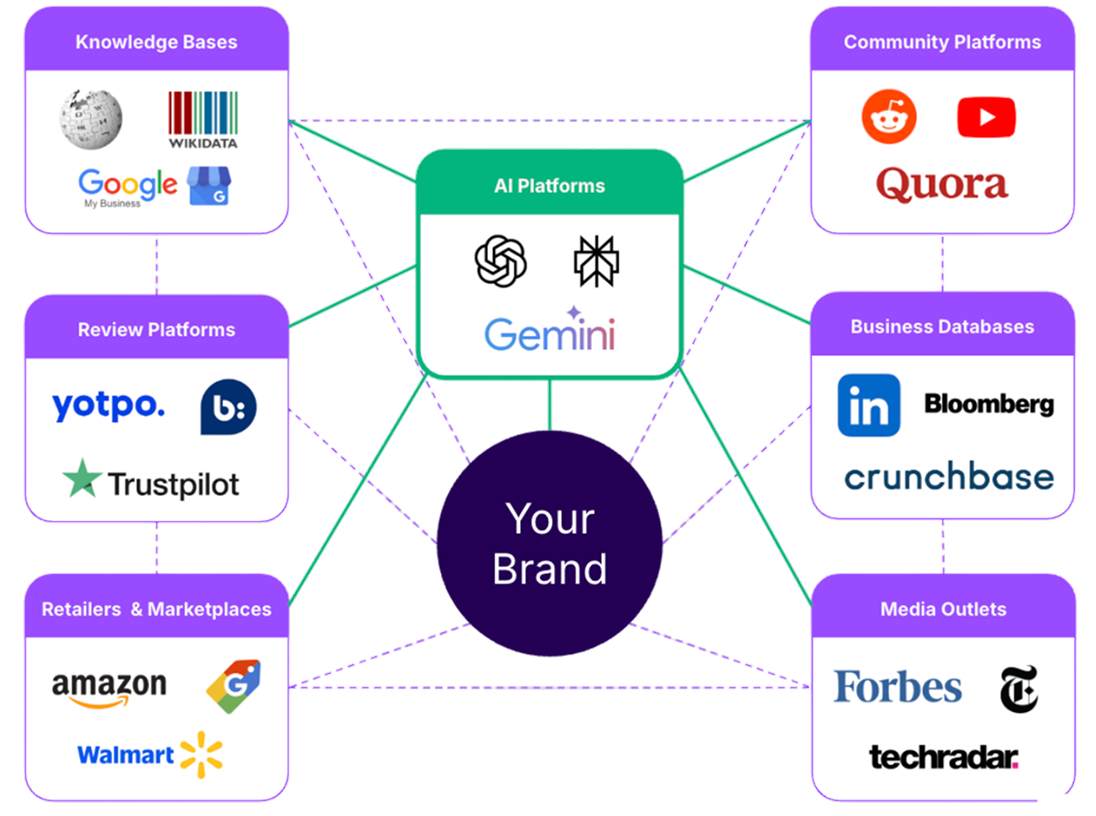
AI engines can cross-reference product and brand information across multiple independent sources before deciding whether a recommendation is credible. Your own website may serve as the primary source of truth, but information from knowledge bases, business databases, retailers, reviews, community platforms, and media coverage can all contribute to the broader picture.

Imagine your website says a product has one set of specifications while a major marketplace lists something different. A human shopper might simply assume one page has not been updated. For an AI system trying to determine which information is accurate, however, that contradiction creates uncertainty.

That is why consistency across channels matters so much. If product descriptions, specifications, identifiers, policies, or other details differ from one destination to another, confidence can erode. A governed source of truth that distributes consistent product information across channels gives AI systems a much clearer foundation to work from.


Customer Input


3. Freshness: Be Relevant

Real-time data velocity is an important trust signal for AI engines. Products need active, recent information around them if they are going to maintain visibility over time.

For your brand, that might mean recent customer sentiment on review platforms or up-to-date signals from major marketplaces. In B2B environments, freshness can come from mentions in analyst reports, partner ecosystems, professional directories, or industry publications.

Maybe you have a product that launched three years ago and has since been updated with new functionality. If most third-party descriptions still reflect the original version, an AI engine may encounter conflicting evidence about what the product can actually do.

AEO therefore cannot be treated as a one-time optimization project. Product information, marketplace content, reviews, and external references all need ongoing attention as products and markets evolve.

Get Your Products Seen, Trusted, and Recommended by AI

4. Relevance: Be Recommended

The final pillar may be the most important distinction between simply being visible and actually being chosen.

Technical completeness makes your product understandable. Context makes it recommendable. AI engines increasingly respond to conversational questions built around needs, situations, and use cases rather than simple keyword combinations.

That means product content should go beyond generic claims like “sleek design” or “high performance.” Specific, extractable facts are far more useful. 

Context also means connecting products to real-world occasions and needs. A coffee machine is not always just a coffee machine. Depending on its attributes, it might also be a compact espresso maker for a studio apartment, a housewarming gift under £100, or an everyday appliance for a remote worker. Those details help AI connect a product to the way someone is actually asking a question.

You can go one step further by providing clear answers to common customer questions directly within product content. AI engines are designed to synthesize answers, so making useful information easy to extract increases the likelihood that your product can become part of that answer.

From Search Visibility to AI Readiness

The four pillars of AEO work together: structure helps AI understand your products, while authority helps it trust them. Freshness shows that the information remains relevant, and context helps AI connect the product to a shopper’s specific need.

Ultimately, AEO is not about abandoning SEO or chasing another marketing acronym. It reflects a broader change in product discovery. As shoppers increasingly rely on AI to compare options and make recommendations, product information has to work for machines as well as humans.

The Invisible Shelf: Get Your Products Seen, Trusted, and Recommended by AI

Download the AEO playbook and learn how to make your products visible, trusted, and recommended in the era of AI commerce.

Casey Paxton, Content Marketing Manager

Akeneo

SAP Commerce On-Premise Support Is Changing: What Should You Do Next?

Technology

SAP Commerce On-Premise Support Is Changing: What Should You Do Next?

The final SAP Commerce on-premise release is here, along with the end of mainstream maintenance. With that comes an an opportunity to look beyond the technical migration itself. This blog explains what the support change does (and does not) mean, how to evaluate the future role of SAP’s embedded PCM, and why a dedicated, best-of-breed PIM may be worth considering as part of a wider strategy for composable commerce, omnichannel growth, and AI readiness.

For organizations running SAP Commerce on-premise (formerly SAP Hybris Commerce), July 31, 2026 was an important planning date.

On that day, version 2205, the final on-premise release, reached End of Mainstream Maintenance and moved into Customer-Specific Maintenance.

It’s important to note that SAP has stated that there is currently no defined sunset or end-of-life date for SAP Commerce on-premise, and this change does not affect SAP Commerce Cloud. 

The other good news is that this is not an overnight shutdown, nor does it automatically require every organization to replace its product information management capabilities. It is, however, a valuable moment to review the role SAP Commerce plays in your technology landscape and decide what should come next.

A modernization milestone, not a forced migration

When SAP Commerce 2205 enters Customer-Specific Maintenance, customers can continue to access support under their existing arrangements, but the scope changes. SAP will no longer adapt the release to certain new or changing requirements, including legal changes, technological updates, new support packages, updates to third-party libraries, or support for new interfaces.

For some organizations, the logical next step will be a move to SAP Commerce Cloud. Others may use the milestone to compare commerce platforms, adopt a more composable architecture, or modernize several parts of their digital stack at once.

There is another important point to clarify: Product Content Management, or PCM, is not a standalone SAP product that is independently reaching end of life. It is an embedded capability within SAP Commerce, and SAP Commerce Cloud continues to include product, content, and catalog management capabilities. An organization moving to SAP Commerce Cloud can therefore continue using SAP’s embedded PCM without adopting a separate PIM.

The right conversation is not, “What must we replace?” It is, “What architecture will best support the business we are becoming?”

Modernization is about more than infrastructure

Moving from customer-managed infrastructure to a cloud service can be a major undertaking, but infrastructure is only one part of modernization.

Product information now supports far more than a single eCommerce storefront. The same data may need to power regional sites, mobile experiences, marketplaces, distributor portals, print catalogs, customer service tools, retail partners, and emerging AI-powered discovery channels. It must also serve teams across marketing, eCommerce, product, compliance, sales, and operations.

At the same time, organizations are investing in AI and composable commerce. Both increase the importance of trusted, structured, well-governed product information. An AI agent cannot reliably compare, describe, or recommend products when attributes are incomplete, terminology is inconsistent, or critical context is scattered across systems. A composable architecture also delivers limited flexibility when product data remains tightly coupled to one commerce platform.

That makes this milestone an opportunity to ask a broader strategic question: Should product information remain embedded within commerce, or should it be managed through a dedicated, best-of-breed PIM?

When a dedicated PIM may make sense

Embedded PCM can remain a practical choice for organizations whose product content processes are closely aligned with their SAP Commerce environment. A dedicated PIM becomes worth considering when product information has a wider role across the enterprise.

Questions to consider include:

  • Are multiple suppliers, business units, regions, or agencies contributing product information?
  • Does the same catalog need to be adapted for different languages, markets, retailers, marketplaces, or distributors?
  • Do marketing and product teams need greater ownership of enrichment, validation, approvals, and localization?
  • Are custom workflows or data-quality rules becoming difficult to maintain within the commerce platform?
  • Do AI initiatives require a more governed taxonomy, richer attributes, stronger context, and a reliable source of approved product information?
  • Would separating product data from commerce make future platform changes faster and less disruptive?

These are stronger indicators of a PIM opportunity than the maintenance date alone. The goal is not to introduce another platform for its own sake. It is to create an operating model in which product information can be collected, enriched, governed, and activated efficiently wherever the business needs it.

Meet with an Akeneo Expert Today

Akeneo can complement whichever commerce path you choose

Akeneo provides a centralized source of trusted product information that can sit alongside SAP Commerce Cloud or support a broader commerce transformation. Product data can be brought together from ERP systems, suppliers, and internal teams; enriched and governed in one place; and then delivered to commerce platforms, marketplaces, distributors, and other customer-facing destinations.

For organizations continuing with SAP, Akeneo offers an accelerator for SAP Commerce Cloud built on SAP Integration Suite. It provides prebuilt integration artifacts to help synchronize complete, localized product information from Akeneo PIM into SAP Commerce Cloud while reducing the need for custom integration work.

This approach allows commerce and product information to evolve on their own timelines. Your commerce platform can focus on transactions, storefront experiences, promotions, and orders, while a dedicated PIM supports product data quality, enrichment workflows, governance, and omnichannel activation.

It also creates room for a phased modernization strategy. An organization may first migrate its commerce infrastructure, then strengthen product data governance, expand to new channels, improve supplier collaboration, or prepare its catalog for AI-powered experiences. Modernization does not have to be a single, disruptive replacement project.

Akeneo: a partner for life

Every SAP Commerce environment is different. Some organizations have relatively standard implementations; others have years of customizations, integrations, and business processes built around the platform. The right modernization plan must reflect that reality.

Akeneo is committed to being a partner for life, not simply a technology selected for a single migration project. We help organizations assess the current role of product information, define the capabilities their future architecture requires, and build a practical path forward, whether that means complementing SAP Commerce Cloud with a best-of-breed PIM or supporting a wider transformation.

The July 2026 SAP maintenance milestone deserves attention, but it does not need to create panic. Approached thoughtfully, it can become a catalyst for better governance, greater architectural flexibility, and more reliable product experiences. The result is a product information foundation that can support today’s migration decisions and continue adapting as channels, customer expectations, and AI capabilities evolve.

Considering your next step after SAP Commerce on-premise? Connect with an Akeneo expert for a conversation about your modernization strategy, or request a personalized demo to see how a best-of-breed PIM can support your business, whether you’re migrating to SAP Commerce Cloud or exploring a broader transformation.

Are you ready to take the next step?

Our Akeneo Experts are here to answer all the questions you might have about our products and help you to move forward on your PX journey.

Demi Tuck, Partner Solutions Engineer

Akeneo

How to Prepare for AEO as a B2B Organization

Artificial Intelligence

How to Prepare for AEO as a B2B Organization

Large language model-powered search is reshaping B2B discovery just as quickly as it is transforming consumer commerce. Discover why traditional SEO is no longer enough, the product data challenges that can keep B2B offerings out of AI-generated answers, and the practical steps organizations can take to make their products easier for intelligent systems to understand, trust, and recommend.

B2B organizations have traditionally moved more cautiously than consumer brands when adopting new digital technologies.

That caution is understandable. B2B buying journeys are complex, sales cycles are long, and product information can include hundreds of technical attributes, certifications, compatibility rules, pricing structures, and implementation requirements.

But large language model (LLM)-powered search and discovery is not waiting for B2B businesses to catch up.

Business buyers are already using AI tools to research suppliers, compare products, evaluate technical fit, and create shortlists before speaking to a sales representative. According to Forrester, 89% of B2B buyers now use generative AI during the buying process, making it a primary source of self-guided information.

That makes Answer Engine Optimization, or AEO, a strategic priority. AEO is the practice of structuring content and building sufficient authority so AI engines can confidently cite and recommend a company’s products.

From ranking in search to appearing in the answer

Traditional search engine optimization helps pages rank for keywords and attract website traffic. AEO focuses on whether an AI system can understand, trust, cite, and recommend a product in response to a buyer’s question.

The distinction matters because AI engines do not simply return a list of links. They interpret intent, compare options, evaluate available evidence, and synthesize a direct response.

A B2B buyer might ask:

“Which industrial pump is compatible with corrosive chemicals and meets ATEX requirements?”

“What warehouse management platform is best for a multi-site distributor?”

“Which packaging material meets food-safety standards and supports recyclability targets?”

Answering those questions requires structured, complete, current, and credible information.

A product can perform well in traditional search and still be absent from an AI-generated recommendation if its specifications are incomplete, buried in PDFs, inconsistent across channels, or difficult for machines to verify. We call this the Invisible Shelf; when a product shows up in traditional search, but is largely ignored from LLM searches.

Get Your Products Seen, Trusted, and Recommended by AI

Why AEO is especially challenging for B2B

B2B organizations face several distinct obstacles.

First, their product data is highly complex. One product may have hundreds of attributes, technical dependencies, region-specific certifications, and compatibility requirements. When those details live in unstructured documents or disconnected systems, AI engines may not be able to interpret them confidently.

Second, B2B product information is frequently fragmented. Manufacturers, suppliers, distributors, partners, marketplaces, and sales teams may all publish different versions of the same product record. Contradictory specifications and outdated claims create uncertainty, and AI systems are less likely to recommend products they cannot verify.

Third, B2B buying intent is nuanced. Buyers are often searching for a solution to an operational, regulatory, or commercial problem, not simply a product category. A product record that lists dimensions and materials but lacks information about operating environments, integrations, total cost of ownership, or implementation requirements may fail to answer the buyer’s actual question.

Finally, many organizations treat AEO as a visibility exercise rather than a product data challenge. Monitoring whether products appear in AI answers can reveal a problem, but it cannot correct missing attributes, govern supplier information, manage enrichment workflows, or distribute updated content across channels.

Five practical steps for improving B2B AI discoverability

1. Understand how buyers ask questions

Review sales conversations, support requests, website searches, request-for-proposal language, and industry terminology. Identify the prompts buyers are likely to use and test whether your products appear in the responses.

Prioritize commercially valuable topics such as compatibility, compliance, performance, installation, and industry-specific applications.

2. Build a governed product data foundation

Centralize critical product information and establish clear ownership for attributes, identifiers, certifications, claims, and updates.

A machine-ready catalog must serve two audiences simultaneously: people need persuasive narratives and context, while AI systems need structured, standardized, and unambiguous facts.

3. Make technical information machine-readable

Use structured product schema, standardized categories, global identifiers, clear product relationships, and consistent attribute fields. Move essential facts out of PDFs and dense prose wherever possible.

Do not make an AI engine infer that a component is suitable for outdoor use. Provide explicit attributes such as “outdoor-rated,” temperature range, ingress-protection rating, compatible materials, and supported environments.

4. Add context, not just specifications

Technical completeness makes a product understandable. Context makes it recommendable.

Enrich product records with the problems products solve, the industries they serve, the environments they support, and the systems they work with. Replace vague claims such as “fast installation” with specific, verifiable evidence, such as “reduces average installation time from four hours to 90 minutes.”

5. Create a continuous trust loop

AI discoverability will continue changing as models, buyer behavior, competitors, and commerce channels evolve. Regularly check for outdated records, conflicting specifications, emerging buyer questions, and changes in certifications or availability.

Align information across websites, distributor feeds, marketplaces, partner directories, analyst sources, and industry publications. AI engines cross-reference these environments, so inconsistencies can quickly undermine trust.

AEO is the next phase of B2B digital readiness

B2B organizations do not need to transform every product record at once. Start by identifying where commercially important products are invisible, prioritize the highest-impact gaps, and create a repeatable process for improving product information.

The goal is not to produce more content for its own sake. It is to make products easier for intelligent systems to understand, and safer for them to recommend.

As AI becomes more influential during research, evaluation, and purchasing, B2B companies that invest in trusted, machine-ready product information will be better positioned to earn visibility, credibility, and consideration.

For a deeper look at the data, governance, and content practices behind AEO for both B2B and B2C organizations, download ‘The Invisible Shelf’ today.

The Invisible Shelf: Get Your Products Seen, Trusted, and Recommended by AI

Download the AEO playbook and learn how to make your products visible, trusted, and recommended in the era of AI commerce.

Casey Paxton, Content Marketing Manager

Akeneo

What is Agentic PIM? How AI Agents Are Changing Product Information Management

Artificial Intelligence

What is Agentic PIM? How AI Agents Are Changing Product Information Management

AI can already generate product descriptions or fill missing attributes, but agentic PIM goes much further. Discover how specialized AI agents can work across every stage of the product lifecycle, while operating within clear business rules and human oversight. Explore what agentic PIM really means, how it works through practical examples, and why trusted data, shared context, orchestration, and governance are essential for turning isolated AI experiments into dependable product operations.

At first glance, “agentic PIM” can sound like another piece of AI jargon. 

Product information management has always been about centralizing, improving, and distributing product data. Generative AI has already accelerated parts of that work, from drafting descriptions to translating content and suggesting missing attributes.

Agentic PIM represents a deeper shift than this. Instead of waiting for a person to initiate every task, AI agents can understand an objective, plan the steps, work across data and tools, and move a process forward within defined guardrails.

The gap between experimentation and scale remains wide. McKinsey states that 88% of respondents said their organizations regularly used AI in at least one business function, yet only about one-third had begun scaling AI across the enterprise.

What Does “Agentic PIM” Actually Mean?

Agentic PIM is a product information management environment in which specialized AI agents can observe a catalog, reason over product and business context, propose or take actions, collaborate with people and systems, and monitor results.

A traditional PIM is primarily a system of record: it centralizes and governs product information. An AI-assisted PIM might generate a description when a user clicks a button. An agentic PIM would go further by becoming a governed system of action. It can recognize that a product family is incomplete, determine what is missing, retrieve evidence from approved sources, draft updates, route higher-risk decisions for review, and prepare approved information for the right channels.

It’s important to note here that this does not mean removing people from the PIM process. “Agentic” describes purposeful, multi-step action, not unlimited autonomy. Normalizing units may be safe to automate, but complex acts like publishing a sustainability claim or changing regulated technical information should still require expert validation.

Why is PIM a Natural Home for AI Agents?

AI agents need more than a language model. They need trusted context: taxonomies, attribute definitions, variant relationships, approved terminology, supplier sources, channel requirements, permissions, and decision history. 

A PIM already contains much of this information, and can act as the perfect foundation for training and supporting AI agents.

Without that foundation, agents can produce individually plausible but collectively inconsistent results. A content agent may describe an unvalidated feature. A localization agent may translate content that is still changing. A channel agent may publish an outdated record. The problem is not simply model accuracy; it is coordination around a shared source of truth.

Agentic PIM addresses both sides of the AI shift. Internally, agents help teams collect, enrich, govern, and syndicate product information. Externally, that data must be comprehensive and machine-readable enough for AI search engines, shopping assistants, and buying agents to understand. Forrester reported in January 2026 that 94% of business buyers were using AI in their buying process.

Get Your Products Seen, Trusted, and Recommended by AI

What Does Agentic PIM Look Like in Practice?

AI agents can support work across every stage of the product lifecycle. Rather than functioning as isolated tools, specialized agents can collaborate around a shared, governed product record, moving work forward while keeping human experts involved in decisions that require judgment or carry greater risk. 

Consider a manufacturer onboarding a supplier catalog containing spreadsheets, technical PDFs, and product images. A supplier data agent could classify products, map source fields to the company’s product model, normalize measurements, identify duplicates, and flag uncertain mappings. High-confidence, low-risk changes could move forward automatically, while exceptions are routed to a product expert with source evidence attached.

An enrichment agent could then identify missing dimensions, compatibility details, certifications, or use-case attributes. 

A content agent might create different descriptions for a distributor portal and a direct-to-consumer website, using the approved brand voice and each destination’s requirements. 

A localization agent could adapt that content for different markets, while a compliance agent isolates regulated claims for human approval. The agents perform specialized roles, but work from the same record and follow the same sequence.

The process can continue after publication. Suppose a marketplace changes its taxonomy or begins rejecting a required image field. An activation agent could detect the failures, group affected SKUs, identify the root cause, propose a corrected mapping, and prepare products for republication. A market intelligence agent could then analyze search behavior, reviews, channel performance, returns, or AI-discovery signals and recommend improvements to the core record.

That feedback loop matters because product information is never finished. Buyer language changes, channel requirements evolve, and new use cases appear. The National Retail Federation estimates that nearly 20% of all online sales (worth $850 billion) are returned. 

Product information is not responsible for every return, but preventing avoidable confusion around fit, compatibility, dimensions, materials, or usage can have material value.

What Makes Agentic PIM Trustworthy?

A reliable agentic PIM needs an “AI harness”: infrastructure that determines what the model can access, what context it receives, which tools it may use, and what controls apply. That means role-based permissions, business rules, source attribution, confidence signals, approval workflows, audit trails, observability, and reversibility.

It also requires orchestration. Supplier ingestion must happen before enrichment; validated enrichment should precede content creation; approved content should precede activation. When agents operate independently, every use case adds another data copy, rule set, integration, and failure point. When they share a governed foundation, their value compounds.

This discipline matters because agentic technology is easy to overhype. Gartner predicts that more than 40% of agentic AI projects will be canceled by the end of 2027 because of escalating costs, unclear business value, or inadequate risk controls. 

The better starting question is not “Where can we add an agent?” but “Which product information bottleneck has a clear outcome, trustworthy data, and defined decision boundaries?”

From Data Entry to Strategic Orchestration

Agentic PIM does not eliminate product experts. It changes where their expertise is applied. 

Repetitive tasks such as mapping supplier fields, identifying missing attributes, adapting content for different channels, and monitoring publication errors can be handled by agents operating within governed workflows. Human expertise remains central, but it is applied where it has the greatest value: setting policies, reviewing exceptions, validating sensitive claims, and improving the rules that guide automation.

As catalogs become larger, channels multiply, and product information is consumed by both people and machines, PIM must coordinate far more than data storage. 

Agentic PIM brings that coordination into everyday product operations, continually identifying gaps, preparing recommendations, routing decisions, activating approved information, and feeding market signals back into the product record. 

The result is a product information practice that can respond more quickly to new products, regulations, channels, and buyer expectations while maintaining clear oversight. 

Over time, the product record becomes a living operational asset: richer, more useful, and more trustworthy with every interaction.

The Invisible Shelf: Get Your Products Seen, Trusted, and Recommended by AI

Download the AEO playbook and learn how to make your products visible, trusted, and recommended in the era of AI commerce.

Casey Paxton, Content Marketing Manager

Akeneo

AI Product Data Enrichment: A Practical Guide

Artificial Intelligence

AI Product Data Enrichment: A Practical Guide

AI is changing how customers discover, evaluate, and purchase products, but AI is only as good as the product data it receives. Discover what AI product data enrichment really means, why simply filling in missing attributes isn’t enough, and how you can use AI to create richer, more structured, contextual product information at scale.

For years, product data enrichment has largely been a manual exercise.

Marketing teams wrote product descriptions. Merchandisers categorized products. Product managers filled in technical specifications. eCommerce teams hunted down missing images, dimensions, certifications, and compatibility information.

Today, AI can automate much of that work.

Large language models can generate compelling product descriptions in seconds. Computer vision can identify product attributes from images. AI can classify products, normalize supplier data, translate content, summarize customer reviews, and even suggest missing attributes based on similar products.

But while AI has dramatically changed how enrichment happens, it hasn’t changed what makes product data valuable.

In fact, as AI increasingly becomes part of the buying journey itself, the quality of your product data matters more than ever. 

Rich, structured, accurate product information determines whether AI systems can understand, compare, and recommend your products.

What is AI product data enrichment?

AI product data enrichment is the process of using artificial intelligence to improve the completeness, quality, consistency, and usefulness of product information.

Rather than relying solely on manual effort, AI can help organizations:

  • Generate SEO-friendly product descriptions
  • Fill in missing product attributes
  • Categorize and classify products
  • Standardize supplier data
  • Translate product content
  • Extract information from specification sheets and PDFs
  • Improve metadata
  • Recommend related products
  • Identify inconsistencies or missing information

AI enrichment is more than writing descriptions

One of the biggest misconceptions surrounding AI enrichment is that it’s simply an AI copywriter.

Generating product descriptions is certainly useful, but it’s only one piece of the puzzle.

Your catalog should also include:

  • Complete technical specifications
  • Consistent attributes
  • Product relationships
  • Compatibility information
  • Certifications
  • Dimensions and materials
  • Use cases
  • Customer-facing benefits
  • Rich metadata
  • Structured product identifiers

AI can help enrich each of these areas, turning incomplete product records into comprehensive product experiences.

The richer your product data becomes, the more opportunities customers, and increasingly AI assistants, have to discover the right product.

Get Your Products Seen, Trusted, and Recommended by AI

Best practices for AI-powered enrichment

1. Audit the current catalog

Before introducing AI, understand the condition of your data. Select a representative sample across categories, markets, suppliers, and price points. Review it for missing attributes, duplicate values, inconsistent units, outdated claims, weak descriptions, and conflicts between channels.

Do not evaluate every field equally. Care instructions may be critical for apparel, while voltage, compatibility, and certifications matter more for electronics or industrial equipment. Prioritize attributes according to customer intent, regulatory needs, channel requirements, and commercial value.

The result should be an enrichment backlog showing which fields are missing, which products are affected, what source information exists, and which improvements matter most.

2. Define the target product record

AI works best when it has a clear destination. Define what a complete record should contain for each product category before generating or extracting content.

That model might include: 

  • Identifiers
  • Taxonomy 
  • Specifications 
  • Dimensions 
  • Materials 
  • Compatibility 
  • Benefits 
  • Use cases 
  • Media 
  • Safety information 
  • FAQs 
  • Channel-specific content

Set allowed values and formatting rules. Decide which measurement units to use, how colors will be standardized, and which claims require evidence.

This structure gives AI boundaries. Instead of producing free-form text, it can populate approved fields, map supplier terminology to a controlled vocabulary, and flag information that does not fit established rules.

3. Apply AI to the right tasks

Different AI techniques suit different jobs. Large language models can rewrite descriptions, generate FAQs, and adapt content for specific audiences. Natural language processing can extract specifications from manuals. Classification models can assign categories, while translation models can localize content.

A workflow may combine several capabilities. AI could extract a material from a supplier PDF, convert a measurement, map the product to your taxonomy, and draft a customer-friendly benefit.

Preserve traceability throughout. Teams should know whether a value came from a trusted source, was transformed by a business rule, or was inferred by AI. Inferred information should not be presented as confirmed fact without review.

4. Enrich for context, not just completeness

A technically complete record can still be unhelpful. Shoppers often describe needs through problems, occasions, environments, or constraints rather than exact product terminology.

For example, “width: 18 centimeters” is useful. “Fits on narrow countertops and under standard kitchen cabinets” explains why it matters. Similarly, software should be described not only by features, but also by company size, workflows, implementation requirements, and industry use cases.

AI can turn specifications into contextual content, but the facts must remain precise. Replace phrases such as “high performance” or “compact design” with measurable, verifiable detail. This gives customers clearer reasons to buy and helps search and AI systems interpret the product.

Context for AI


5. Keep humans in the loop

AI increases speed, but accountability remains with the business. Establish review rules based on risk. Low-risk tasks, such as reformatting units or applying approved category labels, may be automated. Claims about safety, compliance, ingredients, performance, pricing, or sustainability should receive specialist approval.

Use reusable prompts, validation rules, confidence thresholds, and approval workflows. Require source references for critical attributes and maintain brand guidelines so generated content remains consistent.

Governance should also monitor unsupported claims, repetitive phrasing, incorrect translations, and content that may be accurate but unsuitable for a market.

6. Publish consistently and measure outcomes

Enriched data should flow from a governed source of truth to every relevant channel. If specifications differ between a brand site, retailer feed, marketplace listing, and structured website data, customers become confused and automated systems receive conflicting signals. The whitepaper likewise emphasizes consistent information wherever a product appears.

Measure more than output volume. Useful indicators include attribute completion, validation pass rates, onboarding time, manual correction rates, channel rejections, conversion, returns, and customer-service questions.

Treat enrichment as a continuous loop: identify gaps, improve records, validate outputs, distribute updates, and learn from customer and channel feedback.

The future of enrichment is machine-ready product data

As AI becomes increasingly involved in product discovery, product information must serve two audiences simultaneously.

First, it needs to persuade human buyers with compelling descriptions, imagery, and storytelling.

Second, it needs to provide structured, machine-readable information that AI systems can easily interpret, compare, and recommend.

A well-governed product catalog supports stronger customer experiences, faster product launches, improved operational efficiency, and better visibility across traditional search, marketplaces, and emerging AI-powered shopping experiences.

As product discovery becomes more conversational and machine-mediated, enriched product data will support immediate commercial goals and long-term readiness. The objective is simple: create product records that people can understand, systems can process, and teams can trust.

The Invisible Shelf: Get Your Products Seen, Trusted, and Recommended by AI

Download the AEO playbook and learn how to make your products visible, trusted, and recommended in the era of AI commerce.

Casey Paxton, Content Marketing Manager

Akeneo

Turning AI Into Operational Advantage in Distribution

Artificial Intelligence

Turning AI Into Operational Advantage in Distribution

As AI reshapes B2B buying, wholesale distributors have a chance to turn outdated processes into a competitive advantage by modernizing search, product discovery, and purchasing. Discover the practical strategies that help distributors improve operational efficiency, empower their teams, and create the seamless buying experiences today’s customers expect.

Historically, wholesale distribution has trailed behind other sectors in digital transformation, often relying on legacy systems that can feel daunting to upgrade. However, modernizing your tech stack does not have to be an overwhelming overhaul. By implementing artificial intelligence (AI), distribution executives can turn operational challenges into significant growth opportunities.

Advanced algorithms can transform the core pillars of your business, optimizing how products are searched, discovered, and purchased to meet the demands of today’s B2B buyers.

How AI can help distributors across search, discovery, and purchasing

Upgrade search and discovery with AI in distribution workflows

B2B buyers now expect the same frictionless search experiences they encounter in consumer retail. In 2025, 64% of B2B buyers were Millennials or Gen Z—digital natives seeking top-tier digital experiences. For wholesale distributors, this means upgrading static catalogs into dynamic, intuitive discovery platforms. 

To effectively upgrade your search and discovery workflows, implement the following operational upgrades:

  • Standardize your foundation. Clean, organized product data is the prerequisite for intelligent search. Before algorithms can surface relevant products to buyers faster, your data must be uniform, accurate, and comprehensive. Audit your existing data for inaccuracies or inconsistencies, and make a plan to resolve them so you’re giving your product information management system (PIM) the most up-to-date information possible.
  • Implement intelligent search capabilities. Replace rigid keyword-matching with semantic search algorithms that understand buyer intent, industry-specific jargon, and product synonyms. This functionality allows buyers to search using their own terminology, incomplete SKUs, or partial part numbers, instantly surfacing matches and eliminating the “no results found” dead ends common in legacy systems.
  • Optimize the discovery phase. Machine learning algorithms can analyze past buyer behavior, regional trends, and purchasing patterns to personalize the catalog experience for each account. By automatically grouping complementary items, suggesting relevant alternatives for out-of-stock products, and uncovering hyper-relevant cross-selling opportunities directly on the product page, this technology guides buyers to items they need but didn’t explicitly search for.

Beyond just fixing search bars, treat your platform’s search query data as a direct feedback loop from your customers. Regularly reviewing failed search analytics can reveal emerging market demands or pinpoint exact areas where you can refine your catalog taxonomy.

Empower smarter purchasing decisions

Procurement is the engine of wholesale distribution, and inefficiencies here impact your bottom line. By integrating predictive analytics and agentic commerce models into your purchasing workflows, you can replace reactive ordering with a proactive strategy. This shift automates complex decisions, drives revenue, and optimizes your overall market positioning.

Consider how intelligent tools can refine your procurement strategies:

  • Automate forecasting. Purchasing managers can use predictive analytics to anticipate seasonal demand spikes and supply chain bottlenecks before they happen. By analyzing historical data and market trends, these tools help maintain optimal inventory levels and prevent costly stockouts.
  • Streamline vendor management. Sophisticated algorithms actively evaluate supplier performance by monitoring pricing fluctuations and tracking delivery times. This objective data allows your procurement team to negotiate better terms and pivot when a vendor underperforms.
  • Accelerate routine purchasing. Transition routine reordering to autonomous AI agents that execute purchases based on predefined risk parameters and real-time inventory triggers. This tool shifts manual data entry to the algorithm, freeing your procurement specialists to focus entirely on strategic sourcing and high-level vendor negotiations.

To maximize the return on investment for these purchasing tools, sync your predictive forecasting data directly with your distributor marketing and promotions calendar. This integration ensures your sales teams highlight products that your system guarantees will be in stock, aligning demand generation with inventory reality.

Preparing your team and technology for AI adoption

Introducing new technology is only half the battle. The true challenge lies in change management. Executives must carefully guide their IT, operations, and sales personnel through this digital transition to ensure high adoption rates. Constructing an optimized tech stack that supports advanced analytics requires both operational shifts and targeted upskilling across departments.

Here is how you can help different departments navigate this digital integration:

  • IT: Shift your IT team away from simply maintaining legacy servers and toward managing advanced data architectures. Establish clear data governance policies and build tech stacks designed to support continuous analytical processing.
  • Operations: Empower your warehouse and logistics managers to use AI-driven inventory mapping and automated routing systems. Transitioning these groups from manual tracking to managing algorithmic workflows makes for faster fulfillment times and reduces physical bottlenecks on the floor.
  • Sales: Explain that integrating AI into sales workflows saves time that sales team members can spend improving the customer experience instead of sifting through data. For example, as MDM’s distribution sales training guide notes, “Before sales calls, sales representatives can use AI to predict customer purchasing behavior, allowing them to present more personalized, data-driven up-sells, cross-sells, and add-on recommendations.”

Consider forming a committee of early AI adopters from IT, operations, and sales. This dedicated group can pilot new tools, document best practices, and champion the technology to their more hesitant peers, drastically reducing internal resistance.

Embracing AI fundamentally upgrades how wholesale distributors manage search, discovery, and purchasing. By standardizing data and empowering your teams with predictive insights, you create a frictionless experience that benefits both your buyers and your bottom line. As these technologies continue to evolve, regularly audit your tech stack and upskill your workforce to maintain your competitive edge.

The Invisible Shelf: Get Your Products Seen, Trusted, and Recommended by AI

Download the AEO playbook and learn how to make your products visible, trusted, and recommended in the era of AI commerce.

Bart Tessel, Chief Innovation Officer

National Association of Wholesale-Distributors