Product discovery is changing as more shoppers turn to AI for direct answers and recommendations instead of scrolling through traditional search results. Discover how Answer Engine Optimization (AEO) differs from SEO and the four pillars that determine whether AI can confidently recommend your products.

Table of Contents
Keywords
For years, digital visibility has largely meant one thing: search engine optimization (SEO). We optimized product pages around keywords, technical performance, and search rankings with the goal of getting shoppers to click through to our websites.
That strategy still matters. But the way people discover products is changing.
Instead of searching for “best coffee machines” and scrolling through pages of results, a shopper can now ask ChatGPT, “What’s the best coffee machine for a small apartment that can make espresso?” ChatGPT then interprets the shopper’s intent, compares different products, evaluates available information, and produces an answer.
That shift is where Answer Engine Optimization (AEO) comes in. AEO is the practice of structuring product content and building brand authority so that AI engines can confidently cite and recommend your products.
The important distinction is that SEO primarily focuses on optimizing pages to rank in traditional search, while AEO focuses on whether your products are visible and understandable within AI-generated answers. A product can rank well on Google and still remain virtually invisible to an AI system if its product information is incomplete, inconsistent, difficult to verify, or inaccessible in a machine-readable format; we call this the Invisible Shelf.
So how do you make your products easier for AI to understand and recommend? It starts with four pillars: Structure, Authority, Freshness, and Relevance.
Before an AI engine can recommend your product, it has to understand what it actually is.
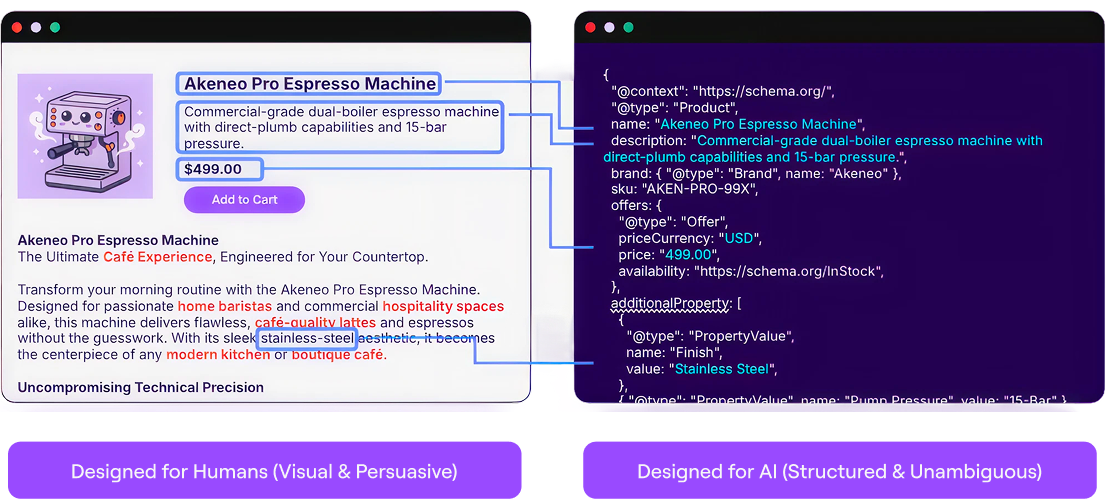
AI engines rely on consistent categorization and clearly defined attributes to connect products with shopper intent. Structured data, including Schema.org markup, essentially acts as a translator between the product information humans see on a page and the machine-readable facts AI systems can interpret.
Let’s go back to our shopper looking for a coffee machine for a small kitchen. An AI system may interpret that request as a combination of specific requirements: an espresso machine, a compact footprint, and suitability for a countertop. If dimensions, product type, or other relevant attributes exist only in a paragraph of marketing copy (or are missing altogether) the AI may struggle to make that connection.
The lesson is simple: do not make AI guess. Product dimensions, materials, compatibility, identifiers, features, and other important facts should be clearly structured and accessible.
Being understandable is only the first hurdle. AI also needs to trust what it finds.
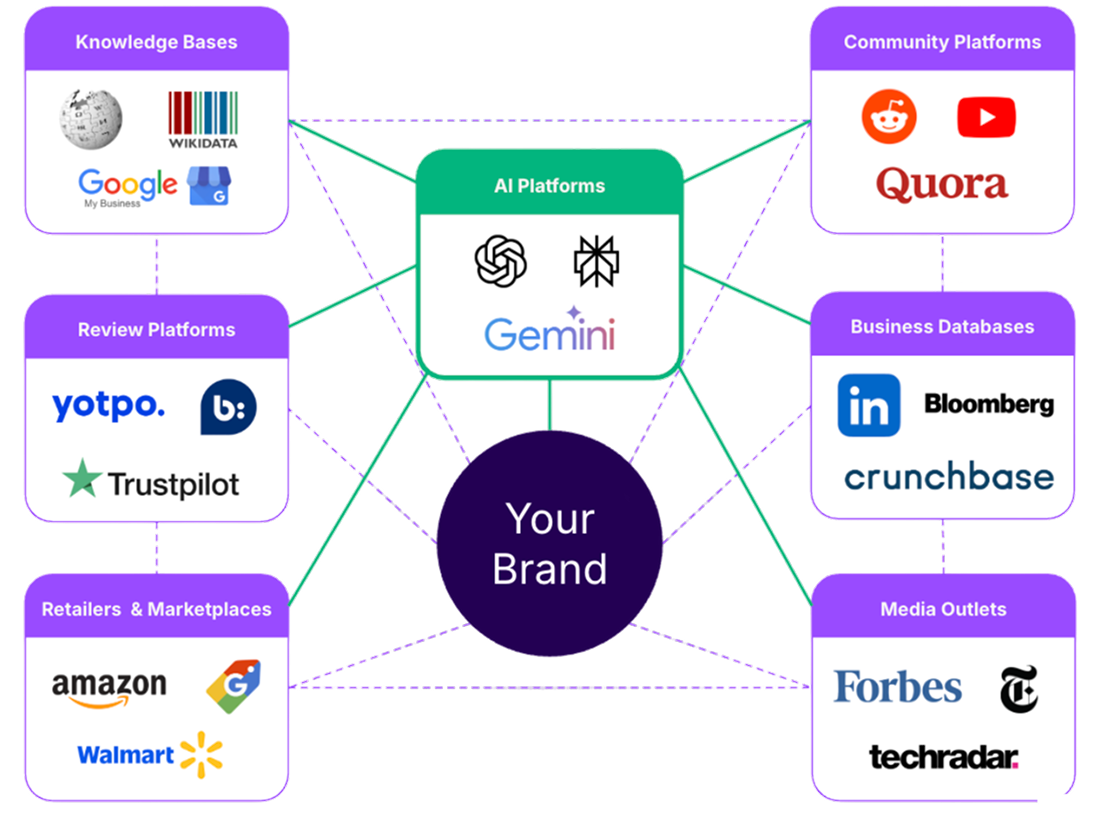
AI engines can cross-reference product and brand information across multiple independent sources before deciding whether a recommendation is credible. Your own website may serve as the primary source of truth, but information from knowledge bases, business databases, retailers, reviews, community platforms, and media coverage can all contribute to the broader picture.
Imagine your website says a product has one set of specifications while a major marketplace lists something different. A human shopper might simply assume one page has not been updated. For an AI system trying to determine which information is accurate, however, that contradiction creates uncertainty.
That is why consistency across channels matters so much. If product descriptions, specifications, identifiers, policies, or other details differ from one destination to another, confidence can erode. A governed source of truth that distributes consistent product information across channels gives AI systems a much clearer foundation to work from.
Real-time data velocity is an important trust signal for AI engines. Products need active, recent information around them if they are going to maintain visibility over time.
For your brand, that might mean recent customer sentiment on review platforms or up-to-date signals from major marketplaces. In B2B environments, freshness can come from mentions in analyst reports, partner ecosystems, professional directories, or industry publications.
Maybe you have a product that launched three years ago and has since been updated with new functionality. If most third-party descriptions still reflect the original version, an AI engine may encounter conflicting evidence about what the product can actually do.
AEO therefore cannot be treated as a one-time optimization project. Product information, marketplace content, reviews, and external references all need ongoing attention as products and markets evolve.
The final pillar may be the most important distinction between simply being visible and actually being chosen.
Technical completeness makes your product understandable. Context makes it recommendable. AI engines increasingly respond to conversational questions built around needs, situations, and use cases rather than simple keyword combinations.
That means product content should go beyond generic claims like “sleek design” or “high performance.” Specific, extractable facts are far more useful.
Context also means connecting products to real-world occasions and needs. A coffee machine is not always just a coffee machine. Depending on its attributes, it might also be a compact espresso maker for a studio apartment, a housewarming gift under £100, or an everyday appliance for a remote worker. Those details help AI connect a product to the way someone is actually asking a question.
You can go one step further by providing clear answers to common customer questions directly within product content. AI engines are designed to synthesize answers, so making useful information easy to extract increases the likelihood that your product can become part of that answer.
The four pillars of AEO work together: structure helps AI understand your products, while authority helps it trust them. Freshness shows that the information remains relevant, and context helps AI connect the product to a shopper’s specific need.
Ultimately, AEO is not about abandoning SEO or chasing another marketing acronym. It reflects a broader change in product discovery. As shoppers increasingly rely on AI to compare options and make recommendations, product information has to work for machines as well as humans.
Download the AEO playbook and learn how to make your products visible, trusted, and recommended in the era of AI commerce.