Consumers are already turning to AI to discover and evaluate products, and the next evolution of commerce is quickly approaching: autonomous purchasing powered by intelligent agents. That’s why we’re breaking down the two emerging standards at the center of agentic commerce, explaining how they work, why they matter, and what their rise means for brands.

Table of Contents
Keywords
For decades, eCommerce has been built around human behavior: browsing websites, comparing products, reading reviews, and completing purchases manually.
But the rise of artificial intelligence is fundamentally reshaping that process.
Increasingly, consumers are turning to AI assistants and large language models (LLMs) to help them discover, evaluate, and eventually purchase products.
In fact, 37% of consumers now begin their searches on LLMs rather than traditional search engines like Google.
The only major friction point left is trust during the purchase process itself. Today, 58% of consumers use AI for product research, yet only 17% trust AI to complete purchases on their behalf. That gap will close over time, and when it does, brands will face a simple reality: either become readable and accessible to AI agents, or risk becoming invisible.
This is where agentic commerce enters the picture.
Agentic commerce describes a process where AI agents can independently research, compare, recommend, and even purchase products on behalf of consumers. Rather than consumers manually navigating websites, intelligent agents will increasingly handle the process autonomously.
Now, in simple terms, this has one major impact: AI does not interpret your brand, and is not impressed with flashy, clean eCommerce web experiences. It only cares about your data. If your product information is fragmented, inconsistent, or incomplete, AI agents will struggle to understand your products and may bypass your brand entirely.
The good news is that agentic commerce will not replace eCommerce overnight, if at all. Instead, it will emerge as an entirely new commerce channel, one powered by machine-to-machine interaction rather than human browsing.
The question brands need to ask now is simple: when AI becomes the buyer, will it choose you?
To answer that, brands first need to understand the infrastructure powering this shift. Agentic commerce is not driven by AI alone, it depends on the protocols and standards that allow AI agents, retailers, payment systems, and platforms to communicate with each other securely and in real time.
These emerging frameworks will shape how products are discovered, evaluated, and ultimately purchased in the age of autonomous commerce.
At the foundation of agentic commerce are the protocols that allow systems to communicate with one another in real time.
An agentic commerce protocol is a standardized framework that enables AI agents to securely discover, interact with, and transact with retailers or service providers on behalf of users. These protocols support autonomous purchasing workflows from product discovery through checkout and payment.
In simple terms, these protocols act as the “rules of engagement” between merchants and AI agents.
Without standards, every AI assistant would need custom integrations for every retailer, payment provider, inventory system, and commerce platform. That would make large-scale agentic commerce nearly impossible.
If every agent needs a custom integration with every retailer, agentic commerce is dead on arrival. Without shared protocols, there is no scale, there is only chaos.

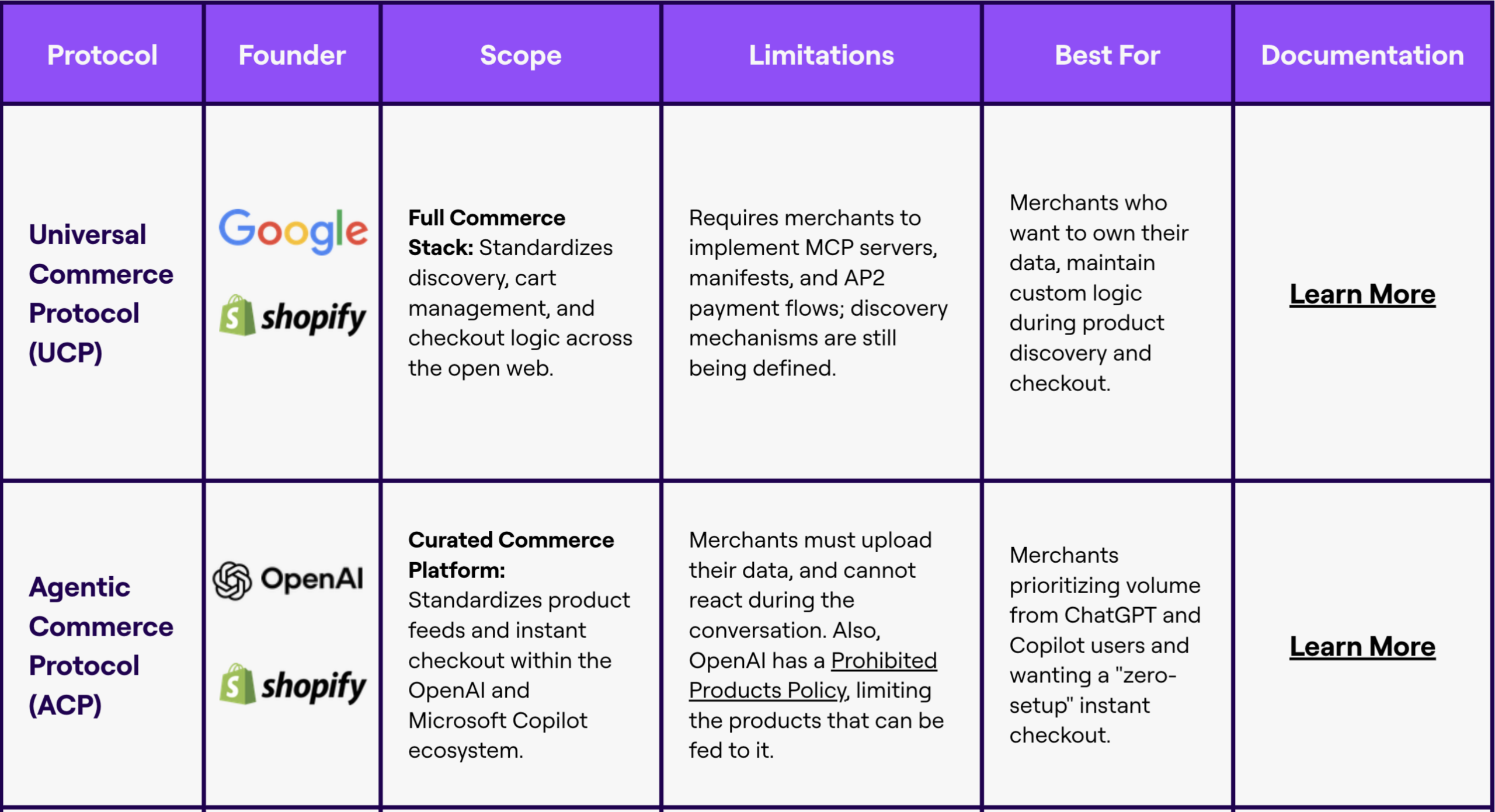
Protocols like Universal Commerce Protocol (UCP) and Agentic Commerce Protocol (ACP), which we’ll dive deeper into in a minute, aim to solve this problem by creating common frameworks for interoperability.
While both protocols are designed to support AI-driven commerce experiences, they approach the future very differently.
Universal Commerce Protocol (UCP) follows an open-web philosophy.
Under this model, any merchant and any AI agent can participate as long as they comply with the protocol standards. Strategically, UCP is designed to preserve the openness of the web while enabling AI-native commerce experiences.
Merchants maintain ownership of their checkout experience, pricing logic, and customer interactions. They also remain discoverable through search indexing and accessible across a broad ecosystem of AI assistants and services.
The core of UCP is the manifest file. Every UCP-compliant merchant publishes a machine-readable file that describes the merchant’s capabilities. This file acts like a directory entry for AI agents, telling them how to interact with the merchant’s backend systems and which tools or APIs are available for completing specific tasks.
For example, an AI agent could use a merchant’s manifest to:
This is the vision for UCP; in practice today, product information is sent through Google Merchant Center to Google, making it effectively a feed-based approach, very similar to how ACP works.
That said, the protocol is evolving quickly.
With the introduction of newer capabilities such as Catalog, announced in March 2026, UCP is beginning to support more real-time, conversational interactions between AI agents and merchant systems.
This opens the door to far more advanced use cases, including:
One of UCP’s strengths is its flexibility. Merchants can begin with a relatively lightweight feed-based setup and gradually evolve toward more advanced, real-time integrations as their infrastructure matures.
It’s also important to note that momentum for UCP is building. Google has recently announced that major platforms such as Commerce Inc, Salesforce, and Stripe will implement UCP, signaling growing ecosystem support and increasing the likelihood of broader adoption across the industry.
Agentic Commerce Protocol (ACP) is the alternative “Marketplace” standard.
Unlike UCP’s “open web” philosophy, ACP operates closer to a platform model. Merchants need to explicitly register or integrate with the specific ACP endpoints (maintained by partners like Stripe for the payment) to be accessible. It prioritizes a highly controlled, high-quality user experience over broad, open-web discoverability.
To simplify merchant participation, Stripe created the Agentic Commerce Suite, which acts as an aggregation layer for ACP product feeds. Instead of submitting separate feeds to each agent platform, merchants can send a single feed to Stripe, which then syndicates it to supported platforms such as ChatGPT, Microsoft Copilot, and future ACP-compatible environments.
This approach significantly reduces integration complexity for merchants while helping AI platforms maintain more standardized product experiences.
Several early examples of ACP-style commerce are already emerging.
Microsoft Copilot currently offers a Checkout feature that enables users to complete purchases directly within the conversational interface. Rather than redirecting users to external websites, transactions can happen seamlessly inside the AI interaction itself.
ChatGPT also announced its “Buy For Me” feature in September 2025. However, OpenAI later scaled back aspects of the in-product transaction experience, highlighting one of the key realities of agentic commerce:
AI purchasing remains more difficult than many initially expected.
Challenges around trust, liability, consumer comfort, fraud prevention, and transaction responsibility are still significant barriers. Consumers may be comfortable asking AI for recommendations, but fully delegating purchasing authority is a much bigger psychological leap.
Even so, ACP demonstrates how platform-centric ecosystems may evolve into highly curated commerce environments where AI assistants manage large portions of the customer journey directly.
It is still far too early to predict whether ACP or UCP will emerge as the dominant standard.
Both protocols are in the early stages of development, adoption remains limited, and implementations are still evolving rapidly.
History shows that technological standards are rarely determined solely by technical superiority. Instead, success is usually driven by adoption, ecosystem power, and distribution.
A technically elegant protocol with limited adoption has little influence. Meanwhile, a simpler standard backed by major platforms can quickly become the foundation for an entire industry.
The future of agentic commerce will likely be shaped less by protocol design and more by which ecosystems gain traction with consumers, merchants, AI providers, and payment platforms.
For brands, the key takeaway is simple: do not wait for a winner to emerge before preparing.
Regardless of which protocol ultimately succeeds, there are several steps brands can take now to prepare for the future of AI-driven commerce.
AI agents rely entirely on data quality.
Incomplete descriptions, inconsistent attributes, missing specifications, and poor taxonomy structures make it difficult for AI systems to understand and recommend products accurately.
Brands should focus on creating clean, enriched, and standardized product information that is machine-readable across channels.
Future commerce ecosystems will depend on systems being able to communicate with one another seamlessly.
Brands should evaluate whether their current commerce infrastructure supports APIs, real-time data exchange, and flexible integrations that can evolve alongside emerging protocols.
AI agents need more than product titles and pricing.
Rich metadata, detailed specifications, compatibility information, sustainability details, customer sentiment, and contextual attributes will increasingly influence how products are ranked and recommended by AI systems.
Consumers will still browse websites for years to come, but increasingly, AI agents will act as intermediaries between customers and brands. Discovery, evaluation, comparison, and even purchasing decisions will gradually shift toward machine-driven interactions.
Protocols like ACP and UCP are laying the groundwork for that future today.
Some ecosystems will favor openness and interoperability. Others will prioritize tightly controlled platform experiences. Both models may coexist for years, just as marketplaces and open-web commerce coexist today.
But regardless of which standards ultimately win, the direction of commerce is becoming more clear, and it seems that it will be guided by what AI agents can interpret and understand just as much as it’s guided by what appeals to human shoppers.
Are you ready for AI agents that buy for customers? Discover the autonomous agents that can research, compare, and complete transactions on behalf of customers, and how you can prepare.
 Summer Release