Strong SEO rankings alone may no longer be enough when AI assistants and autonomous agents are comparing products, interpreting specifications, evaluating trust signals, and potentially making purchases on a shopper’s behalf. Discover what agentic commerce and AEO mean for brands, retailers, manufacturers, and distributors, and the practical steps you can take to build product data that is ready to compete when the decision-maker is a machine.
Table of Contents
Keywords
My sister recently needed to replace her child’s car seat before a long road trip.
She needed one that fit her particular car model, worked for a specific age and weight range, met the right safety standards, had a washable cover, and could be delivered within two days, in time for the road trip.
A few years ago, that would have meant opening a handful of retailer tabs, checking specifications, reading reviews, comparing delivery dates, and probably second-guessing whether it was actually compatible with her car model or would actually arrive on time.
Instead, she went straight to ChatGPT.
She described exactly what she needed and asked it to narrow down the options. Within minutes, she had a shortlist of products that appeared to meet her criteria, along with explanations of why each one might be a good fit.
That experience captures a much bigger shift in how people are beginning to shop. Increasingly, consumers are not starting with a search bar and working their way through a list of links. They are starting with a question, a problem, or a set of constraints and asking AI to do more of the research for them.
And this is only the beginning.
As AI evolves from recommending products to acting on behalf of shoppers, we are moving toward agentic commerce: a world where AI agents can research options, compare products, assess details like price, availability and policies, and potentially complete purchases with far less human intervention.
That changes the rules of product discovery. AI agents need product information they can actually interpret, verify, compare, and trust.
That is where Answer Engine Optimization, or AEO, comes in. And more importantly, it is why preparing your product data for AI today is quickly becoming one of the most important steps toward succeeding in agentic commerce tomorrow.
Today, most AI-powered shopping experiences still involve a human somewhere in the decision-making process. A shopper asks a question, an AI assistant recommends products, and the shopper decides what to do next.
Agentic commerce pushes more of that journey onto the AI.
An agent might interpret a request, establish requirements, compare products, evaluate compatibility, check delivery or return policies, assess trust signals, and eventually complete a transaction.
The next phase of AI-powered discovery happens when agents move beyond answering questions to evaluating and potentially acting on behalf of shoppers.
But an agent can only make decisions based on the information available to it.
If your dimensions are missing, compatibility information is buried in a PDF, availability is outdated, or two retailers list conflicting specifications, the agent has a problem. It cannot confidently determine whether your product meets the shopper’s requirements.
And confidence matters when the AI is deciding whether to recommend or purchase it.
SEO was designed for a world of keywords, rankings, traffic, and clicks. The objective was to get a page high enough in search results that a human would click through, visit your website, and continue their journey there.
AEO focuses on a different outcome: making information understandable, credible, relevant, and structured enough that an AI engine can use it in an answer or recommendation.
That distinction is increasingly important because SEO success does not automatically equal AI visibility. A product can rank well in conventional search while remaining difficult for AI to recommend because its underlying information is incomplete, inconsistent, unstructured, or difficult to verify.
Ultimately, AEO (and agentic commerce readiness) comes back to the product data itself.
AI readiness becomes much harder when product information is scattered across spreadsheets, ERP systems, supplier portals, eCommerce platforms, and regional teams.
Agents need reliable product information, and organizations need a clear place where that information can be governed.
That is already influencing AI architecture; 65% of organizations rely on structured systems such as PIM or ERP to power their AI models, partly in response to integration challenges and data silos.
A centralized product information foundation gives teams somewhere to standardize, validate, enrich, approve, and distribute the information agents will depend on.
Beautiful product pages are designed for people. Agents need information designed for machines.
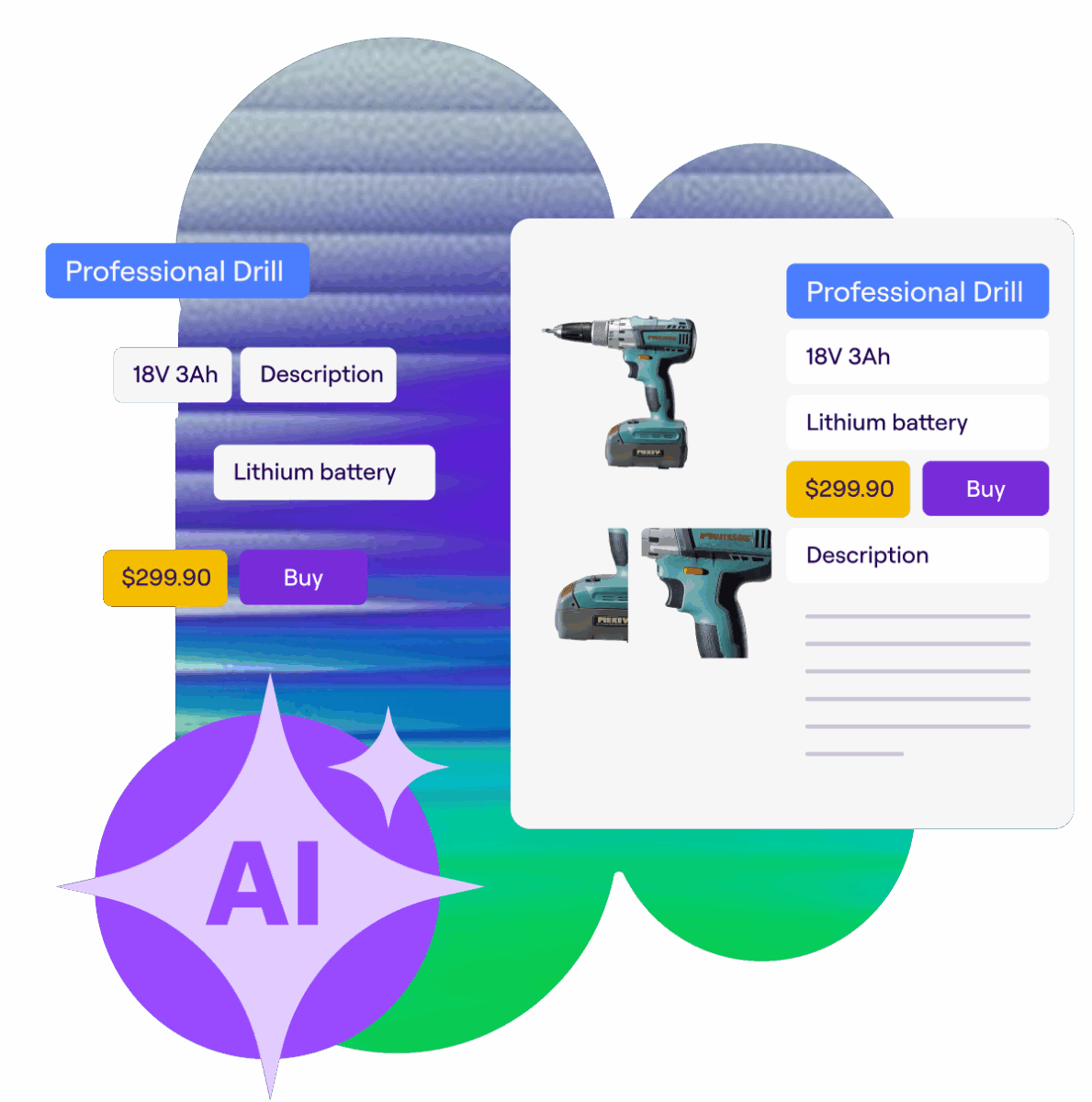
That means structured attributes, standardized categories, global identifiers, relationships between products, and appropriate product schema. These elements create the translation layer between human-facing content and machine interpretation.
Instead of forcing an AI to extract a product’s dimensions from a paragraph, give it clearly defined height, width, depth, material, compatibility, and other relevant attributes.
The less an agent has to infer, the easier your product is to evaluate.
A completed product record should not simply mean that every mandatory field in your PIM is filled in. Completeness increasingly needs to reflect buyer intent.
If someone asks for “a waterproof backpack suitable for commuting with a 16-inch laptop,” does your product data explicitly contain enough information to establish waterproofing, laptop compatibility, capacity, intended use, and relevant materials?
That’s why we recommend enriching records around environments, occasions, personas, problems, compatibility, and customer intent so AI can match products to real-world situations.
AI systems need evidence.
“Sleek design” tells an agent very little. “6-inch footprint that fits beneath standard kitchen cabinets” is far more useful. Specific, extractable facts help AI systems connect product characteristics with what a shopper is actually asking for.
Look at reviews, customer questions, search queries, and return reasons too. They can reveal the information shoppers care about that may never have made it into the original product record.
An agent may encounter your product on your website, a retailer site, a marketplace, a product feed, a review platform, or somewhere else entirely.
Conflicting prices, specifications, identifiers, or claims create uncertainty. The goal should be one governed product record that distributes consistent, enriched information across every relevant channel.
With the growing popularity of AI-powered search and discovery, a shopper may never read your carefully written description, scroll through your comparison table, or click through your category navigation. An AI agent may encounter your product somewhere else entirely, pull together what it can find, compare it against a dozen alternatives, and make a judgment in seconds.
In that moment, your product data becomes your salesperson.
It has to explain what the product is, who it is for, what it works with, why it is different, whether it is available, and whether the information can be trusted. There is no opportunity for a merchandising team to step in and clarify a missing attribute. No second chance to explain that an outdated retailer listing is wrong. The agent works with the evidence it has.
That is why preparing for agentic commerce is less about chasing the newest AI capability and more about making your catalog impossible to misunderstand.
Download the AEO playbook and learn how to make your products visible, trusted, and recommended in the era of AI commerce.