Anyone on your team can now build an AI agent in an afternoon, but who’s in control once it starts touching your live catalog? Discover why vibe-coded agents create hidden risks for product data, and the five control layers that let your teams move fast without losing trust in what reaches customers.
Table of Contents
Keywords
Not long ago, building an AI agent meant writing a project brief, waiting for engineering capacity, and hoping your use case made it onto the roadmap. Today, someone on your product team can describe what they want in plain English and have a working prototype by the end of the afternoon.
That shift has a name. “Vibe coding,” a term coined by AI researcher Andrej Karpathy in February 2025, was named Collins Dictionary’s Word of the Year just nine months later. Few things show more clearly how quickly building with natural language has gone mainstream.
For product data teams, this is genuinely exciting. A content agent, an enrichment script, a quick channel-validation check: all of them are suddenly within reach.
But as these agents move from side projects into live catalogs, a new question comes up. Who is actually in control?
Karpathy described vibe coding as fully giving in to the vibes and forgetting that the code even exists. You describe the outcome, the AI writes the code, and if it seems to work, you move on.
That approach is fine for a weekend project. It is very different when the output touches thousands of SKUs, dozens of sales channels, and product claims that carry legal or regulatory weight.
The barrier to building an agent has dropped dramatically, but the barrier to operating one reliably has not. McKinsey’s 2026 State of AI survey found that nearly nine in ten respondents use AI regularly in at least one business function, yet only 44% say it is being scaled across the enterprise and just 37% attribute any EBIT impact to it.
Looking ahead, Gartner predicts that more than 40% of agentic AI projects will be cancelled by the end of 2027, citing escalating costs, unclear business value, and inadequate risk controls.
In other words, the agent is rarely the hard part. Control is.
Vibe-coded agents tend to share one blind spot: the person building them rarely spells out the constraints that matter, and the AI will not fill them in on its own.
The software world has already measured this. Veracode’s 2025 GenAI Code Security Report tested more than 100 large language models across 80 coding tasks and found that AI-generated code introduced security vulnerabilities in 45% of cases. When models could choose between a secure and an insecure approach, they chose the insecure one 45% of the time. Veracode’s CTO linked the problem directly to vibe coding, where developers often never define security requirements at all.
The same pattern plays out with product data. Ask an agent to fill in missing dimensions without telling it which sources are authoritative, and it will happily produce plausible-sounding values. Ask it to write product descriptions without your glossary, channel rules, or regulated-claim policies, and you will get copy that reads well but cannot be published.
Now multiply that across several agents, each built by a different team, each working from its own copy of the data and its own version of the rules. Individually, each one looks like a success. Together, they become a collection of automation silos, each with its own latency, its own version of the truth, and its own failure mode.
Whether an agent took six months or six hours to build, it should run through the same five layers before anything reaches a customer:
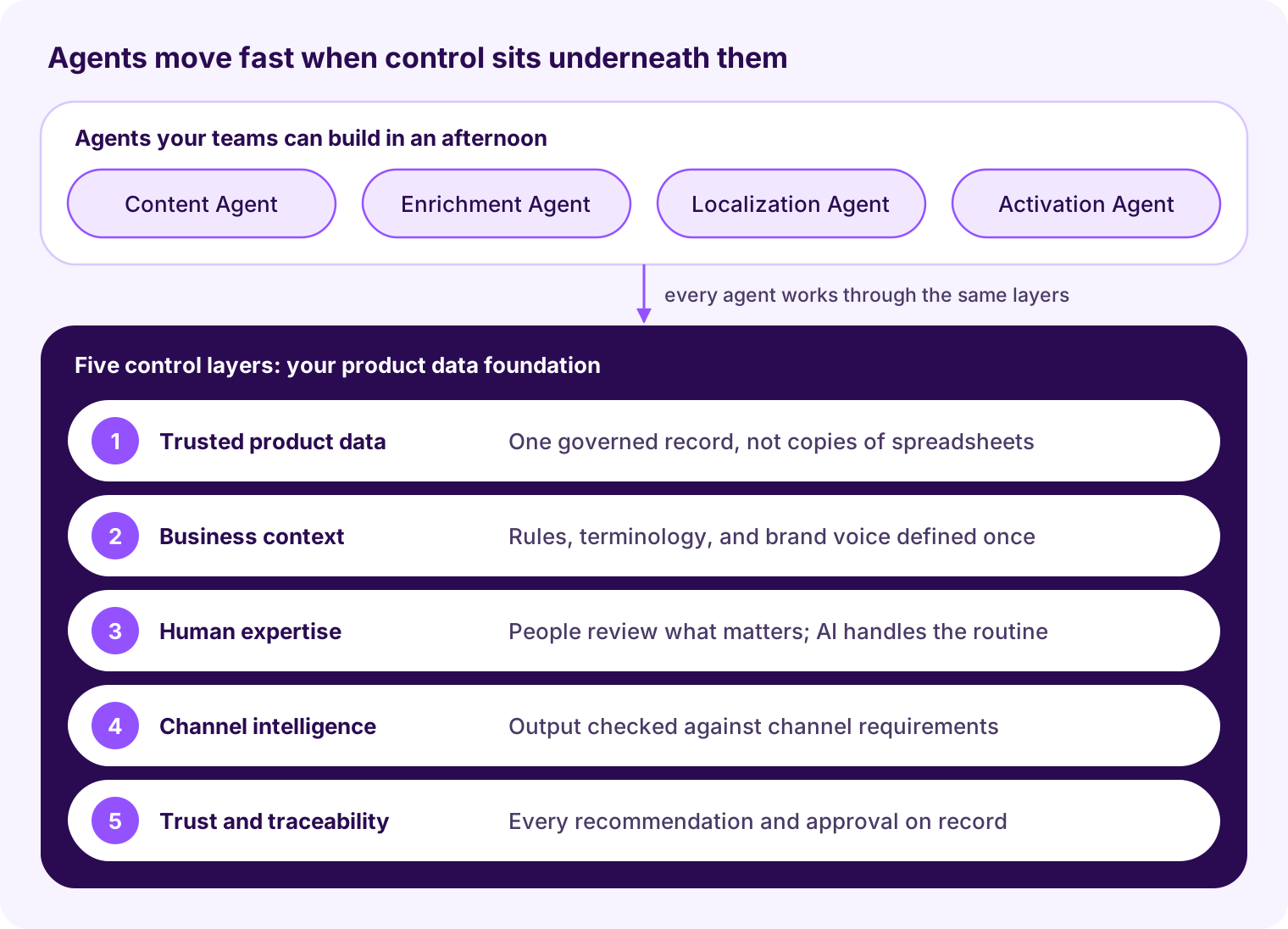
None of this means slowing your team down. Vibe coding is a fantastic way to test an idea, prove a use case, and learn what AI can do for your product operations. A custom agent can be exactly the right choice for a narrow, low-risk problem.
The shift happens when those experiments start acting on the same products, the same launches, and the same customers. At that point, control stops being a nice-to-have and becomes the thing that decides whether your agents scale or stall.
With peak season pushing catalogs to their limits and planning for 2027 already underway, now is a good moment to ask a simple question: if every agent your teams have built went live tomorrow, would you trust what reached your customers?
Download The Agentic PIM Playbook to explore the 10 AI agents your product data team should be planning for, and the foundation that keeps them working together. Or request an AI Readiness Diagnostic to see where your greatest opportunities lie.
Discover the 10 AI agents reshaping product operations, and the trusted product data foundation you need to make them work together at scale.


 Release