Two-thirds of people rely on AI output without checking it, and more than half have made mistakes because of it. Akeneo’s Director of Engineering shares the simple habit that turns AI recommendations from risky shortcuts into decisions your team can stand behind.

Table of Contents
Keywords
AI has a way of sounding sure of itself. Ask it to classify a product, fill in a missing attribute, or draft a description, and the answer arrives instantly, neatly formatted, and with total confidence. It is very easy to nod along.
Many of us do. In a global study of more than 48,000 people by the University of Melbourne and KPMG, 66% of respondents said they rely on AI output without evaluating its accuracy, and 56% said they had made mistakes in their work because of AI.
The answer is not to use AI less. It is to use it better. And according to Chuck Hardy, Director of Engineering at Akeneo, that starts with one simple habit: interrogation.
Researchers at Microsoft and Carnegie Mellon University surveyed 319 knowledge workers about how they think critically when using generative AI. What they found is that higher confidence in AI was associated with less critical thinking, while higher confidence in one’s own expertise was associated with more. Stakes mattered too; when people saw a task as low-stakes, they were less likely to check the AI’s work at all.
In product data, very few tasks are truly low-stakes once they scale. An enrichment agent that fills in a missing dimension with a plausible-sounding value does not make one mistake; it can repeat that mistake across an entire product family. A single miscategorization or invented compliance claim published across thousands of SKUs quickly becomes a brand and regulatory problem.
As Chuck puts it, the biggest mistake teams make with AI is “treating outputs as conclusions instead of starting points.” AI is strong at repetitive, well-bounded work like classification, matching, and first drafts. But it does not know your customers, and it does not know why your team made the decisions it did years ago. That context is where human judgment still wins.
Chuck’s approach to interrogation is refreshingly practical. When the model recommends something, he works through a short series of questions before acting on it.
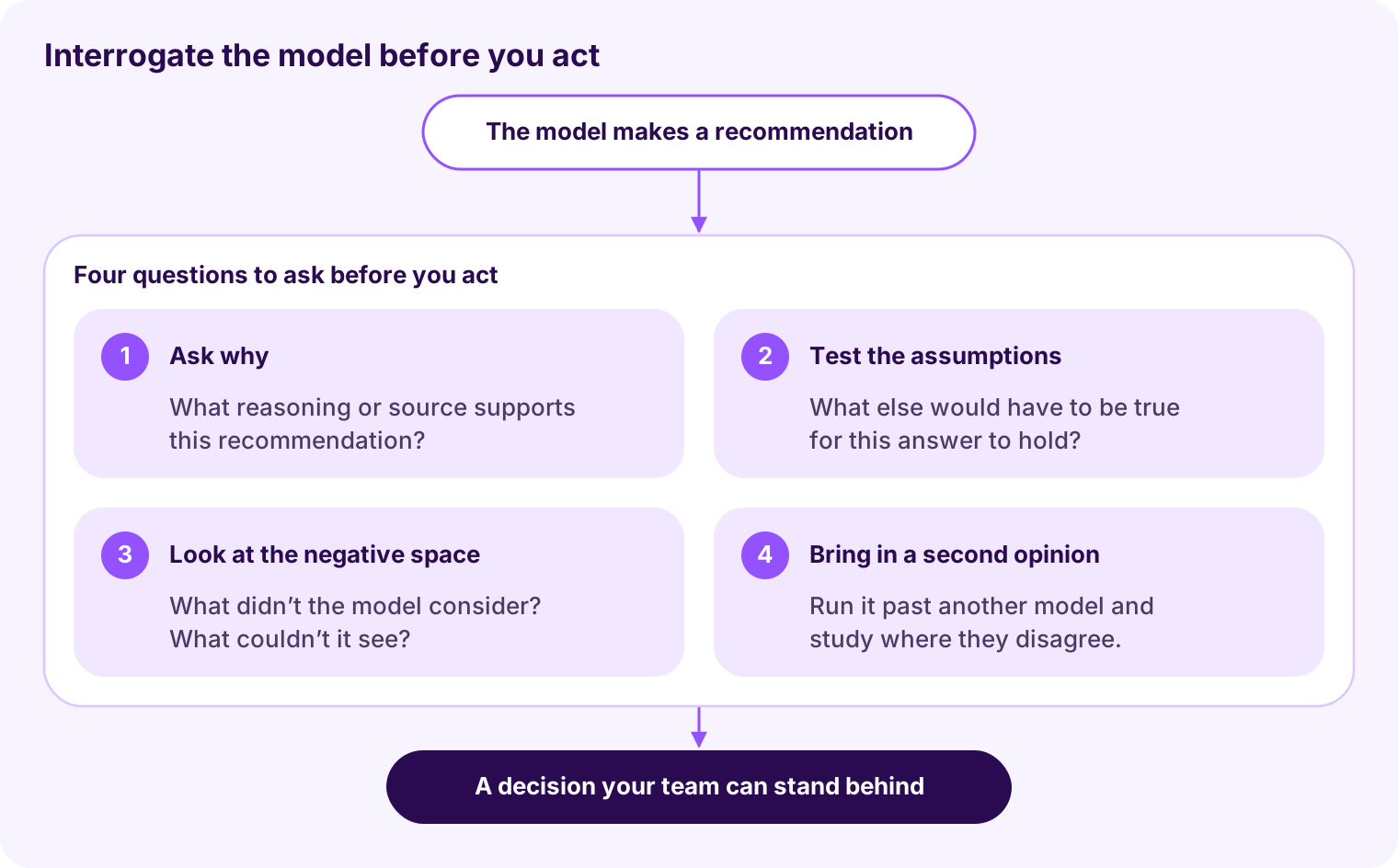 1. Ask why. What reasoning or evidence led to this answer? If an agent cannot point to a source for the value it filled in, that is your first signal to slow down.
2. Test the assumptions. Ask what else would have to be true for the answer to hold. A recommended category may only make sense if the supplier’s material data is accurate, and that is worth checking.
3. Look at the negative space. What didn’t the model consider, and what couldn’t it see? The most important context, such as a regional regulation, a retailer requirement, or a workaround your team put in place years ago, often never made it into the prompt.
4. Bring in a second opinion. Chuck often hands the same problem to a model from a different provider and lets it play adversarial collaborator against the first. Working through where the two disagree is one of the fastest ways to sharpen your own understanding of the problem.
The beauty of interrogation is that it is not a specialist skill. As Chuck describes it, product managers can run it in requirements reviews, developers in code review, and operations teams in postmortems: same muscle, different rooms.
For product data teams, the rooms look like this:
Interrogation only works if there is something to interrogate. An agent that cannot show where its information came from, or why it made a recommendation, leaves reviewers guessing. That is why the habit depends on a foundation: governed product data, clear source attribution, and a history of what each agent did and who approved it. We explored that record in more depth in Your AI Governance Policy Isn’t Enough.
It also helps to be deliberate about where interrogation happens. Define the confidence, risk, or business-impact thresholds that send an output to a person, so your experts spend their time on the exceptions that matter rather than re-checking every routine decision. And capture what reviewers learn. When the same correction comes up again and again, turn it into a rule the next agent inherits.
AI will keep getting faster and more fluent, and its answers will only sound more convincing. That makes the habit of asking good questions more valuable, not less. The teams that get the most from AI agents will not be the ones that trust them blindly or the ones that refuse to trust them at all. They will be the ones that treat every output as the start of a conversation.
If you are setting resolutions for the new year, this is a good one to add to the list. Pick one AI workflow your team relies on, and start asking it why.
Discover the 10 AI agents reshaping product operations, and the trusted product data foundation you need to make them work together at scale.


 Release