Most AI pilots stall long before they deliver results, and the reasons usually trace back to decisions made before launch. Learn the five steps product data teams should take before deploying their first AI agent, from picking the right problem to proving it worked.

Table of Contents
Keywords
If an AI agent made it onto your 2027 roadmap, you are probably already picturing the payoff: product descriptions drafted in seconds, missing attributes filled in automatically, supplier files mapped without a spreadsheet marathon.
That excitement is well founded. But the first deployment is also where many AI initiatives quietly go off course. MIT’s NANDA initiative found that only about 5% of enterprise AI pilots achieve rapid revenue acceleration, while the vast majority stall with little to no measurable impact on P&L. The researchers pointed less to model quality and more to flawed integration with how businesses actually work.
For product data teams, that is good news. Most of what separates a stalled pilot from a scalable one happens before the agent goes live, and it is well within your control.
Here are five steps to take first.
It is tempting to start with whatever AI use case is getting the most buzz. A better starting point is your team’s most persistent operational pain: where do people spend the most time on repetitive work, wait the longest on bottlenecks, or fix the same avoidable errors week after week?
More than half of generative AI budgets go to sales and marketing tools, yet the same MIT study found the biggest returns in back-office automation and streamlined operations. For product teams, common high-value starting points include quality validation, supplier data ingestion, and attribute enrichment.
Start by shortlisting three potential use cases, then choose one to pilot based on four criteria: expected value, data readiness, operational risk, and how easily you can measure the outcome.
An agent cannot decide which product value is correct unless your data already provides that structure and authority. AI does not fix fragmented product data; it scales it.
This is where many projects come undone. Gartner predicts that by the end of this year, organizations will abandon 60% of AI projects that are not supported by AI-ready data, and its survey of data management leaders found that 63% of organizations either lack or are unsure whether they have the right data practices for AI.
The good news is you do not need a perfect catalog. You need data that is ready for one use case. Review a representative sample of product families, suppliers, and channels, and ask:
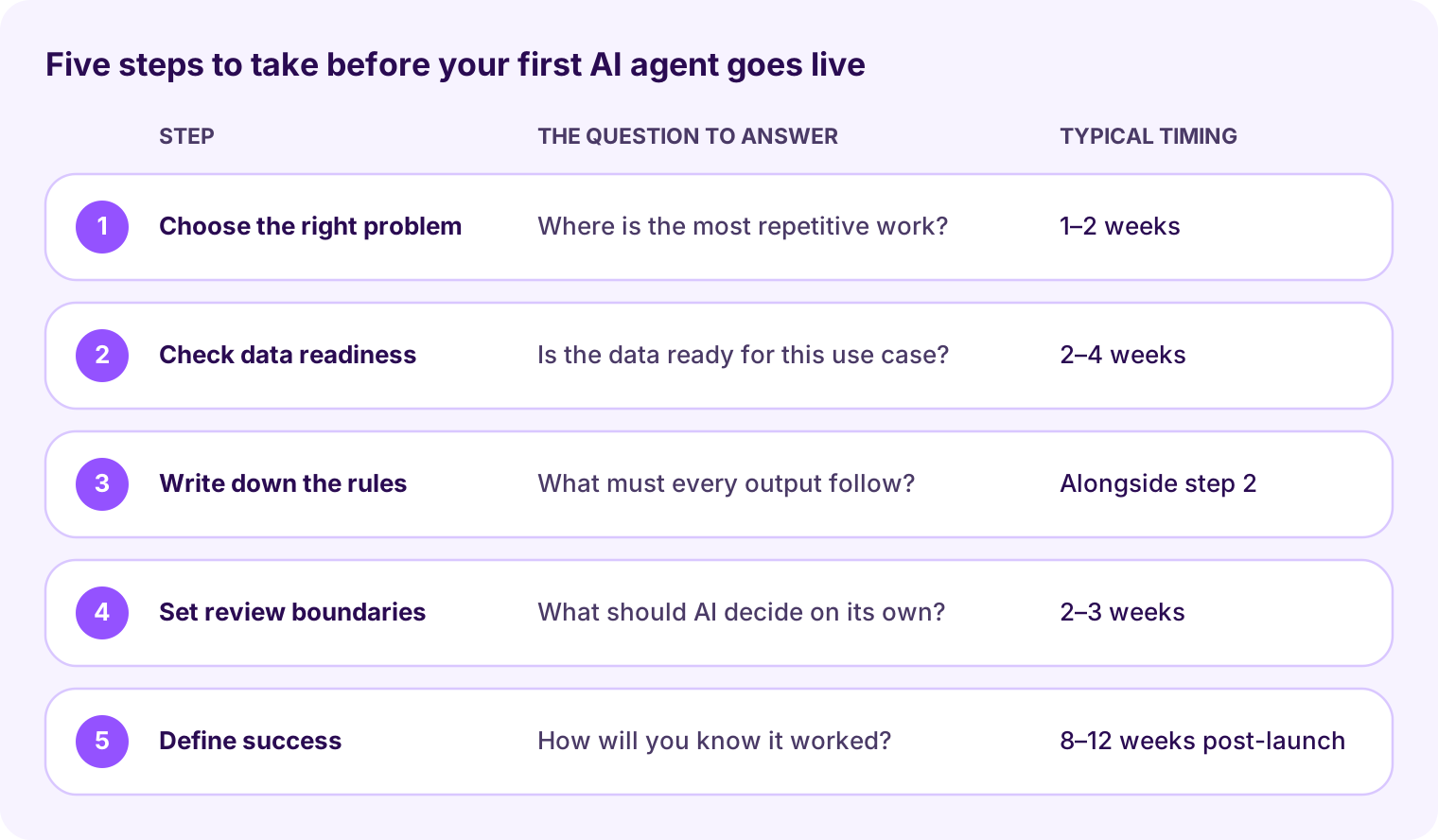
The first two steps decide what your agent works on. The next three decide how it behaves once it does.
A generic language model knows nothing about your product hierarchy, channel-specific attribute requirements, brand tone of voice, or approved terminology. Without that context, it produces output that is sometimes accurate but rarely consistent or channel-ready.
Capture these rules somewhere governed and reusable, not buried inside a single prompt. That way, your second agent can inherit them instead of starting from zero.
Sweaty Betty shows what this unlocks: by designing attribute models around how customers actually shop and pairing them with governed workflows and AI-assisted enrichment, the brand cut enrichment cycles by 96% and delivered seasonal copy three times faster.
Before going live, sort every action your agent can take into three buckets: fully automated, automated with review, and human-led. Then set the confidence, risk, or business-impact thresholds that move work from one bucket to another.
For example, a localization agent might publish routine translations automatically but flag anything touching regulated claims, such as material composition, warranty terms, or energy ratings, for expert review.
As Akeneo’s Director of Engineering Chuck Hardy notes, AI is strongest at repetitive, well-bounded tasks like classification, matching, and first drafts. Human judgment still wins where context matters.
You cannot prove an agent made things better if you never measured how things were before. Capture a baseline of your current process, then compare the agent’s performance against it over the first 8 to 12 weeks.
Track four dimensions: operational efficiency, quality and reliability, human adoption and trust, and business impact.
That last one matters more than it might seem. Demonstrable results are what earn the budget and buy-in for your next agent.
Your first AI agent is a proof of concept. Your tenth is an operating model. The groundwork you lay now (governed data, shared rules, clear review boundaries, and honest measurement) is exactly what lets the next agent launch faster instead of starting from scratch.
As you head into the new year, a little preparation now can be the difference between a pilot that impresses in a demo and one that earns a permanent place in your product operations.
Discover the 10 AI agents reshaping product operations, and the trusted product data foundation you need to make them work together at scale.


 Release