We’re breaking down SoftwareReviews’ head-to-head comparison of Akeneo Product Cloud and Salsify, drawing on verified feedback from practitioners using these platforms every day. Looking beyond feature lists, the analysis explores vendor capabilities, product performance, and emotional sentiment to show how each solution supports real teams, real workflows, and long-term growth.

Table of Contents
Keywords
A new year tends to lend itself to sharpening priorities. Teams take stock of what’s working, what’s slowing them down, and where the right technology could make a meaningful difference in the months ahead.
For many organizations, especially in 2026, that reflection brings product information into focus, and with it, the question of whether their current Product Information Management (PIM) platform is truly set up to support growth.
Choosing a PIM solution is rarely about ticking boxes on a feature list alone. Usability, long-term value, vendor partnership, and the ability to adapt as product experiences evolve all play a role.
Of course, every PIM vendor wants to tout themselves as the best at everything, which can make it difficult to decipher what’s self-promotional and what’s true. That’s where independent, user-driven research can offer a clearer, more grounded perspective.
SoftwareReviews’ Head-to-Head reports take exactly that approach, and today, we’re taking a look at their comparison between Akeneo Product Cloud and Salsify, which is based on verified feedback from real practitioners using these platforms day to day. The report examines how each solution performs across product capabilities, feature depth, customer experience, and the overall quality of the vendor relationship.
Taken together, the findings provide a practical snapshot of how the two platforms stack up in real-world environments, highlighting areas of strength, points of differentiation, and what may matter most for teams looking to build a more resilient, scalable approach to product information in the year ahead.
Let’s dive in!
At a high level, Akeneo Product Cloud received a higher composite score (7.7) than Salsify (7.0), reflecting stronger performance across multiple dimensions, including likelihood to recommend, customer experience (CX) score, and emotional footprint.
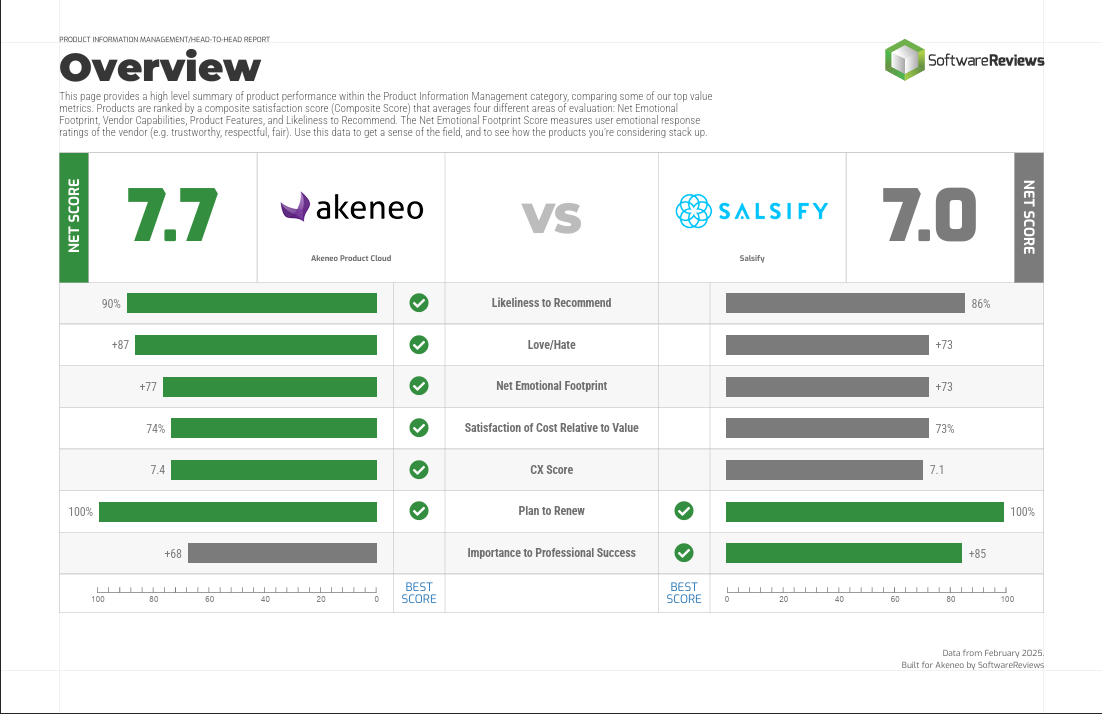
Notably, 90% of Akeneo users surveyed indicated a likelihood to recommend, while both Akeneo and Salsify received a 100% intention to renew. Akeneo scored higher for positive sentiment, net emotional footprint (which we’ll dive into more in-depth later), and satisfaction of cost relative to value, which all are metrics that go beyond functional capability to capture trust, respect, and perceived partnership.
While both platforms demonstrate value in the PIM space, the data suggests Akeneo delivers a more consistently positive experience across the customer lifecycle.
When evaluating a PIM solution, it’s easy to focus almost entirely on features; what the platform can do today. But features alone rarely determine long-term success. How a vendor supports customers, evolves the product, and delivers value over time often has a greater impact on whether a platform continues to meet business needs year after year.
This is where vendor capabilities come into play. In the SoftwareReviews Head-to-Head report, vendor capabilities are used to assess how well a software provider supports customers across the full lifecycle from implementation and adoption to ongoing innovation and support. Rather than measuring what the software does, these capabilities focus on how effectively the vendor enables customers to succeed.
SoftwareReviews evaluates 11 core vendor capabilities, based entirely on feedback from verified end users. These include areas such as:
Together, these categories represent what SoftwareReviews considers “table stakes” for building a strong, sustainable vendor–customer relationship
In this category, Akeneo Product Cloud earned a net score of 78%, compared to 76% for Salsify, indicating a slight but consistent advantage across multiple dimensions of vendor performance.
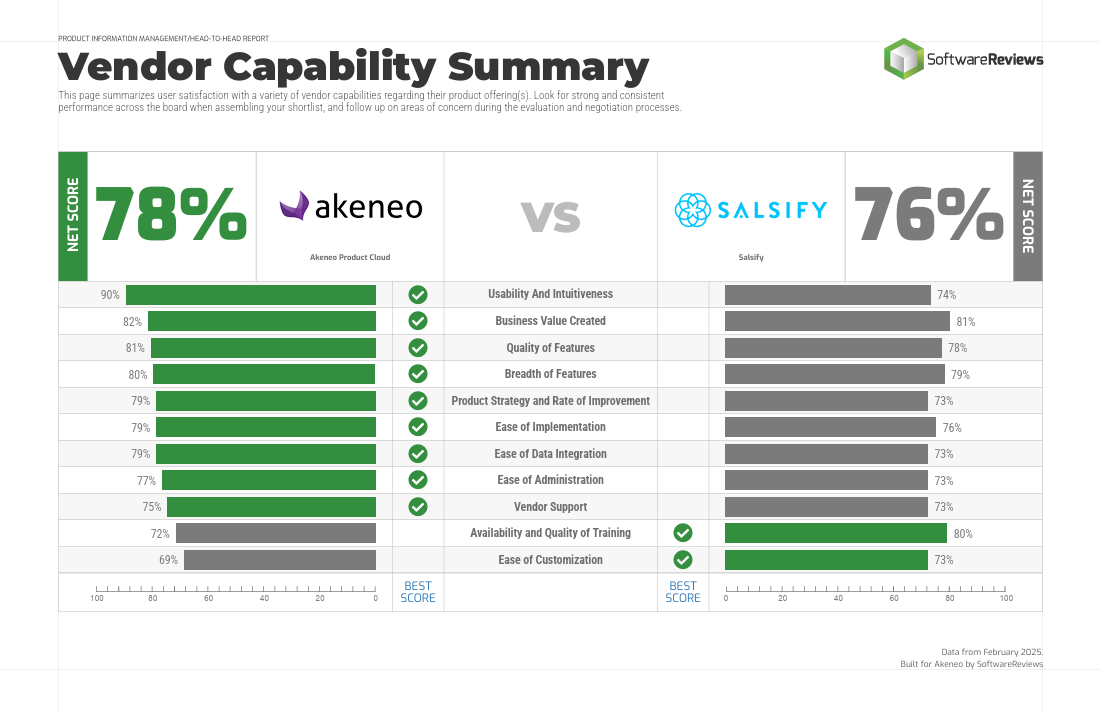
Akeneo scored particularly well in areas that directly affect day-to-day efficiency and long-term scalability. Users rated the platform highly for usability and intuitiveness, suggesting faster adoption and lower learning curves for internal teams. Akeneo also led in business value created, reflecting the platform’s perceived ability to drive tangible outcomes.
Another area of differentiation was product strategy and rate of improvement, where Akeneo users expressed confidence in the vendor’s roadmap and ongoing investment in innovation. In fast-moving digital commerce environments, this capability is critical; a PIM platform must evolve alongside new channels, customer expectations, and data requirements. Akeneo also scored higher in ease of data integration and administration, helping reduce friction for IT teams responsible for maintaining complex tech ecosystems.
Salsify, meanwhile, received higher scores in availability and quality of training and ease of customization, which may be attractive for organizations with specific enablement or configuration needs. However, the report shows that Akeneo’s strength lies in its broader consistency across core vendor capabilities, which is an important consideration for teams looking to balance flexibility with stability over the long term.
While vendor capabilities focus on the relationship and long-term partnership, product features address a more direct question: How well does the software support the day-to-day work it’s meant to do? In the context of PIM, this includes everything from managing core product records to supporting omnichannel delivery, workflows, analytics, and integrations across the broader tech stack.
According to SoftwareReviews Product Feature Summary, Akeneo achieved an 84% net score, compared to 76% for Salsify.
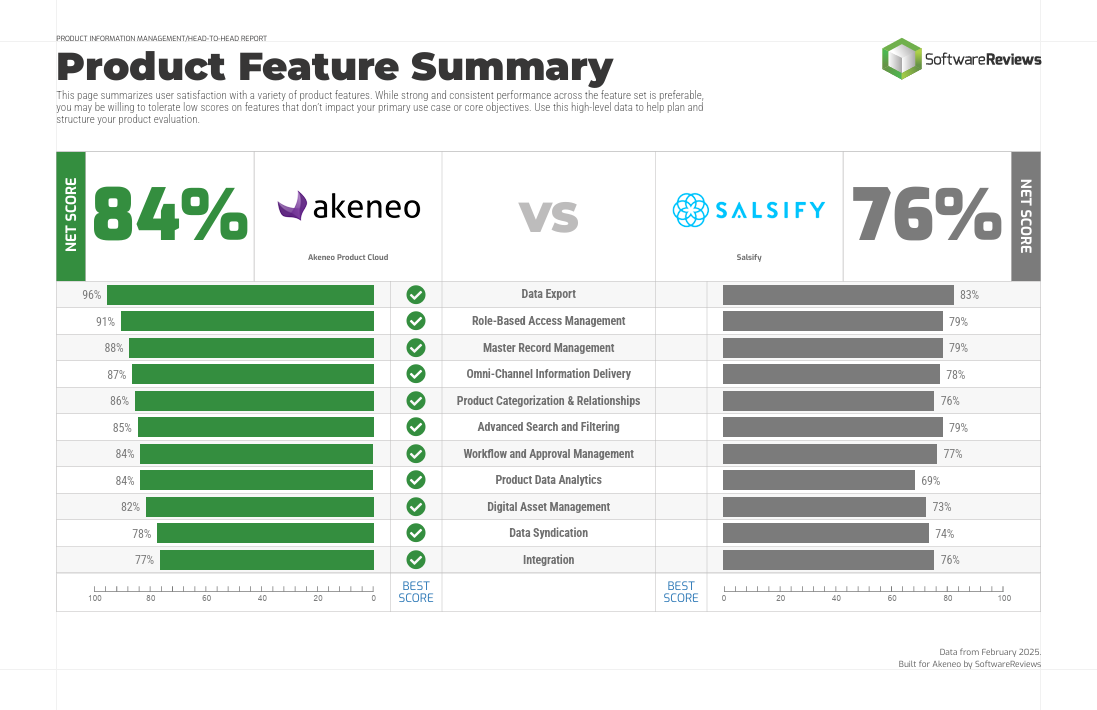
Akeneo led across all evaluated features, including:
These capabilities are increasingly important as organizations move toward API-first architectures and customer-informed product experiences. Strong performance in workflow, analytics, and omnichannel delivery suggests Akeneo is well positioned to support complex, cross-functional product operations.
Beyond features and functionality, the quality of the relationship between a customer and a software vendor plays a significant role in long-term satisfaction and success. That’s why SoftwareReviews includes an Emotional Footprint assessment to capture how users feel about their vendor based on real experiences over time.
The Emotional Footprint is built from verified end-user survey responses and evaluates sentiment across five key dimensions:
Respondents rate a series of emotional descriptors, such as trustworthiness, transparency, reliability, fairness, and innovation, on an eight-point scale. These responses are then converted into net emotional scores, offering a quantitative view of what is often considered qualitative or subjective feedback.
Akeneo scored higher overall in emotional footprint, with particularly strong results in:
Akeneo received a +82 net score, outperforming Salsify (+70). Users cited continual improvement, innovation support, and meaningful product enhancements as key strengths.
With a +86 net score, Akeneo users rated the platform highly for reliability, productivity enablement, performance, and security. These attributes are critical for organizations managing large, complex product catalogs at scale.
Akeneo scored higher in transparency, client-first negotiation, and over-delivery, which are factors that can significantly influence long-term partnerships.
Both vendors performed well here, but Akeneo maintained a slight lead (Akeneo +80 vs Salsify +79), particularly in integrity and trustworthiness.
Service experience was one of the closest categories, with both vendors earning strong scores (Akeneo +72 vs Salsify +71), indicating that customers generally feel supported post-purchase.
Taken together, the findings suggest that while both Akeneo and Salsify are credible, enterprise-grade PIM solutions, Akeneo Product Cloud demonstrates a more consistent strength across product capabilities, customer experience, and vendor relationship metrics. Rather than excelling in only one area, Akeneo shows balanced performance across the dimensions that tend to matter most over the full lifecycle of a PIM investment.
For organizations evaluating PIM as a long-term foundation rather than a point solution, this consistency can be especially meaningful. PIM platforms often sit at the center of increasingly complex ecosystems, supporting multiple teams, channels, regions, and integrations. As a result, success depends not only on what the platform can do today, but also on how well it scales, evolves, and is adopted across the business.
As AI continues to reshape and break everything we thought we knew about the commerce landscape, product information has taken on a far more visible and strategic role. AI-driven search, recommendations, and conversational experiences are only as effective as the data that powers them, making product data quality, completeness, and structure essential. Because of this, PIM platforms have moved from behind-the-scenes systems to foundational infrastructure for modern commerce.
This SoftwareReviews head-to-head comparison highlights how different PIM solutions are positioned to support this shift. By evaluating product features, vendor capabilities, and emotional sentiment through verified user feedback, the report offers insight into how platforms perform once AI-driven demands meet real-world operations.
For organizations planning for the future of AI-enabled commerce, independent research like this provides valuable context. As product experiences become increasingly dynamic and data-driven, choosing a PIM platform that can evolve alongside new technologies (and support teams throughout that evolution) will be critical to sustaining growth and delivering meaningful customer experiences.

 Akeneo Product Cloud
 Product Cloud Packages
 Shopify
 Adobe
Adobe
 Salesforce
 SAP
SAP
 See All Integrations
 Professional Services
 Training & Certification
 Support & Help Center
 PX Strategy Self Assessment
 The Akeneo Partner Ecosystem
 Blog
Blog
 Resource Library
 Seasonal Release
 Register