Summer Release

Introducing the First Truly Agentic Product Experience Platform

Learn More
Akeneo-Logo

The Four Pillars of AEO: How to Make Your Products Visible, Trusted, and Recommended by AI

Artificial Intelligence

The Four Pillars of AEO: How to Make Your Products Visible, Trusted, and Recommended by AI

Product discovery is changing as more shoppers turn to AI for direct answers and recommendations instead of scrolling through traditional search results. Discover how Answer Engine Optimization (AEO) differs from SEO and the four pillars that determine whether AI can confidently recommend your products.

For years, digital visibility has largely meant one thing: search engine optimization (SEO). We optimized product pages around keywords, technical performance, and search rankings with the goal of getting shoppers to click through to our websites.

That strategy still matters. But the way people discover products is changing.

Instead of searching for “best coffee machines” and scrolling through pages of results, a shopper can now ask ChatGPT, “What’s the best coffee machine for a small apartment that can make espresso?” ChatGPT then interprets the shopper’s intent, compares different products, evaluates available information, and produces an answer.

That shift is where Answer Engine Optimization (AEO) comes in. AEO is the practice of structuring product content and building brand authority so that AI engines can confidently cite and recommend your products.

The important distinction is that SEO primarily focuses on optimizing pages to rank in traditional search, while AEO focuses on whether your products are visible and understandable within AI-generated answers. A product can rank well on Google and still remain virtually invisible to an AI system if its product information is incomplete, inconsistent, difficult to verify, or inaccessible in a machine-readable format; we call this the Invisible Shelf.

So how do you make your products easier for AI to understand and recommend? It starts with four pillars: Structure, Authority, Freshness, and Relevance.

1. Structure: Be Understandable

Before an AI engine can recommend your product, it has to understand what it actually is.

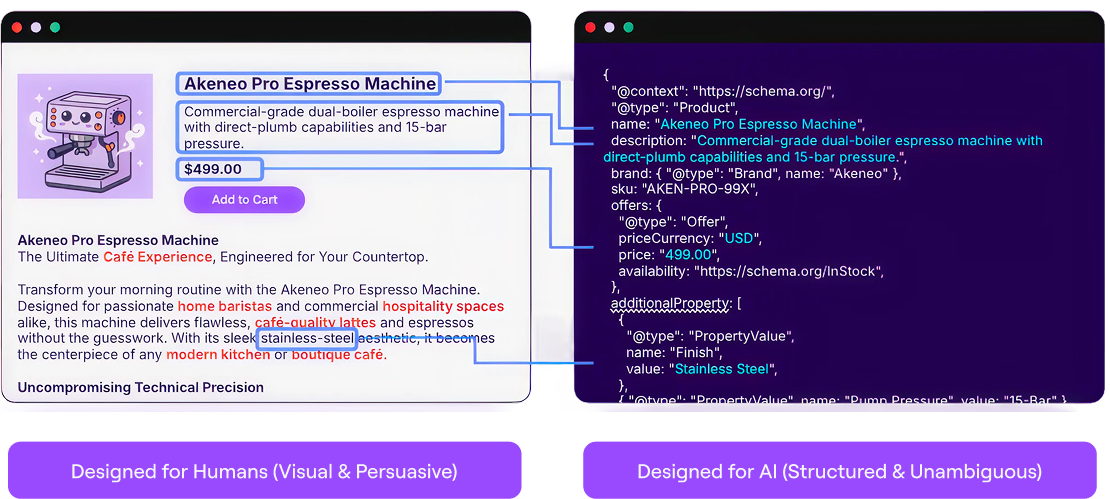
AI engines rely on consistent categorization and clearly defined attributes to connect products with shopper intent. Structured data, including Schema.org markup, essentially acts as a translator between the product information humans see on a page and the machine-readable facts AI systems can interpret.

Let’s go back to our shopper looking for a coffee machine for a small kitchen. An AI system may interpret that request as a combination of specific requirements: an espresso machine, a compact footprint, and suitability for a countertop. If dimensions, product type, or other relevant attributes exist only in a paragraph of marketing copy (or are missing altogether) the AI may struggle to make that connection.

The lesson is simple: do not make AI guess. Product dimensions, materials, compatibility, identifiers, features, and other important facts should be clearly structured and accessible.
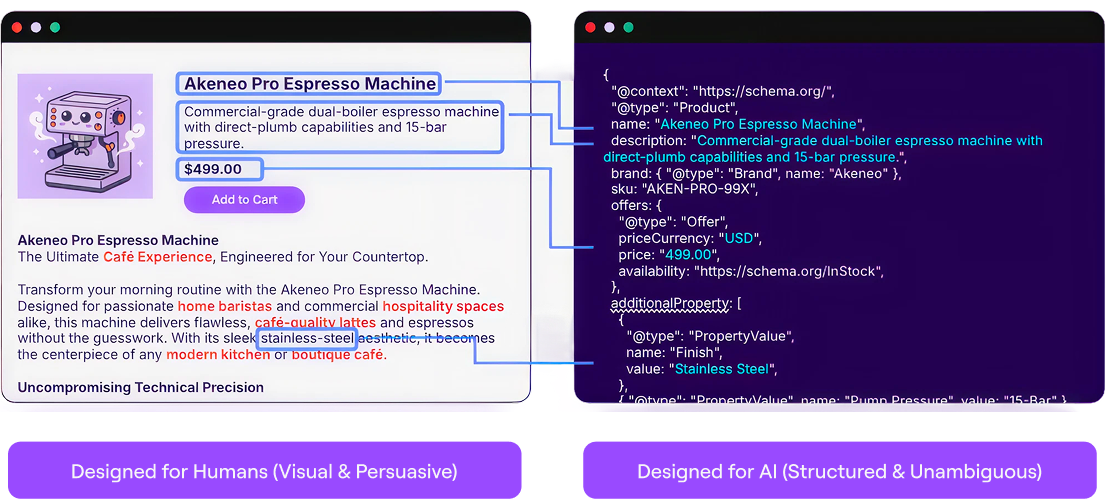
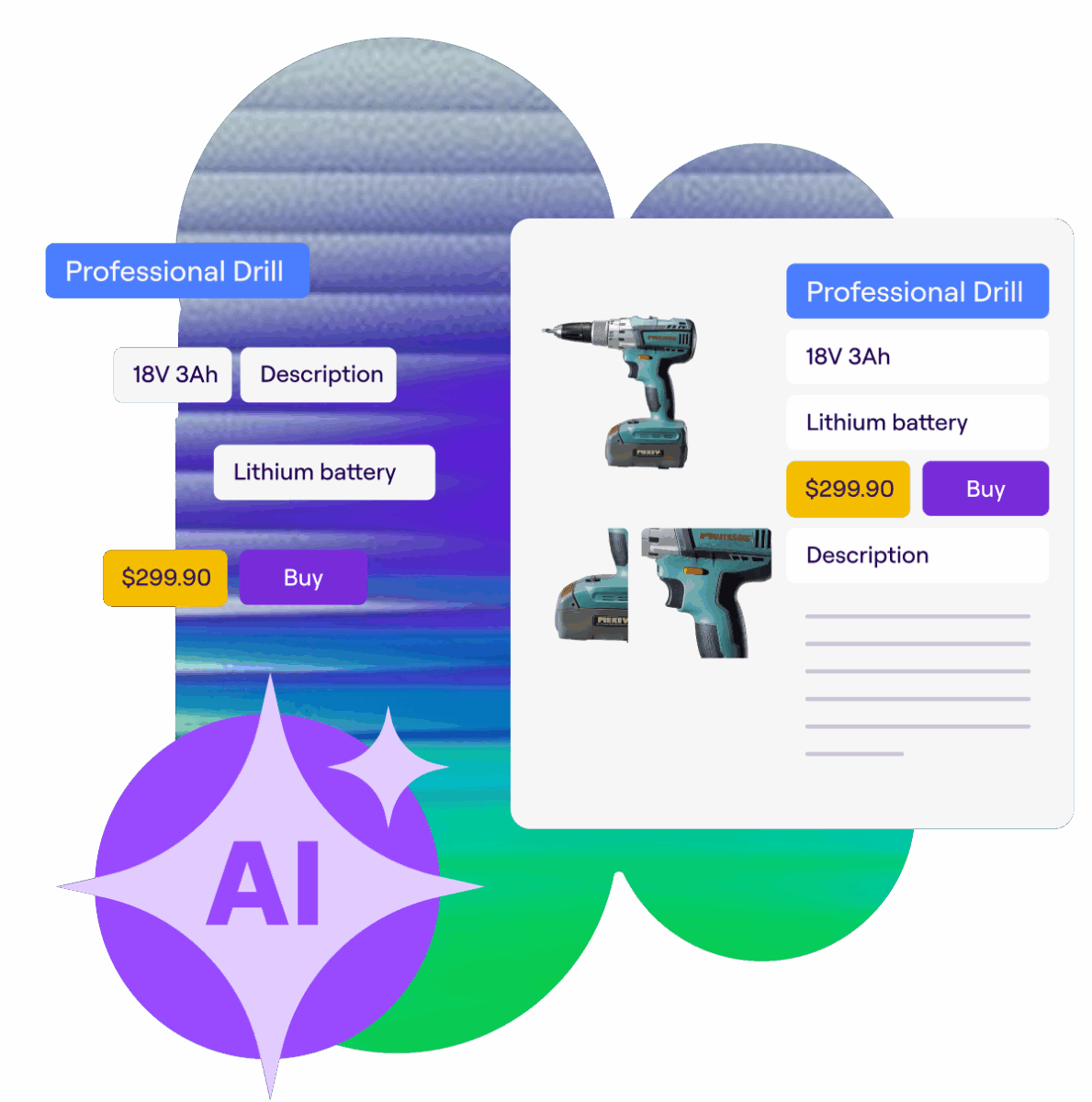
Designed humans vs AI


2. Authority: Be Credible

Being understandable is only the first hurdle. AI also needs to trust what it finds.

AI engines can cross-reference product and brand information across multiple independent sources before deciding whether a recommendation is credible. Your own website may serve as the primary source of truth, but information from knowledge bases, business databases, retailers, reviews, community platforms, and media coverage can all contribute to the broader picture.

Imagine your website says a product has one set of specifications while a major marketplace lists something different. A human shopper might simply assume one page has not been updated. For an AI system trying to determine which information is accurate, however, that contradiction creates uncertainty.

That is why consistency across channels matters so much. If product descriptions, specifications, identifiers, policies, or other details differ from one destination to another, confidence can erode. A governed source of truth that distributes consistent product information across channels gives AI systems a much clearer foundation to work from.
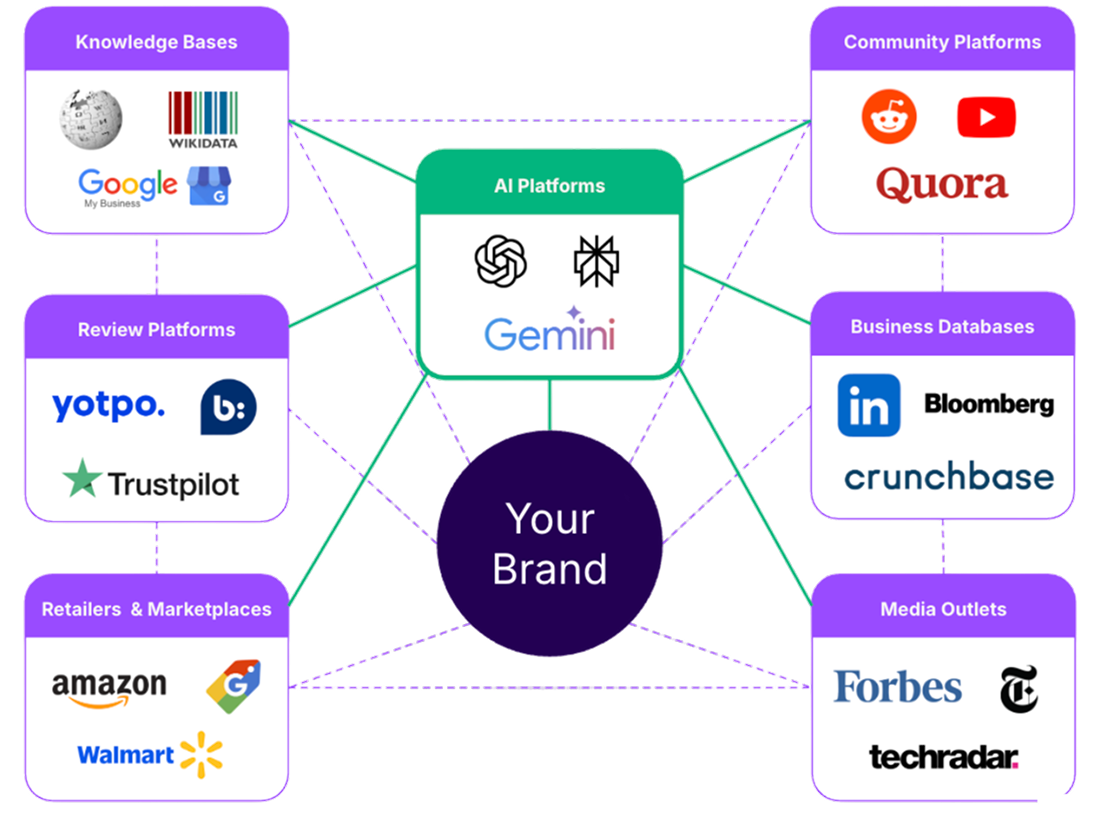
 

Customer Input


3. Freshness: Be Relevant

Real-time data velocity is an important trust signal for AI engines. Products need active, recent information around them if they are going to maintain visibility over time.

For your brand, that might mean recent customer sentiment on review platforms or up-to-date signals from major marketplaces. In B2B environments, freshness can come from mentions in analyst reports, partner ecosystems, professional directories, or industry publications.

Maybe you have a product that launched three years ago and has since been updated with new functionality. If most third-party descriptions still reflect the original version, an AI engine may encounter conflicting evidence about what the product can actually do.

AEO therefore cannot be treated as a one-time optimization project. Product information, marketplace content, reviews, and external references all need ongoing attention as products and markets evolve.

Get Your Products Seen, Trusted, and Recommended by AI

4. Relevance: Be Recommended

The final pillar may be the most important distinction between simply being visible and actually being chosen.

Technical completeness makes your product understandable. Context makes it recommendable. AI engines increasingly respond to conversational questions built around needs, situations, and use cases rather than simple keyword combinations.

That means product content should go beyond generic claims like “sleek design” or “high performance.” Specific, extractable facts are far more useful. 

Context also means connecting products to real-world occasions and needs. A coffee machine is not always just a coffee machine. Depending on its attributes, it might also be a compact espresso maker for a studio apartment, a housewarming gift under £100, or an everyday appliance for a remote worker. Those details help AI connect a product to the way someone is actually asking a question.

You can go one step further by providing clear answers to common customer questions directly within product content. AI engines are designed to synthesize answers, so making useful information easy to extract increases the likelihood that your product can become part of that answer.

From Search Visibility to AI Readiness

The four pillars of AEO work together: structure helps AI understand your products, while authority helps it trust them. Freshness shows that the information remains relevant, and context helps AI connect the product to a shopper’s specific need.

Ultimately, AEO is not about abandoning SEO or chasing another marketing acronym. It reflects a broader change in product discovery. As shoppers increasingly rely on AI to compare options and make recommendations, product information has to work for machines as well as humans.

The Invisible Shelf: Get Your Products Seen, Trusted, and Recommended by AI

Download the AEO playbook and learn how to make your products visible, trusted, and recommended in the era of AI commerce.

Casey Paxton, Content Marketing Manager

Akeneo

SAP Commerce On-Premise Support Is Changing: What Should You Do Next?

Technology

SAP Commerce On-Premise Support Is Changing: What Should You Do Next?

The final SAP Commerce on-premise release is here, along with the end of mainstream maintenance. With that comes an an opportunity to look beyond the technical migration itself. This blog explains what the support change does (and does not) mean, how to evaluate the future role of SAP’s embedded PCM, and why a dedicated, best-of-breed PIM may be worth considering as part of a wider strategy for composable commerce, omnichannel growth, and AI readiness.

For organizations running SAP Commerce on-premise (formerly SAP Hybris Commerce), July 31, 2026 was an important planning date.

On that day, version 2205, the final on-premise release, reached End of Mainstream Maintenance and moved into Customer-Specific Maintenance.

It’s important to note that SAP has stated that there is currently no defined sunset or end-of-life date for SAP Commerce on-premise, and this change does not affect SAP Commerce Cloud. 

The other good news is that this is not an overnight shutdown, nor does it automatically require every organization to replace its product information management capabilities. It is, however, a valuable moment to review the role SAP Commerce plays in your technology landscape and decide what should come next.

A modernization milestone, not a forced migration

When SAP Commerce 2205 enters Customer-Specific Maintenance, customers can continue to access support under their existing arrangements, but the scope changes. SAP will no longer adapt the release to certain new or changing requirements, including legal changes, technological updates, new support packages, updates to third-party libraries, or support for new interfaces.

For some organizations, the logical next step will be a move to SAP Commerce Cloud. Others may use the milestone to compare commerce platforms, adopt a more composable architecture, or modernize several parts of their digital stack at once.

There is another important point to clarify: Product Content Management, or PCM, is not a standalone SAP product that is independently reaching end of life. It is an embedded capability within SAP Commerce, and SAP Commerce Cloud continues to include product, content, and catalog management capabilities. An organization moving to SAP Commerce Cloud can therefore continue using SAP’s embedded PCM without adopting a separate PIM.

The right conversation is not, “What must we replace?” It is, “What architecture will best support the business we are becoming?”

Modernization is about more than infrastructure

Moving from customer-managed infrastructure to a cloud service can be a major undertaking, but infrastructure is only one part of modernization.

Product information now supports far more than a single eCommerce storefront. The same data may need to power regional sites, mobile experiences, marketplaces, distributor portals, print catalogs, customer service tools, retail partners, and emerging AI-powered discovery channels. It must also serve teams across marketing, eCommerce, product, compliance, sales, and operations.

At the same time, organizations are investing in AI and composable commerce. Both increase the importance of trusted, structured, well-governed product information. An AI agent cannot reliably compare, describe, or recommend products when attributes are incomplete, terminology is inconsistent, or critical context is scattered across systems. A composable architecture also delivers limited flexibility when product data remains tightly coupled to one commerce platform.

That makes this milestone an opportunity to ask a broader strategic question: Should product information remain embedded within commerce, or should it be managed through a dedicated, best-of-breed PIM?

When a dedicated PIM may make sense

Embedded PCM can remain a practical choice for organizations whose product content processes are closely aligned with their SAP Commerce environment. A dedicated PIM becomes worth considering when product information has a wider role across the enterprise.

Questions to consider include:

  • Are multiple suppliers, business units, regions, or agencies contributing product information?
  • Does the same catalog need to be adapted for different languages, markets, retailers, marketplaces, or distributors?
  • Do marketing and product teams need greater ownership of enrichment, validation, approvals, and localization?
  • Are custom workflows or data-quality rules becoming difficult to maintain within the commerce platform?
  • Do AI initiatives require a more governed taxonomy, richer attributes, stronger context, and a reliable source of approved product information?
  • Would separating product data from commerce make future platform changes faster and less disruptive?

These are stronger indicators of a PIM opportunity than the maintenance date alone. The goal is not to introduce another platform for its own sake. It is to create an operating model in which product information can be collected, enriched, governed, and activated efficiently wherever the business needs it.

Meet with an Akeneo Expert Today

Akeneo can complement whichever commerce path you choose

Akeneo provides a centralized source of trusted product information that can sit alongside SAP Commerce Cloud or support a broader commerce transformation. Product data can be brought together from ERP systems, suppliers, and internal teams; enriched and governed in one place; and then delivered to commerce platforms, marketplaces, distributors, and other customer-facing destinations.

For organizations continuing with SAP, Akeneo offers an accelerator for SAP Commerce Cloud built on SAP Integration Suite. It provides prebuilt integration artifacts to help synchronize complete, localized product information from Akeneo PIM into SAP Commerce Cloud while reducing the need for custom integration work.

This approach allows commerce and product information to evolve on their own timelines. Your commerce platform can focus on transactions, storefront experiences, promotions, and orders, while a dedicated PIM supports product data quality, enrichment workflows, governance, and omnichannel activation.

It also creates room for a phased modernization strategy. An organization may first migrate its commerce infrastructure, then strengthen product data governance, expand to new channels, improve supplier collaboration, or prepare its catalog for AI-powered experiences. Modernization does not have to be a single, disruptive replacement project.

Akeneo: a partner for life

Every SAP Commerce environment is different. Some organizations have relatively standard implementations; others have years of customizations, integrations, and business processes built around the platform. The right modernization plan must reflect that reality.

Akeneo is committed to being a partner for life, not simply a technology selected for a single migration project. We help organizations assess the current role of product information, define the capabilities their future architecture requires, and build a practical path forward, whether that means complementing SAP Commerce Cloud with a best-of-breed PIM or supporting a wider transformation.

The July 2026 SAP maintenance milestone deserves attention, but it does not need to create panic. Approached thoughtfully, it can become a catalyst for better governance, greater architectural flexibility, and more reliable product experiences. The result is a product information foundation that can support today’s migration decisions and continue adapting as channels, customer expectations, and AI capabilities evolve.

Considering your next step after SAP Commerce on-premise? Connect with an Akeneo expert for a conversation about your modernization strategy, or request a personalized demo to see how a best-of-breed PIM can support your business, whether you’re migrating to SAP Commerce Cloud or exploring a broader transformation.

Are you ready to take the next step?

Our Akeneo Experts are here to answer all the questions you might have about our products and help you to move forward on your PX journey.

Demi Tuck, Partner Solutions Engineer

Akeneo

How to Prepare for AEO as a B2B Organization

Artificial Intelligence

How to Prepare for AEO as a B2B Organization

Large language model-powered search is reshaping B2B discovery just as quickly as it is transforming consumer commerce. Discover why traditional SEO is no longer enough, the product data challenges that can keep B2B offerings out of AI-generated answers, and the practical steps organizations can take to make their products easier for intelligent systems to understand, trust, and recommend.

B2B organizations have traditionally moved more cautiously than consumer brands when adopting new digital technologies.

That caution is understandable. B2B buying journeys are complex, sales cycles are long, and product information can include hundreds of technical attributes, certifications, compatibility rules, pricing structures, and implementation requirements.

But large language model (LLM)-powered search and discovery is not waiting for B2B businesses to catch up.

Business buyers are already using AI tools to research suppliers, compare products, evaluate technical fit, and create shortlists before speaking to a sales representative. According to Forrester, 89% of B2B buyers now use generative AI during the buying process, making it a primary source of self-guided information.

That makes Answer Engine Optimization, or AEO, a strategic priority. AEO is the practice of structuring content and building sufficient authority so AI engines can confidently cite and recommend a company’s products.

From ranking in search to appearing in the answer

Traditional search engine optimization helps pages rank for keywords and attract website traffic. AEO focuses on whether an AI system can understand, trust, cite, and recommend a product in response to a buyer’s question.

The distinction matters because AI engines do not simply return a list of links. They interpret intent, compare options, evaluate available evidence, and synthesize a direct response.

A B2B buyer might ask:

“Which industrial pump is compatible with corrosive chemicals and meets ATEX requirements?”

“What warehouse management platform is best for a multi-site distributor?”

“Which packaging material meets food-safety standards and supports recyclability targets?”

Answering those questions requires structured, complete, current, and credible information.

A product can perform well in traditional search and still be absent from an AI-generated recommendation if its specifications are incomplete, buried in PDFs, inconsistent across channels, or difficult for machines to verify. We call this the Invisible Shelf; when a product shows up in traditional search, but is largely ignored from LLM searches.

Get Your Products Seen, Trusted, and Recommended by AI

Why AEO is especially challenging for B2B

B2B organizations face several distinct obstacles.

First, their product data is highly complex. One product may have hundreds of attributes, technical dependencies, region-specific certifications, and compatibility requirements. When those details live in unstructured documents or disconnected systems, AI engines may not be able to interpret them confidently.

Second, B2B product information is frequently fragmented. Manufacturers, suppliers, distributors, partners, marketplaces, and sales teams may all publish different versions of the same product record. Contradictory specifications and outdated claims create uncertainty, and AI systems are less likely to recommend products they cannot verify.

Third, B2B buying intent is nuanced. Buyers are often searching for a solution to an operational, regulatory, or commercial problem, not simply a product category. A product record that lists dimensions and materials but lacks information about operating environments, integrations, total cost of ownership, or implementation requirements may fail to answer the buyer’s actual question.

Finally, many organizations treat AEO as a visibility exercise rather than a product data challenge. Monitoring whether products appear in AI answers can reveal a problem, but it cannot correct missing attributes, govern supplier information, manage enrichment workflows, or distribute updated content across channels.

Five practical steps for improving B2B AI discoverability

1. Understand how buyers ask questions

Review sales conversations, support requests, website searches, request-for-proposal language, and industry terminology. Identify the prompts buyers are likely to use and test whether your products appear in the responses.

Prioritize commercially valuable topics such as compatibility, compliance, performance, installation, and industry-specific applications.

2. Build a governed product data foundation

Centralize critical product information and establish clear ownership for attributes, identifiers, certifications, claims, and updates.

A machine-ready catalog must serve two audiences simultaneously: people need persuasive narratives and context, while AI systems need structured, standardized, and unambiguous facts.

3. Make technical information machine-readable

Use structured product schema, standardized categories, global identifiers, clear product relationships, and consistent attribute fields. Move essential facts out of PDFs and dense prose wherever possible.

Do not make an AI engine infer that a component is suitable for outdoor use. Provide explicit attributes such as “outdoor-rated,” temperature range, ingress-protection rating, compatible materials, and supported environments.

4. Add context, not just specifications

Technical completeness makes a product understandable. Context makes it recommendable.

Enrich product records with the problems products solve, the industries they serve, the environments they support, and the systems they work with. Replace vague claims such as “fast installation” with specific, verifiable evidence, such as “reduces average installation time from four hours to 90 minutes.”

5. Create a continuous trust loop

AI discoverability will continue changing as models, buyer behavior, competitors, and commerce channels evolve. Regularly check for outdated records, conflicting specifications, emerging buyer questions, and changes in certifications or availability.

Align information across websites, distributor feeds, marketplaces, partner directories, analyst sources, and industry publications. AI engines cross-reference these environments, so inconsistencies can quickly undermine trust.

AEO is the next phase of B2B digital readiness

B2B organizations do not need to transform every product record at once. Start by identifying where commercially important products are invisible, prioritize the highest-impact gaps, and create a repeatable process for improving product information.

The goal is not to produce more content for its own sake. It is to make products easier for intelligent systems to understand, and safer for them to recommend.

As AI becomes more influential during research, evaluation, and purchasing, B2B companies that invest in trusted, machine-ready product information will be better positioned to earn visibility, credibility, and consideration.

For a deeper look at the data, governance, and content practices behind AEO for both B2B and B2C organizations, download ‘The Invisible Shelf’ today.

The Invisible Shelf: Get Your Products Seen, Trusted, and Recommended by AI

Download the AEO playbook and learn how to make your products visible, trusted, and recommended in the era of AI commerce.

Casey Paxton, Content Marketing Manager

Akeneo

What is Agentic PIM? How AI Agents Are Changing Product Information Management

Artificial Intelligence

What is Agentic PIM? How AI Agents Are Changing Product Information Management

AI can already generate product descriptions or fill missing attributes, but agentic PIM goes much further. Discover how specialized AI agents can work across every stage of the product lifecycle, while operating within clear business rules and human oversight. Explore what agentic PIM really means, how it works through practical examples, and why trusted data, shared context, orchestration, and governance are essential for turning isolated AI experiments into dependable product operations.

At first glance, “agentic PIM” can sound like another piece of AI jargon. 

Product information management has always been about centralizing, improving, and distributing product data. Generative AI has already accelerated parts of that work, from drafting descriptions to translating content and suggesting missing attributes.

Agentic PIM represents a deeper shift than this. Instead of waiting for a person to initiate every task, AI agents can understand an objective, plan the steps, work across data and tools, and move a process forward within defined guardrails.

The gap between experimentation and scale remains wide. McKinsey states that 88% of respondents said their organizations regularly used AI in at least one business function, yet only about one-third had begun scaling AI across the enterprise.

What Does “Agentic PIM” Actually Mean?

Agentic PIM is a product information management environment in which specialized AI agents can observe a catalog, reason over product and business context, propose or take actions, collaborate with people and systems, and monitor results.

A traditional PIM is primarily a system of record: it centralizes and governs product information. An AI-assisted PIM might generate a description when a user clicks a button. An agentic PIM would go further by becoming a governed system of action. It can recognize that a product family is incomplete, determine what is missing, retrieve evidence from approved sources, draft updates, route higher-risk decisions for review, and prepare approved information for the right channels.

It’s important to note here that this does not mean removing people from the PIM process. “Agentic” describes purposeful, multi-step action, not unlimited autonomy. Normalizing units may be safe to automate, but complex acts like publishing a sustainability claim or changing regulated technical information should still require expert validation.

Why is PIM a Natural Home for AI Agents?

AI agents need more than a language model. They need trusted context: taxonomies, attribute definitions, variant relationships, approved terminology, supplier sources, channel requirements, permissions, and decision history. 

A PIM already contains much of this information, and can act as the perfect foundation for training and supporting AI agents.

Without that foundation, agents can produce individually plausible but collectively inconsistent results. A content agent may describe an unvalidated feature. A localization agent may translate content that is still changing. A channel agent may publish an outdated record. The problem is not simply model accuracy; it is coordination around a shared source of truth.

Agentic PIM addresses both sides of the AI shift. Internally, agents help teams collect, enrich, govern, and syndicate product information. Externally, that data must be comprehensive and machine-readable enough for AI search engines, shopping assistants, and buying agents to understand. Forrester reported in January 2026 that 94% of business buyers were using AI in their buying process.

Get Your Products Seen, Trusted, and Recommended by AI

What Does Agentic PIM Look Like in Practice?

AI agents can support work across every stage of the product lifecycle. Rather than functioning as isolated tools, specialized agents can collaborate around a shared, governed product record, moving work forward while keeping human experts involved in decisions that require judgment or carry greater risk. 

Consider a manufacturer onboarding a supplier catalog containing spreadsheets, technical PDFs, and product images. A supplier data agent could classify products, map source fields to the company’s product model, normalize measurements, identify duplicates, and flag uncertain mappings. High-confidence, low-risk changes could move forward automatically, while exceptions are routed to a product expert with source evidence attached.

An enrichment agent could then identify missing dimensions, compatibility details, certifications, or use-case attributes. 

A content agent might create different descriptions for a distributor portal and a direct-to-consumer website, using the approved brand voice and each destination’s requirements. 

A localization agent could adapt that content for different markets, while a compliance agent isolates regulated claims for human approval. The agents perform specialized roles, but work from the same record and follow the same sequence.

The process can continue after publication. Suppose a marketplace changes its taxonomy or begins rejecting a required image field. An activation agent could detect the failures, group affected SKUs, identify the root cause, propose a corrected mapping, and prepare products for republication. A market intelligence agent could then analyze search behavior, reviews, channel performance, returns, or AI-discovery signals and recommend improvements to the core record.

That feedback loop matters because product information is never finished. Buyer language changes, channel requirements evolve, and new use cases appear. The National Retail Federation estimates that nearly 20% of all online sales (worth $850 billion) are returned. 

Product information is not responsible for every return, but preventing avoidable confusion around fit, compatibility, dimensions, materials, or usage can have material value.

What Makes Agentic PIM Trustworthy?

A reliable agentic PIM needs an “AI harness”: infrastructure that determines what the model can access, what context it receives, which tools it may use, and what controls apply. That means role-based permissions, business rules, source attribution, confidence signals, approval workflows, audit trails, observability, and reversibility.

It also requires orchestration. Supplier ingestion must happen before enrichment; validated enrichment should precede content creation; approved content should precede activation. When agents operate independently, every use case adds another data copy, rule set, integration, and failure point. When they share a governed foundation, their value compounds.

This discipline matters because agentic technology is easy to overhype. Gartner predicts that more than 40% of agentic AI projects will be canceled by the end of 2027 because of escalating costs, unclear business value, or inadequate risk controls. 

The better starting question is not “Where can we add an agent?” but “Which product information bottleneck has a clear outcome, trustworthy data, and defined decision boundaries?”

From Data Entry to Strategic Orchestration

Agentic PIM does not eliminate product experts. It changes where their expertise is applied. 

Repetitive tasks such as mapping supplier fields, identifying missing attributes, adapting content for different channels, and monitoring publication errors can be handled by agents operating within governed workflows. Human expertise remains central, but it is applied where it has the greatest value: setting policies, reviewing exceptions, validating sensitive claims, and improving the rules that guide automation.

As catalogs become larger, channels multiply, and product information is consumed by both people and machines, PIM must coordinate far more than data storage. 

Agentic PIM brings that coordination into everyday product operations, continually identifying gaps, preparing recommendations, routing decisions, activating approved information, and feeding market signals back into the product record. 

The result is a product information practice that can respond more quickly to new products, regulations, channels, and buyer expectations while maintaining clear oversight. 

Over time, the product record becomes a living operational asset: richer, more useful, and more trustworthy with every interaction.

The Invisible Shelf: Get Your Products Seen, Trusted, and Recommended by AI

Download the AEO playbook and learn how to make your products visible, trusted, and recommended in the era of AI commerce.

Casey Paxton, Content Marketing Manager

Akeneo

AI Product Data Enrichment: A Practical Guide

Artificial Intelligence

AI Product Data Enrichment: A Practical Guide

AI is changing how customers discover, evaluate, and purchase products, but AI is only as good as the product data it receives. Discover what AI product data enrichment really means, why simply filling in missing attributes isn’t enough, and how you can use AI to create richer, more structured, contextual product information at scale.

For years, product data enrichment has largely been a manual exercise.

Marketing teams wrote product descriptions. Merchandisers categorized products. Product managers filled in technical specifications. eCommerce teams hunted down missing images, dimensions, certifications, and compatibility information.

Today, AI can automate much of that work.

Large language models can generate compelling product descriptions in seconds. Computer vision can identify product attributes from images. AI can classify products, normalize supplier data, translate content, summarize customer reviews, and even suggest missing attributes based on similar products.

But while AI has dramatically changed how enrichment happens, it hasn’t changed what makes product data valuable.

In fact, as AI increasingly becomes part of the buying journey itself, the quality of your product data matters more than ever. 

Rich, structured, accurate product information determines whether AI systems can understand, compare, and recommend your products.

What is AI product data enrichment?

AI product data enrichment is the process of using artificial intelligence to improve the completeness, quality, consistency, and usefulness of product information.

Rather than relying solely on manual effort, AI can help organizations:

  • Generate SEO-friendly product descriptions
  • Fill in missing product attributes
  • Categorize and classify products
  • Standardize supplier data
  • Translate product content
  • Extract information from specification sheets and PDFs
  • Improve metadata
  • Recommend related products
  • Identify inconsistencies or missing information

AI enrichment is more than writing descriptions

One of the biggest misconceptions surrounding AI enrichment is that it’s simply an AI copywriter.

Generating product descriptions is certainly useful, but it’s only one piece of the puzzle.

Your catalog should also include:

  • Complete technical specifications
  • Consistent attributes
  • Product relationships
  • Compatibility information
  • Certifications
  • Dimensions and materials
  • Use cases
  • Customer-facing benefits
  • Rich metadata
  • Structured product identifiers

AI can help enrich each of these areas, turning incomplete product records into comprehensive product experiences.

The richer your product data becomes, the more opportunities customers, and increasingly AI assistants, have to discover the right product.

Get Your Products Seen, Trusted, and Recommended by AI

Best practices for AI-powered enrichment

1. Audit the current catalog

Before introducing AI, understand the condition of your data. Select a representative sample across categories, markets, suppliers, and price points. Review it for missing attributes, duplicate values, inconsistent units, outdated claims, weak descriptions, and conflicts between channels.

Do not evaluate every field equally. Care instructions may be critical for apparel, while voltage, compatibility, and certifications matter more for electronics or industrial equipment. Prioritize attributes according to customer intent, regulatory needs, channel requirements, and commercial value.

The result should be an enrichment backlog showing which fields are missing, which products are affected, what source information exists, and which improvements matter most.

2. Define the target product record

AI works best when it has a clear destination. Define what a complete record should contain for each product category before generating or extracting content.

That model might include: 

  • Identifiers
  • Taxonomy 
  • Specifications 
  • Dimensions 
  • Materials 
  • Compatibility 
  • Benefits 
  • Use cases 
  • Media 
  • Safety information 
  • FAQs 
  • Channel-specific content

Set allowed values and formatting rules. Decide which measurement units to use, how colors will be standardized, and which claims require evidence.

This structure gives AI boundaries. Instead of producing free-form text, it can populate approved fields, map supplier terminology to a controlled vocabulary, and flag information that does not fit established rules.

3. Apply AI to the right tasks

Different AI techniques suit different jobs. Large language models can rewrite descriptions, generate FAQs, and adapt content for specific audiences. Natural language processing can extract specifications from manuals. Classification models can assign categories, while translation models can localize content.

A workflow may combine several capabilities. AI could extract a material from a supplier PDF, convert a measurement, map the product to your taxonomy, and draft a customer-friendly benefit.

Preserve traceability throughout. Teams should know whether a value came from a trusted source, was transformed by a business rule, or was inferred by AI. Inferred information should not be presented as confirmed fact without review.

4. Enrich for context, not just completeness

A technically complete record can still be unhelpful. Shoppers often describe needs through problems, occasions, environments, or constraints rather than exact product terminology.

For example, “width: 18 centimeters” is useful. “Fits on narrow countertops and under standard kitchen cabinets” explains why it matters. Similarly, software should be described not only by features, but also by company size, workflows, implementation requirements, and industry use cases.

AI can turn specifications into contextual content, but the facts must remain precise. Replace phrases such as “high performance” or “compact design” with measurable, verifiable detail. This gives customers clearer reasons to buy and helps search and AI systems interpret the product.

Context for AI


5. Keep humans in the loop

AI increases speed, but accountability remains with the business. Establish review rules based on risk. Low-risk tasks, such as reformatting units or applying approved category labels, may be automated. Claims about safety, compliance, ingredients, performance, pricing, or sustainability should receive specialist approval.

Use reusable prompts, validation rules, confidence thresholds, and approval workflows. Require source references for critical attributes and maintain brand guidelines so generated content remains consistent.

Governance should also monitor unsupported claims, repetitive phrasing, incorrect translations, and content that may be accurate but unsuitable for a market.

6. Publish consistently and measure outcomes

Enriched data should flow from a governed source of truth to every relevant channel. If specifications differ between a brand site, retailer feed, marketplace listing, and structured website data, customers become confused and automated systems receive conflicting signals. The whitepaper likewise emphasizes consistent information wherever a product appears.

Measure more than output volume. Useful indicators include attribute completion, validation pass rates, onboarding time, manual correction rates, channel rejections, conversion, returns, and customer-service questions.

Treat enrichment as a continuous loop: identify gaps, improve records, validate outputs, distribute updates, and learn from customer and channel feedback.

The future of enrichment is machine-ready product data

As AI becomes increasingly involved in product discovery, product information must serve two audiences simultaneously.

First, it needs to persuade human buyers with compelling descriptions, imagery, and storytelling.

Second, it needs to provide structured, machine-readable information that AI systems can easily interpret, compare, and recommend.

A well-governed product catalog supports stronger customer experiences, faster product launches, improved operational efficiency, and better visibility across traditional search, marketplaces, and emerging AI-powered shopping experiences.

As product discovery becomes more conversational and machine-mediated, enriched product data will support immediate commercial goals and long-term readiness. The objective is simple: create product records that people can understand, systems can process, and teams can trust.

The Invisible Shelf: Get Your Products Seen, Trusted, and Recommended by AI

Download the AEO playbook and learn how to make your products visible, trusted, and recommended in the era of AI commerce.

Casey Paxton, Content Marketing Manager

Akeneo

Turning AI Into Operational Advantage in Distribution

Artificial Intelligence

Turning AI Into Operational Advantage in Distribution

As AI reshapes B2B buying, wholesale distributors have a chance to turn outdated processes into a competitive advantage by modernizing search, product discovery, and purchasing. Discover the practical strategies that help distributors improve operational efficiency, empower their teams, and create the seamless buying experiences today’s customers expect.

Historically, wholesale distribution has trailed behind other sectors in digital transformation, often relying on legacy systems that can feel daunting to upgrade. However, modernizing your tech stack does not have to be an overwhelming overhaul. By implementing artificial intelligence (AI), distribution executives can turn operational challenges into significant growth opportunities.

Advanced algorithms can transform the core pillars of your business, optimizing how products are searched, discovered, and purchased to meet the demands of today’s B2B buyers.

How AI can help distributors across search, discovery, and purchasing

Upgrade search and discovery with AI in distribution workflows

B2B buyers now expect the same frictionless search experiences they encounter in consumer retail. In 2025, 64% of B2B buyers were Millennials or Gen Z—digital natives seeking top-tier digital experiences. For wholesale distributors, this means upgrading static catalogs into dynamic, intuitive discovery platforms. 

To effectively upgrade your search and discovery workflows, implement the following operational upgrades:

  • Standardize your foundation. Clean, organized product data is the prerequisite for intelligent search. Before algorithms can surface relevant products to buyers faster, your data must be uniform, accurate, and comprehensive. Audit your existing data for inaccuracies or inconsistencies, and make a plan to resolve them so you’re giving your product information management system (PIM) the most up-to-date information possible.
  • Implement intelligent search capabilities. Replace rigid keyword-matching with semantic search algorithms that understand buyer intent, industry-specific jargon, and product synonyms. This functionality allows buyers to search using their own terminology, incomplete SKUs, or partial part numbers, instantly surfacing matches and eliminating the “no results found” dead ends common in legacy systems.
  • Optimize the discovery phase. Machine learning algorithms can analyze past buyer behavior, regional trends, and purchasing patterns to personalize the catalog experience for each account. By automatically grouping complementary items, suggesting relevant alternatives for out-of-stock products, and uncovering hyper-relevant cross-selling opportunities directly on the product page, this technology guides buyers to items they need but didn’t explicitly search for.

Beyond just fixing search bars, treat your platform’s search query data as a direct feedback loop from your customers. Regularly reviewing failed search analytics can reveal emerging market demands or pinpoint exact areas where you can refine your catalog taxonomy.

Empower smarter purchasing decisions

Procurement is the engine of wholesale distribution, and inefficiencies here impact your bottom line. By integrating predictive analytics and agentic commerce models into your purchasing workflows, you can replace reactive ordering with a proactive strategy. This shift automates complex decisions, drives revenue, and optimizes your overall market positioning.

Consider how intelligent tools can refine your procurement strategies:

  • Automate forecasting. Purchasing managers can use predictive analytics to anticipate seasonal demand spikes and supply chain bottlenecks before they happen. By analyzing historical data and market trends, these tools help maintain optimal inventory levels and prevent costly stockouts.
  • Streamline vendor management. Sophisticated algorithms actively evaluate supplier performance by monitoring pricing fluctuations and tracking delivery times. This objective data allows your procurement team to negotiate better terms and pivot when a vendor underperforms.
  • Accelerate routine purchasing. Transition routine reordering to autonomous AI agents that execute purchases based on predefined risk parameters and real-time inventory triggers. This tool shifts manual data entry to the algorithm, freeing your procurement specialists to focus entirely on strategic sourcing and high-level vendor negotiations.

To maximize the return on investment for these purchasing tools, sync your predictive forecasting data directly with your distributor marketing and promotions calendar. This integration ensures your sales teams highlight products that your system guarantees will be in stock, aligning demand generation with inventory reality.

Preparing your team and technology for AI adoption

Introducing new technology is only half the battle. The true challenge lies in change management. Executives must carefully guide their IT, operations, and sales personnel through this digital transition to ensure high adoption rates. Constructing an optimized tech stack that supports advanced analytics requires both operational shifts and targeted upskilling across departments.

Here is how you can help different departments navigate this digital integration:

  • IT: Shift your IT team away from simply maintaining legacy servers and toward managing advanced data architectures. Establish clear data governance policies and build tech stacks designed to support continuous analytical processing.
  • Operations: Empower your warehouse and logistics managers to use AI-driven inventory mapping and automated routing systems. Transitioning these groups from manual tracking to managing algorithmic workflows makes for faster fulfillment times and reduces physical bottlenecks on the floor.
  • Sales: Explain that integrating AI into sales workflows saves time that sales team members can spend improving the customer experience instead of sifting through data. For example, as MDM’s distribution sales training guide notes, “Before sales calls, sales representatives can use AI to predict customer purchasing behavior, allowing them to present more personalized, data-driven up-sells, cross-sells, and add-on recommendations.”

Consider forming a committee of early AI adopters from IT, operations, and sales. This dedicated group can pilot new tools, document best practices, and champion the technology to their more hesitant peers, drastically reducing internal resistance.

Embracing AI fundamentally upgrades how wholesale distributors manage search, discovery, and purchasing. By standardizing data and empowering your teams with predictive insights, you create a frictionless experience that benefits both your buyers and your bottom line. As these technologies continue to evolve, regularly audit your tech stack and upskill your workforce to maintain your competitive edge.

The Invisible Shelf: Get Your Products Seen, Trusted, and Recommended by AI

Download the AEO playbook and learn how to make your products visible, trusted, and recommended in the era of AI commerce.

Bart Tessel, Chief Innovation Officer

National Association of Wholesale-Distributors

What is Answer Engine Optimization (AEO)?

Artificial Intelligence

What is Answer Engine Optimization (AEO)?

As shoppers increasingly turn to ChatGPT, Gemini, and other AI assistants instead of traditional search engines, brands face a new challenge: ensuring their products are recommended by AI, not overlooked. Discover what Answer Engine Optimization (AEO) is, how AI is reshaping product discovery, why visibility tools alone won’t solve the problem, and the four foundational pillars that help AI understand, trust, and recommend your products.

For more than two decades, digital visibility meant ranking on Google.

Brands optimized web pages, targeted keywords, and competed for clicks. If you earned a spot near the top of the search results, you had a strong chance of winning the customer.

That model is rapidly changing.

Today, shoppers are increasingly turning to ChatGPT, Gemini, Perplexity, Claude, and other AI assistants to help them research products, compare options, and make buying decisions. 

Instead of scrolling through pages of links, they simply ask:

  • “What’s the best espresso machine for a small apartment?”
  • “Which running shoes are best for marathon training?”
  • “What’s the most durable outdoor dining set under $1,500?”

Rather than presenting ten blue links, AI engines synthesize an answer by evaluating products, interpreting specifications, weighing trust signals, and recommending the options they believe best satisfy the request. 

Product discovery is moving beyond the website and into AI-powered environments where your product data must speak for itself.

That means a product can rank highly in traditional search and still fail to appear in AI-generated recommendations if its underlying product information is incomplete, inconsistent, or difficult for machines to interpret.

What Is AEO?

Answer Engine Optimization (AEO), sometimes referred to as Generative Engine Optimization (GEO), is the practice of structuring your content and product information so AI-powered answer engines can confidently understand, cite, and recommend your products.

Unlike traditional SEO, which focuses on improving rankings within search results, AEO focuses on increasing visibility inside AI-generated answers.

That’s an important distinction; SEO helps users discover your website, while AEO helps AI discover your products.

To do that successfully, AI must be able to interpret your product data the way a human would. Instead of simply matching keywords, AI understands entities, relationships, attributes, and user intent. 

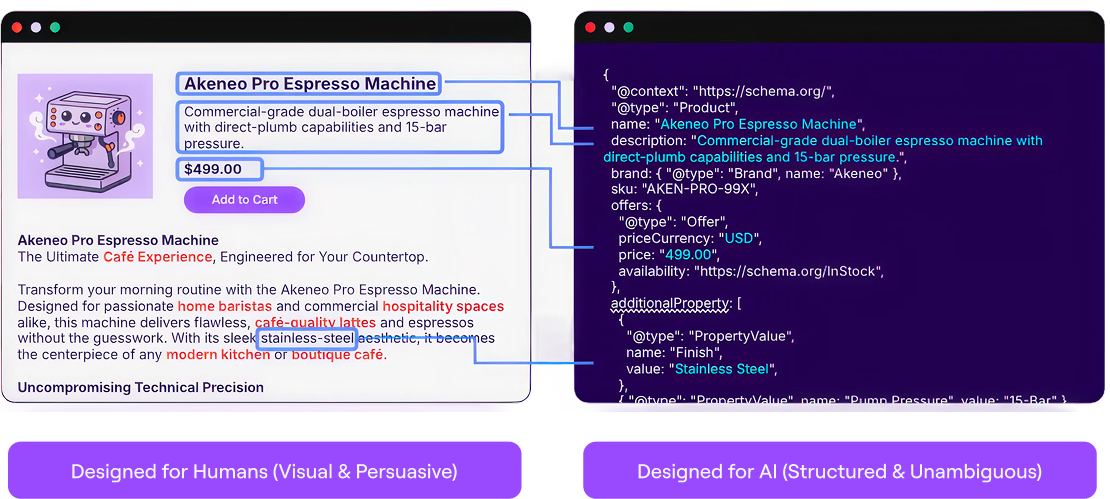
When someone asks for a “compact espresso machine for a small kitchen,” the AI isn’t searching for those exact words—it translates the request into structured attributes like dimensions, appliance type, countertop footprint, and intended use case. If your catalog doesn’t contain that information in a machine-readable format, your product may never be considered.

Product Data for a Human vs AI

Why Product Discovery Is Changing

AI-powered shopping assistants are changing how people buy.

Instead of researching across multiple websites, comparing dozens of product pages, and reading countless reviews, consumers increasingly expect AI to perform much of that work for them.

That means visibility depends less on how well your website performs and more on how understandable, complete, and trustworthy your product information is.

This trend extends to B2B organizations as well, which have historically adopted new digital behaviors more slowly. According to Forrester, 89% of B2B buyers now use generative AI during the buying process, making AI-powered discovery one of their primary self-service research channels.

Get Your Products Seen, Trusted, and Recommended by AI

Why Standard AEO Tools Aren’t Enough

The growing popularity of AEO has led to a wave of tools that measure AI visibility such as Profound, SEMrush, and Adobe’s LLM Optimizer.

These platforms are valuable because they can tell you whether your brand appears in AI-generated responses, identify competitors that are winning more recommendations, and highlight gaps in your visibility across different prompts and answer engines.

The problem? Most of them stop there.

They diagnose the issue, but they don’t solve it.

Traditional AEO tools generally don’t enrich missing product attributes, govern product information, align supplier data, manage enrichment workflows, syndicate corrected content across channels, or create a continuous feedback loop between AI discoverability and product data quality.

In other words, they measure visibility but don’t improve the product information that drives visibility.

As AI models evolve and buying behavior changes, maintaining AI discoverability requires continuous optimization, not just reporting. That’s why many organizations are pairing AI visibility tools with Product Information Management (PIM) systems that can actually improve the completeness, consistency, and quality of their product catalogs.

The Four Pillars of AEO

Building an effective AEO strategy is built on four foundational pillars.

1. Structure: Be Understandable

AI engines rely on structured, machine-readable product information to understand what you’re selling.

Complete schema markup, standardized attributes, accurate categories, identifiers, and relationships help AI connect your products to customer intent. Without this structure, AI is forced to guess, and AI rarely guesses in your favor.

2. Authority: Be Credible

AI doesn’t simply trust what your website says.

Instead, it validates your information across multiple trusted sources, including knowledge bases, retailer listings, review platforms, business directories, media coverage, and other third-party references.

When those signals are consistent, AI gains confidence in recommending your products. When they conflict, your credibility and visibility declines.

3. Freshness: Be Relevant

AI favors products supported by recent, active information.

Fresh reviews, updated specifications, current pricing, recent marketplace activity, analyst mentions, and ongoing customer engagement all contribute to stronger trust signals.

An outdated product record may still exist online, but it becomes increasingly difficult for AI to recommend with confidence.

4. Relevance: Be Recommended

Finally, AI rewards context, not just technical specifications.

Instead of vague marketing language, products should include specific, extractable facts, clear answers to common customer questions, and use cases that reflect how buyers actually search.

For example, describing a product as a “compact espresso machine ideal for apartments” provides far more context than simply listing its dimensions. Rich, contextual product content makes it easier for AI to match your products to conversational queries and recommend them confidently.

AEO Starts With Product Data

Many organizations think AEO is simply another SEO initiative.

In reality, it’s a product data challenge.

AI cannot recommend products it doesn’t fully understand. That means brands need machine-readable, complete, consistent, trustworthy product information that can be interpreted across every AI-powered buying experience.

As AI-powered product discovery continues to grow, success won’t be determined solely by who ranks highest in search results. It will be determined by whose product data AI trusts enough to recommend.

The Invisible Shelf: Get Your Products Seen, Trusted, and Recommended by AI

Download the AEO playbook and learn how to make your products visible, trusted, and recommended in the era of AI commerce.

Casey Paxton, Content Marketing Manager

Akeneo

Akeneo’s Summer Release is Bringing the Heat

Akeneo News

Akeneo’s Summer Release is Bringing the Heat

Managing product data has always meant more manual work, more complexity, more bottlenecks. Akeneo’s Summer Release flips that script. With the arrival of Agentic Ziggy, an AI operational layer that understands your goals and helps execute them, teams can finally move from maintaining information to acting on it. Here’s everything that’s new, and why it changes the game.

Summer is the season of momentum. 

It’s when businesses prepare for peak selling periods, launch new campaigns, and look for ways to move faster without sacrificing quality. But for many product teams, the reality is that managing product information, syndicating content, and preparing assets for every channel can still feel like a manual, time-consuming process.

That’s why we’re excited to introduce Akeneo’s Summer Release 2026, a release designed to help organizations work smarter, move faster, and unlock a new era of product experience management. 

Welcome to the era of the Agentic Product Cloud.

Meet Agentic Ziggy: Your AI Operational Layer

The headline of the Summer Release is Agentic Ziggy, and it’s a big one.

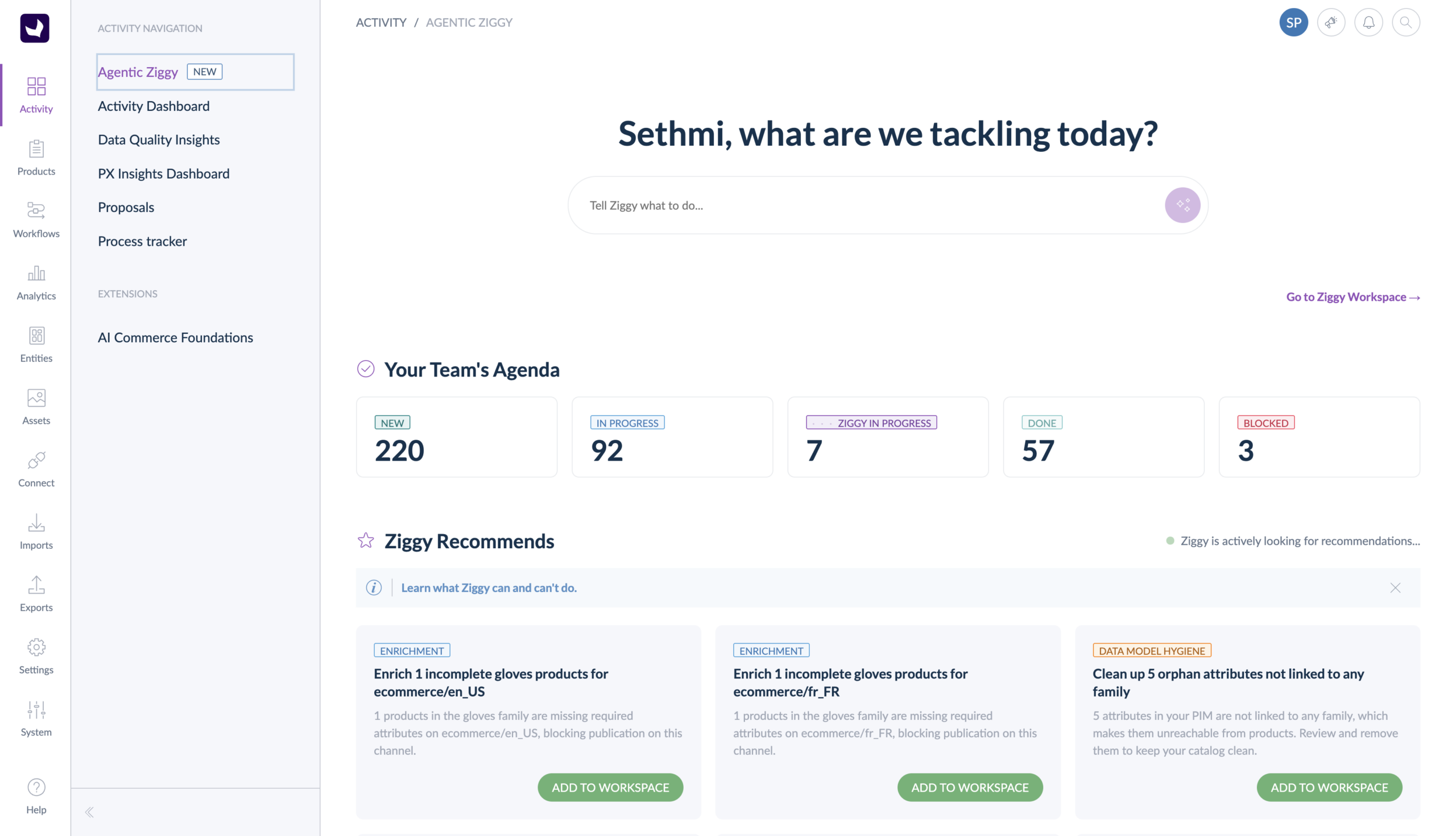
Agentic Ziggy introduces an AI-native workspace where teams can manage product experiences through intelligent agents rather than manual configuration. Instead of navigating complex menus or relying on technical specialists, users can guide outcomes through natural language interactions, letting coordinated AI agents handle the heavy lifting of product data workflows.

Think of it as augmenting your team with an intelligent layer that understands your objectives, recommends actions, and helps execute work across your entire product experience ecosystem. Whether you’re enriching data, preparing products for activation, or continuously optimizing experiences, Agentic Ziggy acts as an extension of your team, taking on repetitive, time-consuming tasks so your people can stay focused on the decisions that actually drive growth.

It’s important to note that this isn’t automation without oversight. Agentic Ziggy embeds governance directly into execution, ensuring teams can move faster without sacrificing the data integrity and control they depend on. Speed and data quality no longer have to be a trade-off.

For those already familiar with Ask Ziggy (the context-aware PIM assistant that helps users navigate complex configurations in real time), Agentic Ziggy builds on that foundation and takes it significantly further. Where Ask Ziggy guides, Agentic Ziggy acts.

Agentic Ziggy Dashboard

“Agentic Ziggy has become the fastest way for our team to get clear, structured answers from our PIM data, with the added benefit of moving from question to action with the help of AI.”

Garreth Trent, Merchandise Support Manager

Pepkor Lifestyle

AI-Powered Innovation Across the Entire Product Lifecycle

Agentic Ziggy is the star of the show, but the Summer Release also brings meaningful upgrades across every stage of the product experience lifecycle:

1. Smarter product modeling

With enhancements to the Data Architect Agent and the new Product Model Experience, building and evolving product architectures has become more intuitive than ever. What was once a technical exercise reserved for specialists is now a guided, accessible experience that supports faster onboarding, cleaner data structures, and better scalability.

2. Image editing without the bottleneck

Akeneo DAM now supports prompt-based AI image transformations. Teams can modify product visuals using simple text instructions; for example, swapping backgrounds, adapting imagery for seasonal campaigns, or generating channel-specific variations, all without routing requests back to a design studio or spinning up external tools. Work that used to take days of back-and-forth can now be done in seconds, directly inside Akeneo.

3. Activation that troubleshoots itself 

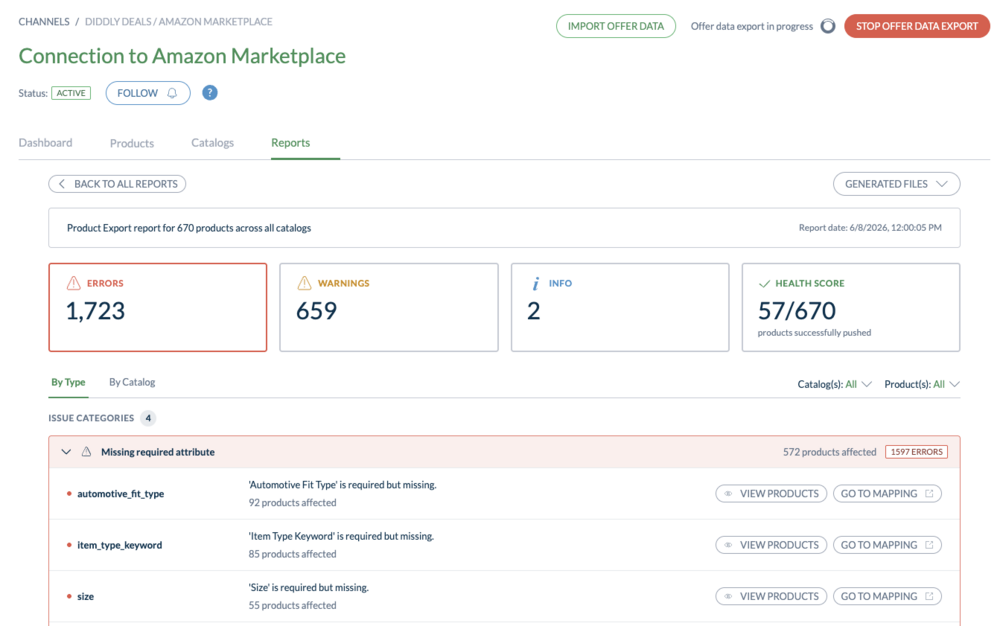
Syndication errors have always been a drain on time and technical resources. Intelligent Error Management changes that by translating complex retailer errors into clear, actionable guidance that’s in the user’s own language. Teams can now self-serve their way through activation issues without needing deep technical expertise or constant support intervention.


Akeneo Activation

4. Optimization that drives outcomes

By combining PX Insights with Agentic Ziggy, teams can move from identifying opportunities to acting on them in one seamless flow. Surface an AI readiness recommendation, understand the priority, and take action, all without leaving your workflow.

Why This Matters Now

Commerce teams are under more pressure than ever. More products, more channels, more personalized expectations. The traditional answer (add more headcount, add more process) doesn’t scale.

The smarter answer is augmenting your team with intelligent systems that can help complete work, recommend next steps, and continuously raise the bar on product experiences. That’s what Akeneo’s Agentic Product Cloud is built to deliver.

Ready to See It in Action?

Just like summer itself, this release brings a season of possibility; new tools, new ways of working, and a genuine opportunity to get ahead. Whether you’re looking to reduce manual effort, accelerate time to market, or simply do more with the team you already have, Agentic Ziggy and the Summer Release innovations are ready to help.

Join Akeneo’s upcoming Deminar to see Agentic Ziggy and the full Summer Release in action, and discover what it looks like when your product data starts working as hard as you do.

Akeneo’s 2026 Summer Release is Here.

Learn how Agentic Ziggy and new AI-powered capabilities within Akeneo Product Cloud help your team do more, faster.

Demi Tuck, Partner Solutions Engineer

Akeneo

Top 5 Things to Know Ahead of Amazon Prime Day

Retail Trends

Top 5 Things to Know Ahead of Amazon Prime Day

As Prime Day 2026 approaches, new research from Akeneo reveals that shoppers are becoming more strategic, more price-conscious, and increasingly reliant on AI tools. Discover the key findings from our latest survey and learn why high-quality product information may be the most important competitive advantage this Prime Day.

When Amazon’s annual Prime Day event kicks off on June 23, millions of consumers will be hunting for the best deals, comparing products, and filling their carts with everything from household essentials to big-ticket purchases.

While Prime Day may be built on discounts, today’s shoppers aren’t taking deals at face value. With 74% of consumers saying economic conditions are forcing them to cut back on spending, Akeneo surveyed 1,000 U.S. consumers to uncover how people are becoming more strategic in their purchasing decisions, relying on AI tools, and searching harder than ever for genuine value.

Let’s take a look at the five key trends shaping shopper behavior ahead of Prime Day 2026, and what you can do to stay competitive.

1. AI Has Become a Critical Part of the Shopping Journey

Mainstream AI tools like ChatGPT and Gemini are reshaping the future of commerce, and it is arriving faster than most teams expect. 

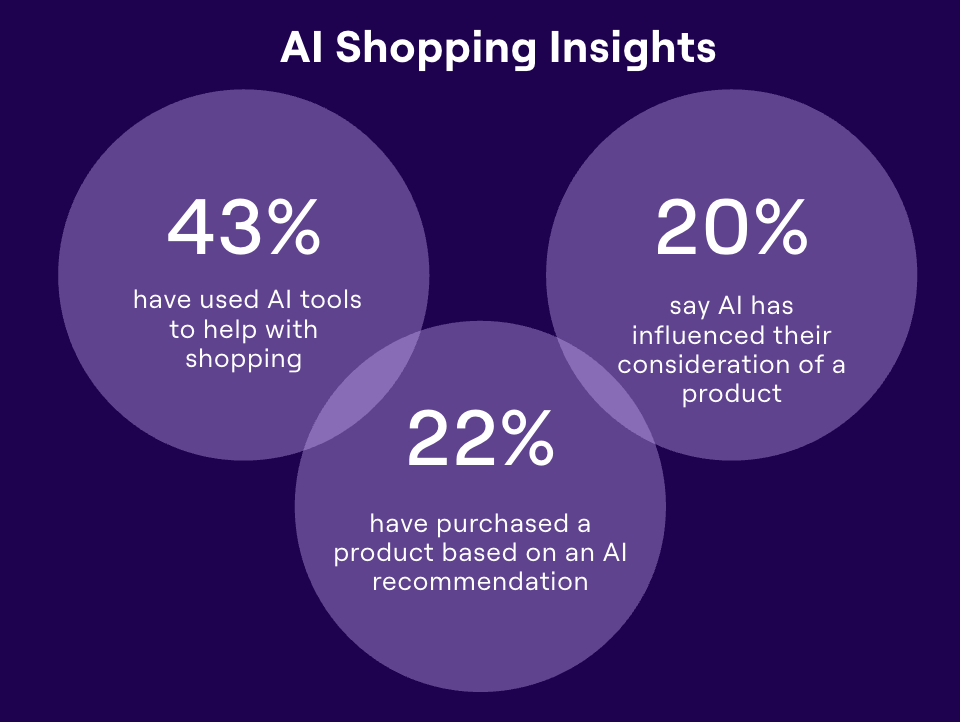
Ahead of Prime Day, 43% of consumers have already used AI to support shopping tasks like finding deals, narrowing down options, and summarizing product reviews. 

What’s particularly notable here is that AI is actively influencing purchasing decisions; 20% of consumers say AI has influenced their consideration of a product, while 22% report purchasing a product based on an AI recommendation.

As AI becomes a trusted source of shopping guidance, brands must ensure their product information is complete, accurate, and structured in ways that AI systems can easily understand and surface.

If AI cannot confidently understand or recommend your product, you risk becoming invisible during the earliest stages of the buying journey.

AI Shopping Insights

2. Consumers are More Value-Conscious Than Ever

The economic climate is having a significant impact on shopping behavior.

According to our survey, 74% of consumers say current economic conditions are affecting their Prime Day plans. While 84% still intend to participate in Prime Day shopping, consumers are approaching purchases with greater caution and intentionality.

This means shoppers are less likely to make impulse purchases and more likely to carefully evaluate whether a product truly offers value. Every purchase is being scrutinized, and consumers want confidence that they’re making the right decision before they click “Buy Now.”

For brands, this creates a new challenge. Discounting alone may attract attention, but it won’t necessarily earn trust. Shoppers want reassurance that they’re getting quality products, genuine savings, and accurate information that helps them understand what they’re purchasing.

3. Prime Day Has Become a Multi-Retailer Event

For years, Prime Day was viewed primarily as Amazon’s moment. Today, consumers see it differently.

More than half of shoppers (55%) say they plan to shop across multiple retailers to find the best deals, while 62% compare prices across different retailers before making a purchase.

In other words, consumers aren’t limiting themselves to Amazon. Instead, they’re treating Prime Day as a broader shopping opportunity and using it as a trigger to evaluate deals wherever they can find them.

Winning requires consistency. Product information, pricing, promotions, and customer experiences must be aligned across every channel where consumers encounter your products.

If shoppers find conflicting information or a better experience elsewhere, they’ll have no hesitation in switching.

How AI & Economic Uncertainty Impact Amazon Prime Day 2026

4. Shoppers Don’t Trust Deals at Face Value 

Consumers have become increasingly skeptical of promotional claims.

Only 9% of consumers say they trust deals without verifying them first.

Instead, shoppers are conducting extensive research before making purchases. 32% check price-history tools and trackers to verify discounts, while 29% review detailed product information as part of their decision-making process.

This behavior highlights an important reality: shoppers want proof.

Consumers want to know whether a discount is genuinely meaningful, whether the product meets their needs, and whether they can trust the retailer’s claims.

The more friction brands remove from the research process, the more likely they are to earn consumer trust and conversions.

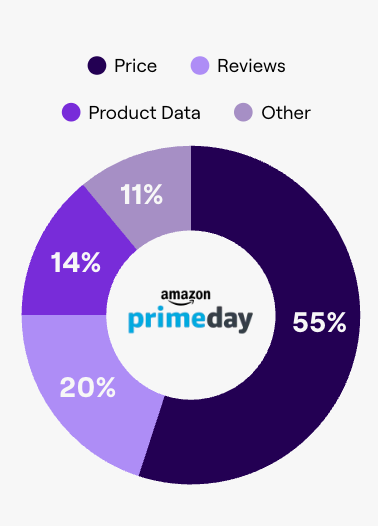
Biggest Shopping Influences

5. Product Information Matters More Than AI Recommendations

Despite all the attention surrounding AI, traditional decision drivers still dominate.

When consumers were asked what influences their purchasing decisions most, price ranked first at 55%. Reviews followed at 20%, while product information accounted for 14%.

Interestingly, AI recommendations themselves remain relatively low on the list of direct purchase influences.

What can we take away from this? AI may help shoppers discover products, but it is still product information that helps them decide whether to buy.

Consumers ultimately want trustworthy details about what they’re purchasing. They want specifications, features, dimensions, compatibility information, sustainability credentials, usage instructions, and customer reviews.

AI may introduce a product, but product information closes the sale.

Our CEO, Romain Fouache, said it best: 

As AI becomes more integrated into the shopping experience, consumers still expect accuracy, transparency, and trust before making a purchase. Whether shoppers discover products through AI tools, retailer websites, or search engines, the quality of product information will continue to shape how confident consumers feel when buying.

Romain Fouache CEO

Akeneo

Are You Ready for Prime Day 2026?

Prime Day 2026 is becoming a test of how well brands can support increasingly informed, strategic, and AI-enabled shoppers.

Shoppers are comparing prices across retailers, verifying discounts before making purchases, and relying on a growing mix of digital tools to evaluate their options. At the same time, expectations for accurate product information, transparency, and overall value continue to rise.

These behaviors are unlikely to disappear once Prime Day ends. Instead, they signal a broader shift in how consumers discover products, build trust, and make purchasing decisions. 

As AI becomes more deeply embedded in shopping experiences and economic pressures continue to shape spending habits, the ability to provide consistent, trustworthy, and accessible product information will play an increasingly important role in influencing what ends up in consumers’ carts.Want to dive deeper into the data and uncover additional insights shaping shopper behavior ahead of Prime Day 2026? Download the full Prime Day report to explore the complete survey findings and learn how brands can prepare for the evolving retail landscape.

How AI & Economic Uncertainty Impact Amazon Prime Day 2026

Discover how consumers are preparing for Prime Day 2026 amid ongoing economic uncertainty and the growing influence of AI-powered shopping.

Adam Clark, Communications Working Student

Akeneo

Welcome PricingHUB: Bringing Product Data and Pricing Together for the Future of Commerce

Akeneo News

Welcome PricingHUB: Bringing Product Data and Pricing Together for the Future of Commerce

Akeneo’s acquisition of PricingHUB marks an exciting new chapter in our mission to help brands and retailers create exceptional product experiences. By bringing product data and pricing intelligence together, organizations can make smarter decisions, react faster to market changes, and build the trusted data foundation needed to thrive in an increasingly AI-driven commerce landscape.

Today, we’re excited to share some big news: Akeneo has acquired PricingHUB, a leading pricing management platform, and we’re thrilled to welcome the PricingHUB team to the Akeneo family!

This marks an important milestone in our personal journey to help brands and retailers create exceptional product experiences. But more than that, it’s a reflection of where commerce is headed, and what businesses need to succeed in an increasingly AI-driven world.

Why Pricing? Why Now?

For years, product information has been at the heart of digital commerce. Rich, accurate, and consistent product data helps customers discover products, understand them, and ultimately make confident purchasing decisions.

But product data tells only part of the story.

Pricing is one of the most powerful signals in commerce. It influences customer behavior, shapes competitiveness, and impacts profitability. Yet in many organizations, product information and pricing are managed in entirely separate systems by different teams using different processes.

The reality is that these two disciplines have always been deeply connected.

A product’s price doesn’t exist in a vacuum. Pricing decisions depend on product attributes, category structures, assortment strategies, competitor positioning, customer expectations, and market dynamics. Without high-quality product data providing context, pricing becomes much harder to optimize.

That’s why bringing PricingHUB into Akeneo feels like such a natural fit.

Building a Single Source of Truth

At Akeneo, we’ve long believed that businesses perform best when they can rely on a single source of truth for product information.

With PricingHUB joining Akeneo, we’re extending the concept of a single source of truth beyond product data to include pricing intelligence as well.

Imagine product managers, pricing teams, category managers, eCommerce leaders, and merchandising teams working from the same foundation of trusted data. Instead of operating in silos, they can align around a shared understanding of products, market conditions, and pricing strategies.

The result:

  • Faster decision-making
  • Better coordination across teams
  • More consistent customer experiences
  • Greater competitiveness in rapidly changing markets

By connecting product data and pricing more closely, businesses can focus their efforts on the products that matter most and react more quickly when market conditions change.

The Rise of Agentic Commerce

This acquisition is especially important because commerce itself is changing.

Increasingly, customers aren’t just browsing websites and comparing products manually; 77% of consumers use AI to shop nowadays. AI-powered assistants and autonomous shopping agents are beginning to influence how products are discovered, evaluated, and purchased.

In this emerging era of agentic commerce, AI systems rely on structured data to make recommendations and decisions.

Two of the most important signals these systems evaluate are product information and price.

An AI shopping assistant can’t properly compare products if descriptions are incomplete or inconsistent. Likewise, it can’t make informed recommendations if pricing data lacks context or isn’t aligned with product information.

As AI becomes a larger part of the buying journey, organizations will need more than disconnected systems and fragmented data sources. They will need a unified decision layer where product information and pricing work together.

This is exactly the future we’re building toward.

By combining Akeneo’s expertise in product experiences with PricingHUB’s pricing intelligence capabilities, we’re helping organizations create the data foundation needed to compete in an AI-driven marketplace.

What This Means for Customers

For Akeneo customers, this acquisition opens the door to exciting new possibilities.

Over time, organizations will be able to more closely align pricing strategies with their product structures, gain stronger competitive insights, and reduce friction between pricing, merchandising, category management, and eCommerce teams.

The goal is simple: help businesses make better decisions faster.

PricingHUB customers can also look forward to continued innovation and investment. PricingHUB will continue operating as a dedicated business unit within Akeneo, ensuring continuity while benefiting from the broader vision and capabilities of the Akeneo Product Cloud.

And for both customer communities, this combination creates an opportunity to unlock greater value from data that has always been interconnected.

Welcome to the Team, PricingHUB

Most importantly, we’re excited to welcome the talented PricingHUB team to Akeneo.

Their expertise, passion, and deep understanding of pricing strategy make them a perfect addition to our mission of helping organizations create better product experiences.

Together, we’re taking another step toward a future where product data, pricing, insights, activation, and AI work seamlessly together to power commerce.

We’re incredibly excited about what’s ahead, and we’re just getting started.

Welcome to Akeneo, PricingHUB!

Akeneo is Acquiring PricingHUB

Casey Paxton, Content Marketing Manager

Akeneo