Summer Release

Introducing the First Truly Agentic Product Experience Platform

Learn More
Akeneo-Logo

E-commerce Catalog Management: Spreadsheets suck but there is a better way!

Product Experience

E-commerce Catalog Management: Spreadsheets suck but there is a better way!

Still doing your e-commerce catalog management in spreadsheets? Spreadsheets are the most commonly used “e-commerce catalog management” tool out …

Still doing your e-commerce catalog management in spreadsheets? Spreadsheets are the most commonly used “e-commerce catalog management” tool out there. The only problem is that spreadsheets are terrible at catalog management.

Spreadsheets suck at many critical tasks

Here are just a few of the critical tasks that spreadsheets are bad at:
  • Dealing with multiple sources of information
  • Differentiating between mobile and desktop versions of media and product descriptions
  • Handling multiple languages and translations
  • Accommodating multiple contributors
  • Enforcing separate edit/approval/publish rights
  • Version control and content rollbacks
  • Staging new products and catalogs
  • Quality control
So why do so many people use spreadsheets for a job for which they are inherently badly designed?

It seemed easy.

Until you get started. Then most merchants quickly find themselves struggling with dozens of files, 20+ columns in every spreadsheet, and multiple tabs. Version control quickly becomes a problem and suddenly you’re dealing with outdated, incomplete, and incorrect product data being pushed to prospective customers.

Spreadsheets don’t scale well.

Hopefully, good things are happening for your company. Your team and product lines are growing. Distribution platforms and sales channels are proliferating. Products are constantly being updated. Those are all great things… Unless you’re trying to manage your e-commerce catalog management with spreadsheets. Then your life becomes a nightmare as you struggle to maintain compelling, complete, and up-to-date product information. This steals focus from your real job of merchandizing and marketing strategy.

There is a solution

The product category for e-commerce catalog management is generally referred to as product information management or PIM for short. PIM solves all the problems that spreadsheets don’t because they are custom-built for managing product information across websites, e-commerce platforms, print catalogs, e-commerce, points of sale, mobile applications, and more.

Want to know more? Take a tour with our online demo.

Discover how to increase:
  • Productivity by 50%
  • Data Quality by 30%
  • Revenue by 10%
Convert your collection of spreadsheets into a single definitive source of product information across every sales channel and in every language. Simplify your current chaotic workflow into one of simplicity and power: 1. Import your data Automatically import your data from any third party system including ERPS, spreadsheets, and your supplier’s systems. 2. Organize and classify Organize and classify your products however you want. Stop trying to organize your workflow around SKUs and use more logical product groupings instead. An easy GUI eliminates hundreds of useless columns. 3. Enrich, edit and translate Complete your product information, add rich media in any format, and translate just the descriptions that are needed. 4. Utilize built in workflow and quality checks Enable multiple contributors with edit/publish workflows and automated checks to ensure that all mandatory fields are always completed. 5. Publish your data Export all product data to any e-commerce platform, mobile application, print catalogs, or point of sale interface.

Take a tour with our online demo.

Managing product information is seamless and easy when you have a solution built for this purpose. Why settle for spreadsheets? Take a tour with our online demo or contact us to learn more.

An LDAP Authentication extension is now available on our Marketplace!

Akeneo News

An LDAP Authentication extension is now available on our Marketplace!

A new additional extension has landed into the Akeneo marketplace to allow PIM authentication against a LDAP server. For several companies, it is com…

A new additional extension has landed into the Akeneo marketplace to allow PIM authentication against a LDAP server.

For several companies, it is common to have centralized user credentials in a unique directory to simplify this credentials management.

The LDAP protocol is a widespread solution, especially with its Active Directory implementation for Windows.

This new extension will allow Akeneo users of the Enterprise Edition to authenticate against this LDAP directory instead of the internal PIM system. It is designed to work with both Windows Active Directory or Open LDAP.

User management modifications

The use of this module will imply some modifications in the users workflow. Here are the new conditions:

  • The user must exists in Akeneo PIM. It can be a user created before the installation of this extension, or users can be created with this extension already installed.
  • The username must exist in the LDAP directory, because the authentication is made with this username.
  • After this extension is installed, the “forgot your password” feature will not be available anymore because the password management is out of the PIM scope and will now be the responsibility of the LDAP system.
  • When an admin creates a new user with this extension enabled, he will not have to provide a password for the user, because this password is not in the PIM scope anymore.

This extension activation is totally transparent for the users and the login screen is the same than a plain vanilla Akeneo. The only difference is the disappearance of the “forgot your password” link.

Rescue user

A special rescue user can be used, usually the “admin” user of Akeneo. This user will not be authenticated against the LDAP but just with its PIM credentials. This way, you can always log in Akeneo even if the LDAP is down or not functional.

Uninstall

Users created prior to this module installation will get their original passwords back if this module is uninstalled. But all users created while it was active will need a password reset (the “forgot your password” link will re-appear), they will still be useable once they’ll have correct credentials.

If you are using an LDAP in your company, and you have Akeneo Enterprise Edition, don’t wait and have a look at this new extension now to ease your life. Our marketplace team is here to help you and answer your questions!

You can contact us at: [email protected]

Enjoy!

What systems do I need to fulfill my cross-channel strategy?

Product Experience

What systems do I need to fulfill my cross-channel strategy?

4 questions for Mathieu Jourdain, Head of e-commerce at NatalysSince 1953, Natalys has provided happiness for future and young parents from pregnancy …

4 questions for Mathieu Jourdain, Head of e-commerce at Natalys

Since 1953, Natalys has provided happiness for future and young parents from pregnancy to the third year of the child. The brand joined the Sergent Major group and launched its e-commerce website, Natalys.com, in 2009. The brand now embodies the example of a successful cross-channel strategy. From launching its marketplace to optimizing its product catalogue, Mathieu Jourdain, Head of e-commerce at Natalys, shows us the keys that made this long-standing retailer a shining example of successful cross-channel retailer. Natalys sells its products both in store and on the Natalys.com website. The entire catalog is available on the website and in store. The brand is even planning to launch a community website in the near future, dedicated to selling Natalys branded articles secondhand. This is innovation in action and a powerful driving force for fulfilling the needs of its customers, who are continually seeking more choice at the right price with a good quality of service, which the brand has been providing for almost 60 years now. How important is product information management to you? MJ: The quality of our product data is one of our primary concerns. It is crucial to have a standardized and centralized product database. We needed to have a collaborative and user-friendly system, that could be used and connected to every department: Purchasing, Logistics, photo shoots and web-merchandising. In other words, we needed a PIM (Product Information Management). It has even become an essential tool of our cross-channel strategy. What’s more, it did not take long for us to choose Akeneo, the leading open-source solution on the market. In addition to being easy to integrate and user-friendly, the solution was already being used by other brands of the group. The Akeneo PIM made it easily for us to standardize and control the quality of our product information.  
natalys
Why launch a marketplace now? MJ: The launch of our marketplace forms part of an overarching strategy, the objective of which is to innovate in order to fulfill the needs of our customers and boost our growth. Nowadays, in order to play a leading role in a given sector, one must be in a position to offer a broad choice to our ever more demanding customers. The marketplace provides a solution to the problem of catalog expansion, so that the Natalys teams can react to customer demands much more quickly. In our opinion, it is much less complicated and less risky to bring in a new supplier or a new category of products using the marketplace than listing it on our standard website. This strengthens our position as a specialist with a greater product depth, while also offering a long tail of related products that can appeal to our customers. We chose Mirakl because it is the leading, most comprehensive solution on the market, giving us access to all the functionality needed to operate our marketplace quickly and successfully. Mirakl’s strength lies in the support provided by its teams throughout the project and after its launch.  In order to fulfill the expectations of Natalys’s customers, you decided to launch a marketplace grounded in robust management of product data. What are you expecting to gain from it? MJ: Within 3 years, the Natalys marketplace will represent at least 30 % of our sales and will be completely cross-channel. Natalys’s objective is to have all of the Natalys and Marketplace product data stored in a single database so that each department can modify and add to the data of the partner sellers. As a result, when our customers are browsing our website, there will be no noticeable difference between a product sold and shipped by Natalys, and that of a partner seller. Standardized data also helps to improve the user experience, ensuring a remarkable end-to-end shopping experience. In addition to this, we have many objectives for further development with the aim of improving our growth. For instance, we are seeking to expand the Services and Young Creator aspects as well as the sale of secondhand products through the Natalys community. The international segment will also contribute to our growth, and the marketplace is a very powerful tool for growing a local presence. In your opinion, what are the key factors of success of your cross-channel strategy? MJ: First off, we need to know how to drive change within our business. There will always be some internal resistance when innovative projects are put on the table. In our case, this change was put forward directly by management. The chairman and managing director as well as the brand manager played a significant role in developing the strategy and overall approach, which was instrumental in facilitating its deployment internally.  The Marketplace project also helped breathe new life into our teams, both at headquarters and in stores. In this type of project, the need to tackle many “political” obstacles is always to be expected. The change is significant and operational conventions, which have been established over long periods of time, are being more or less broken. The cross-channel strategy must be supported by all teams at headquarters as well as in stores. To achieve this, all the stakeholders must be involved from the very beginning of the project and at every step, whether it is during the analysis phase regarding the choice of the system, or the integration phase and the decision on whether to favor a gradual deployment of the project or in big-bang mode. Secondly, connectivity is essential within the framework of a cross-channel project. Today, it is better to opt for tried and tested technologies and specialists in their domain, who will help create connections with the entire ecosystem. Mirakl and Akeneo are two leading recognized solutions that have developed a common connector that can be used to integrate them easily. The decision to select these solutions was all the more obvious for us because of that.

“The common trait between Mirakl and Akeneo? Two flexible solutions that are easy to integrate!”

Mathieu Jourdain

Five good reasons to adopt a PIM system prior to your e-commerce project – Reason #5

Product Experience

Five good reasons to adopt a PIM system prior to your e-commerce project – Reason #5

PIM (Product Information Management) is still a nebulous concept for a lot of people. And it’s sometime difficult to understand why a dedicated tool…

PIM (Product Information Management) is still a nebulous concept for a lot of people. And it’s sometime difficult to understand why a dedicated tool is needed for catalog management. Here are five good reasons to think about PIM before starting your e-commerce project.

Reason #5 – Earlier is cheaper

Of course it’s never too late to implement a PIM system. But the required amount of work will be far more significant, as you will need to do some reverse engineering to adapt the system to what has already be done.

And today, thanks to open source alternatives like Akeneo, integrating a PIM is no longer a complex / expensive / time consuming project. Starting your PIM journey with a first channel like an e-commerce website will help you have a cross channel approach from day one and will save you a lot of concerns related to archaic tools / processes.

Ready to start?

Contact Us Now!

  _  

<<  Reason #4 – Prepare your multichannel future

Five good reasons to adopt a PIM system prior to your e-commerce project – Reason #4

Product Experience

Five good reasons to adopt a PIM system prior to your e-commerce project – Reason #4

PIM (Product Information Management) is still a nebulous concept for a lot of people. And it’s sometime difficult to understand why a dedicated tool…

PIM (Product Information Management) is still a nebulous concept for a lot of people. And it’s sometime difficult to understand why a dedicated tool is needed for catalog management. Here are five good reasons to think about PIM before starting your e-commerce project.

Reason #4 – Prepare your multichannel future

For now, you are thinking only about your e-commerce channel. But you know that things are going fast and that you will probably need to open some new channels (a mobile app, for instance) or to share the work you’ve done on your product information with existing channels (printed catalogs, point of sales, etc.) It will always be easier to plug new channels into a PIM system rather than trying to adapt / customize your e-commerce system.

  _  

Curious about Akeneo PIM? Want to know more about the solution? Want a demo?

Contact Us Now!

  _  

<<  Reason #3 – Leverage your recommendation engine / searchandizing tool…

Reason #5 – Earlier is cheaper >>

Five good reasons to adopt a PIM system prior to your e-commerce project – Reason #3

Product Experience

Five good reasons to adopt a PIM system prior to your e-commerce project – Reason #3

PIM (Product Information Management) is still a nebulous concept for a lot of people. And it’s sometime difficult to understand why a dedicated tool…

PIM (Product Information Management) is still a nebulous concept for a lot of people. And it’s sometime difficult to understand why a dedicated tool is needed for catalog management. Here are five good reasons to think about PIM before starting your e-commerce project.

Reason #3 – Leverage your recommendation engine / searchandizing tool…

As a modern and well-informed e-merchant, you will probably want – at some point – to personalize the experience of your customers with some dedicated tools like recommendation engines (Avail, RichRelevance, Prediggo, etc.) or searchandizing tools (Endeca, Fredhopper, etc.).

To give relevant results, these tools need high quality product information. And guess what? That’s the purpose of a PIM system!

  _  

Curious about Akeneo PIM? Want to know more about the solution? Want a demo?

Contact Us Now!

  _  

<<  Reason #2 – Avoid spreadsheet nightmares

Reason #4 – Prepare your multichannel future >>

Five good reasons to adopt a PIM system prior to your e-commerce project – Reason #2

Product Experience

Five good reasons to adopt a PIM system prior to your e-commerce project – Reason #2

PIM (Product Information Management) is still a nebulous concept for a lot of people. And it’s sometime difficult to understand why a dedicated tool…

PIM (Product Information Management) is still a nebulous concept for a lot of people. And it’s sometime difficult to understand why a dedicated tool is needed for catalog management. Here are five good reasons to think about PIM before starting your e-commerce project.

Reason #2 – Avoid spreadsheet nightmares

Without a PIM system, you will have three options to feed your e-commerce website with product information:

Plug your ERP directly to your e-commerce system

A lot of retailers (especially large ones) believe that everything they need in terms of product information is already in their ERP. Save yourself from disillusion or poor product pages: your ERP does not contain enough information to be used without human enrichment.

Enrich information within your e-commerce system

OK – if you don’t have enough data in your ERP, why not simply enrich it directly in the backend of your e-commerce system?

Well, even if tools like Magento have some quite intuitive and simple UI, they are not meant to be used for this kind of purpose. A simple example? When creating a new product in Magento, you have to give a value for every attribute identified as mandatory. If for some reason you don’t already have all the required values for a product (maybe because you don’t have the information yet from one of your suppliers), you won’t be able to create or save an incomplete product.

Let’s be clear on that point: it totally makes sense for a front-end tool like Magento to ask for complete product information, as you don’t want to display poor / inconsistent product pages to your customers. But if you cannot store some “work in progress” product information in your e-commerce system, how will you manage this enrichment work?

Enrich information within spreadsheets

This is usually where Excel comes into the picture. Because spreadsheets often look like a reasonable approach to not waste time on enrichment: everyone knows how to use them and it should not be too complex to import data from Excel into your e-commerce system.

And although it may be a good fit for small and simple catalogs, it will mostly be where a never-ending pain begins for a lot of merchants… To adapt spreadsheets to your own data model (attributes, families, etc.), you will have to make them more complex or multiply them quickly. Experience shows that even for a small catalog, you will end up struggling with dozens of files containing 20+ columns, thousands of lines and multiples tab.

Using a PIM from day one could help you avoid those concerns. A PIM system is not an additional tool for managing your product contents. It is a necessary tool for your own good.

Curious about Akeneo PIM? Want to know more about the solution? Want a demo?

Contact Us Now!

  _  

<<  Reason #1 – Give your product information the time it (really) deserves

Reason #3 – Leverage your recommendation engine / searchandizing tool… >>

Five good reasons to adopt a PIM system prior to your e-commerce project – Reason #1

Product Experience

Five good reasons to adopt a PIM system prior to your e-commerce project – Reason #1

PIM (Product Information Management) is still a nebulous concept for a lot of people. And it’s sometime difficult to understand why a dedicated tool…

PIM (Product Information Management) is still a nebulous concept for a lot of people. And it’s sometime difficult to understand why a dedicated tool is needed for catalog management. Here are five good reasons to think about PIM before starting your e-commerce project.

Reason #1 – Give your product information the time it (really) deserves

Save time with Akeneo PIM

When launching a new e-commerce website, you will have a ton of things to think about: design, SEO, e-marketing, the sales funnel, payment providers, warehouse management, etc.

Structuring your product information will be only one item among many in preparing this project. And you can already bet on the fact that you won’t be able to spend much time on this particular one.

A PIM project is a unique opportunity to spend some time asking yourself the right questions about your catalog:

  •      How should your products be classified?
  •      How many attributes will you need for each product family?
  •      Which ones will be used now or in the near future for faceted navigation?
  •      Where does your data (ERP, suppliers, your team, etc.) come from?
  •      What is the level of data quality required for your e-commerce website? And for your future channels?

And you know what else? The time you will spend on this project won’t be lost, as it can be reused directly for your e-commerce system integration!

Curious about Akeneo PIM? Want to know more about the solution? Want a demo?

Contact Us Now!

Reason #2 – Avoid spreadsheet nightmares >>

Akeneo2Shopware: the first connector between Akeneo and Shopware!

Akeneo News

Akeneo2Shopware: the first connector between Akeneo and Shopware!

So far, there were only two possibilities for Shopware shop operators to use Akeneo as the central repository for their online shop product informatio…

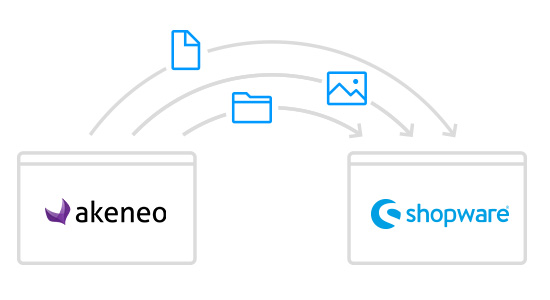
So far, there were only two possibilities for Shopware shop operators to use Akeneo as the central repository for their online shop product information. They either had to maintain product data in a time consuming way and deal with several exports and imports toward the e-commerce platform, or develop an expensive individual interface. Today, there is a third alternative: akeneo2shopware.

For our German solution partner Basecom, also partner of Shopware, the development of an interface was of course obvious. Thus, they have developed during the last weeks an extension, Akeneo2shopware, which quickly and comfortably enables an easy application of Akeneo and Shopware.

export

Following the installation of the connector, product information can be transferred easily into the database of the Shopware shop after a few steps. An API key has to be generated and the transmitted category tree has to be chosen after the completed category export. If the existing Shopware website already contains individual attributes, these will have to be transmitted initially into Akeneo by an import job after the installation of a free Shopware extension. As soon as all jobs are created and configured, the connector simply transmits all the products information including images, categories, and product families.

If you want to have a quick overview of the extension, you can take a look at the video below:

You can find the Shopware connector on our marketplace by clicking here!

Also, if you have any question regarding the connector, training or support, you can contact Basecom it-consultant, Steffen Krueger at [email protected].

Prestaneo: a Prestashop connector by Synolia

Akeneo News

Prestaneo: a Prestashop connector by Synolia

Released last March 2016, Prestaneo is the first module that allows you to connect Akeneo to the web platform Prestashop.Following our previous articl…

Released last March 2016, Prestaneo is the first module that allows you to connect Akeneo to the web platform Prestashop.

Following our previous article about the connector Prestaneo, discover all the functionalities of the connector in the recording of the webinar hosted by our French partner Synolia:

For any question regarding the connector,

you can go on the Github page Synolia/Prestaneo or send an email to [email protected].

We are looking forward hearing your feedbacks about the connector…