Spring 26

The Great Restack: Welcome to the New Age of Commerce

Learn More
Akeneo-Logo Akeneo-Logo

Five good reasons to adopt a PIM system prior to your e-commerce project – Reason #2

Product Experience

Five good reasons to adopt a PIM system prior to your e-commerce project – Reason #2

PIM (Product Information Management) is still a nebulous concept for a lot of people. And it’s sometime difficult to understand why a dedicated tool…

PIM (Product Information Management) is still a nebulous concept for a lot of people. And it’s sometime difficult to understand why a dedicated tool is needed for catalog management. Here are five good reasons to think about PIM before starting your e-commerce project.

Reason #2 – Avoid spreadsheet nightmares

Without a PIM system, you will have three options to feed your e-commerce website with product information:

Plug your ERP directly to your e-commerce system

A lot of retailers (especially large ones) believe that everything they need in terms of product information is already in their ERP. Save yourself from disillusion or poor product pages: your ERP does not contain enough information to be used without human enrichment.

Enrich information within your e-commerce system

OK – if you don’t have enough data in your ERP, why not simply enrich it directly in the backend of your e-commerce system?

Well, even if tools like Magento have some quite intuitive and simple UI, they are not meant to be used for this kind of purpose. A simple example? When creating a new product in Magento, you have to give a value for every attribute identified as mandatory. If for some reason you don’t already have all the required values for a product (maybe because you don’t have the information yet from one of your suppliers), you won’t be able to create or save an incomplete product.

Let’s be clear on that point: it totally makes sense for a front-end tool like Magento to ask for complete product information, as you don’t want to display poor / inconsistent product pages to your customers. But if you cannot store some “work in progress” product information in your e-commerce system, how will you manage this enrichment work?

Enrich information within spreadsheets

This is usually where Excel comes into the picture. Because spreadsheets often look like a reasonable approach to not waste time on enrichment: everyone knows how to use them and it should not be too complex to import data from Excel into your e-commerce system.

And although it may be a good fit for small and simple catalogs, it will mostly be where a never-ending pain begins for a lot of merchants… To adapt spreadsheets to your own data model (attributes, families, etc.), you will have to make them more complex or multiply them quickly. Experience shows that even for a small catalog, you will end up struggling with dozens of files containing 20+ columns, thousands of lines and multiples tab.

Using a PIM from day one could help you avoid those concerns. A PIM system is not an additional tool for managing your product contents. It is a necessary tool for your own good.

Curious about Akeneo PIM? Want to know more about the solution? Want a demo?

Contact Us Now!

  _  

<<  Reason #1 – Give your product information the time it (really) deserves

Reason #3 – Leverage your recommendation engine / searchandizing tool… >>

Five good reasons to adopt a PIM system prior to your e-commerce project – Reason #1

Product Experience

Five good reasons to adopt a PIM system prior to your e-commerce project – Reason #1

PIM (Product Information Management) is still a nebulous concept for a lot of people. And it’s sometime difficult to understand why a dedicated tool…

PIM (Product Information Management) is still a nebulous concept for a lot of people. And it’s sometime difficult to understand why a dedicated tool is needed for catalog management. Here are five good reasons to think about PIM before starting your e-commerce project.

Reason #1 – Give your product information the time it (really) deserves

Save time with Akeneo PIM

When launching a new e-commerce website, you will have a ton of things to think about: design, SEO, e-marketing, the sales funnel, payment providers, warehouse management, etc.

Structuring your product information will be only one item among many in preparing this project. And you can already bet on the fact that you won’t be able to spend much time on this particular one.

A PIM project is a unique opportunity to spend some time asking yourself the right questions about your catalog:

  •      How should your products be classified?
  •      How many attributes will you need for each product family?
  •      Which ones will be used now or in the near future for faceted navigation?
  •      Where does your data (ERP, suppliers, your team, etc.) come from?
  •      What is the level of data quality required for your e-commerce website? And for your future channels?

And you know what else? The time you will spend on this project won’t be lost, as it can be reused directly for your e-commerce system integration!

Curious about Akeneo PIM? Want to know more about the solution? Want a demo?

Contact Us Now!

Reason #2 – Avoid spreadsheet nightmares >>

Akeneo2Shopware: the first connector between Akeneo and Shopware!

Akeneo News

Akeneo2Shopware: the first connector between Akeneo and Shopware!

So far, there were only two possibilities for Shopware shop operators to use Akeneo as the central repository for their online shop product informatio…

So far, there were only two possibilities for Shopware shop operators to use Akeneo as the central repository for their online shop product information. They either had to maintain product data in a time consuming way and deal with several exports and imports toward the e-commerce platform, or develop an expensive individual interface. Today, there is a third alternative: akeneo2shopware.

For our German solution partner Basecom, also partner of Shopware, the development of an interface was of course obvious. Thus, they have developed during the last weeks an extension, Akeneo2shopware, which quickly and comfortably enables an easy application of Akeneo and Shopware.

export

Following the installation of the connector, product information can be transferred easily into the database of the Shopware shop after a few steps. An API key has to be generated and the transmitted category tree has to be chosen after the completed category export. If the existing Shopware website already contains individual attributes, these will have to be transmitted initially into Akeneo by an import job after the installation of a free Shopware extension. As soon as all jobs are created and configured, the connector simply transmits all the products information including images, categories, and product families.

If you want to have a quick overview of the extension, you can take a look at the video below:

You can find the Shopware connector on our marketplace by clicking here!

Also, if you have any question regarding the connector, training or support, you can contact Basecom it-consultant, Steffen Krueger at [email protected].

Prestaneo: a Prestashop connector by Synolia

Akeneo News

Prestaneo: a Prestashop connector by Synolia

Released last March 2016, Prestaneo is the first module that allows you to connect Akeneo to the web platform Prestashop.Following our previous articl…

Released last March 2016, Prestaneo is the first module that allows you to connect Akeneo to the web platform Prestashop.

Following our previous article about the connector Prestaneo, discover all the functionalities of the connector in the recording of the webinar hosted by our French partner Synolia:

For any question regarding the connector,

you can go on the Github page Synolia/Prestaneo or send an email to [email protected].

We are looking forward hearing your feedbacks about the connector…

Roy Rubin, the former CEO and co-founder of Magento joins Akeneo as an Advisor

Akeneo News

Roy Rubin, the former CEO and co-founder of Magento joins Akeneo as an Advisor

The Akeneo team is extremely proud to announce that Roy Rubin, co-founder and former CEO of Magento, the world leader in e-commerce platforms, is join…

The Akeneo team is extremely proud to announce that Roy Rubin, co-founder and former CEO of Magento, the world leader in e-commerce platforms, is joining us as our dedicated board advisor.

After the opening of our office in Boston, we are really happy to prepare for further US developement with Roy Rubin’s knowledge and expertise in the field. Frédéric de Gombert, our CEO, is proud of this recent addition to the team and predicts a healthy and valuable market ahead: “It is an amazing opportunity to be able to receive the best advice from an e-commerce and open source expert such as Roy Rubin. Magento has always been a great inspiration for Akeneo. We are extremely proud to have the two founders on our team. It also confirms that product information management is becoming a key part of building a multi channel retail platform.” Roy Rubin is also very excited to join the team: “Akeneo’s progress has been remarkable and I couldn’t be more excited to join the team as an advisor. The opportunity for an open source, enterprise class PIM solution is tremendous and Akeneo has delivered to the market an exceptional product to address the needs of businesses around the world.”

Having Roy Rubin on our side is great and we are really excited to benefit from the expertise of THE e-commerce and open source leader. He will be involved in the strategic decisions for Akeneo, specifically the company’s short-term goals which include further U.S development.

Prestaneo, the new Prestashop connector is ready!

Akeneo News

Prestaneo, the new Prestashop connector is ready!

  Dear Community, We are very happy to announce the release of the Akeneo x PrestaShop connector, Prestaneo, developped by our French partn…

  Dear Community, We are very happy to announce the release of the Akeneo x PrestaShop connector, Prestaneo, developped by our French partner Synolia.
Prestaneo is an add-on module that allows you to import your product catalogs, from Akeneo, directly into PrestaShop. No more struggle with numerous tools; you enjoy all the power of Akeneo PIM to administrate efficiently your catalog’s information (products, medias, categories…). Prestaneo takes care of importing and updating your data directly and frequently on PrestaShop. PRESTANEO? Prestaneo is currently the only add-on module that connects Akeneo to PrestaShop; it allows you to take advantage of the PIM’s strengths to revolutionize the way you manage products intended for your e-commerce activity.
  • Simple: it’s integrated directly into your PrestaShop platform
  • Quick: the add-on module imports and synchronizes your Akeneo data directly in your PrestaShop back-office
  • Efficient: its design leans on the experience of Synolia’s experts to respect the application’s development standards to make reliable interfaces.
  • Complete: Prestaneo is the perfect app to import, manage and embellish all your products data in order to deliver the best customer experience to your online customers.
CURIOUS ABOUT PRESTANEO? You want to discover the power of Prestaneo? All information is already available on GitHub! It’s not enough? There’s even more! Synolia invites you to a dedicated webinar to the Akeneo x PrestaShop extension in English on Thursday, April 7th, at 5:00pm (GMT + 1) and in French on Thursday, Mars 24th, at 11:00am (GMT + 1). Do not wait to register for a complete demo!

Attributes: why would you need some localizable or scopable ones?

Product Experience

Attributes: why would you need some localizable or scopable ones?

In Akeneo, attributes can be qualified by two adjectives: localizable or scopable; but what does it mean?A localizable attribute can have a different …

In Akeneo, attributes can be qualified by two adjectives: localizable or scopable; but what does it mean?

A localizable attribute can have a different value depending on its locale (combination of a language and a country). This option can be very useful when it comes to translating marketing information for a catalog of products or if you have a different value depending on a country (for example a price).

A scopable attribute can have a different value depending on the channel. It can be convenient if you want a different description on 2 channels or if the release date on each channel is different.

These options are easily configurable at the creation on the attribute.

You want to know more about this feature or you want a personalized presentation?

Contact Us Now!

Please welcome aboard Ziggy, the multichannel Hydra

Akeneo News

Please welcome aboard Ziggy, the multichannel Hydra

It took some time making that dream come true but it’s finally here; Akeneo is proud and happy to officially introduce our very own pet: Ziggy, the…

It took some time making that dream come true but it’s finally here; Akeneo is proud and happy to officially introduce our very own pet: Ziggy, the multichannel hydra!

You might already have seen this charming creature on our website, depicting a threatening multichannel monster facing Julia, our marketing heroin. Today, Julia tamed the hydra and turned it into a nice and friendly multichannel pet, easy to work with and not frightening anymore.

Falling in love with our tamed hydra and desperately looking for a way to adopt one?

Don’t worry, you will get a chance to get your own Ziggy in a variety of ways:

  • by visiting our booth during an event we are sponsoring (like Internet World, Magento Imagine, or IRCE)
  • by sharing with us your Akeneo PIM experience (drop us an email at [email protected])
  • by contributing to the product (don’t know where to start? check out our contribution guide).

We can’t wait for our Ziggy to travel the world!

Casey Paxton, Content Marketing Manager

Akeneo

Multi-Channel Ecommerce Software: Streamline Data Enrichment with Akeneo

Product Experience

Multi-Channel Ecommerce Software: Streamline Data Enrichment with Akeneo

Every company wants to grow. In ecommerce that means going multi-channel and multi-location, but this is easier said than done.Silly Spreadsheets If …

Every company wants to grow. In ecommerce that means going multi-channel and multi-location, but this is easier said than done.

Silly Spreadsheets

If you are like many ecommerce companies, you are probably managing your product information in spreadsheets. And, as you know from personal experience, this is a pain in the butt. Spreadsheets were just not designed to handle this kind of work. Every new product added is another time-consuming data entry project. And it’s not just data entry that has to be done once, its data entry across a whole series of spreadsheets over and over. Plus, every time you want to add another platform, channel, or location it can get even more complicated. If you’re relying on spreadsheets to manage all this product information, going multi-channel could drive your team into the ground, but there is something that can help.

Multi-channel ecommerce software can make it easier for your company to enter new markets by removing the constraints associated with maintaining spreadsheets.

Akeneo: Flexible Multi-Channel Ecommerce Software

Akeneo is extremely flexible multi-channel ecommerce software. While most multi-channel ecommerce software is highly limited and designed solely to help push existing product information across multiple channels, Akeneo offers additional levels of flexibility. Akeneo helps you take control of multiple channel challenges by:
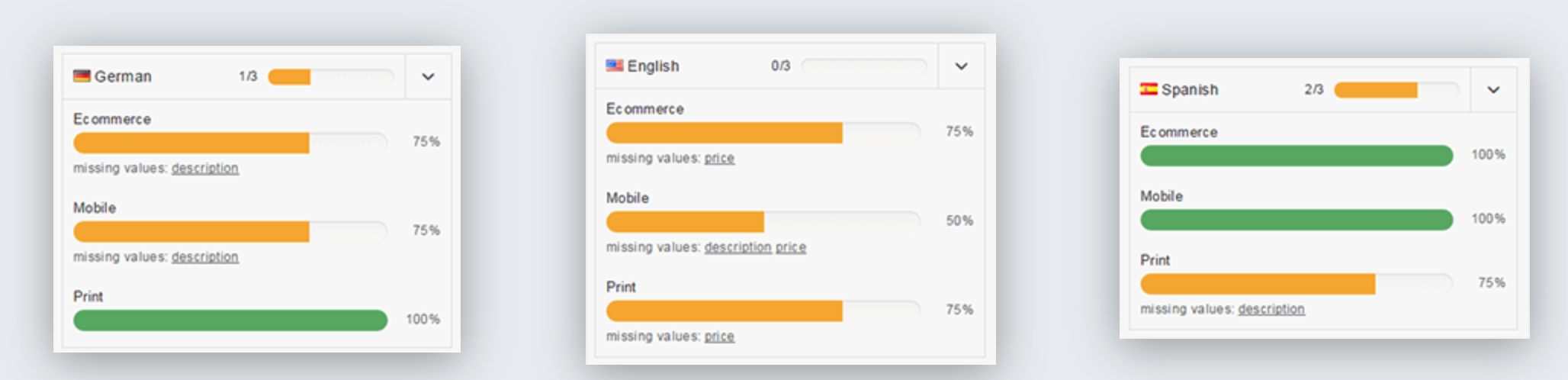
1. Automatically importing updated product data from a disparate set of sources like ERPs, spreadsheets, and .csv files. 2. Providing a centralized workflow for your teams to quickly and efficiently organize, enrich, and translate product information. 3. Ensuring quality controls by automatically monitoring completeness of product descriptions, localizations, and multi-media uploads. 4. Exporting your data to whatever ecommerce platforms you desire.
multi-channel ecommerce software

Multi-Channel Made Easy

Akeneo’s multi-channel software allows you can change only what needs to change between channels, like altering the picture formats for digital and print. You can export everything in one easy step while ensuring all the rest of your information remains the same. You can be sure that all the time you took writing enticing descriptions won’t be lost and product specs won’t be mangled.

You can even generate print catalogs with the push of a button using Akeneo’s InDesign plug-in.

Customized for Your Platform

Every ecommerce platform has different formatting requirements. Between your company website, your partner websites, and Amazon, Alibaba, and other online marketplaces, you might have to deal with quite a few different platforms. Akeneo allows you to change only the information that needs to change and automatically export the right formats for each platform, making it much easier to handle all of your product information. Akeneo offers off-the-shelf integrations for the major ecommerce platforms including Magento, Mirakl, Shopware, PrestaShop, and many more. Plus, our open-source model and thriving ecosystem of partners and integrators means that you can easily support custom systems. Akeneo’s open architecture provides much more flexibility in building out new and custom platforms compared to proprietary software that really only address three or four specific platforms.

Akeneo offers many off-the-shelf integrations for major ecommerce platforms.

Localization made scalable

A global multi-channel strategy includes multiple channels in multiple countries. Akeneo streamlines the process of localization with powerful workflows for distributed localization teams, off the shelf connectors to translation services like TextMaster or Translations.com, and easy to customize quality measurements for localized content. With Akeneo, the effective cost of creating and maintaining multi-channel localizations drops by over 50%! This radically improves the economics of creating localizations for markets large and small. Ready to take the plunge and see if multi-channel ecommerce software is right for you? Get a demo and stop the spreadsheet madness once and for all or read our white papers Kill your spreadsheets before your spreadsheets kill youFrom Overwhelming to Organized: Scaling Global Product Management

Organize your products views with the filters

Product Experience

Organize your products views with the filters

In the product grid, a view is a saved copy of the actual layout considering the attribute filters and the columns display. You can have as many views…

In the product grid, a view is a saved copy of the actual layout considering the attribute filters and the columns display. You can have as many views as you want.

We saw previously how to organize the columns, let’s now see how to use the filters.

Any attribute can be a filter if it has been defined as such when it was created. You have different ways to use the filters in order to get a view of the required products. You can add as many filters as you want and then select the attribute values you need.

Let’s see with a little more details how it works…

You want to know more about this feature or you want a personalized presentation?

Contact Us Now!