Summer Release

Introducing the First Truly Agentic Product Experience Platform

Learn More
Akeneo-Logo

Understanding the PIM and B2B Market: An Interview with Joshua Warren from Creatuity

Product Experience

Understanding the PIM and B2B Market: An Interview with Joshua Warren from Creatuity

We sat down with Joshua Warren, founder and CEO of Creatuity to get some insight on how PIM, a previously B2C focused product, is starting to make its…


We sat down with Joshua Warren, founder and CEO of Creatuity to get some insight on how PIM, a previously B2C focused product, is starting to make its way into the B2B market. We wanted to have a better understanding of why PIM is vital in a B2B setting as well as how PIM can help the B2B market strengthen its exponential growth. Here’s our conversation:

Can you please tell us about Creatuity, and what is your experience and history with eCommerce projects and solutions?

I started Creatuity back in 2008, so we just celebrated ten years in the Magento space. Prior to that, I was a developer working on several different platforms and solutions. In the end, I opted to run a Magento-only agency because I felt the platform was poised to be dominant… and I was correct!  Creatuity’s successes have allowed us to be an innovator in the ecosystem, contributing instant purchase functionality, award-winning websites, and specializing in providing true omnichannel commerce technologies.

B2B eCommerce is growing 7 times faster than the B2C eCommerce. What do you see as the main obstacles B2B vendors need to overcome to fully leverage an eCommerce strategy?

The most important obstacle for B2B companies to conquer is providing a true omnichannel customer experience. Just as with B2C companies, B2B merchants want their customers to be able to buy online and pick up in-store, ship from store, and manage multiple vendors as well as distributors. Next, it is imperative to place product and service management at the center of your eCommerce strategy. If your catalog or buying experience is tedious or hard to navigate, a buyer will move on to the next option. You will also want to master inventory visibility and control for real-time buyer/supplier relationships that enable superior customer self-service. Next, B2B companies are in desperate need of better business intelligence models that allow them to fully leverage a data-driven view of their business. Platforms like Magento, the dominant leader on the IR300 B2B list of ranked sites, utilize innovative technologies to capitalize on untapped and growing B2B sales.
B2B companies are in desperate need of better business intelligence models that allow them to fully leverage a data-driven view of their business.

What main characteristics and challenges do you see in B2B eCommerce projects?

B2B companies often find their data is all over the place. Older business practices that are built upon traditional B2B operational styles are often overwhelmed by the sheer magnitude of information they need to compile and streamline. They typically have a need for advanced B2B capabilities like segmentation, invoices, multiple catalogs, different pricing agreements, etc. The scope of B2B projects is usually larger than B2C, as B2B companies often have more SKUs/attributes/bundles. In order to maintain a competitive edge in such an evolutionary vertical, B2B merchants must stay one step ahead of the aggressively moving benchmark.

B2B projects are usually more complex and require advanced capabilities, what must-have solutions do you recommend in B2B eCommerce projects?

In many cases, the nature of the product data, SKUs, dimensions, weights, diagrams, and photos often necessitate a PIM, plus the need to distribute content and to publish it on multiple sites beyond their own, which broadens their reach and visibility. B2B businesses must spread their product content with the goal of increasing brand awareness and driving traffic from a relevant audience.

The B2B market is evolving very quickly, as well as the behavior of its customers. What new buying trends have you noticed?

The way B2B shoppers buy is evolving. They shop on Amazon and on eBay. They want to order online, have prices right away and not ask for a quote. Essentially, they want an experience that is more reminiscent of a B2C experience rather than a traditional, “Call us NOW for a quote or more information” hassle. Their primary focus is having that speed to market, being able to buy quickly and be reactive. B2B customers need to be as pampered as B2C customers, if not more. These are long-term relationships with typically large average prices per transaction.
The way B2B shoppers buy is evolving. They shop on Amazon and on eBay. They want to order online, have prices right away and not ask for a quote.

B2B customers are requesting more and more personalized offers. Do you think merchants are ready for this?

Every customer wants to feel like they are the most important relationship you have. Making them feel like you know them, their needs, preferences and offering them unique buying, shipping, payment, and discounted inventory opportunities that make their buying experience more pleasurable only enhances and strengthens your long-term relationship potential.  Are buyers ready for this?  Absolutely. Are merchants ready for this? Not at all. It is such a paradigm shift, and the early adopters are destined to reap the benefits of their slower-moving rivals.

B2B customers want a smooth buying experience, how do you think a PIM solution can help?

PIM optimizes a business and its catalog for an omnichannel experience that’s just as much in demand for B2B as it is for B2C. The technology allows a merchant to populate a compelling amount of product information, which only enhances the buying experience and reduces returns and poor reviews.

In conclusion, how do you see the evolution of PIM solutions in the market?

PIMs must become more mainstream. A great PIM should be fully embracing and laying the foundation for exceptional PxM (Product Experience Management). This technology will be invaluable in the enhancement of the way buyers interact with B2B brands.

About Joshua Warren:

Joshua has worked in eCommerce since 1999. He is the Founder & CEO of Creatuity, a Magento Enterprise Solutions Partner & eCommerce agency that since 2008 has helped retailers of all sizes achieve success with Magento. As a frequent conference speaker and author, he is constantly exploring the future of commerce and how technology will provide richer, more engaging shopping experiences. He is a Magento Certified Solution Specialist, a Magento Certified Developer Plus, and a 2016 Magento Master.  

Four Reasons PIM Will Become More Important to B2B Merchants

Product Experience

Four Reasons PIM Will Become More Important to B2B Merchants

In today’s experience-based economy, B2B merchants and manufacturers need to optimize their product information to deliver compelling product experi…

In today’s experience-based economy, B2B merchants and manufacturers need to optimize their product information to deliver compelling product experiences wherever buyers shop or interact with their brands. According to the Salesforce State of the Connected Customer Report, almost 70 percent of business buyers expect “Amazon-like buying experiences” and 67 percent “have switched vendors for a more consumer-like experience.”
Just like in B2C, every touchpoint in B2B eCommerce is part of that customer’s experience with the brand. Quality control across all channels is essential – and that’s where product information management (PIM) can help. PIM provides a one-stop shop for B2B merchants to manage the product data needed to market and sell their goods through all distribution channels, including websites, print catalogs, mobile apps, points of sale, and other channels.
Adopted first by retailers and B2C brands, PIM is now becoming more prevalent among B2B organizations looking to market and sell their products through multiple channels and locales.
Here are four ways that PIM can help B2B merchants and manufacturers create compelling product experiences in every customer touchpoint.

1.    Enabling Omnichannel Product Experiences

B2B customers increasingly have a variety of ways to interact with merchants, including shopping on a company’s B2B eCommerce website, purchasing through a distributor, a marketplace, or browsing third-party print catalogs. As Andy Hoar, the former principal analyst of B2B eCommerce at Forrester, said in a recent interview, “B2B companies stand to gain from migrating customers into an omnichannel environment, where customers can interact with sellers and receive consistent service across selling channels, including mobile commerce, desktop websites and sales reps.” To succeed in this omnichannel space, B2B sellers need to make their products and services accessible to customers wherever and whenever they are ready to buy. The most efficient, effective, and productive way to accomplish this is to use a PIM solution to organize and manage product information. A PIM makes it easy for marketers to customize catalogs by channel and locale, as well as to scope and optimize product information to fit the customer experience in each channel. The result is an easier way to create a consistent experience wherever and whenever a customer interacts with the brand.
Using PIM as a “single source of multiple truths” helps to improve the omnichannel customer experience – regardless of where customers may be viewing products.

2.    Supporting Cross-Border eCommerce Growth

Forrester predicts that cross-border purchases will account for 20 percent of worldwide eCommerce by 2022. B2B merchants need sophisticated PIM solutions to create and customize product data specific to individual international markets. PIM helps B2B merchants offer localized versions of their product information for local markets and for overseas buyers. A PIM system that can handle multilingual product descriptions is crucial. Selling products overseas means more than just translating websites into different languages, however. B2B merchants also need to take into account local vernaculars, sizing differences, cultural nuances, images, regulations and other regional elements that affect the customer experience. All of this can be managed in a PIM solution.

3.    Onboarding Product Data

According to Episerver, 98% of shoppers have been discouraged from completing a purchase because of incomplete or incorrect product information. How can you ensure you’ve got all the information you need? Ideally, suppliers and manufacturers have the definitive technical information about their products — but sometimes it isn’t readily available or it is delivered in an incompatible format which makes gathering this information from suppliers and manufacturers challenging. A PIM can streamline the product information onboarding process by offering an environment for suppliers to directly upload their product information, which your internal teams can quickly and easily enrich.
A robust PIM solution can provide the tools you need to onboard product information from a variety of sources, and help accelerate your time-to-market.

4.    Streamlining Catalog Management

Traditionally, product information has been scattered around different departments, saved in multiple digital and hard copy formats, and only accessed or modified by certain employees or by using certain systems. With PIM, companies can consolidate and maintain consistent data – about everything from product specs to model variations ­– and improve the productivity of their marketing and eCommerce teams. This resource becomes increasingly valuable as companies scale up and expand their operations. PIM helps streamline catalog management with capabilities that increase productivity and track that product information is complete and ready to be published. You PIM should have features such as mass editing and validation workflows that improve team productivity and aid in data governance. With automation in workflow and business rule processing, marketing and eCommerce teams will have more time to write compelling and emotional product descriptions to deliver a compelling product experience foundation for a great customer experience.

PIM: The B2B Product Information Hero

Maintaining complete and accurate product data across channels and locales and delivering compelling product experiences is critical to remaining competitive in an omnichannel world. PIM provides a robust set of tools and features that can help B2B organizations increase team productivity, speed time-to-market, and deliver the product experience needed to fuel a great customer experience.  

Akeneo Continues Expanding with a New US Boston Office

Akeneo News

Akeneo Continues Expanding with a New US Boston Office

This month Akeneo celebrated the opening of its new US office, located in the Boston suburb of Somerville. The grand opening of our office marks both …

This month Akeneo celebrated the opening of its new US office, located in the Boston suburb of Somerville. The grand opening of our office marks both the expansion of our business in the American market and growth in the number of US-based employees whose mission is to serve customers and make #PIMforAll a reality in the US and Canada!

Boston Office Grand Opening

To mark the occasion, we held a gala celebration with nearly 100 guests, including employees, customers, partners, industry analysts, friends from French Tech Boston, as well as members of local community organizations including the President of the Somerville Chamber of Commerce and representatives from Somerville’s Office of Strategic Planning & Community Development. Located in a newly renovated former MBTA trolley repair facility, the celebration’s “steampunk” theme embraced the building’s past merged with its technological future as our US base of operations. Check out the pictures from a fun evening of networking and celebrating!

Continued Expansion

The opening of our new office marks an exciting time for Akeneo. Besides physical global expansion, our ecosystem and community of partners continues to thirve as well. Our community continues to play a vital role in our progress and we can’t thank our partners enough! We are excited to see what the future has in store for Akeneo.

Want to Join In On the Fun? We’re Hiring!

That’s right. With all of this expansion, we need a strong team of individuals ready to tackle the challenges of product information management. To support the US and Canadian markets we are hiring for numerous roles in our Boston location – apply to join our team today!

Omnichannel Commerce: Which Customer Experience for Which Channel?

Product Experience

Omnichannel Commerce: Which Customer Experience for Which Channel?

Online sales continue to grow in the United States and around the world. In 2016 alone, the US had 177.8 million online buyers who made purchases tota…

Online sales continue to grow in the United States and around the world. In 2016 alone, the US had 177.8 million online buyers who made purchases totaling $409.2 billion. By 2021, those numbers are expected to significantly increase, with a predicted 204.4 million online purchasers spending a total of $603.3 billion. While offline sales remain 10 times larger than online, eCommerce sales are growing three times faster than offline and will represent a much larger percentage of overall sales. To ensure you keep pace with changing buyer touchpoints, it’s critical to deliver an omnichannel customer experience.

The Rise of Omnichannel Customer Experiences

The digital transformation has boosted the importance of omnichannel customer experiences in recent years. Ten years ago, a company could simply put its catalog on the web as an online store. But then five years later, they needed to also offer a mobile experience to ensure they would not lose customers to the competition. Today, shopping experiences must make it easy to buy at any time of the day, from anywhere, and through a variety of devices. As a result of this evolution, the boundaries between eCommerce and point of sale are less and less visible: the customer comes to a brand by clicking on an advertisement, then goes to the website before ending up in a store.
In the era of digital transformation, the boundaries between eCommerce and point of sale have become increasingly blurred.
But this omnichannel logic is not limited to the ability of a company to offer its products or services through all channels in the same way. The customer experience must be adapted and contextualized for each channel to support the customer’s buying journey. If a website allows you to organize products by category, the mobile experience will favor a more visual style, while in-store advisors will be able to answer specific questions to address the smallest details sought by the customer.

The Added Value Lies in the Complementarity of  Channels

Omnichannel offers the opportunity to combine the benefits of the different channels, each with their own specificities. The winning strategy is to offer differentiated product experiences, depending on the channel used. Who has not experienced the disappointment of going to a store, after doing research online, to get additional information from a merchant who merely opens a web page to read … what you have already discovered yourself? At a time when all information is now available online, the physical channel must offer added value that the buyer cannot find elsewhere. The seller must therefore offer personalized support and recommendations useful to the act of purchase. Global personal care and beauty retailer Sephora understood the benefit of this approach. Their in-store sales clerks have become “beauty consultants” who take advantage of digital technology to offer personalized advice to customers. At the same time, Sephora also follows their clients’ comments and questions on social networks in order to identify opportunities for improving the experience.
Each channel must provide valuable product data and information to help the purchaser through the buying journey.

Organize the Product Experience in an Omnichannel Context

Companies have no choice but to manage their product information across a variety of sales channels. In addition to ensuring consistency across channels, brands must also embrace new channels and take into account their unique characteristics. For example, with social networks, broadcasting images can improve the conversion rate on a product. Imagine that by clicking on the image of a product on Instagram, the consumer could discover your product with a description adapted to its uses, and make an emotional connection with the item and your brand. In addition, with the rise of voice technologies, organizations need to manage product data very precisely to provide the experience customers expect. Voice inquiries tend to be at least 15 words including phrases like “where,” “how,” and “what.” Organizations must understand how customers interact with these channels and provide optimized product descriptions in order for their products to be discovered using these new technologies. To effectively work with all of these technological situations, organizations must have solutions in place to manage channel specific product data and emotional descriptions. Marketplaces, meanwhile, bring their own challenges. For example, as certain marketplaces like Amazon have specific requirements, you may not be able to provide the same emotional context or experiences as your own website. Organizations must find a way to convey their message across both their website where they have complete control and across marketplaces where they must fulfill certain requirements. It becomes urgent for brands to realize that omnichannel is not only about managing customer interactions but also about providing contextual information and a product experience that meets customer expectations. It is, therefore, necessary to organize product data and to define a data model to help broadcast the right information to the right channel. The next generation of product experience management (PXM) solutions make it possible to easily launch offers across channels by providing the necessary contextual information. This is the critical component for brands to optimize their omnichannel customer experiences.
Remember: Omnichannel isn’t just about managing customer interactions across channels; it also requires providing contextual information to match customer expectations.

Interested in learning more about how Akeneo PIM solutions can help you deliver omnichannel customer experiences? Contact our team.

It Takes More Than Technology to Create a Memorable User Experience

Product Experience

It Takes More Than Technology to Create a Memorable User Experience

Consumer companies across the globe, regardless of sector, are all moving toward a common goal: creating the best possible experience for the customer…

Consumer companies across the globe, regardless of sector, are all moving toward a common goal: creating the best possible experience for the customer.
How can organizations work to not only create good customer experiences but to create custom and memorable ones by mobbing beyond just using new technologies? Read the full article on Forbes…

Onboarding Product Information from Suppliers

Product Experience

Onboarding Product Information from Suppliers

Maintaining accurate and complete product information is critical to running your business. Utilizing a product information management (PIM) solution …

Maintaining accurate and complete product information is critical to running your business. Utilizing a product information management (PIM) solution to collect product data and enrich it, while managing the process, helps ensure that you have complete and accurate product information for all of your various channels. However, collecting product information from suppliers is typically a manual process involving meetings, phone calls, emails, and spreadsheets. An improved flow of product data between suppliers and eCommerce managers helps:

  • Speed up time to market
  • Improve product data quality
  • Make it easier to introduce new products
  • Remove the need to transfer information from spreadsheet to spreadsheet
  • Simplify the supplier onboarding process
  • Reduce the time it takes to review product information
  • Increase bandwidth for marketing

Giving suppliers a cloud-based environment to provide authoritative product information makes it easier and faster to get products to market and to add new products to your catalog.

Managing Product Information from Suppliers

There are several options for retailers to collect product data directly from suppliers. They are, after all, the experts in their products and should have the most up to date and reliable information. Here are a few of the ways retailers have to tap suppliers as a valuable resource for gathering product information.

Option 1: Manual Input

Every supplier has different formats and product content and it’s common for product information to be brought together from fragmented sources into cumbersome and confusing spreadsheets. As a result, retailers need to manually collate and organize product data that suppliers manually provide, and load it into their PIM for further enrichment and classification into catalogs.

Manually inputting product information is a tedious, time-consuming, and error-prone task.

Option 2: Supplier Portals

Instead of manual input, some retailers instead rely on supplier portals in an attempt to resolve these issues. However, supplier portals are typically set up by the suppliers with little regard for the information that you need. In this setup, suppliers still have slightly different product information standards and each supplier uses a different portal. With this setup, your team is still left completing manual tasks to get the information you require.

Supplier portals don’t support streamlined collaboration and communication between teams.

Option 3: Supplier Product Onboarder

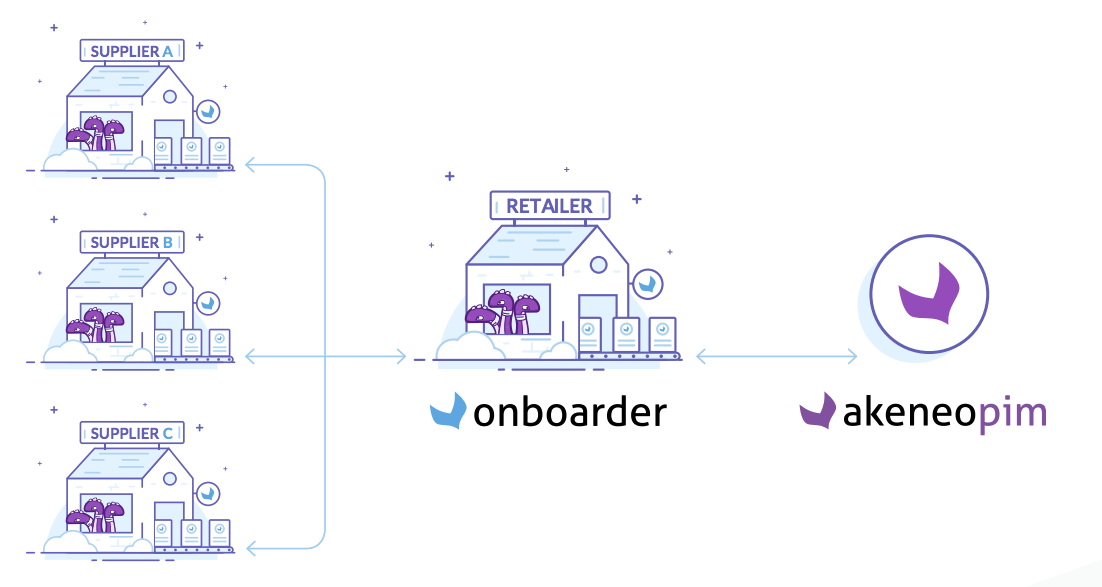
A supplier product onboarding solution that integrates with your PIM gives you the best of both worlds. This solution enables your suppliers to directly provide their product information in the format that you require. With seamless integration with your PIM, both suppliers and retailers/distributors can improve collaboration, increase productivity, and deliver high-quality product information.

Enable your suppliers to directly provide their product information using the format that you require.

The Akeneo Onboarder

The Akeneo Onboarder is a new product that complements Akeneo PIM Enterprise Edition and allows suppliers to directly provide product information to the retailer for streamlined processing into Akeneo PIM. There is no need for back and forth emailing spreadsheets or files. Instead, retailers/distributors can define required information attributes and catalog structures, and then suppliers input the product information directly into the Onboarder. The retailer can then review and accept the information and enrich the data in Akeneo PIM. This optimized process significantly increases productivity by removing the need to manually reformat or convert product data.

The Akeneo Onboarder makes it easy to:
–   Increase productivity
–   Expand product offerings
–   Ensure security

Suppliers benefit from having more control over the information provided to the retailer, and can also propose new products for the retailer to carry. If the retailer accepts the new products, they are automatically added to the retailer’s catalog. As a result, suppliers and retailers can both recognize the business benefits from an expanded catalog.

The Onboarder also allows your organization to maintain control over product information. You can easily accept or reject product data but still eliminate tedious manual enrichment tasks. Plus, providing suppliers with the ability to directly submit product information increases accuracy which supports better product and customer experiences. These productivity improvements give your team more time to focus on expanding product catalogs and other key enrichment tasks.

Simplified Product Information Enrichment Processes

Setting up the SaaS-based Akeneo Onboarder is simple:

  1. The retailer creates supplier accounts
  2. The retailer defines product information requirements
  3. The retailer sends supplier invitations via email
  4. The supplier accepts the invitation and logs in to Akeneo Onboarder
  5. Products that need to be enriched are displayed on a clear grid
  6. Completely enriched products are automatically sent back to the retailer/distributor for approval and subsequent integration into the retailer’s Akeneo PIM instance

Capabilities

Within the Akeneo Onboarder retailers and distributors can:

  • Define supplier product data requirements
  • Allow suppliers to directly provide product information
  • Enable suppliers to propose new products
  • Streamline product data management approval workflows
  • Easily review and accept or reject product information
  • Mass-approve and accept new products from trusted suppliers
  • Scale to support up to 2,500 different suppliers

Improve Supplier Product Information Management Using Akeneo Onboarder

By having a dedicated UI for your suppliers to input product information, you can be sure that you always have the complete and accurate information you need. The Akeneo Onboarder helps streamline these processes and workflows so you can increase productivity and get products to market faster to drive more sales.

Interested in learning more about the Akeneo Onboarder or want to learn more about Akeneo PIM? Just give us a shout and we would be happy to answer any of your questions.

Expert Interview with AOE: How Omnichannel Commerce is Reinventing the Customer Experience in the Travel Industry

Product Experience

Expert Interview with AOE: How Omnichannel Commerce is Reinventing the Customer Experience in the Travel Industry

How consumers shop for products in an omnichannel world is changing faster than ever. In particular, airport shopping has shifted as consumers can eas…

How consumers shop for products in an omnichannel world is changing faster than ever. In particular, airport shopping has shifted as consumers can easily purchase products online and have them sent to their destination rather than having to make last minute and extra costly airport purchases. To combat this trend airports and airlines are starting to embrace the omnichannel trend to provide highly-customized digital experiences to their passengers.
Kian Gould, founder and CEO of AOE, explains this shopping shift and how they implemented Akeneo PIM to help manage the products of numerous retailers and ensure that customers are receiving one consistent user experience. For the complete story, check out the interview:

Interview Transcript:

My name is Kian Gould. I’m the founder and CEO of AOE. And we have built a very high-scale omnichannel multi-merchant marketplace solution, that we call OM3. And it’s powering most of the world’s airport’s digital experiences – now and in the future.

What main retail and eCommerce trends do you witness in the travel industry?

So, the travel retail industry is really going through somewhat of a transformational phase. They’ve always relied a lot on impulse purchasing. And that is really going away now. More and more, we’re seeing spending per passenger drop. And of course, one of the reasons is that there’s such a vast amount of possibilities to purchase products digitally throughout their journey, whether it’s on Amazon or other channels. And so, the classic travel retail industry has started to suffer. A lot of airports, airlines, and also retailers are trying to combat that kind of disruption by providing real omnichannel digital experiences to their passengers. The crucial thing about that is that, in travel retail, there’s generally much more of a possibility to know your customer because they are passengers, and they are flying. So you have more information on them. And that makes it possible to personalize, recommend, and build experiences that are much more catered to each of these passengers. Which is, of course, very different from a classic retail environment where you really have anonymous visitors coming into your store.

How do shoppers respond to this omnichannel buying experience?

You always have to ask yourself the question, “Why does a person decide to shop through one channel versus another?” And what it comes down to, in our experience, is that it’s very much about this kind of microsecond decisions. Where it depends a lot on convenience, it depends a lot on pricing, it depends on how desperately I want a product at that moment. This is really what we’re seeing that the customers are looking for. If a product is not available at that moment when they want it, they will not come back to check it at a later stage. If the product doesn’t have a good price now, they will not try to come back to check if it has a good price later. They will try to find another channel that has it at a better price. So, a lot of the importance in this channel is, that you’re really providing a value and that it’s accepted by these travelers to help them along their journey. Either through convenience or through an actual good value proposition, cost-wise.

How do you power an omnichannel commerce strategy for your clients?

So, what we’ve done, because we work for these big, massive airports that have a lot of different systems that have to be integrated. They have physical retail, they have physical food and beverage. They have a lot of channels that their customers use. Whether it’s the website or the app but very often it’s also third-party websites and apps that have to be fed that content. We had to build a solution that is truly agnostic to where traffic comes from, where products come from, and where they’re fulfilled. So we built something that we call, OM3. The Omnichannel Multi-Merchant Marketplace Suite. And that basically enables these multi-retailer venues to take all of their products, all of their services, integrate them all into one solution and then provide it to the customer independent of what channel they’re using (even if it’s not their own channel). Through APIs, through voice APIs, we can integrate with virtually any channel that you can think of.

Can you give us an example of a successful omnichannel project?

So, we’re now live at three airports around the world. Frankfurt was the first to embark on this journey. We then went live in Heathrow and in Auckland. We’re currently doing projects with several airports and major airlines around the world. This is not only a project, this is a new strategy and a new solution approach that we have taken with that. You’re going to see much more of that in the future of these kind omnichannel experiences, that are driven by passengers and multi-retailer venues. One of the most challenging aspects of building this solution was that you have products coming from multiple retailers. They all have their own ERP, or POS, or PIM systems. The data and the attributes are not necessarily aligned. The big challenge is, how do you take all this data and then present it to the customer in a way that they can relate to it. A simple example, one retailer could call a color black and the other one could call it noir. At that moment, you wouldn’t be able to match those two products in a certain category anymore. So, a lot of the work that has to be done, is to consolidate all that data. And then, make sure that independent of what the sources of the retailers, we can present it all to the customer in one common user experience. In order to achieve that, we decided to use Akeneo as a PIM solution for all of the products. We had to then customize the solutions significantly because there are some very specific requirements in travel retail. Amongst them, is that every product comes with a certain concession fee that is paid by the retailer to the airport when it’s sold. Certain products are only allowed to be sold in certain volumes. Which are restrictions imposed by the brands. You cannot buy more than two Chanel Number Fives as one passenger, for example. There are restrictions on volumes of liquor. Then there are also restrictions on whether we can deliver one product from this terminal to another. Because one is domestic and one is an international terminal. Also, sometimes products sit in warehouses. One is a bonded warehouse, the other one is actually not a bonded warehouse. So all of that is functionality that had to be developed specifically inside of the PIM system. So that, we make sure that we never try to sell a product to a customer that we’re not allowed to, or that we cannot sell to them. That requires quite a sophisticated PIM solution and we integrated that seamlessly into our whole OM3 platform.

Want to learn more about the omnichannel advantages of PIM?

Check out the complete customer story of AOE and our Frankfurt Airport Project.

About Kian T. Gould

Kian T. Gould is the CEO and Founder of AOE, one of the leading global Omnichannel E-Commerce and Digital Transformation experts within the Open Source space. He is a regular speaker at many global conferences and a well-known expert in airport digitalization. For the past 15 years, his company AOE has assisted global Fortune 1000 companies with their Digital Transformation and Omnichannel E-Commerce strategies.

About AOE

AOE is a leading global provider of services for digital transformation and digital business models. AOE relies exclusively on established Enterprise Open Source technologies. This leads to innovative solutions, digital products and portals in agile software projects, and helps build long-lasting, strategic partnerships with our customers. In our daily work, such diverse systems as PIM, CRM and E-Commerce are integrated.

Product Data Quality: 5 Steps to Improving Product Data

Product Experience

Product Data Quality: 5 Steps to Improving Product Data

We talk a lot about the importance of high-quality, complete, and accurate product information. It’s critical to conversions and customer satisfacti…

We talk a lot about the importance of high-quality, complete, and accurate product information. It’s critical to conversions and customer satisfaction. But just because your data is present and accounted for doesn’t mean it’s doing its job. Great product data is the cornerstone of a great customer experience. And it’s much, much more than just accurate specifications. So, the question is: How can you create consistent, relevant, up-to-date and accessible product information to take the product experience from drab to fab?

According to Shotfarm, one in four consumers say they have abandoned a purchase because of poor product information.

Here are 5 steps to get it done with a PIM solution.

1. Collect and prepare your current product data

Once you’ve adopted a PIM solution, the first step is to collect your existing product data and prepare to enrich it for use in your channels. This data usually comes from a variety of systems such as your ERP, from marketing systems, and externally from suppliers. PIM will help you through the process of cleaning this data and deciding which sources have the best attribute data. Plus, once these workflows are established, they are not only helpful when implementing a PIM solution, they can also be used when on-boarding new items.

Once your data is in the PIM, a range of powerful data validation, editing, localization, and export options become yours, giving you the tools you need to quickly expand into new channels and locales, significantly speeding up time-to-market.

Importing your data into your PIM is also the perfect time to teach your team how to collaborate within the program.

Pro-Tip: Akeneo offers the Akeneo Onboarder, which gives your suppliers a cloud-based environment to easily provide their product information directly to you. We also offer a range of ready-to-rock import tools as well as a huge worldwide ecosystem of integrators.

2. Organize your products and attributes to scale data enrichment

With thousands of products to manage, it’s critical to find ways to ensure your product information processes will scale. A PIM should make the process run smoothly and make it easy for marketers to find and enrich the right product information. For example, Akeneo PIM helps simplify the process by allowing you to create families and attribute groups. Products in a family can share a set of attributes, so as new products are added to the family, they automatically inherit the shared attributes. These attribute values can be updated sequentially or as a mass action.

Another capability of Akeneo PIM is an attribute group. This feature enables you to group attributes together to better organize related attributes and give more visibility to those teammates responsible for providing and validating those values, as well as to help organize the team’s work across a range of products. For example, you can group together name and description into a “marketing” attribute group,  size, weight, and color into a “Technical specs” attribute group, and images and files into a “media” attribute group. The product form will display these attributes together to make editing simpler. You can further control who does what by assigning permissions on attribute groups to specify who can edit those attribute values.

These capabilities save time and can enable teams to better focus their enrichment activities.

Pro-Tip: Akeneo PIM allows you to set a completeness check for each product listing to ensure no product is published to a channel unless it is 100% complete and ready.

3. Classify your products

In addition to managing attributes and attribute groups, PIM lets you structure your catalog in categories. These categories should be broken down into groups that customers are actively searching for. When figuring out your own product categories, it’s a good idea to consult with your eCommerce managers who have deep knowledge of how your customers are browsing for products.

For example, Fossil makes it easy to search for and find watches based on who it is for (men or women), by watch type (where types vary whether it is a man’s or woman’s watch), and by different features such as strap material and color. Some categories will vary dynamically based on if the product is on sale, is a new product, or is a best seller. By grouping your products into specific categories that customers use to search, you’ll greatly improve the browsing experience and chances of a sale.

Pro-Tip: Akeneo PIM enables huge flexibility in structuring your catalog. You can classify products differently for different channels in order to deliver the right product experience by channel or locale.

4. Write awesome descriptions to be relevant and impactful

Just because your data is present and accounted for doesn’t mean that it’s doing its job. To create truly high-quality product information your team needs to utilize their marketing skills to create compelling and emotionally impactful product descriptions that work for each channel and platform. PIM gives your team the bandwidth to do this high-value work by automating the tedious manual work that used to occupy 90% of their day. They can now take the time to consider questions like:

How should your product make buyers feel?

How can you make your product stand out from alternatives?

An emotional connection has proven to be important for buyers, even in a B2B scenario.

The “voice” of your brand is discernable across multiple touchpoints. PIM makes it easy to ensure this voice is consistent and appropriate for every channel. Managing your eloquent, emotional descriptions and related media in your PIM will make it easier to localize, as well as ensure your brand’s voice is consistent across all channels. Here are some things to consider to ensure your product descriptions accurately represent your products:

  • Successful brands have consistent editorial styles and tones. Apple prefers the minimal approach, relying on brilliant images and a few perfectly chosen words to convey their message. The Peterman Catalog, on the other hand, sells every product with an enticing short story. Think about how you’d like to present your products to the world, and how your descriptions can serve this goal.
  • A good product story conveys emotion and should include more than just specs and usage information. Try to tell a story about your product with words, images, or both. Customers get a better sense of how they might use a product when they see it in context. An image of a GPS on a jogger’s wrist, or an athletic shoe on a trail runner’s foot, give customers an innate sense of the product’s purpose and how it could become a part of their lives.
  • When creating any product description, write strategically so you optimize your product to appear in search results (a practice known as SEO or search engine optimization). Choose words or phrases that people are searching for. Just be sure to avoid “word salad” descriptions—customers want to see recognizable language, not a string of adjectives and nouns designed for algorithms. For optimal SEO, ensure that every product that goes live has metadata.

Pro-Tip: Unleash your marketing team’s creativity for massive increases in conversions and revenue.

5. Create associations among products

Using your PIM, you can create sets of seasonal items in advance of actual seasonal sales, and associate several products you want to market together. For example, in Akeneo PIM you can set up a “collection” association type and group together spring or summer items months in advance. Similarly, you can create a cross-sell association to support selling related items, such as a computer and a printer, a camera and a bag, or a t-shirt and jeans. With the flexibility in Akeneo PIM, associations can be made at the individual product level or at the product model level such that different variants of a product – by size, by color – can be managed without having to specify the association for every possible combination of colors and sizes.

Pro-Tip: Akeneo Enterprise Edition provides for unlimited numbers of collections—allowing your team to prepare for every holiday and every season.

PIM is a Key Solution to Effectively Power Any Merchandising Strategy

By delivering high-quality product data that is complete, accurate, consistent, relevant, accessible and up-to-date, PIM is the essential tool for merchandising.

A PIM solution is the central platform to capture all product knowledge, comments and suggestions from your teams across your organization and across all touchpoints. It works cross-channel and delivers a compelling product experience to your customers wherever they are. But PIM can be more than a container – it can deliver product information, provide insights, and offer recommendations to make product information management a linchpin for any merchandising strategy.

Product data quality doesn’t come easy, but we can help make it a lot easier. Give us a shout to talk to one of our business analysts or solution partners about best practices that you can adopt for product data quality.


eCommerce Growth: Managing Internationalization

Product Experience

eCommerce Growth: Managing Internationalization

As you seek to expand to new markets and locales it’s critical to localize your product information for those channels. That means you need to updat…

As you seek to expand to new markets and locales it’s critical to localize your product information for those channels. That means you need to update your entire catalog — compelling descriptions, market-appropriate specifications, attributes, and media — and configure it for local languages and sensibilities.
To do this at scale, your team can benefit from tools that make localization processes more efficient and enable you to deliver better product experiences, even in a complex environment. Considerations for accomplishing this task and selecting the right tool for the job include:
  • What is the best way to manage translation at scale?
  • How do you manage multiple metrics and standards?
  • How do you adapt product information for cultural specificities and localization?
  • How will distributed teams collaborate on editing product information?
  • How can you ensure compliance with the rules and regulations for each market?
Product information management (PIM) provides the infrastructure you need to think globally while acting locally.

The Foundation to eCommerce Growth: Product Information Management (PIM)

PIM is a business application designed for marketers and eCommerce teams that makes it easy to address new markets and methodically prepare product information to be translated, localized, and deployed to relevant channels and touchpoints.
PIM is critical to any eCommerce internationalization strategy.

PIM Benefits

  • Easily manage and adjust product information at scale: PIM makes it easy to manage and edit product information across an entire organization. Mass edit capabilities allow you to update large amounts of product data at once and ensure that the product information that shows on any channel is exactly what you specify. Business rules can help automate attribute fields and categorization for a localized product mix. Whether you need to modify descriptions and images based on specific cultural requirements or simply need to include different measurement systems and sizes, PIM can handle and automate many of these tasks to simplify the product enrichment process.
  • Increase localization efficiency across distributed teams: PIMs provide translation capabilities that can manage the job of translation without users ever needing to leave the PIM. These translation plug-ins provide users with a choice of automated or manual translation services and significantly accelerate the translation and localization processes with streamlined workflows across global teams. What’s more, distributed workflows allow local contributors to modify product descriptions based on local needs while keeping headquarters staff informed and in charge of the global process.
  • Accelerate time to market: PIM speeds up time to market by optimizing all the workflows associated with product information management. Product information can be automatically pulled from supplier ERPs and other data systems to populate and update product descriptions. The final product information can then be distributed to eCommerce storefronts, marketplaces, and print catalogs in the required formats. No more days wasted with tedious copying and pasting information to and from spreadsheets.
  • Ensure quality control, legal compliance, and risk management: PIM tools that offer validation workflows and a business rules engine can better control product information quality and be sure that products are properly represented across every market. What’s more, countries have variable rules regarding labeling, licensing, and merchandising. These rules are often more strict for highly regulated industries such as financial services, healthcare, and food & beverage — where for example different states and countries require different labeling for ingredients, country of origin, health warnings, etc. By using PIM, organizations can ensure that these rules are met and as a result better manage their risk.
  • Improved conversion and return rates. The final outcome of all your hard work is more accurate and compelling product information and a better product experience. This naturally increases conversions and decreases returns. Profits follow.
PIM is a centralized tool that makes it easy to address new markets and prepare product information to be translated, localized, and deployed to the relevant channels and touchpoints.

What to Look for in a PIM Solution

There are a number of PIM solutions on the market. Here’s what to look for:
  • A centralized platform that allows your team to handle all product information enrichment, localization, translation, etc. in one place.
  • Integrated enrichment process: Look for a solution that ensures comprehensive, complete, and accurate product data. The best tools offer workflow-driven processes so product data changes can be reviewed and validated for accuracy. You should also look for a completeness tool to be sure your product information is fully enriched and populated before spreading it to sales channels.
  • Automation tools that can eliminate some of the time-consuming and repetitive tasks required in product information translation and localization including metric system conversions, currency conversions, as well as actual content translation.
  • Workflow and business rules that validate and control product information quality, improve localized asset management, and manage locale-specific attributes, which makes it possible to maintain catalogs in multiple languages within a single PIM.
PIM acts as a single source of truth for all product information.

PIM the eCommerce Internationalization Accelerator

PIM is the platform you need to power your internationalization strategy. Optimized workflows and tools ensure that your products look good and are relevant across every channel, in every locale, and in alignment with your brand. Interested in seeing how a PIM could support your growth plans? Contact us today or sign up for a demo.

Akeneo PIM Enables Omnichannel with New Shopify Plus Connector

Akeneo News

Akeneo PIM Enables Omnichannel with New Shopify Plus Connector

Akeneo and Shopify have recently partnered to enable integration between Akeneo PIM and Shopify Plus! Shopify Plus customers and partners can now seam…

Akeneo and Shopify have recently partnered to enable integration between Akeneo PIM and Shopify Plus! Shopify Plus customers and partners can now seamlessly use Akeneo’s PIM solution to manage and enrich their product information and deliver it more easily and quickly to multiple sites, locales, and sales channels.
Shopify Plus, the leading cloud-based, multi-channel commerce platform, was built for high-growth, high-volume businesses. Akeneo PIM complements Shopify Plus and enables merchants to efficiently manage and scale their product catalogs, centralize product information from multiple internal and external sources, and deliver product information reliably and consistently wherever it is needed. The integration between Akeneo and Shopify Plus is possible thanks to a new connector that is available on Akeneo Marketplace. The plugin connects both platforms and makes it possible to seamlessly spread product information to multiple Shopify Plus stores as well as to other sales channels including marketplaces, print catalogs, and POS, among others.

Akeneo Solution Partners

To implement this integrated solution, Akeneo works with multiple partners that offer skills and competency in both Shopify Plus and Akeneo. Here are some Akeneo solution partners who can help merchants build and run their digital solutions successfully:

Guidance

Guidance is a digital commerce agency based in Los Angeles that serves growth-oriented mid-market and enterprise branded manufacturers and merchants in both B2C and B2B. The agency offers industry-leading practices in multichannel retail strategies, mobile, customer experience, innovative visual design, UI/UX and complex system integration. Since 1993, national flagship retailers and consumer brand manufacturers have relied on Guidance’s expertise to facilitate more than $5 billion in web, mobile and social commerce. Brands including Foot Locker, Munchkin, Sole Society, Burlington, Johnny Was, K-Swiss, Robert Graham, Yamaha, Burlington, and others have engaged Guidance to build more than 300 world-class, omnichannel websites and apps that captivate and engage users and accelerate growth. “Our partnership with Akeneo and Shopify Plus is a great example of an ecosystem coming together to bring brands, merchants, manufacturers, and distributors the most advanced technical commerce solutions available in today’s market with one goal in mind, accelerate growth for our mutual clients,”  says Jeff Herrera, VP, Marketing and Channel Development at Guidance.

Redstage

Redstage specializes in design, development, growth, and strategy for digital commerce globally. The company provides support for a multitude of diverse market demands, with scalable services for enterprises of any scale. Redstage’s capabilities enable the agency to build profound eCommerce experiences and conquer even the most unique B2B & B2C challenges for clients. “Empowering online stores with the latest technology is at the heart of our brand philosophy,” says Hasan Elkomey, SVP of strategic partnerships at Redstage. “Akeneo PIM, combined with the Shopify Plus platform, is a powerful blend of such technologies, enabling businesses to streamline and simplify back-end processes so they can focus on bigger initiatives and scale faster. I’m excited for what’s to come as we continue developing the future of eCommerce together.”

Blue Badger

Blue Badger is a boutique eCommerce agency that has been making an impact in the eCommerce world since 2015. Founded on our passion for being excellent at the technical aspects of building, updating and maintaining an eCommerce website, today we proudly work in collaboration with some of North America’s finest retailers. We believe we have the experience and skills to take your eCommerce business to the next level of success. “As an official partner of both platforms, Blue Badger is extremely happy to see how Akeneo and Shopify complete each other in a meaningful way,” explained David Benchetrit, Blue Badget co-founder and head of client services. “Shopify’s streamlined approach to eCommerce makes it possible to go from zero to live in a matter of weeks, but the tradeoff is that in exchange they drastically limit the ways in which merchants can define and enrich their products. Enter Akeneo – whose easy-to-use PIM empowers merchants efficiently to manage product knowledge and expose it to their sales channels through a set of robust and powerful APIs. When these two best-in-class systems are used in tandem, incredible synergies can be found, because each system is both focused on the one thing they are amazing at while compensating for a weakness in its counterpart.”

Akeneo and Shopify Plus

As an open-source solution, Akeneo provides the flexibility to add new functionality to address specific and unique business processes. This capability also allows for easy integration with other systems that are either sources or destinations for product information. If you’re a Shopify Plus customer and are looking to deliver compelling product experiences, check out Akeneo PIM and the Shopify Akeneo Connector and see how you can enable a better omnichannel experience with high quality, comprehensive product information.