Summer Release

Introducing the First Truly Agentic Product Experience Platform

Learn More
Akeneo-Logo

Using a PIM to manage a successful Multi-vendor Marketplace

Product Experience

Using a PIM to manage a successful Multi-vendor Marketplace

When using a PIM with your multi-vendor marketplace, quality standards can be embedded and automatically enforced, the performance of your vendors can…

When using a PIM with your multi-vendor marketplace, quality standards can be embedded and automatically enforced, the performance of your vendors can be easily tracked, and non-performing vendors can be easily corrected or terminated.

A PIM supports the different needs of both the Vendor Manager and the Product Manager in fulfilling their distinct roles:
  • The Vendor Manager focuses on supporting existing vendors and onboarding new vendors and is deeply involved in those relationships (e.g. KPI analysis, contract renewal, etc.)
  • The Product/Category Manager manages onboarding new products and improving product quality. This involves enhancing product descriptions with the e-tailer’s own vision and branding while adapting that data to the target audience. The product manager’s vendor relationship relies on micro moments such as onboarding a new collection, marketing promotions, etc.

A PIM supports strategic vendor management across the portfolio of vendors and a better product experience for end buyers, resulting in lower returns with increased traffic and conversion.

Reduce Risk in Experimenting with New Product categories or Geographic Expansion

Marketplaces can fuel rapid growth in new product categories and/or geographic markets. Partnering with marketplace vendors can radically speed up entry into these new markets. Partnerships slash inherent risk as well.

Allowing partners to carry the burden of additional inventory and logistics reduces the need to invest heavily in an untested market and provides the opportunity to explore new markets with relatively low risk. Once market demand is proven, the risk of brand investment drops significantly.

Net Addition and Diversification of Revenue Stream

A commonly overlooked benefit of a marketplace strategy is revenue diversification.

A smart marketplace approach can be as profitable as direct sales for the sponsoring brand.

Even if margins are higher for direct sales, the revenue increase in a marketplace approach outweighs the cannibalistic effect of marketplace sales. If you don’t offer a product/service that the buyer wants, where they want it, and with the right shipping offer… you will lose the sale. Marketplaces help you retain some of that revenue while building customer satisfaction.


Ricard Case Study

Ricard decided to test opening a new sales channel as a departure from its historical business model. The Marketplace LesNouveauxCavistes offers independent and local liquor stores an opportunity to expand their offerings online. The marketplace, powered by Mirakl marketplace management software, launched at the start of 2017. It provides the following benefits:
  • A new channel approach for beginners, early adopters or experts to discover new products, featuring more than 3,700 references with advanced advice and great content.
  • A simple and easy path for 70 Independent Liquor Stores to test an initial online sales experience and boost revenue.
  • A chance for Ricard to earn additional revenue through a new direct sales channel and then expand the program for larger growth.

What are the risks of a Multi-Vendor Marketplace Strategy?

The biggest risk in hosting a multi-vendor marketplace is damage to brand reputation from non-performing vendors. Studies show that if something goes wrong in the transaction with a third-party vendor, 85% of the customers blame the seller and not the marketplace brand itself.

The second biggest risk is from poor customer experience when sellers don’t provide high quality product information. This degrades the shopping experience and increases the number and severity of downstream problems with customer satisfaction following the transaction.

Critical Tools for A Successful Multi-Vendor Marketplace Strategy

The two critical tools needed to solve the brand risk challenge of launching a marketplace are:

  • The Online Marketplace Management software
  • Product Information Management software

Online Marketplace Management software

Good Online Marketplace Management software is a key requirement for launching a marketplace. There’s no need to homebrew software. Excellent best-of-breed tools (such as Mirakl, used in the Ricard study above) enable you to automate vendor relationships within the marketplace.

Online Marketplace Management software needs to provide full control over quality and KPIs for service levels, response time, logistics, customer ratings, etc. This allows you to easily maintain quality levels to protect your brand from non-performing vendors without a lot of time-consuming manual reporting and management tasks.

Product Information Management software

Product Information Management (PIM) software is the final piece of the puzzle in creating a thriving marketplace.

Akeneo PIM is tailored for marketers to easily personalize workflow processes, leverage the product family data structure to simplify and streamline data capture, and easily assign responsibilities across the organization. It’s powerful, flexible, easy-to-use, and integrates with virtually every storefront, marketplace, ERP, and digital asset management tool available. And it’s open source.

You can take our suggestion of choosing Akeneo as your PIM of choice with a grain of salt (although seriously – it’s open source – why wouldn’t you at least try it out ). But what you shouldn’t take with a grain of salt is that a PIM is an absolute necessity in a successful marketplace process.

Better product descriptions = Higher Customer Satisfaction Better Conversion Rates Lower Return Rates

If your biggest risk in implementing a marketplace strategy is reputational damage from sub-standard product listings (and vendors), the best way to mitigate that risk is to ensure that every product listing in your marketplace meets your quality standards for product description and detail. Better product descriptions equal lower returns and higher customer satisfaction.

With Akeneo PIM, it’s easy to ensure that every product description on your site, whether your own or one of your marketplace partners’, is complete, accurate, and up-to-date.

Akeneo PIM makes it easy to enforce quality standards. If you’re already using Akeneo PIM for your current product information you can simply extend your existing product information quality standards to your marketplace partners. Likewise, Akeneo will automatically import your partner’s product data from a variety of spreadsheets and ERP systems or other sources. Akeneo then flags SKUs that need additional product information, media files, or translation for accurate completion.

Managing your marketplace using Akeneo PIM benefits your partners as well, since no reputable vendor wants to post product information with incomplete, outdated, or erroneous information.

Conclusion

Multi-vendor marketplaces can be a great strategy to extend product offerings and expand geographic reach while increasing customer satisfaction and revenues. In order to reap the rewards of your marketplace, be sure to arm yourself with two essential tools: Online Marketplace Management software and PIM.

Looking for the world’s best PIM software?

Over 40,000 merchants worldwide choose Akeneo.

Find out what Akeneo can do you for you with a test-drive or a free consultation! Contact us for more information!

<<< Part#1. Multi-vendor marketplace: Is it right for you?

Multi-vendor marketplace: Is it right for you?

Product Experience

Multi-vendor marketplace: Is it right for you?

Amazon and Alibaba have created massive marketplaces where buyers can purchase virtually anything they want from any location. To compete, many compan…

Amazon and Alibaba have created massive marketplaces where buyers can purchase virtually anything they want from any location. To compete, many companies are looking to expand their product assortment and geographic reach by incorporating multi-vendor marketplaces into their existing eCommerce stores. There are risks to this strategy but most experts think the potential benefits outweigh them. For an in-depth look at both the pluses and minuses of a multi-vendor marketplace strategy, read on…

What’s Keeping You Awake at Night?

The biggest competition in today’s online eCommerce market is the massive multi-vendor marketplace. In the early days, the big A’s – Amazon and Alibaba – helped to increase online shopping, getting consumers and business customers alike accustomed to buying online. Their victories were your victories.

But today, that balance has shifted. Now, eCommerce executives need a strategy to compete with – or risk becoming little more than suppliers to huge multi-vendor marketplaces. The Big A’s compete on product, price, and volume, offering a large range of product options through a product inventory that is almost impossible to match. Amazon accounted for the majority (53%) of the growth in US e-commerce sales for last year…. and that phenomenal growth was largely based on the marketplace model, where third-party sellers offer products alongside Amazon’s own.

Tactics to best compete with Amazon and Alibaba are on the minds of many eCommerce executives these days. As well they should be.

Adopting the Multi-vendor Marketplace model with a product quality focus:

To remain competitive, many large and mid-size companies need smarter approaches to merchandising. One promising approach is to transform a traditional eCommerce site into a multi-vendor marketplace by offering an increased range of higher-quality products without the risk of inventory, logistics, or servicing investments. This approach provides a unique competitive advantage against the Big A’s. Another approach is to shorten the value chain, bypassing wholesalers and buying directly from brands.

Two technologies are key to a successful marketplace: a marketplace management platform for onboarding and managing sellers, and a product information management (PIM) application. A PIM ensures that the right mix of products are presented in the most efficient and effective way possible, giving customers the best value for each product category. For maximum efficiency, the marketplace platform and PIM application need to be tightly integrated. Using the Mirakl marketplace management platform in combination with Akeneo PIM can make the move to a marketplace strategy efficient and highly successful.

Why is product information a key driver for a successful marketplace?
  • Personalization requires high-quality product information
  • Omnichannel needs product data that is consistent across all touchpoints
  • Intelligence from new sources – such as Chatbots – relies on accurate product data

There are massive opportunities in the creation of carefully curated horizontal and vertical marketplaces that can provide customers with incredible value for given product categories or market segments.

Here are two examples that illustrate how a marketplace approach can succeed:

The first example is Deco.fr (M6 Web Group), a specialized online store that sells to a highly targeted audience of women age 25-45. Approximately 40% of the audience was upscale. The store featured household goods and had significant traffic. Specialized brands are a key part of their portfolio. Deco.fr decided to transform its strategy from a traditional model to a marketplace approach using Mirakl as the marketplace management platform and Akeneo as the PIM system. The key goal was to reach critical mass at the end of the first year through a focused effort to onboard 75-100 vendors via the Mirakl platform – with an average of 1,000 offers each – for a total of 80,000 SKUs managed in Akeneo PIM.

  • The Mirakl system made it easy to onboard the new vendors and all the new product information was smoothly managed in Akeneo PIM.
  • The PIM uses access right managements that allow vendors to upload product information to the system where Deco.fr marketers can enrich the product data.

Using the marketplace approach, Deco.fr could promote additional vendors and brands, with more relevant product information to a larger audience, and engage customers in new ways such as personalization. Deco.fr relies on Akeneo PIM to deliver their full range of product information across channels in whatever formats are required – for standard descriptions, videos, demos and more. Now Deco.fr is a successful marketplace with the ability to grow and expand in France and even to new countries.

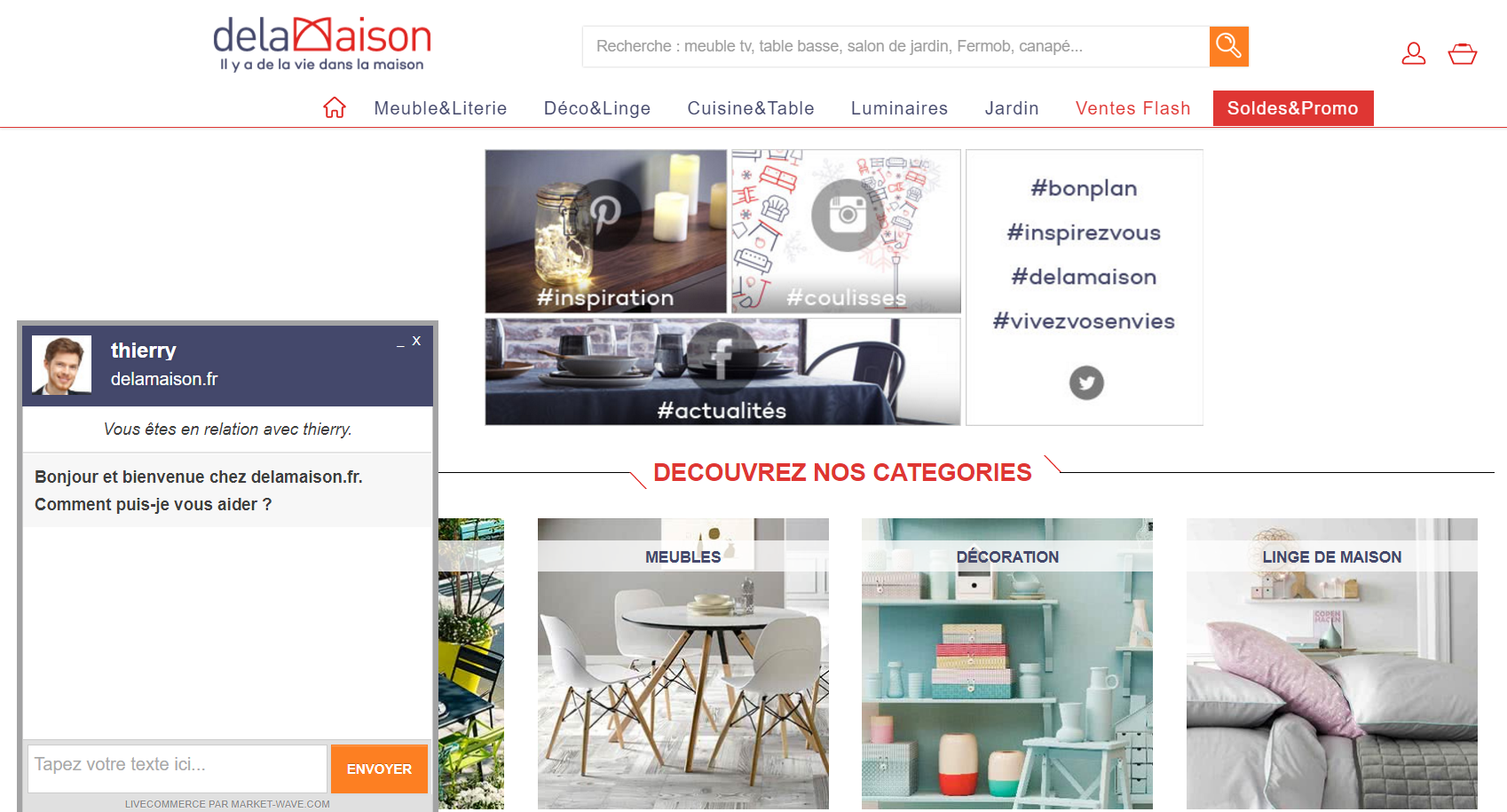
Delamaison is a second example of a successful marketplace approach. Delamaison is a specialized store featuring household goods including home decoration & garden products.

Using Mirakl as their marketplace management platform and Akeneo as their PIM, Delamaison offers highly curated and trusted selections of inventory to their customers which result in higher conversion rates. Thus, for many eCommerce players, adding a multi-vendor marketplace can be seen as less of a radical shift in strategy and more like leveraging existing competitive advantages. And quality product information is critical to that success.

What are the consumer advantages of Multi-Vendor Marketplaces?

Marketplaces provide customers with more product offerings, fair prices, and an optimal customer experience.

Multi-vendor marketplaces control the buying process for both consumer and B2B goods. To win business, your product offerings need to feature a variety of products presented in a highly compelling fashion, with accurate, complete descriptions that resonate with buyers. If your product presentation doesn’t meet buyer expectations they will go and shop at your competitors. Worse, if you consistently can’t give them a superior product presentation with the information they desire, they’ll stop coming back. And price competition – with multiple sellers competing – ensures that your customers get the best price possible.

Marketplaces allow for rapid and radical increases in product assortment.

With the right software, a Marketplace Manager can typically manage ten times the number of traditional vendors and each can offer a larger selection of products.

Why? The Multi-vendor Marketplace is a more streamlined relationship model.

In a typical vendor relationship, a Marketplace Manager is required to:

  • Find new vendors and products
  • Negotiate contract terms
  • Onboard vendors and their products
  • Setup rules to define minimum data quality standards
  • Organize merchandising
  • Review, suspend, and promote vendors
  • Periodically re-negotiate terms and restart the entire process when onboarding a new supplier

However, with a marketplace, you can bring an entire assortment of products onboard as simply as integrating the vendor’s product data. 90% of the tasks (orders, payments, invoices, contracts) can be automated. In the next blog post, we’ll explore how a PIM makes the migration to a marketplace model cost effective and efficient while driving to higher revenue and saving costs.

Part#2. Using a PIM to manage a successful Multi-vendor Marketplace >>>

PIM ROI #3: Calculating Your Actual PIM ROI

Product Experience

PIM ROI #3: Calculating Your Actual PIM ROI

How can Akeneo PIM increase your bottom line? This final blog post in our three-part series shows how to calculate the return on investment (ROI) of a…

How can Akeneo PIM increase your bottom line? This final blog post in our three-part series shows how to calculate the return on investment (ROI) of a Product Information Management (PIM) system. Our first blog post focused on the savings associated with reducing product management overhead; the second showed how PIM contributes to higher revenue through lower returns and increased sales. These calculations demonstrate the bottom line value of a PIM.

The table below shows how productivity savings, conversion improvements, reductions in return rates, and increased margin from higher revenue yields a total of $140,629 in gains the first year. Depending on the complexity of your project, you can quickly reach  financial breakeven very soon, accelerate  market expansion and offers can significantly leverage your Return on investment

Assumptions: Table 3.1 shows the entire ROI equation over the three-year period based on calculations from the two previous posts.
Year 1 Year 2 Year 3
Productivity Savings per year $12,500 $27,917 $43,056
Increasing Revenues of a PIM by
Decreasing Returns $400,000 $400,000 $400,000
Increasing the conversion rate $3,870,968 $3,870,968 $3,870,968
Expanding markets and offers Intangible Intangible Intangible
Total of additional revenues $4,270,968 $4,270,968 $4,270,968
Average net profit margin 3.00% 3.00% 3.00%
Benefits $128,129 $128,129 $128,129
Benefits + Savings $140,629 $156,046 $171,185
Table 3.1 – Summary of cost savings and revenue increases enabled by the use of PIM at a company with 30,000 SKUs in year one.

As shown in the first two blog posts, an eCommerce business selling 30,000 SKUs could save $12,500 by improving product management productivity with PIM. As the product list and sales channels expand,  productivity savings increase in years two and three, as shown in Table 3.1 above. The PIM delivers additional revenue increases by improving on-site conversions and reducing merchandise returns.

“R” is the cumulative gains from productivity savings and increased revenue. The average net profit margin is 3% (see Stern.nye.edu). In year one, the $12,500 in productivity gain, added to the $128,129 in increased margin from higher revenue, yields a total of $140,629 in gains.

While omitted from our calculation due to wide variances across industries, PIM is also able to facilitate revenue growth by simplifying expansions into new market and product offerings.

The Math of PIM ROI

ROI is a number determined by the following formula:

ROI = (Net Profit – Cost of Investment) ÷ Cost of Investment *100

As an example, a Net Profit of $25 on a Cost of investment of $20, yields an ROI of 25%, as shown by the equation: ($25 – $20)/$20 = $5/$20 = 25% Your return (The “R”) in this case equals your PIM efficiency savings and increased profits from PIM. Your investment (The “I”) is the total cost of ownership of the PIM system.

Akeneo – Smarter Design, Risk-free, Maximum Value, and Seamless Integration:

What makes Akeneo PIM the superior choice? Low total cost of ownership is just the beginning. Akeneo removes the risk from your PIM decision. With Akeneo PIM, you can try the Akeneo Community Edition as a free proof of concept before investing in the Enterprise Edition. With first-hand system knowledge and experience, you understand how the system works with your product data – the risk simply goes away. Akeneo is more cost efficient by design. We’re open source. A traditional system is a closed box; you pay expensive licensing fees and must work with what’s inside. With Akeneo PIM, you only invest in functionality that solves your unique challenges.   Akeneo PIM delivers maximum value for your budget at significantly lower costs. We’re open source – so the base cost of Akeneo is zero. With Akeneo PIM, you only pay for what you choose. And that means better ROI and higher growth, year after year. The Akeneo Enterprise Edition is smart design for seamless integration into current product enrichment workflows. Rather than clumsily trying to build new workflows to match a proprietary PIM tool, Akeneo enables easier adoption, markedly better user satisfaction, and greater efficiencies. The Akeneo Enterprise Edition includes the standard features of the Akeneo Community Edition plus: – Advanced rights management – Validation workflow – Versioning and publication – Rules engine – Product asset manager – Teamwork Assistant The Akeneo Enterprise Edition is a customizable PIM system, designed for seamless integration across your merchandizing workflows, to deliver maximum ROI. Want to see how PIM could decrease costs while increasing revenue for your organization? Ready to learn more about Akeneo PIM integration? Interested in a demo of Akeneo Enterprise Edition? Contact us for a free consultation. Not ready to talk anyone yet? Try taking Akeneo for a test-drive. << How Product Information Management Makes You Money – Part #2

New free extension on our marketplace: a dedicated UI to simplify the rules engine!

Akeneo News

New free extension on our marketplace: a dedicated UI to simplify the rules engine!

The Rules Engine is a key feature of the Akeneo Enterprise Edition. To improve the user experience and make Akeneo PIM more efficient, our German par…

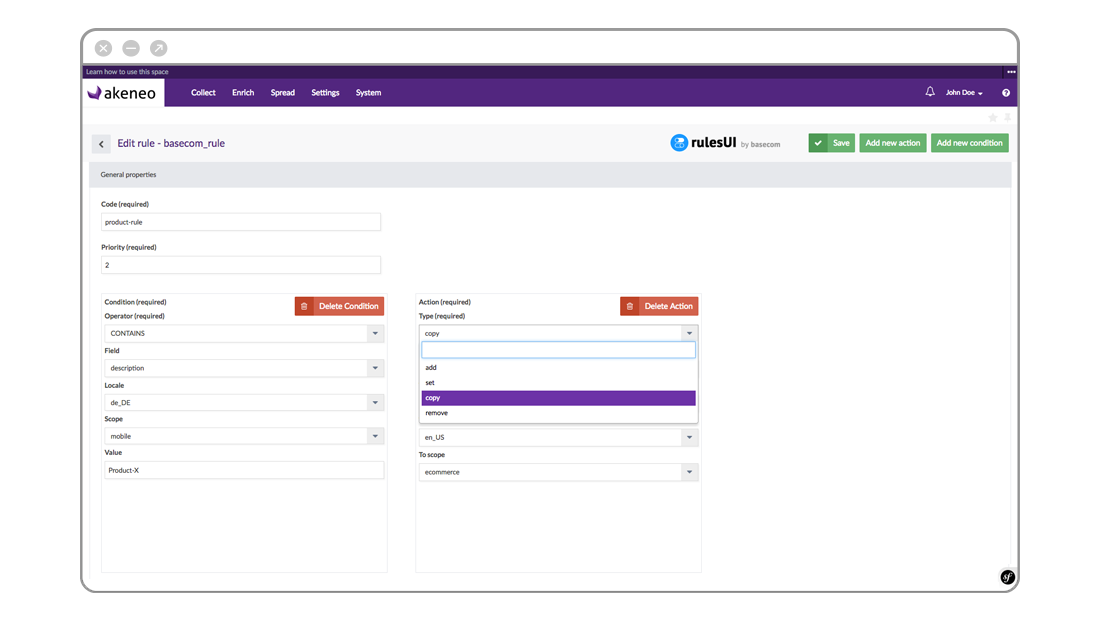
The Rules Engine is a key feature of the Akeneo Enterprise Edition. To improve the user experience and make Akeneo PIM more efficient, our German partner basecom has developed a graphical user interface for the rules engine that simplifies the maintenance and editing of YAML files.

Akeneo rules UI Extension: create, edit and delete rules easily

This rules engine extension provides a graphic user interface that enables more convenient creation, editing and deletion of rules. Previously, the only way to create or edit rules was to import dedicated YAML files.

What is the Rules Engine?

The rules engine is an Enterprise Edition feature that allows you to define automation rules and smart attributes.

  • Automatically classify your products based on their attribute values
  • Edit an attribute value based on another attribute’s value
  • Easily extend the rules engine to add your own actions and triggers which helps you automate many functions within Akeneo

A rule is built with one or several conditions and will trigger one of several actions.

Akeneo rules UI Extension:

With this new extension, you can create a new rule, edit and delete an existing rule directly from the interface without a YAML file.

Interested in more information?

This video from basecom explains everything about the Akeneo Rules Extension: how to install it and how to use it (starting at 4’ minutes).

https://youtu.be/xxJHT8hduuc

If you have any questions or comments regarding the rules UI Extension or if you are considering an integration into your Akeneo Enterprise, please contact Steffen Krüger, IT-Consultant at our partner basecom at [email protected].

New free Akeneo to Criteo Connector: Simple and Seamless!

Akeneo News

New free Akeneo to Criteo Connector: Simple and Seamless!

Akeneo marketplace now offers a new free connector for Criteo! Developed by French partner Agence DnD, the connector bundle allows you to export XML f…

Akeneo marketplace now offers a new free connector for Criteo! Developed by French partner Agence DnD, the connector bundle allows you to export XML files from Akeneo to Criteo. This connector is also available via GitHub.

Criteo is a tool to broadcast customized banners on internet browsers and social networks to better engage audiences and increase sales. Criteo uses predictive algorithms to offer product recommendations to new customers and increase conversion rates of new and existing customers.

The Criteo bundle is plug and play, and will not affect your Akeneo instance. It maps data between Akeneo product attributes and Criteo data requirements, enabling easy export of an Akeneo XML file with all required information for Criteo.

You can choose between automatic and manual modes. Use the automatic tasks (CRON) to export the data from your server or select the manual option to download the XML files directly from the Akeneo interface. Complete product information is exported, with selection options for locale, channel and currency.

Interested in more information? This webinar from Agence DnD fully explains the new Akeneo – Criteo connector:

Any questions? Please contact our partner team at [email protected].

Free Google Shopping Connector: easy export to Google Shopping!

Akeneo News

Free Google Shopping Connector: easy export to Google Shopping!

A new FREE Google Shopping connector – developed by our partner Agence DnD – is now available on the Akeneo marketplace and via Github.This bundle mak…

A new FREE Google Shopping connector – developed by our partner Agence DnD – is now available on the Akeneo marketplace and via Github.

This bundle makes it easy to export a formatted, ready-to-use XML file of your products for use by Google Shopping.

Google Shopping campaigns allow retailers to highlight their products in Google search results. Campaign pricing is based on click-throughs.

The Google Shopping Bundle provides 3 key functions:

  • Creates a translatable custom entity mapped to a product attribute
  • Imports Google Shopping categories by locale
  • Exports a formatted XML product file for Google Shopping

This Plug and Play connector will not disrupt your Akeneo instance. The configuration is very simple and managed from the interface, with no coding required!

Interested in more information? This webinar from Agence DnD fully explains the new Akeneo – Google Shopping connector:

Any questions? Please contact our partner’s team at [email protected].

New extension: Akeneo2GlobalLink, to connect Akeneo PIM with GlobalLink Connect

Akeneo News

New extension: Akeneo2GlobalLink, to connect Akeneo PIM with GlobalLink Connect

We are pleased to announce a new connector for translations now available on the Akeneo Marketplace! Thanks to our partner StrikeTru, you can now con…

We are pleased to announce a new connector for translations now available on the Akeneo Marketplace! Thanks to our partner StrikeTru, you can now connect your favorite PIM to Translations.com’s GlobalLink Connect translation management system, using the Akeneo2GlobalLink Connector.
Translations made easy: This extension allows you to send product content from Akeneo PIM for translation. In one streamlined process, you can submit the contents of single or multiple products – from one source language into one or more destination languages –  to GlobalLink Connect for translation.  Once product content is translated, the translated content from GlobalLink Connect is automatically updated in Akeneo PIM. How to use Akeneo2GlobalLink for translations:
  1. On the Akeneo product grid, select the product(s) you want to send for translation
  2. Click on the Mass Edit operation, and select the “Translate Content” operation
  3. Select your content source language (translate from) and one or more target languages (translate to) for translation
  4. Specify your project ID and submission name
  5. Submit your product(s) to GlobalLink Connect in just one click
  6. Track the status of translation requests in the PIM Translation Dashboard
Once translations are complete, the translated content is automatically imported back into Akeneo PIM into the appropriate products. This extension is compatible with Akeneo PIM 1.5, 1.6, 1.7, and 2.0 and enables translation to all locales supported by Akeneo. To learn more about this new connector, visit our Marketplace or contact Harry from our partner StrikeTru!

Interested in localization? Learn more in our white paper “From Overwhelming to Organized: Scaling Global Product Management” and see how Akeneo can help.

PIM ROI #2: How PIM boosts revenue

Product Experience

PIM ROI #2: How PIM boosts revenue

Welcome to Part 2 of our 3-part series detailing the return on investment (ROI) benefits of product information management (PIM) systems. In Part 1, w…

Welcome to Part 2 of our 3-part series detailing the return on investment (ROI) benefits of product information management (PIM) systems. In Part 1, we outlined productivity benefits and overhead savings associated with an Akeneo PIM implementation. Now, let’s see how implementing Akeneo PIM can reduce return rates, improve conversion, and simplify portfolio expansion to increase revenue.

Decrease Returns through Accurate Product Data

Product returns are a top pain point for online retailers, with some reporting e-Commerce return rates of over 25%. While logistical issues have an impact, a product detail page with accurate product data and rich product content increases buyer confidence and manages product expectations to help minimize returns.

Akeneo PIM enables digital marketers to consistently provide up-to-date, accurate, and detailed product content to your online platform. Akeneo features such as product completeness monitoring, combined with automated product enrichment rules and validation to, ensure that shoppers are more informed prior to purchase, which can decrease return rates by more than 20% according to Akeneo client data.

The revenue gains Akeneo delivers – through reducing restocking time, processing costs and return rates – is shown in the example below

Assumptions:
  • Average sale of $100
  • Rate of returns is conservative at an industry average of 25%
  • Value of items returned per order is conservative at 30%
  • Cost per return is conservative at $10
no PIM with Akeneo PIM Net Gain
 Transactions per year  200,000  200,000
 Average Sale  $100 $100
Total Revenue  $20,000,000  $20,000,000  
 Rate of returns  25%  20%
 Number of returns  50,000  40,000
 Average sale  $100  $100
 % items returned / order (in value)  30%  30%
 Net Sale Loss  $1,500,000 $1,200,000  $300,000
 Cost per return  $10  $10
 Total Cost of Returns – Operating Cost  $500,000 $400,000   $100,000
 Total (Operating) Revenue – After Returns  $18,000,000  $18,400,000  $400,000
Table 2.1. Cost Savings & Revenue Retention By Reducing Online Returns

Increasing Revenue By Improving Conversions

Shoppers are skipping in-store aisles and heading online at a growing rate, but they still demand an immersive shopping experience. Detailed online product information and documents, personalized content, and high-quality images & videos are required to compel website shoppers to convert at the digital shelf while providing essential content support across sales channels. Whether shopping through brick-and-mortars, catalogs, or talking with sales reps, customers expect to see and hear consistent product information across platforms and to instantly search online for product details. Akeneo’s flexible and scaleable PIM helps users manage rich product information across many channels and languages, which can contribute to a 20-50% increase in conversion. A conversion rate growth of 20% delivers a significant increase in revenue:

Assumptions:
  • Conversion rate based on 3.1% industry average
  • Conversion rate of Akeneo PIM based on 3.7% reported results from Akeneo PIM users
  • Average sale at $100
no PIM with Akeneo PIM Revenue Gains
Visitors per/year 6,451,613 6,451,613
Conversion rate 3.1% 3.7%
Estimated transactions / year 200,000 238,710
Average sale $100 $100
Total Revenue $20,000,000 $23,870,968  $3,870,968
Tab 2.2. Revenue Impact of a Conversion Rate Growth of 20%

Increasing Revenue Through Portfolio Expansion

Akeneo simplifies the go-to-market process by streamlining product onboarding and content maintenance within a single environment across all products, channels, and translations. A change to the Akeneo environment is instantly populated across all sales touchpoints.

Contrast the ease of a single, centrally managed Akeneo environment with the outdated model of going to market with new products in new channels where each project is managed in a separate environment, with a separate process, by separate contributors working in silos. In the old approach, efforts are duplicated, opportunities for errors are multiplied, and man-hours are wasted on repetitive tasks.

Akeneo PIM revolutionizes the process of taking new products to market, managing a new collection or range of products and updating product details by providing one centralized, trusted source for product information. A centralized process improves resources allocation; to access more e-Commerce partners, increase catalog efficiencies, support faster language translation and improve ROI.

With Akeneo PIM, your team spends less time replicating efforts, and more time expanding the breadth of your catalogs and entering new markets. And Akeneo offers expanded capabilities and time-saving features including:

  • Advanced workflows and permissions to let internal and external collaborators participate
  • Jump-start new initiatives by sharing product data where replication is unnecessary
  • Safeguards that protect completed products with user restrictions and versioning rollbacks
Learn how Akeneo PIM helped one large local retailer launch over 70 e-Commerce channels here! Akeneo PIM optimizes ROI across marketing and operations:
  • Increases buyer confidence and conversion
  • Lowers online return rates
  • Reduces cost of labor
  • Eliminates duplication of effort
  • Minimizes errors from multiple data entry points
  • Drives efficient product and market expansion

Part 3 in the ROI Of PIM series details how the Akeneo PIM – as the source and repository of authoritative data for every product across the retail ecosystem – – unlocks new ways to maximize profitability and growth in today’s multi-domain retail arena.

Ready to test-drive Akeneo, or need a free consultation? Contact us today! << Reducing Product Management Overhead – Part #1

Calculating Your Actual PIM ROI, Part 3 >>

PIM ROI #1: Reducing Product Management Overhead

Product Experience

PIM ROI #1: Reducing Product Management Overhead

This is the first in a three-part serie of articles which explores how Product Information Management (PIM) systems can generate a substantial return …

This is the first in a three-part serie of articles which explores how Product Information Management (PIM) systems can generate a substantial return on investment (ROI).

Drivers of strong ROI include decreasing the amount of time your employees spend updating spreadsheets and streamlining your entire eCommerce operation. Implementing PIM helps you increase profits reducing costs and increasing revenue. This article discusses how PIM helps you save money by reducing product management overhead. Part II covers PIM’s ability to realize further savings through decreased returns and improved on-site conversions. Part III summarizes and goes into more detail on PIM ROI over a three-year period.

Overview: The Astonishing Volume of Detail in Product Management

Managing multiple product SKUs in an eCommerce business tends to be time-consuming and expensive, especially if the product management team relies on manual processes. To understand why this work is so laborious, think about the amount of detail in a product manager’s workload. Table 1 describes the level of detail tracking required in a company with 30,000 product SKUs in its first year of operation. Each SKU contains 70 attributes, e.g. size, color, prices, images and so forth. If the company has its eCommerce site translated into three languages, that means the product management team has to keep track of 2.7 million data values.

YEAR 1 YEAR 2 YEAR 3
Number of SKUs 30,000 40,000 50,000
Attributes per SKU 70 80 90
Number of languages (Localizations) 3 4 5
Number of channels (e.g. website, catalogue, mobile app) 1 2 3
Number of values to handle 2,700,000 6,200,000 13,500,000
% #values growth (vs year1) +130% +400%
Table 1 – the number of data values a company has to manage as its expands it product portfolio, channels and language localizations.

As the company grows, the data challenge expands with it. If, as Table 1 shows, the company adds 10,000 SKUs, a new language and an additional channel in its second year, the number of data points under management balloons to 6.2 million. In year three, with one more language and channel, they’ve got 13.5 million data points on their hands.

A data management load like this requires a lot of man-hours. Product enrichment is critical to conversion rates, low return rates, and overall profitability, so skimping in this area is not an option. Without the right automation tools, even the most efficient product management team is going to be quite expensive to maintain. And, the work will suffer from productivity and accuracy challenges.

Drivers of Product Management Inefficiency

It’s not an indictment to say that manual product management is inefficient. This is just a reality. You may have the most diligent product managers around. They will still be less efficient that a good PIM solution. Here’s why:

  • When people do the work without the right tools, it takes a long time and is error-prone.
    • Spending time manually emailing, importing and exporting product data.
    • Relying on email and phone to communicate changes about products or get questions answered.
    • Cutting and pasting product information from spreadsheet to spreadsheet.
    • Manually updating nearly identical SKUs.
    • Looking for and correcting product images and videos.
    • Manually correcting product data in multiple locations.
    • Looking for missing data.
    • Repeating all of these tasks across multiple channels and localization efforts.
    • Fixing all the inevitable mistakes from the manual processes.
  • Without PIM, the team managing each channel probably has to oversee its own collection of product data. Or, the teams may circulate eternally out-of-date spreadsheets of product information and waste time correcting product listings.
  • Localizations lead to complexity. More languages, differing units of measurement, and slight product changes from regional market to regional market mean more complexity.
  • Multiple stakeholders in different groups (or even different companies) often have to collaborate on product management processes. The more contributors there are and the more separated they are organizationally, the more inefficient the product management process will become.
  • Most eCommerce systems on their own are not well suited to implementing global strategies. Rather, they tend to be good for immediate merchandizing around specific events like Christmas or high-frequency sales. They are usually devoted to the single channel of eCommerce. Localization and multiple channels, such as print catalogs, are challenging to implement.

Savings from Product Management Productivity Via PIM

A PIM solution saves you money by reducing the amount of time employees must spend administering products for an eCommerce site. With PIM, there is one authoritative product data set. This leads to time savings across multiple channels and makes product managers more productive. It also helps eCommerce sites and print catalogs become more engaging and profitable.

A good PIM solution provides all the stakeholders in the product management process with a connected, intuitive tool to track and manage product details. PIM enables employees to avoid repetitive, dull and error-prone tasks. For instance, PIM will automate the process of making sure a shoe listed as “Blue, Size 11” on an American eCommerce site gets listed as “Blau, Größe 44“ on the German localization without any manual data entry steps. Multiply that process by 30,000; and you can start to see the advantage for the company described in Table 1.

Multi-channel businesses make the PIM advantage more pronounced. Businesses where multiple teams have to coordinate their product management efforts also benefit. The PIM tooling streamlines the process of getting the work done.

PIM provides a number of intangible benefits which can contribute to greater success and profitability. These include a reduction in frustration that stems from having to deal with millions of data points – often on a rushed schedule – as well as the stress of handling errors. Reduced errors on the eCommerce site and richer product detail will result in higher customer satisfaction. And, spending less time on a time-consuming task brings opportunities to spend more time on merchandizing.

Add Up Your Efficiency Gains

In our experience working with numerous multi-channel businesses, we have observed that our PIM solution enables product management efficiency gains of about 50% and can go up to 70% and even more. To understand what this means in terms of dollars, consider the example in Table 2. Modeled on a typical client of ours, this hypothetical company updates 33% of its 30,000 SKUs in the first year. At 5 minutes per update, using a manual process, it will cost the company $25,000 to update its eCommerce catalog in the first year – assuming a fully allocated labor rate of $30 per hour.

With PIM and a 50% bump in productivity, product updates will take just 2’30 minutes. This translates into a savings of $12,500 in year one, $27,917 in year two and $43,056 in year three as the product count grows along with the number of updates.

Year 1 Year 2 Year 3
Catalog Size (# of SKUs) 30,000 40,000 50,000
Product updates (%) 33% 29% 23%
Number of values to update 900,000 2,010,000 3,100,000
Fully allocated cost of a product manager (per hour) $30 $30 $30
Estimated time to update 90 values (Minutes) 5 5 5
Time required to update product values (hours) 833 1,861 2,870
Total cost of manual updates per month $25,000 $55,833 $86,111
Estimated productivity gain from PIM 50% 50% 50%
Time required for product update with PIM (hours) 417 931 1,435
Total cost of PIM-based product updates per month $12,500 $27,917 $43,056
Savings per year $12,500 $27,917 $43,056
Table 2 – Projection of savings from the implementation of PIM in product management.

As Table 2 shows, PIM helps save money by making product management more efficient. There are many other ways that PIM contributes to increased profits and ROI. These will be covered in the next articles in this series.

Want to talk to one of our experts to better understand how PIM could decrease costs while increasing revenue at your organization? Just want an idea of how much it would cost to setup Akeneo?

Contact us for a free consultation, or try taking Akeneo for a test-drive.

How PIM Boosts your revenue, Part 2 >>

The Critical Infrastructure Needed to Power Retail Chatbots

Product Experience

The Critical Infrastructure Needed to Power Retail Chatbots

Chatbots are all the rage in retail management and technology circles.Chatbots create a dialog with humans that simulate a natural conversation and he…

Chatbots are all the rage in retail management and technology circles.
Chatbots create a dialog with humans that simulate a natural conversation and help users find products or services that fit their situations. The promise of chatbots has created huge investments and high expectations across the retail universe. While chatbots are used for a variety of tasks from customer service to internal analysis, we are focusing on how chatbots can be utilized as a new retail sales channel. Continue reading “The Critical Infrastructure Needed to Power Retail Chatbots”