AI can write a product description in seconds, but speed has a hidden cost. Shoppers are scrolling past copy that sounds like everyone else’s, and AI engines are skipping products that say a lot without saying anything. That’s AI slop, and it’s sending products to the invisible shelf: online, but never recommended. That’s why we’re taking a look at what AI slop looks like on a product detail page and why it hurts both human shoppers and AI search.
Table of Contents
Keywords
As the holiday rush kicks into gear, product teams everywhere are racing to get thousands of product detail pages (PDPs) live before Black Friday. Generative AI makes that race feel winnable; a magic tool can write a description in seconds, and a whole catalog in an afternoon.
But speed has a side effect. Shoppers are scrolling past descriptions that all sound the same, and AI engines are skipping products that say a lot without saying anything. The result is a growing pile of content we now call AI slop, and it is quietly costing brands sales.
The good news? Avoiding it does not mean abandoning AI. It means pointing AI at the right foundation: your product data.
Merriam-Webster made “slop” its 2025 Word of the Year, defining it as low-quality digital content, typically churned out in volume by artificial intelligence.
On a product detail page, AI slop is copy that looks finished but carries no real information. It is written to fill a field, not to help a buyer decide. You have probably seen it:
It loses the human shopper. Shoppers do their homework. 89% of consumers research products before buying, and 69% have returned a deal-day purchase. When the details aren’t there, they leave: 70% of shoppers said they would buy a different product due to missing information, and 43% had returned something in the past year because pre-purchase information was wrong.
It loses the AI engine. Discovery is moving off your website. McKinsey projects that $750 billion in US revenue will flow through AI-powered search by 2028. AI engines don’t reward fluent filler. They look for structured, specific, verifiable facts they can compare and cite. Slop gives them nothing to extract, so your product lands on what we call the Invisible Shelf: online, but never recommended.
Take a women’s waterproof rain jacket, a category where sizing and fit questions drive a huge share of returns. Here’s the same product, described two ways:
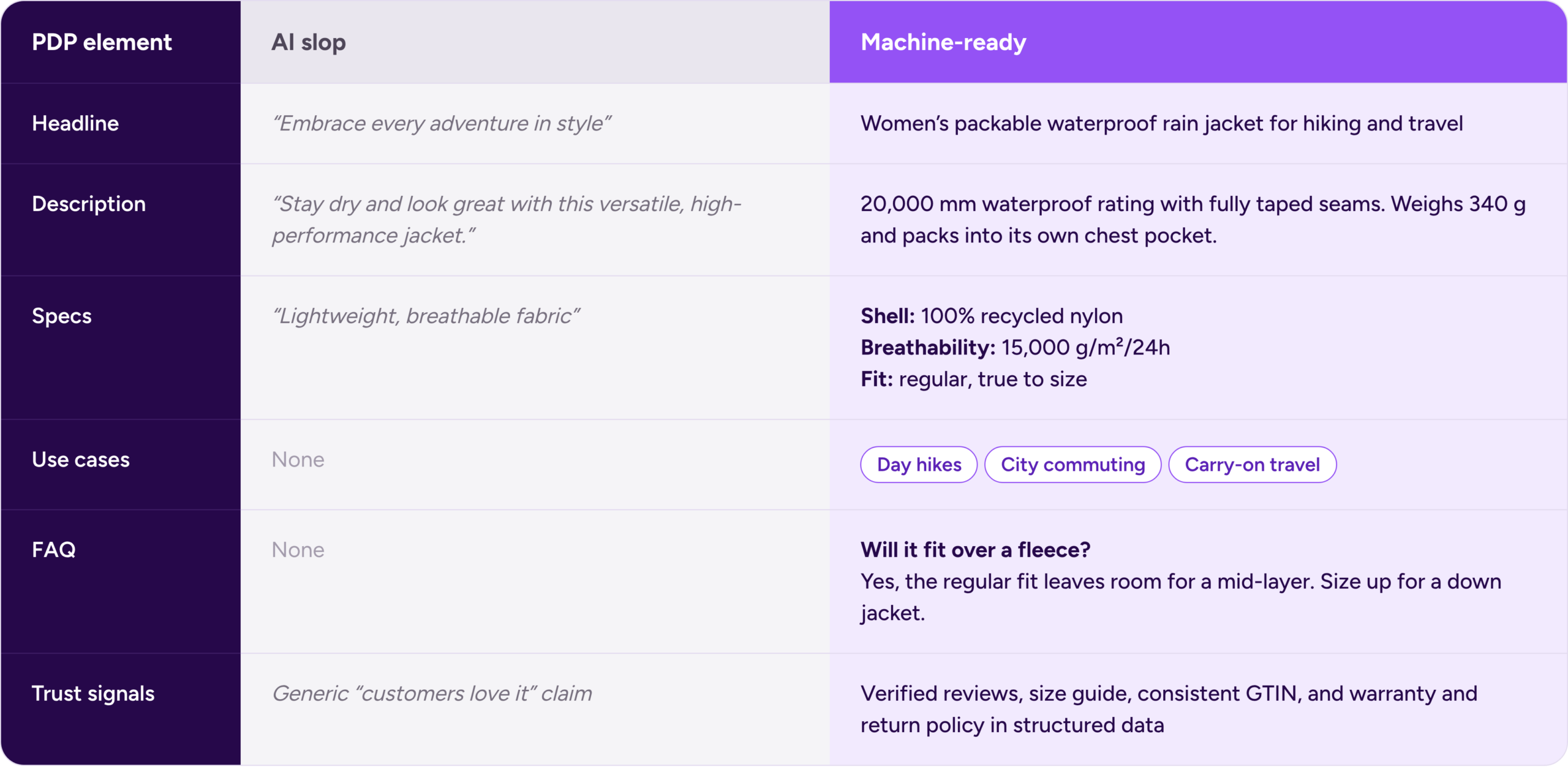
A great PDP does two jobs at once. It tells a human shopper a persuasive, accurate story, and it gives AI engines clean, structured facts (backed by Product Schema) that they can parse, compare and recommend with confidence.
AI only writes slop when it has to guess. Before generating copy, make sure the product record holds the attributes that matter: dimensions, materials, compatibility, care, certifications. Rule of thumb: if a fact isn’t in your product data, it shouldn’t appear in the description.
Paste your description onto a competitor’s product page. If it still reads as true, it’s slop. Rewrite until every sentence could only describe your product.
“Lightweight” becomes “1.2 kg.” “Fast charging” becomes “0 to 80% in 35 minutes.” Search your catalog for words like premium, innovative and seamless, then swap each for a measurable fact.
Pull the top questions from customer service tickets, reviews, and on-site search. Add short FAQs to the PDP, such as “Is it machine washable?” These pre-packaged answers are exactly what AI engines lift into their responses; plus you know you’ll be speaking the same language as your customers since you used their feedback to feed your product information.
Add structured attributes for occasions, environments, and personas: “apartment-friendly,” “gift under £100,” “rated for outdoor use.” Context is what connects your product to a conversational query.
Set brand voice rules and review workflows so a person approves AI-generated copy before it goes live. Then syndicate that approved version everywhere, so your website, marketplaces and Google Merchant Center never contradict each other.
Despite the name, AI isn’t necessarily the villain in this situation. Often, it can be a great writing partner when you give it something real to work with. Slop happens when we ask it to fill in the blanks, and it happily obliges.
So before you hit “generate” on another few hundred descriptions this holiday season, take a quick look at what you’re feeding it. Pick a handful of your best sellers, run the swap test, and trade a few adjectives for facts. You’ll be surprised how quickly the copy starts to sound like your product again.
Your shoppers will notice. And increasingly, so will the AI engines deciding which products to recommend.
Download the AEO playbook and learn how to make your products visible, trusted, and recommended in the era of AI commerce.

 Release