As shoppers increasingly turn to ChatGPT, Gemini, and other AI assistants instead of traditional search engines, brands face a new challenge: ensuring their products are recommended by AI, not overlooked. Discover what Answer Engine Optimization (AEO) is, how AI is reshaping product discovery, why visibility tools alone won't solve the problem, and the four foundational pillars that help AI understand, trust, and recommend your products.

Table of Contents
Keywords
For more than two decades, digital visibility meant ranking on Google.
Brands optimized web pages, targeted keywords, and competed for clicks. If you earned a spot near the top of the search results, you had a strong chance of winning the customer.
That model is rapidly changing.
Today, shoppers are increasingly turning to ChatGPT, Gemini, Perplexity, Claude, and other AI assistants to help them research products, compare options, and make buying decisions.
Instead of scrolling through pages of links, they simply ask:
Rather than presenting ten blue links, AI engines synthesize an answer by evaluating products, interpreting specifications, weighing trust signals, and recommending the options they believe best satisfy the request.
Product discovery is moving beyond the website and into AI-powered environments where your product data must speak for itself.
That means a product can rank highly in traditional search and still fail to appear in AI-generated recommendations if its underlying product information is incomplete, inconsistent, or difficult for machines to interpret.
Answer Engine Optimization (AEO), sometimes referred to as Generative Engine Optimization (GEO), is the practice of structuring your content and product information so AI-powered answer engines can confidently understand, cite, and recommend your products.
Unlike traditional SEO, which focuses on improving rankings within search results, AEO focuses on increasing visibility inside AI-generated answers.
That’s an important distinction; SEO helps users discover your website, while AEO helps AI discover your products.
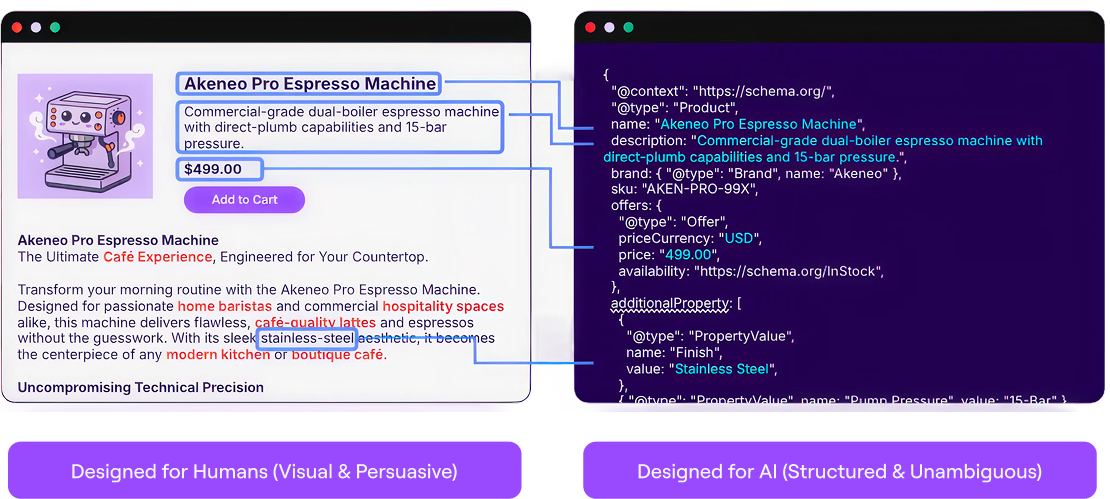
To do that successfully, AI must be able to interpret your product data the way a human would. Instead of simply matching keywords, AI understands entities, relationships, attributes, and user intent.
When someone asks for a “compact espresso machine for a small kitchen,” the AI isn’t searching for those exact words—it translates the request into structured attributes like dimensions, appliance type, countertop footprint, and intended use case. If your catalog doesn’t contain that information in a machine-readable format, your product may never be considered.
AI-powered shopping assistants are changing how people buy.
Instead of researching across multiple websites, comparing dozens of product pages, and reading countless reviews, consumers increasingly expect AI to perform much of that work for them.
That means visibility depends less on how well your website performs and more on how understandable, complete, and trustworthy your product information is.
This trend extends to B2B organizations as well, which have historically adopted new digital behaviors more slowly. According to Forrester, 89% of B2B buyers now use generative AI during the buying process, making AI-powered discovery one of their primary self-service research channels.
The growing popularity of AEO has led to a wave of tools that measure AI visibility such as Profound, SEMrush, and Adobe’s LLM Optimizer.
These platforms are valuable because they can tell you whether your brand appears in AI-generated responses, identify competitors that are winning more recommendations, and highlight gaps in your visibility across different prompts and answer engines.
The problem? Most of them stop there.
They diagnose the issue, but they don’t solve it.
Traditional AEO tools generally don’t enrich missing product attributes, govern product information, align supplier data, manage enrichment workflows, syndicate corrected content across channels, or create a continuous feedback loop between AI discoverability and product data quality.
In other words, they measure visibility but don’t improve the product information that drives visibility.
As AI models evolve and buying behavior changes, maintaining AI discoverability requires continuous optimization, not just reporting. That’s why many organizations are pairing AI visibility tools with Product Information Management (PIM) systems that can actually improve the completeness, consistency, and quality of their product catalogs.
Building an effective AEO strategy is built on four foundational pillars.
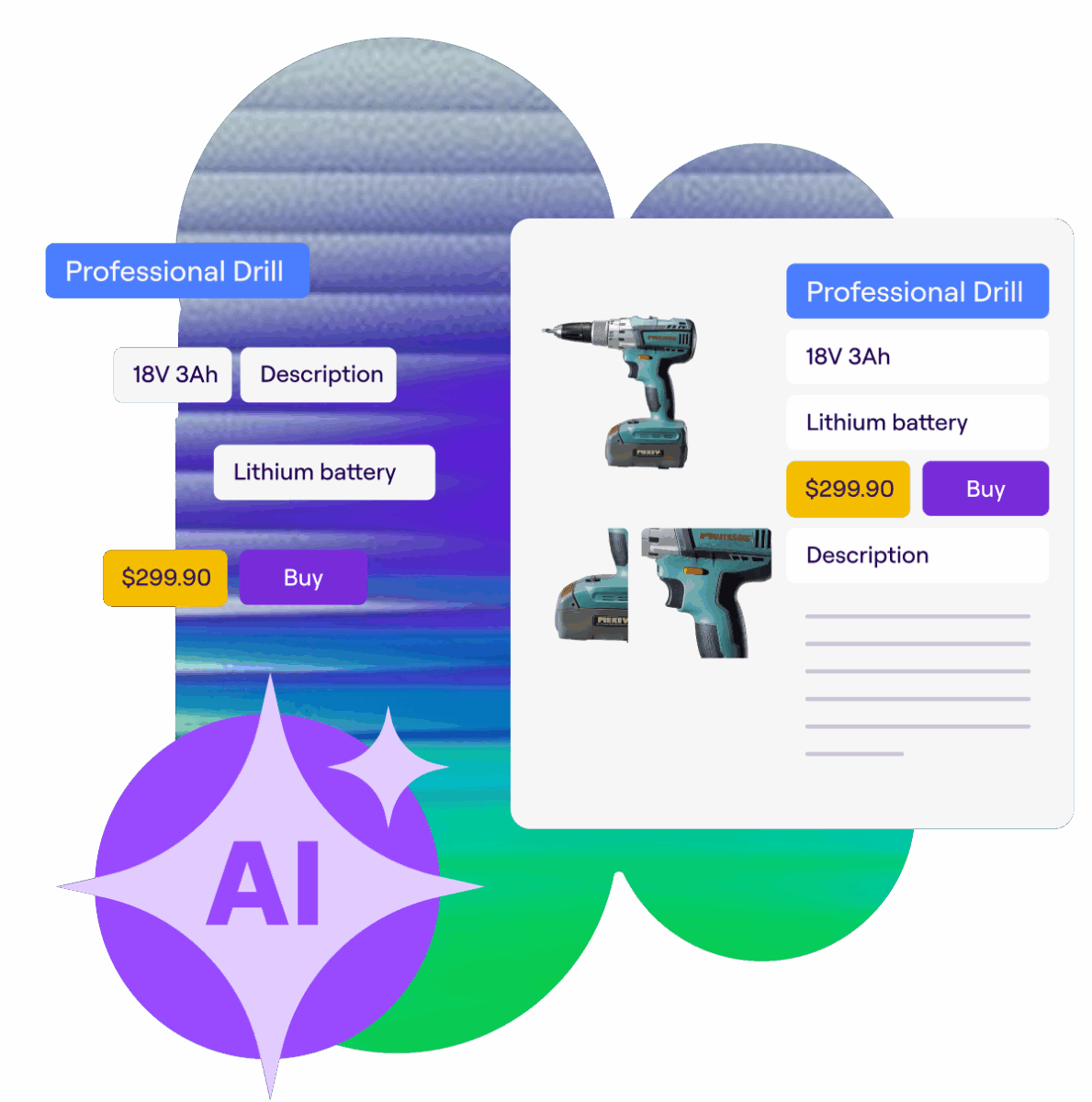
AI engines rely on structured, machine-readable product information to understand what you’re selling.
Complete schema markup, standardized attributes, accurate categories, identifiers, and relationships help AI connect your products to customer intent. Without this structure, AI is forced to guess, and AI rarely guesses in your favor.
AI doesn’t simply trust what your website says.
Instead, it validates your information across multiple trusted sources, including knowledge bases, retailer listings, review platforms, business directories, media coverage, and other third-party references.
When those signals are consistent, AI gains confidence in recommending your products. When they conflict, your credibility and visibility declines.
AI favors products supported by recent, active information.
Fresh reviews, updated specifications, current pricing, recent marketplace activity, analyst mentions, and ongoing customer engagement all contribute to stronger trust signals.
An outdated product record may still exist online, but it becomes increasingly difficult for AI to recommend with confidence.
Finally, AI rewards context, not just technical specifications.
Instead of vague marketing language, products should include specific, extractable facts, clear answers to common customer questions, and use cases that reflect how buyers actually search.
For example, describing a product as a “compact espresso machine ideal for apartments” provides far more context than simply listing its dimensions. Rich, contextual product content makes it easier for AI to match your products to conversational queries and recommend them confidently.
Many organizations think AEO is simply another SEO initiative.
In reality, it’s a product data challenge.
AI cannot recommend products it doesn’t fully understand. That means brands need machine-readable, complete, consistent, trustworthy product information that can be interpreted across every AI-powered buying experience.
As AI-powered product discovery continues to grow, success won’t be determined solely by who ranks highest in search results. It will be determined by whose product data AI trusts enough to recommend.
Download the AEO playbook and learn how to make your products visible, trusted, and recommended in the era of AI commerce.

 Summer Release