Forrester data shows that while AI-driven product discovery is growing, purchase completion in these platforms remains the least-adopted behavior. Discover why platform innovation is outpacing consumer trust, evidenced by ChatGPT's failed checkout experiment, and walk away with practical steps you can take now to prepare for the future of agentic commerce.
Table of Contents
Keywords
Agentic commerce is moving fast. Every week seems to bring a new feature, a new protocol, a new launch, and a new prediction about how buying behavior is about to change forever.
For brands, that creates a real problem. It’s hard enough to stay informed without getting distracted by the sheer volume of noise. The important thing is not to track every release, it’s to stay close to what is actually changing customer behavior.
The customer still sits at the center of the buying journey. Agents will increasingly support, shape, and eventually automate parts of the commerce journey, but they are still working on behalf of a human being with preferences, doubts, habits and limits. To win in this environment, you need to influence both the system and the human behind it.
This is also why it is important to separate real shifts from hype.
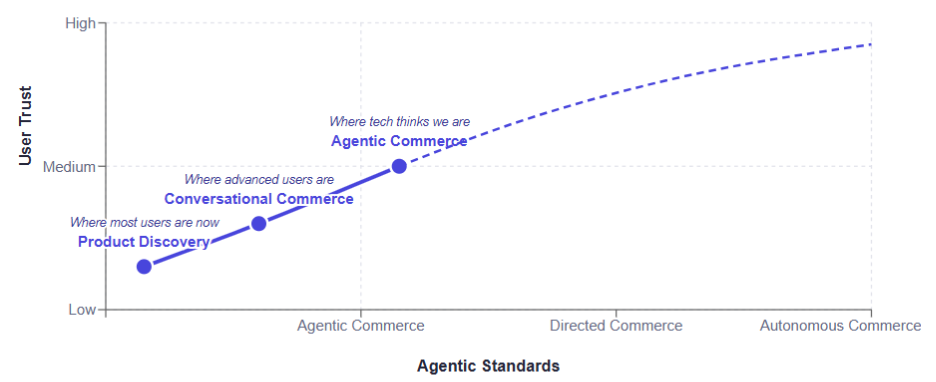
At the moment, platform innovation is moving faster than user trust. New capabilities appear all the time, and some of them are genuinely important, but many look more disruptive in a product demo than they do in the real world.
According to Forrester research, while one-third of younger consumers use ChatGPT for product discovery, completing purchases within answer engines remains their least-adopted behavior. The gap is clear: consumers trust AI to browse and recommend, but not yet to buy on their behalf. This explains why ChatGPT’s agentic checkout, launched with much fanfare in December 2025, was quietly pulled just three months later.
Helping someone research a product is one thing. Ensuring they have enough trust to allow an agent to buy it for them with confidence is another. Shopping and buying are not the same. One is exploratory, while the other involves trust, intent, retailer preference, fulfillment expectations, and a willingness to hand over control.
That’s why fully agentic commerce is harder than many people first assumed.
At ChannelSight, we have spent more than a decade working at the intersection of brands, retailers, and consumers. One thing we have learned over that time is that the buying journey is never static. It needs constant optimization; it’s not something you configure once and forget. It’s shaped just as much by confidence and trust as it is by technology.
Across the market, eCommerce traffic patterns are beginning to shift as more product discovery happens inside conversational interfaces rather than along the traditional search-to-shop path. But that shift has not yet flowed through to lower-funnel purchase behavior in the same way.
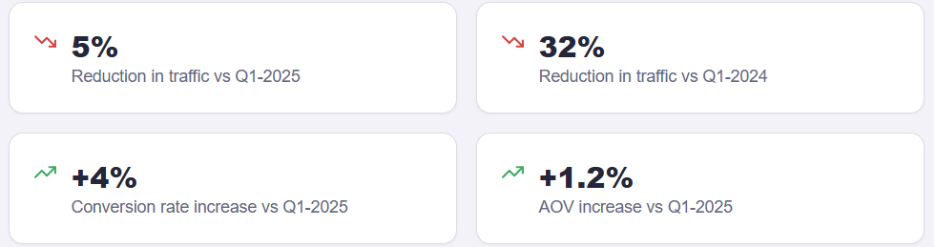
That tells us that while discovery is changing quickly, buying behavior is changing more slowly. The technology may be capable of more, but consumers are not automatically ready to follow.
So, while agentic commerce is absolutely real, it is still early. There will be plenty of developments that look like major turning points in the moment, but not all of them will stick. Behavior is what decides that, not headlines.
If your product data is incomplete, inconsistent, or poorly syndicated across retail channels, you’re making yourself harder to discover in exactly the places that are becoming more important. In an LLM-driven world, structured and reliable content matters even more.
This is where having a strong product information foundation becomes critical. Akeneo Product Information Management (PIM) helps brands centralize, enrich, and standardize product data so it’s complete, consistent, and ready to be consumed by both humans and machines. Instead of fragmented or conflicting information across channels, you create a single, reliable product record that can be easily understood, indexed, and surfaced by AI-driven systems.
Akeneo Activation extends this by ensuring that enriched product content is not just well-managed, but effectively distributed. It enables brands to syndicate product information across retailer sites, marketplaces, and digital touchpoints, helping ensure that wherever agents or customers are searching, the right content is present, accurate, and optimized.
In a world where discovery is increasingly mediated by algorithms and agents, being visible depends on being both structured and everywhere your customers, and their agents, are looking.
Product discovery is clearly moving towards conversational and LLM-led environments. Whether that becomes fully agentic will depend in part on how relationships develop between LLMs, retailers, and commerce platforms, but the immediate priority remains clear: your products need to be visible, understandable, and easy to recommend in these environments.
ChannelSight’s Agent Discoverability tool helps brands see which products and retailers are actually being surfaced across LLM experiences, where the gaps are, and where action is needed:
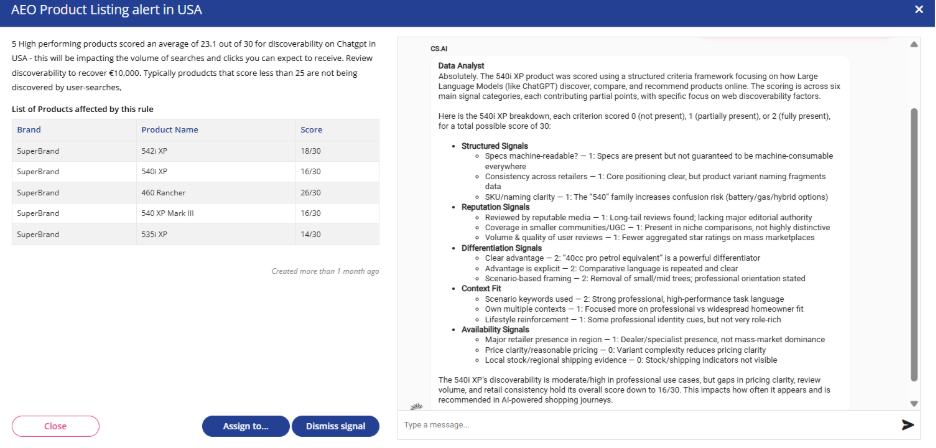
Aspirational product pages still matter, but they’re no longer enough on their own. Brands need content that answers real questions, reflects actual use cases, makes product differences clear, and gives systems something useful to interpret and surface.
That means:
Consider incentivizing reviews more aggressively (cashback promotions, etc.) and adapting your content strategy to focus on Q&A-style content rather than purely aspirational product pages. Hype up your product USPs and what differentiates them from competitors—this is what LLMs will surface when consumers ask comparison questions.
In short, the brands that do well here will be the ones that are easiest to understand.
At ChannelSight, we are watching these shifts closely through traffic patterns across our clients owned and earned channels, and through the tools we are building to help brands understand and improve discoverability in AI-driven environments.
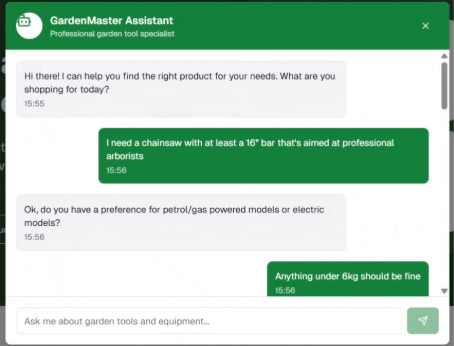
We have also launched Conversational Commerce as part of the ChannelSight AI suite. It allows brands to create product-specific and product-agnostic brand interactions through chat interfaces, then connect those conversations directly to relevant purchase journeys. That reduces friction, limits distraction, and keeps the user moving.
And these experiences don’t have to begin on a website—they can be triggered from email, social media, and display advertising too. Think of it like your brand store growing by 10,000 square meters and becoming conversational.
The space will keep moving quickly. There will be more launches, more claims, and more shiny distractions. But the brands that come out ahead will not be the ones reacting to every announcement. They will be the ones that stay close to real customer behavior, invest in discoverability, and focus on the parts of the buying journey that genuinely matter.
Agentic commerce is here to stay. Every platform wants to show how quickly the buying journey is changing, and every week seems to bring a new reason for brands to rethink their strategy.
That is the real opportunity. The job right now is not to get swept up in every new release. It is to work out what is actually changing customer behavior, and what is still just potentially dressed up as inevitability.
The brands that understand that difference—and act accordingly—will be the ones that thrive.

Our Akeneo Experts are here to answer all the questions you might have about our products and help you to move forward on your PX journey.

 Summer Release